What Can an AI Agent Do for a Project Manager?
Written by Matthew Hale
- What Are AI Agents? A Simple Explanation
- What Can an AI Agent Actually Do for a Project Manager?
- AI Agent Examples and Use Cases in Project Management
- How Generative AI Fits In
- How to Use AI in Project Management: A Simple 5-Step Approach
- Benefits of AI in Project Management
- Popular AI Workflow Automation and Project Management Tools
- What AI Agents Cannot Do (Yet)
- Can AI Replace Project Managers?
- The Future of Project Management
- Project Management Skills You Need in the AI Era
- Project Manager Responsibilities: Who Does What?
- Building Agentic AI Skills the Structured Way
- Final Thoughts
If you manage projects, you already know the feeling. Half your week disappears into status updates, meeting notes, follow-up emails and chasing people for task updates. The planning and decision-making you were hired for gets squeezed into whatever time is left.
This is exactly where the idea of an AI agent project manager setup gets interesting. An AI agent is not just a chatbot that answers questions. It can take a goal, break it into steps, use your tools and get the work done with very little hand-holding.
And this is no longer a side experiment. In a September 2025 survey of 1,000 project professionals, the Association for Project Management (APM) found that 70% said their organisation now uses AI, up from 36% in 2023. Adoption nearly doubled in two years.
So what can an AI agent actually do for a project manager, and where does it still fall short? Let's go through it in plain language.
What Are AI Agents? A Simple Explanation
AI agents are software programs that can understand a goal, decide what steps are needed, take action using connected tools, and adjust when something changes.
A regular AI chatbot waits for your question and gives an answer. An agent goes further. It acts.
Here is an easy way to see the difference:
- Chatbot: "Here is a draft of your weekly status report."
AI agent: Pulls task data from your project tool, writes the report, flags two delayed tasks, and emails it to your stakeholders after you approve it.
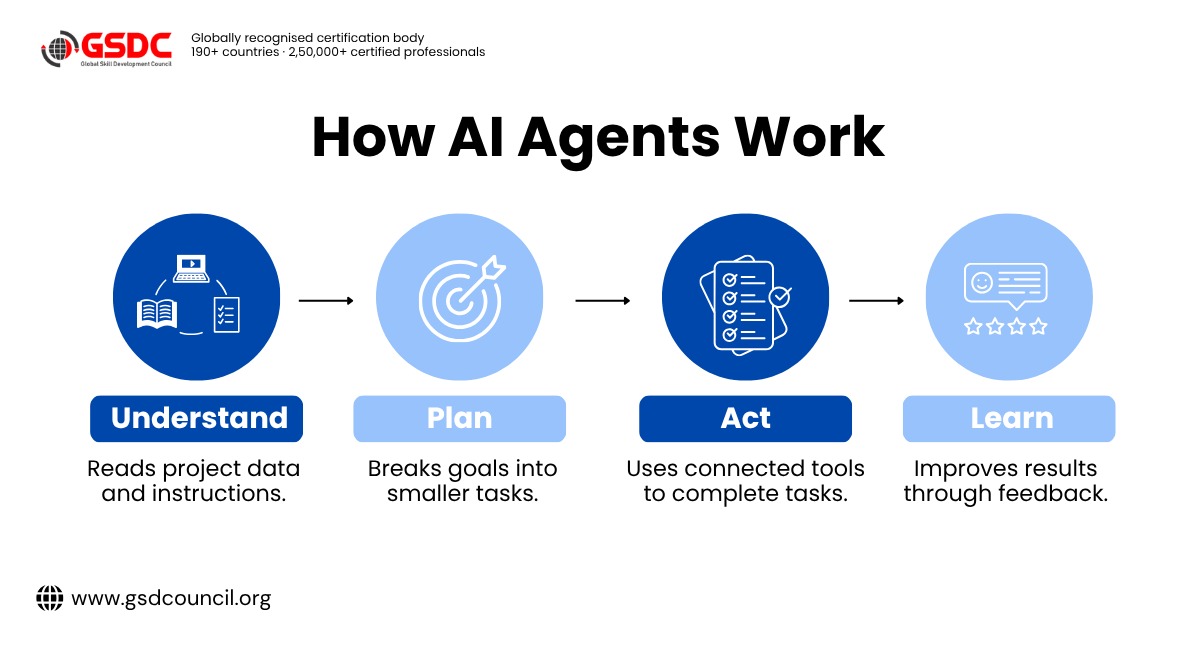
If you are new to the topic, think of an agent as a very fast junior assistant who never gets tired but still needs a manager to check the work.
What Can an AI Agent Actually Do for a Project Manager?
Let's get specific. These are the areas where AI agents are already useful in real project work.
1. Project planning and scheduling
Agents can read a project brief and draft a work breakdown structure, suggest task sequences and propose timelines. They can also spot clashes, like one person being booked on three tasks in the same week.
2. Status reporting
This is the biggest time saver for most people. An agent can collect updates from your task tool, chat messages and documents, then turn them into a clean report in minutes.
3. Meeting support
Agents can join calls, take notes, pull out decisions and action items, assign owners and send the summary right after the meeting ends.
4. Risk spotting
By looking at past project data and current progress, an agent can warn you early. For example, "This task is moving slower than similar tasks before it. The deadline may slip."
5. Resource management
Agents can check who has free capacity, suggest who should take new work and flag burnout risks when someone is overloaded.
6. Stakeholder communication
Need a polite reminder for a late deliverable, or a short update for a busy executive? An agent can draft it in the right tone for each reader.
7. Budget tracking
Agents can compare planned spending against actual spending and alert you when costs begin to drift.
8. Documentation
Project charters, requirement documents, lessons learned and handover notes can all be drafted by an agent from existing material.
Knowing what an agent can do is the easy part. Setting one up well is harder. You need to decide which tasks to hand over, what data it can see, and where a person must approve the result. Many project managers build this skill through hands-on practice on small tasks. Others prefer a structured path, such as the Certified Agentic AI Project Management Professional credential, which is designed around using agentic AI in project work.
AI Agent Examples and Use Cases in Project Management
Seeing it in action helps. Here are some practical AI agent examples across the project lifecycle.
Project Stage | What the AI Agent Does | Time Saved For You |
Initiation | Drafts a project charter and stakeholder list from a short brief | Hours of writing |
Planning | Builds a task list, timeline and dependency map | Days of setup |
Execution | Tracks progress, assigns tasks, sends reminders | Daily follow-ups |
Monitoring | Flags delays, budget drift and quality issues early | Constant checking |
Reporting | Creates weekly and monthly reports automatically | Hours each week |
Closure | Writes lessons learned and handover documents | Hours of review |
These AI use cases in project management share one pattern. The agent handles the repeatable, rule-based work. You handle the judgment, relationships and tough calls.
How Generative AI Fits In
You will often hear generative AI in project management mentioned alongside agents. They are related, but not identical.
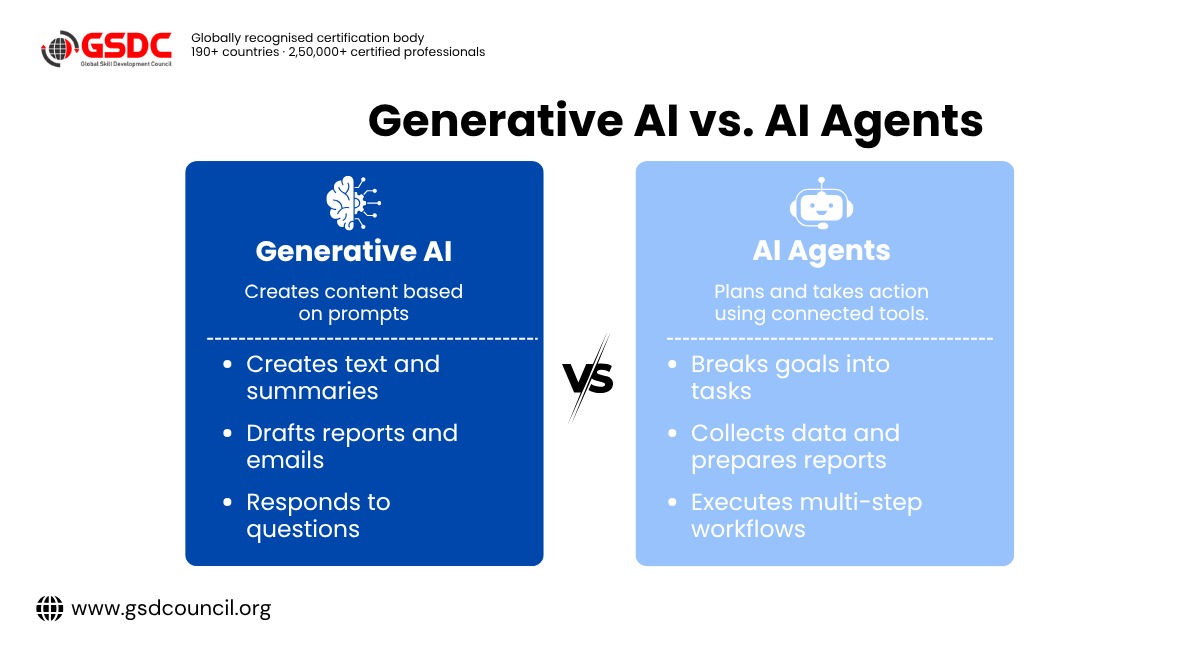
In simple terms, generative AI writes the report. The agent decides when to write it, gathers the data, writes it and sends it.
How to Use AI in Project Management: A Simple 5-Step Approach
Many teams ask how to use AI in project management without making a mess. Start small and build trust.
- Pick one painful task: Status reports and meeting notes are the easiest starting points.
- Choose a tool you can control: Start with an assistant inside the software your team already uses.
- Give clear instructions: Tell the agent what format you want, who the audience is and what to avoid.
- Keep a human check: Review every output at first, especially anything sent to clients or leadership.
- Measure the result: Track hours saved, errors reduced and on-time delivery. Then expand to the next task.
A good rule: if you would hand the task to a new intern with a clear checklist, an AI agent can probably help with it.
If you would rather learn these steps in a structured way than by trial and error, certification bodies such as the Global Skill Development Council (GSDC) offer programs for professionals who work with AI. Either route works. What matters is that you practise on real tasks and keep checking the results.
Benefits of AI in Project Management
The benefits of AI in project management go beyond saving time. In the same APM survey, 49% of project professionals expected AI to free up time for strategic work by cutting admin. In everyday terms, that adds up to:
- Less admin work: More hours for strategy and people.
- Faster decisions: Data is summarized instantly, not after a long manual review.
- Fewer human errors: Agents do not forget a follow-up or mistype a number.
- Earlier risk warnings: Problems show up while they are still small.
- Better consistency: Reports and documents follow the same format every time.
- Happier teams: People spend less time in status meetings.
One fair note: these are expectations and reported benefits, not proof of better project results. The evidence on project performance is still building, so track your own numbers
Popular AI Workflow Automation and Project Management Tools
AI workflow automation means letting software handle the steps between tasks, such as moving a ticket when work is done, notifying the right person or updating a dashboard.
When you look at AI project management tools, check for these features:
- Automatic task creation from emails, chats and meeting notes
- Smart scheduling and workload balancing
- Risk and delay prediction
- Automated reports and dashboards
- Integration with the apps your team already uses
- Clear permission controls and data privacy settings
Many leading project platforms now include built-in AI assistants, and a growing number of standalone AI agents for business can connect to several apps at once. Always test a tool on a small project before rolling it out to the whole company.
Be careful with labels too. Gartner warns about "agent washing", where vendors rebrand chatbots and basic automation as agents. Ask for a live demo of the agent completing a multi-step task before you buy.
What AI Agents Cannot Do (Yet)
Honest talk builds trust, so here are the limits.
- They can be wrong: Agents sometimes produce confident but incorrect information. Always verify important facts and numbers.
- They lack real empathy: An agent cannot read the mood in a tense room or calm a worried client.
- They do not own accountability: If a project fails, the responsibility still sits with a person.
- They depend on good data: Messy or outdated project data leads to poor suggestions.
- They struggle with office politics and context: Negotiation, trust building and conflict handling remain human strengths.
There is a cost warning as well. Gartner predicts that over 40% of agentic AI projects will be canceled by the end of 2027, mainly because of rising costs, unclear business value or weak risk controls. The lesson is simple. Start with a clear problem and a measurable goal, not with the technology.
Can AI Replace Project Managers?
Short answer: not likely, but it will change the job.
Today's agents are strong at narrow, task-level work. Running a whole project means balancing people, politics, trade-offs and surprises, and that is still human territory.
Think of it this way. Calculators did not replace accountants. They removed the manual math so accountants could advise better. AI is doing something similar for project managers.
The people at risk are not those who use AI. They are those who refuse to learn it while others do.
The Future of Project Management
The future of project management looks like a partnership between people and AI agents.
What to expect in the coming years:
- Agents running routine tracking and reporting almost on their own
- PMOs becoming smaller, sharper and more strategic
- Project managers acting as "AI supervisors" who guide, check and correct agents
- Greater demand for professionals who understand both projects and AI
- A stronger focus on ethics, data privacy and responsible AI use
Project Management Skills You Need in the AI Era
Your core project management skills still matter. Some become even more valuable now.
Skill | Why It Matters More Today |
Leadership | Agents cannot motivate or inspire a team |
Communication | You must give agents clear instructions and explain results to people |
Critical thinking | You need to question and verify AI output |
Stakeholder management | Trust and relationships stay human |
Risk judgment | AI flags risks, you decide what to do |
Data literacy | You need to understand what the numbers really say |
AI and prompt skills | Better instructions give better results |
Learning prompt writing, AI tools and responsible AI practices is a smart place to begin.
Project Manager Responsibilities: Who Does What?
Here is how typical project manager responsibilities may be shared between you and an AI agent.
Responsibility | AI Agent Can Help | Human Should Lead |
Planning and scheduling | Draft plans, spot conflicts | Set goals and priorities |
Team coordination | Reminders, task assignment | Motivation and conflict resolution |
Reporting | Collect data, write reports | Interpret and present insights |
Risk management | Detect patterns and early signals | Decide response and trade-offs |
Budget control | Track and flag variances | Approve changes |
Stakeholder management | Draft updates | Build trust and negotiate |
Building Agentic AI Skills the Structured Way
Reading about AI agents is a good start, but confidence comes from using them on real work. Some people get there through practice alone. Others like a clear learning path, and a recognised credential can also show employers and clients that your skills are current.
If you go down the certification route, a few things are worth checking in any program:
- It focuses on applying AI to real project tasks, not just theory.
- It covers risk, data privacy and responsible use alongside the tools.
- It is kept up to date, because this field changes quickly.
The Global Skill Development Council (GSDC) is one certification body in this space. Its Certified Agentic AI Project Management Professional certification is aimed at project managers who want to work with agentic AI in a structured way. A certificate will not replace hands-on experience, but paired with real practice it can give you a clearer starting point.
Final Thoughts
An AI agent will not run your project for you, and you would not want it to. What it can do is take the repetitive, time-heavy work off your plate so you can focus on people, decisions and results.
Start small. Pick one task, test an agent, keep a human in the loop and measure what changes. Those who learn to work with AI now will be well placed for the future of project management.

Related Certifications
Frequently Asked Questions
It usually means an AI agent that supports or handles parts of a project manager's work, like planning, tracking, reporting and reminders. It works alongside a human manager rather than replacing one.
They can draft plans, track progress, write status reports, summarize meetings, flag risks, balance workloads and send reminders.
They can be, if you choose tools with strong security, limit what data they can access and review important outputs before acting on them.
No. Most modern tools work through plain-language instructions.
Yes. Professionals who combine project management knowledge with AI skills are increasingly valued by employers.
Stay up-to-date with the latest news, trends, and resources in GSDC
If you like this read then make sure to check out our previous blogs: Cracking Onboarding Challenges: Fresher Success Unveiled
Not sure which certification to pursue? Our advisors will help you decide!