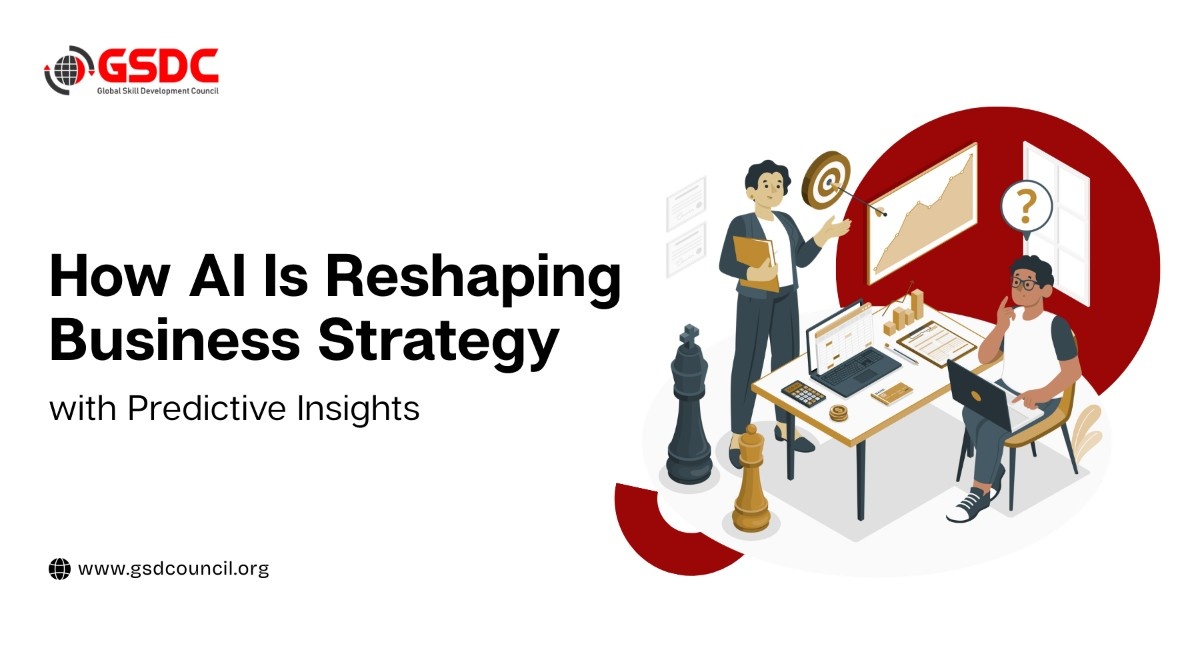
How AI Is Reshaping Business Strategy with Predictive Insights?
Written by Juan Intan Kanggrawan
- The Shift: From Data Collection to Intelligent Action
- AI is not new, but its impact today is unprecedented.
- Aligning AI with Business Strategy (Not the Other Way Around)
- Real-World Example: Data-Driven Strategy in the Travel Industry
- Public Sector Transformation: AI Beyond Profit
- From Static Reports to Predictive Analytics
- Organizational Change: Why AI Requires Cultural Transformation
- Centralized vs. Hybrid AI Models
- Predictive Intelligence in Action: Business Use Cases
- Democratizing Analytics with AI Tools
- Key Takeaway: AI Must Deliver Tangible Impact
- Master Practical AI Tools with GSDC’s AI Tool Certification
- The Future: AI as a Strategic Co-Pilot
- Conclusion
- FAQs
Artificial Intelligence is no longer a futuristic concept; it has become a central force shaping how organizations plan, operate, and compete. Artificial intelligence in business is helping companies move beyond traditional analysis toward intelligent, data-driven decision-making. Businesses today are increasingly adopting AI predictive analytics tools to forecast trends, improve operational efficiency, and identify new growth opportunities. This shift is accelerating AI business transformation across industries.
Organizations are also integrating AI in business strategy to strengthen competitiveness, automate complex processes, and improve strategic planning. From governments and smart cities to global enterprises and startups, AI digital transformation is redefining how institutions operate and deliver value.
Insights from industry-led discussions highlight how AI is reshaping business strategy by turning data into measurable impact, enabling organizations to move faster, make smarter decisions, and create sustainable long-term value.
The Shift: From Data Collection to Intelligent Action
For years, organizations focused on becoming “data-driven.” They invested heavily in collecting, storing, and visualizing data. However, dashboards alone do not create value.
The real transformation happens when organizations move from:
Descriptive Analytics → Predictive Insights → Strategic Action
AI enables organizations to:
- Anticipate trends instead of reacting to them
- Automate complex analyses
- Deliver faster, evidence-based decisions
- Translate data into operational and financial outcomes
This evolution marks the transition from knowing what happened to knowing what will happen next and what to do about it.
AI is not new, but its impact today is unprecedented.
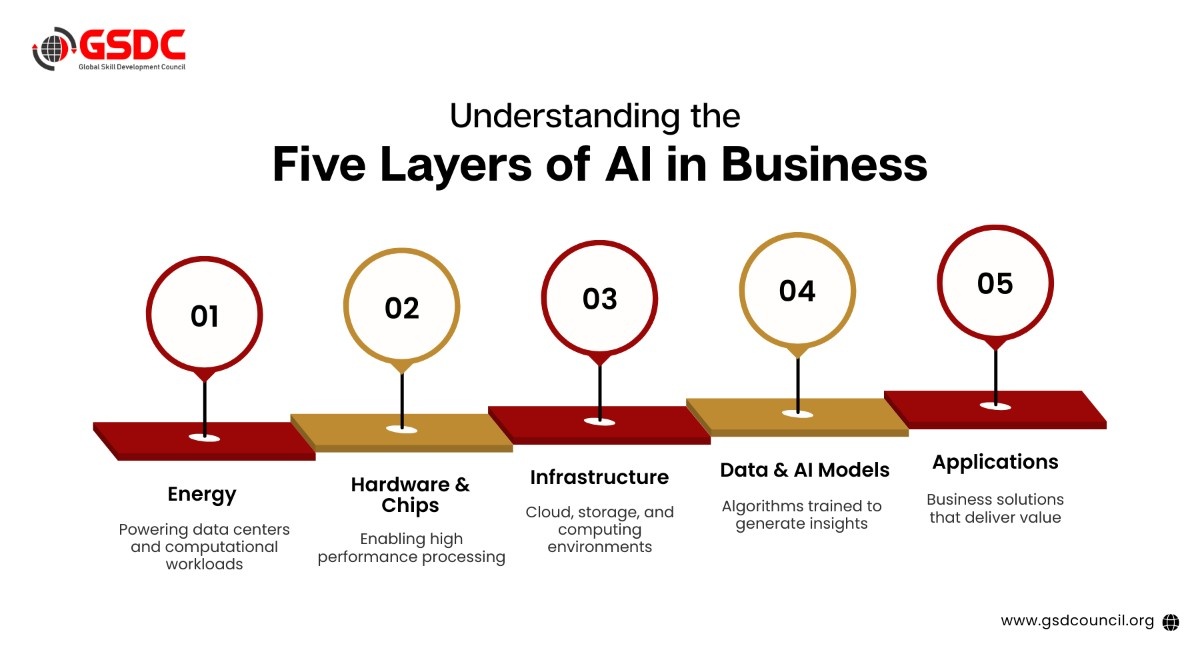
AI research dates back decades, but recent advances in computing power, cloud infrastructure, and large language models (LLMs) have dramatically accelerated real-world adoption.
Modern AI systems are now capable of:
- Processing massive datasets in real time
- Generating actionable recommendations
- Supporting strategic planning across departments
- Enabling predictive modeling at scale
This technological maturity has moved AI from experimentation into boardroom-level decision-making.
Aligning AI with Business Strategy (Not the Other Way Around)
One of the most common mistakes organizations make is adopting AI for the sake of innovation rather than aligning it with business goals.
AI must answer strategic questions such as:
- Which products should we invest in?
- Where should we expand geographically?
- How can we improve operational efficiency?
- What risks can we predict and mitigate?
Technology should serve strategy, not define it.
Real-World Example: Data-Driven Strategy in the Travel Industry
In the travel and hospitality sector, AI-driven analytics help organizations analyze:
- Route performance across countries
- Customer demand patterns
- Revenue optimization opportunities
- Product portfolio performance
Instead of relying on intuition, leadership can decide:
- Which markets deserve expansion
- Which services should be scaled back
- Where to allocate resources for maximum ROI
This is where AI becomes a strategic advisor, not just a reporting tool.
Public Sector Transformation: AI Beyond Profit
AI’s impact is equally powerful in government and urban development. In smart city initiatives, data from transportation, housing, healthcare, and utilities is analyzed to improve citizen services.
For example:
- Predictive flood management systems anticipate risks and deploy resources proactively.
- Demographic analytics guide targeted social aid programs.
- Urban mobility insights improve infrastructure planning.
These applications demonstrate that AI’s true value lies in delivering societal outcomes, not just operational efficiencies.
From Static Reports to Predictive Analytics
Many organizations remain stuck in early data maturity stages, producing reports that rarely influence decisions. The real breakthrough occurs when businesses cross into predictive and prescriptive analytics.
Maturity Evolution:
- Reactive: Data collected, minimal insights
- Tactical: Basic reporting and dashboards
- Enterprise: Integrated analytics across functions
- Strategic: Predictive insights guide planning
- Transformational: AI-driven decision ecosystems
Not every organization must reach the final stage, but understanding current maturity helps define realistic AI adoption goals.
Organizational Change: Why AI Requires Cultural Transformation
AI adoption is not purely technical; it demands new ways of working.
Traditional organizational structures often isolate data teams from business functions. High-performing AI-driven organizations shift toward agile, cross-functional collaboration, where:
- Data scientists work alongside business leaders
- Technology teams align with operational priorities
- Decisions are made iteratively through short innovation cycles
This “organism-like” model replaces rigid hierarchies with adaptive collaboration.
Centralized vs. Hybrid AI Models
Because AI expertise is scarce (often only 2–5% of a workforce), organizations must carefully deploy talent.
A hybrid model works best:
- A central AI team governs infrastructure and standards
- Embedded specialists support business units such as marketing, operations, or logistics
This structure maximizes impact without duplicating resources.
Predictive Intelligence in Action: Business Use Cases
AI is already transforming multiple industries through predictive capabilities:
- Retail & FMCG: Identifying optimal locations for new stores using geospatial analytics
- Healthcare: Forecasting resource needs and population health trends
- Logistics: Optimizing routes and capacity planning
- Urban Planning: Predicting environmental risks and infrastructure demands
These applications replace guesswork with measurable foresight.
Democratizing Analytics with AI Tools
Previously, building dashboards required specialized teams of analysts, engineers, and visualization experts. Today, AI-powered tools can automatically:
- Analyze uploaded datasets
- Generate insights and summaries
- Visualize trends
- Recommend business actions
This democratization allows professionals across departments, not just technical experts, to harness data effectively.
Key Takeaway: AI Must Deliver Tangible Impact
The most important lesson is simple:
AI should not be implemented for innovation’s sake; it must drive real outcomes.
Organizations should continuously ask:
- What decisions have improved because of AI?
- What value did AI create for customers or citizens?
- How did it enhance efficiency, resilience, or growth?
Without measurable impact, AI becomes an expensive experiment rather than a strategic asset.
Master Practical AI Tools with GSDC’s AI Tool Certification
GSDC’s AI Tool Certification program provides professionals with practical training on essential AI tools that businesses use today. The program teaches participants to use AI for three main purposes, which include automated processes, data analysis, and content creation.
The program focuses on practical implementation, enabling professionals to integrate AI tools into daily workflows and drive productivity, innovation, and smarter business outcomes.
The Future: AI as a Strategic Co-Pilot
As AI advances toward autonomous and agentic capabilities, it will increasingly:
- Support complex decision environments
- Simulate future scenarios
- Recommend strategies dynamically
- Act as a collaborative partner to human leadership
The organizations that succeed will be those that treat AI not as a tool but as an integrated capability embedded within their strategy, culture, and operations.
Conclusion
In conclusion, artificial intelligence in business is transforming how organizations design and execute strategy by shifting from retrospective analysis to predictive and proactive decision-making.
By integrating AI in business strategy, leveraging AI predictive analytics tools, and aligning AI initiatives with long-term objectives, companies can accelerate AI business transformation and unlock measurable value.
As AI digital transformation continues to reshape industries, the organizations that combine human expertise with AI-driven insights will be best positioned to drive innovation, resilience, and sustainable growth.
FAQs
1. How does AI differ from traditional data analytics in business strategy?
Traditional analytics explains past performance, while AI predicts future outcomes and recommends actions, enabling proactive and faster decision-making.
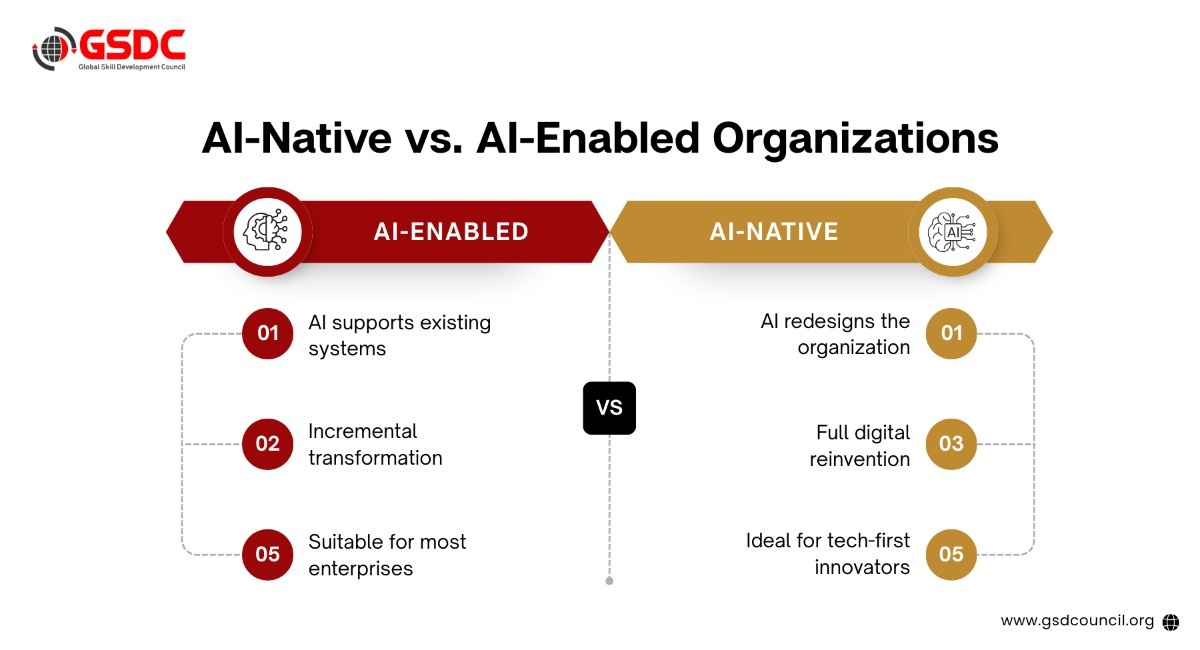
2. Do all organizations need to become AI-native?
No. Many organizations benefit from an AI-enabled approach that integrates AI into existing processes without requiring a complete structural redesign.
3. What is the biggest challenge in implementing AI successfully?
The main challenge is aligning AI initiatives with real business objectives and ensuring cultural and organizational readiness, not just deploying technology.
4. How can companies assess their readiness for AI adoption?
Organizations should evaluate their data maturity, infrastructure, talent availability, and ability to translate insights into actionable decisions.
5. What industries benefit the most from predictive analytics?
Industries such as retail, healthcare, logistics, travel, and urban development see significant advantages through forecasting, optimization, and data-driven planning.

Related Certifications
Stay up-to-date with the latest news, trends, and resources in GSDC
If you like this read then make sure to check out our previous blogs: Cracking Onboarding Challenges: Fresher Success Unveiled
Not sure which certification to pursue? Our advisors will help you decide!