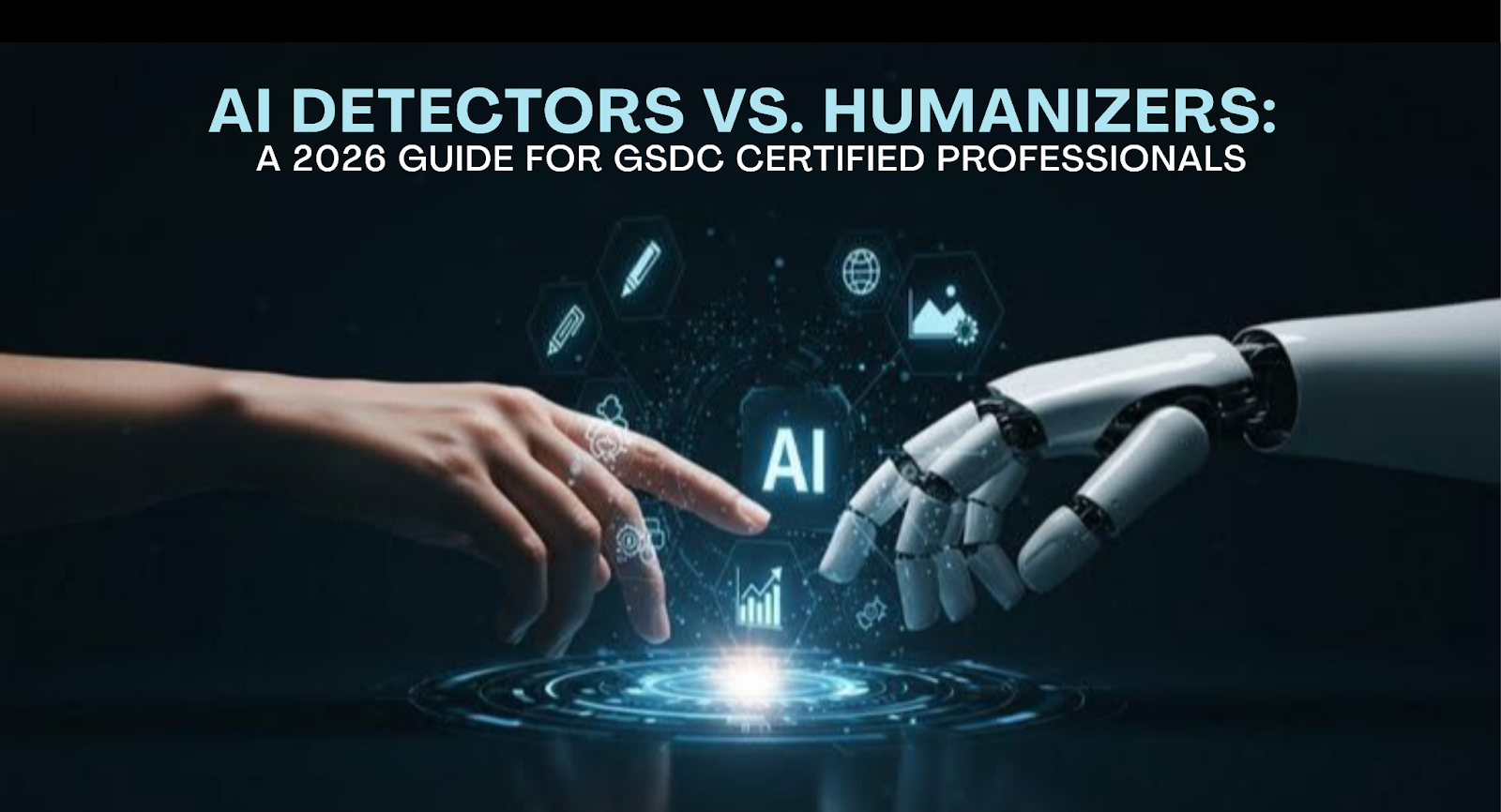
AI Detectors vs. Humanizers: A 2026 Guide for GSDC Certified Professionals
Written by Matthew Hale
AI has changed how professionals create content. They rely on AI tools now that detect and humanize AI content, as AI-written content continues to become more and more sophisticated to the point that it’s indistinguishable from human work. This makes learning these tools both strategic and ethical for GSDC certified professionals’ careers.
But what exactly are these tools and how can they help?
This guide will explain the key concepts and answer the most pressing questions professionals face in 2026.
What Are AI Detectors?
AI detectors are tools that identify AI-generated content. These tools analyze writing patterns and statistical markers that tell us about the origin of the content as to whether it was written by a human or a machine. They can detect robotic wording and sentence structures, for example.
Let’s take a look at how they work.
How Do AI Detectors Work?
AI detectors use three main mechanisms for detection:
- Pattern Recognition
- AI text follows some patterns that are predictable in terms of sentence structure and wording. Its terms and phrases are kind of iconic. AI detectors scan for these patterns.
- Statistical Analysis
- Measures like perplexity and entropy help determine how likely a piece of content was produced by a machine. Low variation means that the content was likely AI.
- Machine Learning Classification
- Detectors are trained on large datasets of human and AI text. It allows them to classify new content with confidence scores.
Example Use Case:
A corporate training manager can use AI detectors to make sure their internal reports or employee submissions are original, maintaining authenticity and compliance.
Why Are AI Detectors Important in 2026?
You might wonder, “Why do I even need an AI detector if AI improves productivity?” Here’s why:
- Academic and Workplace Integrity
Institutions and organizations require verifiable originality. - Content Authenticity
Detecting AI-generated material prevents misinformation and maintains trust. - Regulatory Compliance
Some industries demand documentation of content creation processes.
But AI detectors are not flawless despite their sophistication. Humanized AI text can evade detection. This is why these tools are best used in combination with human judgment.
What Are AI Humanizers?
An AI Humanizer enhances AI output to make it feel more human while detectors reveal AI involvement. They don’t aim to deceive. Rather, they improve tone and emotional resonance.
How Do AI Humanizers Work?
Humanizers use techniques like:
- Prompt Engineering: Creating precise instructions for AI tools to write in the desired style or way.
- Feedback and Fine-Tuning: Continuous human review gradually improves AI’s responses. It makes them more aware of the context.
- Multimodal Integration: Combining text and contextual cues to simulate human-like reasoning and creativity.
Example Use Case:
A marketing professional can use AI humanizers to produce personalized email campaigns that reflect brand voice while remaining contextually appropriate for each audience.
AI Detectors vs. Humanizers: How Do They Interact?
The relationship between detectors and humanizers resembles a technological arms race.
- Detectors evolve to identify subtler AI patterns.
- Humanize AI tools adapt to make AI output more nuanced, reducing detectable markers.
- Certified professionals need to understand both for strategic application in their organizations.
This dynamic has shifted the focus from “AI vs. human” to “AI and human collaboration” that emphasizes skillful application over automation.
Frequently Asked Questions by GSDC Professionals
Q1: Can AI detectors reliably identify all AI-generated content?
Not entirely. Well-humanized AI content can bypass even advanced detectors. Professionals should treat detection results as and not as absolute truth.
Q2: Should I always disclose AI involvement in content?
Transparency is the way. Ethical use involves being open and clear about AI assistance where relevant, especially in academic and corporate work.
Q3: How can humanizers enhance productivity without compromising ethics?
Humanizers should be used to augment human creativity and efficiency. They shouldn’t be used to replace critical thinking or originality. Proper disclosure is also necessary. It maintains ethical standards.
Q4: Are detectors and humanizers mutually exclusive?
No. They serve complementary roles. Detectors ensure authenticity and humanizers ensure readability and engagement. Professionals benefit by understanding both.
Practical Applications for Certified Professionals
Academia and Education
Educational institutions use AI detectors tools to maintain academic integrity by checking students’ assignments. Whereas humanizers help students use AI responsibly. It helps improve learning without undermining critical thinking.
Corporate Communication
Businesses rely on AI tools for reports and marketing content. AI humanizers help make sure these types of content align with their corporate voice and culture. Whereas detectors verify authenticity and reduce compliance risks. GSDC professionals in HR and management roles can use both tools to maintain credibility and maximize their work efficiency.
Media and Publishing
AI Detection tools can prevent misinformation in journalism and media. AI text humanizers help reporters and content creators to make sure their content is compelling without losing human insight.
Ethical Considerations in 2026
Professional AI use is not just about efficiency. It’s about responsibility. Certified professionals need to address the following concerns:
- Transparency: Transparency is necessary for a fair and responsible use of AI tools. So you should indicate where AI is involved in your content creation.
- Bias Awareness: AI models can be biased due to training data or your chat. That’s why your human oversight is needed to avoid the use of content.
- Policy Development: Organizations need to define guidelines for how its people use AI and also implement audit procedures and content verification protocols for compliance purposes.
Ethics help you make sure AI tools improve your work rather than undermining trust or making the work unfair
Skills GSDC Professionals Should Master
Certified professionals need a combination of technical knowledge and critical thinking to make effective use of AI tools. Some main competencies are as follows:
- AI Literacy: Learning about AI tools and understanding their model limitations and output behavior.
- Prompt Engineering: Writing effective input commands using prompt engineering techniques for high-quality AI outputs.
- Critical Evaluation: Making sure the content written by AI is accurate and intent.
- Ethical Oversight: Implementing responsible AI practices and policies in organizational workflows to keep AI use transparent and ethical.
Mastering these skills helps professionals lead AI adoption in a responsible and effective manner.
Looking Ahead: Human-AI Collaboration
The future is not about replacing humans with AI but about enhancing human capabilities with AI. Both AI detection and humanizing tools can improve your work with minimal effort.
AI detection tools protect your authenticity. These allow you to check if your work appears human. Humanizer tools improve your content’s expression and engagement. These allow you to improve your content for human readability and produce work that is credible and ethically sound.
Conclusion
AI detectors and humanizers are essential tools for GSDC certified professionals in 2026. AI detector tools protect authenticity, while humanizers improve human expression. But both require a nuanced understanding to use responsibly. Ethical transparency and strategic application are critical to maintaining trust and effectiveness in the use of AI in professional settings.
Certified professionals who learn these tools will lead the way in creating content that’s not just faster but also engaging and human-centered.

Related Certifications
Stay up-to-date with the latest news, trends, and resources in GSDC
If you like this read then make sure to check out our previous blogs: Cracking Onboarding Challenges: Fresher Success Unveiled
Not sure which certification to pursue? Our advisors will help you decide!