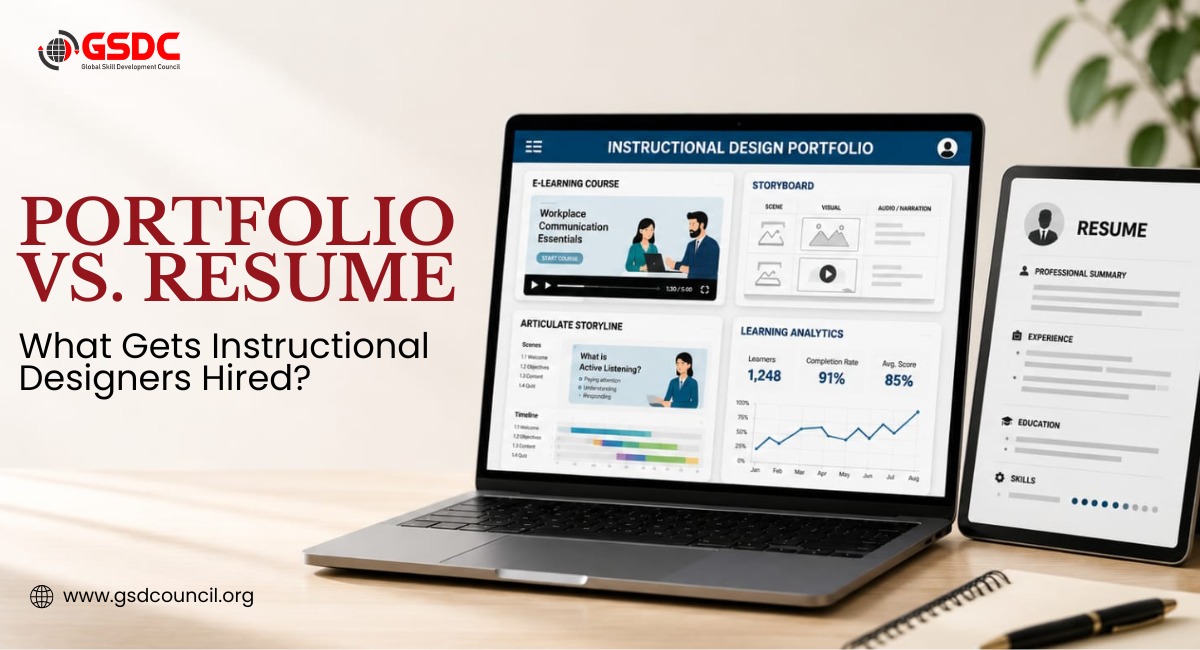
Portfolio vs. Resume: What Gets Instructional Designers Hired?
Written by Matthew Hale
- First, What Does an Instructional Designer Actually Do?
- Why Is Instructional Design Important in Today's Workforce?
- The Resume: Your Entry Ticket, Not Your Golden Ticket
- The Portfolio: Where You Actually Prove You Can Do the Work
- What Makes a Strong Instructional Design Portfolio?
- Real-World Instructional Design Portfolio Examples to Learn From
- Portfolio vs. Resume: A Direct Comparison
- What About Certifications and Salary?
- Common Portfolio Mistakes That Cost People Jobs
- So, Which One Actually Gets You Hired?
- Free Resource: The Instructional Design Portfolio Checklist
- Final Thoughts
You spent hours perfecting your instructional designer resume: clean formatting, strong action verbs, every tool and certification listed in the right order. You hit submit - and then nothing.
Here's what most people trying to break into instructional design find out the hard way: a great resume gets you considered. What actually gets you hired is something most candidates either rush through or skip entirely - the instructional designer portfolio.
But it's not as simple as "resume bad, portfolio good." Both documents serve a purpose, and understanding which one matters when is what separates the candidates who land roles from the ones who keep refreshing their inbox.
First, What Does an Instructional Designer Actually Do?
Before jumping to documents and the hiring process itself, it's time to set the background first.
An instructional designer job description may differ from one organization to another, but the main idea here lies in the name. An instructional designer is a professional responsible for creating effective learning programs, which may include online courses designed for employees of Fortune 500 companies, mandatory training programs for health care providers, or onboarding programs designed for startups.
Common instructional designer job responsibilities include:
- Performing needs assessment and gap analysis
- Creating outlines and designs of courses along with assessment techniques
- Creating e-learning modules using tools such as Articulate Storyline, Adobe Captivate, or Rise 360
- Working with SMEs to make difficult subject matter understandable for learning
- Analyzing and improving training programs based on data
This field is one that lies precisely at the crossroads of psychology, technology, communication, and education. It is due to these reasons that the recruitment process for instructional designers becomes a bit different from other fields.
Why Is Instructional Design Important in Today's Workforce?
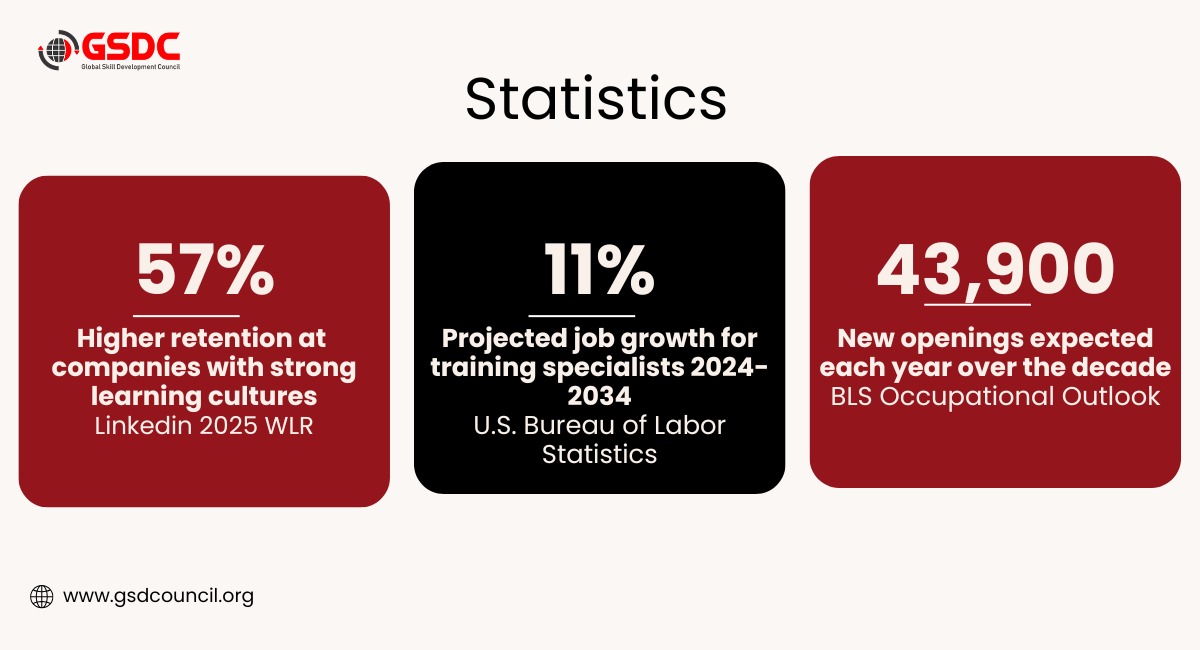
Bad training is expensive. Employee turnover, compliance failures, and productivity dips: a surprising number of these problems trace back to poor learning design. The business case for this profession is no longer just intuitive; it's measurable.
The Resume: Your Entry Ticket, Not Your Golden Ticket
Let’s begin with your resume since that is something you’re probably used to writing.
The standard instructional designer resume template includes all the professional experience, education, software knowledge (including tools such as Storyline, LMS systems, video editing tools), and certifications that you may possess. This will help HR see what kind of an expert you are from a paper perspective.
Questions like these should be answered in your resume: What is your experience? What tools do you use? What industries have you covered?
Here's the reality, though: hiring managers will spend about 30–60 seconds scanning your resume before deciding whether to read further. A clean, well-structured resume gets you past the initial filter. But in a field where showing is more powerful than telling, a resume alone rarely seals the deal.
Think of your resume as the handshake. It opens the door. What's inside the room - that's your portfolio.
The Portfolio: Where You Actually Prove You Can Do the Work
Here’s where instructional designers differentiate themselves from other candidates.
Instructional Designer Portfolio is the compilation of all the projects you have completed - e-learning courses, job aids, storyboards, outlines, instructor guides, videos, infographics, and tests. You show potential employers what you are capable of beyond simply saying that you can create engaging e-learning experiences.
Here's a scenario that plays out constantly in L&D hiring: a hiring manager receives 150 resumes that all list Articulate Storyline as a skill - but when they ask for samples, only 10 candidates can actually show a working module. Those 10 move forward. The other 140 don't.
That gap is exactly why a portfolio matters more than almost anything else on your application.
According to the 2024 Instructional Design Hiring Manager Report by Devlin Peck, one of the most cited surveys in the field 25.7% of hiring managers require a portfolio, and another 38.6% say it plays a significant role in their hiring decision. That means for nearly two-thirds of L&D hiring managers, your portfolio directly influences whether you get the job.
Cathy Moore, creator of the widely used action mapping methodology and one of the most respected voices in instructional design, has long argued that learning design isn't about delivering information; it's about changing what people do. The best portfolios reflect that mindset. They show not just what was built, but the behavioral outcome the design was trying to achieve.
What Makes a Strong Instructional Design Portfolio?
If you're wondering how to create an instructional design portfolio, here's what the best ones consistently include:
1. Work Samples in Various Formats
Be diverse. Try different formats – from e-learning courses to quick references to storyboards and facilitator guides. One work sample will not be sufficient to prove your versatility as a professional.
2. Annotation of Each Sample
It is important to understand that one of the keys to success of a good instructional design portfolio is its ability to reflect the reasoning process of the author of work sample. Therefore, in addition to your work sample, you should include information about the learning need that you were addressing, the target audience, your approach to solving the problem, etc.
3. Clean, professional presentation
Whether you use a personal website (Wix, Squarespace, or Adobe Portfolio work well), a PDF deck, or a tool like Notion, presentation matters. It signals that you understand visual communication, which is literally part of your job.
4. Real work where possible, mockups where not
If you're transitioning from another field, it's completely fine to include spec work projects designed for practice or a fictional scenario. The best instructional designer portfolio samples from newcomers are often indistinguishable from those of experienced professionals because the person clearly practiced, iterated, and cared.
5. An "About Me" or design philosophy statement
A brief note about your process and what you value adds a human dimension that a resume simply can't. It also helps employers assess cultural fit early on.
Real-World Instructional Design Portfolio Examples to Learn From
If you're looking for instructional designer portfolio examples to inspire your own, here's what to pay attention to when studying them:
- The Cathy Moore approach: Moore's action mapping framework is referenced widely in corporate L&D because it ties every design decision to a measurable business goal. Portfolios that reflect this outcome-first thinking stand out immediately to experienced hiring managers.
- eLearning Heroes by Articulate: This community platform regularly showcases instructional design portfolio samples from designers at all levels. Spend time there. Notice which projects show problem-solving versus which ones just look pretty.
The best instructional designer portfolio samples have one thing in common: they tell a story. They take you through the challenge, the process, and the outcome. They feel like evidence, not just decoration.
Portfolio vs. Resume: A Direct Comparison
Factor | Resume | Portfolio |
What it shows | Credentials, history, titles | Actual skills and thinking |
Time to review | 30–60 seconds | 5–20 minutes |
Differentiating power | Low (everyone has one) | High (many skip it) |
Required for all roles? | Yes | For most design roles, yes |
Best for | Getting past ATS filters | Winning interviews and offers |
The instructional design portfolio vs resume debate isn't really a competition; they serve different purposes at different stages of the hiring process. But if you had to weigh them, most L&D hiring professionals would say the portfolio carries more decision-making weight, especially for mid-level and senior roles.
What About Certifications and Salary?
For many professionals transitioning from teaching, HR, or corporate training, certifications help validate instructional design skills and strengthen portfolios. Programs from organizations like the Global Skill Development Council (GSDC) can also help professionals build practical knowledge aligned with current industry needs.
On salary
Instructional design continues to be one of the fastest-growing roles in workplace learning and talent development. Salary typically depends on experience, portfolio quality, technical expertise, and industry specialization.
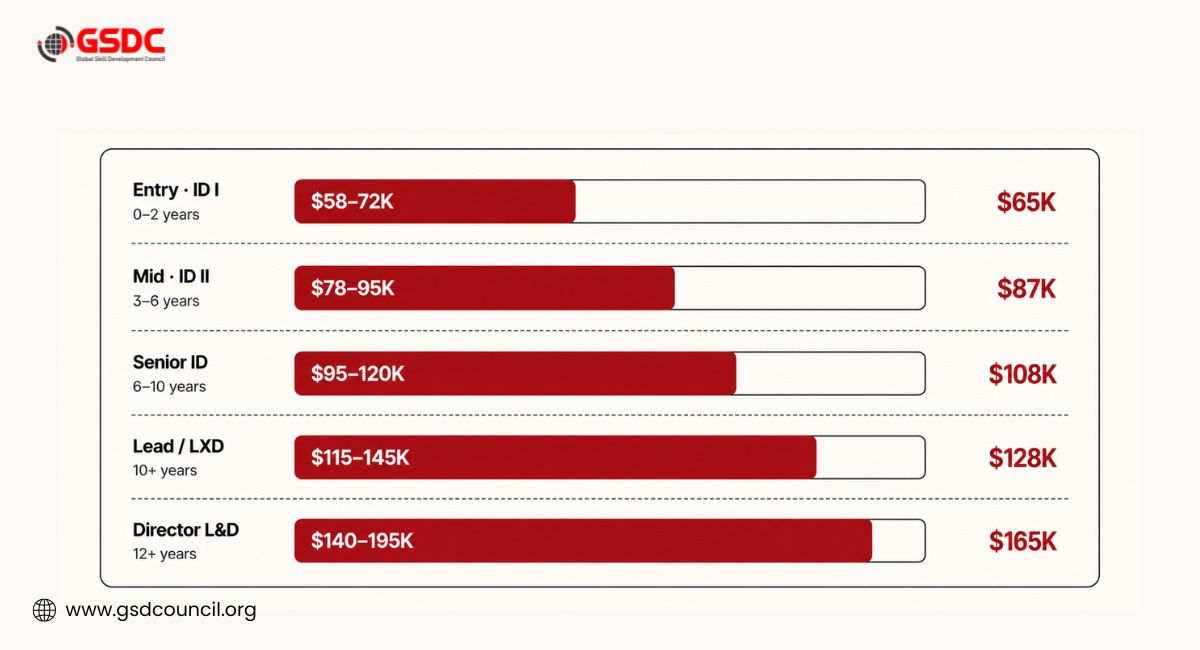
Typical salary progression often looks like this:
- Entry-Level ID: $58K–$72K
- Mid-Level ID: $78K–$95K
- Senior ID: $95K–$120K
- Lead/LXD Roles: $115K–$145K
- Director L&D Roles: $140K–$195K
Professionals with strong portfolios, eLearning expertise, and strategic learning skills often move toward the higher end of these ranges.
For a deeper breakdown of instructional designer salary trends and career growth, explore the Global Skill Development Council salary guide.
Common Portfolio Mistakes That Cost People Jobs
A few recurring patterns consistently hold designers back:
Mistake 1: Uploading without context
A beautiful eLearning demo with no explanation of why you made the design choices you made tells hiring managers nothing about your thinking. Always annotate your work.
Mistake 2: Showing outdated tools
If your portfolio only reflects work from older LMS templates or legacy tools, it signals you haven't kept up. Make sure your samples reflect current tools and design approaches.
Mistake 3: Making it hard to navigate
If a hiring manager has to click through five menus to find your actual work, they'll give up. Keep it simple, clean, and fast-loading.
Mistake 4: Ignoring accessibility
Ironic but true, many instructional designers submit portfolios that aren't accessible. Since accessibility is increasingly a core competency in the field, this is a quiet red flag.
Mistake 5: No variety
One module doesn't show a range. Three to five diverse samples across different formats, topics, and audiences give a much fuller picture of your capabilities.
Professional certifications, such as the Certified Instructional Designer Certification, can also help demonstrate structured learning and commitment to continuous skill development.
So, Which One Actually Gets You Hired?
Here's the honest answer: your portfolio gets you hired, and your resume gets you considered.
In today's market, hiring managers have seen hundreds of resumes from people who all claim to know Storyline, ADDIE, and Bloom's Taxonomy. What separates candidates isn't what they claim. It's what they can show.
A strong, well-curated instructional designer portfolio communicates competence, creativity, and professionalism in a way that a two-page resume simply cannot.
That said, don't neglect your resume. It's still the document that gets your foot past ATS filters and HR screens. And with 9 out of 10 global executives planning to maintain or increase their L&D investment in the near term, the demand for qualified instructional designers isn't slowing down.
A clean, keyword-optimized resume paired with a compelling portfolio is the combination that consistently wins.
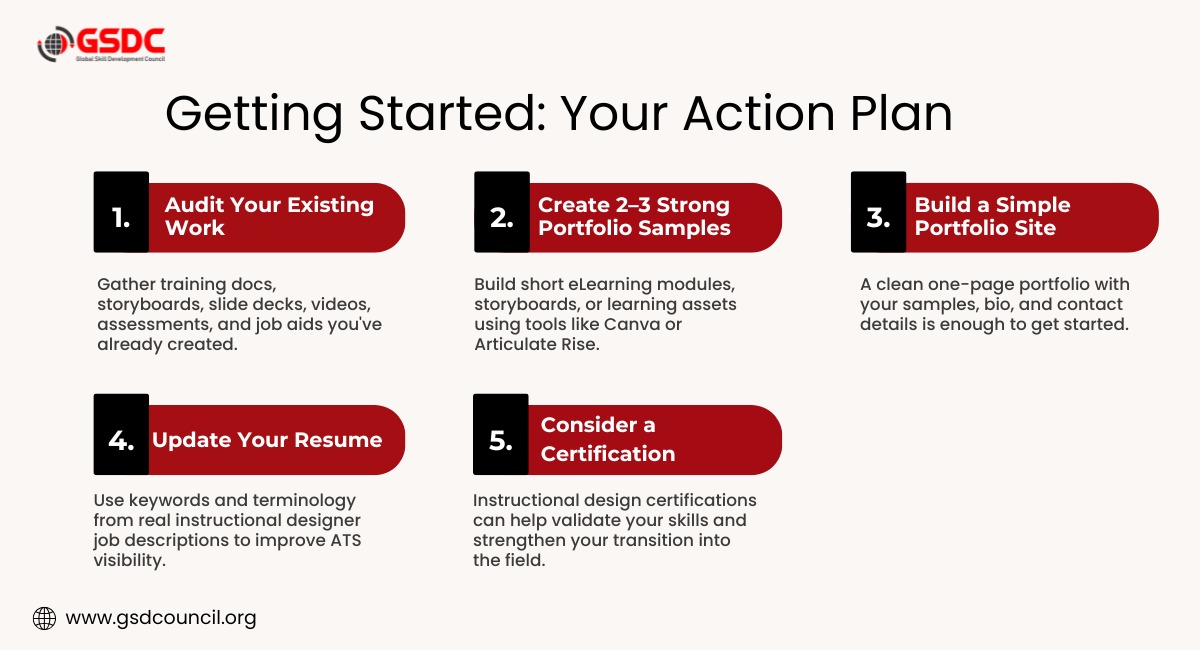
Free Resource: The Instructional Design Portfolio Checklist
Are you uncertain about how ready your instructional design portfolio is for the job market? Then you should consider taking advantage of the Instructional Design Portfolio Checklist offered by the Global Skill Development Council (GSDC).
The Instructional Design Portfolio Checklist will allow you to analyze not only the diversity of your examples but also the construction of your case studies and how accessible your presentation is.

A good portfolio will make your resume even stronger, along with the fact that you have a Certified Instructional Designer Certification and relevant experience.
Final Thoughts
The world of work is changing fast, and so is the way people learn inside organizations. Instructional designers are at the center of that shift, and the professionals who will thrive are those who can both articulate their value (resume) and demonstrate it (portfolio).
If you're serious about building a career in instructional design, treat your portfolio as a living document. Add to it. Refine it. Let it grow with you. Because in this field, your best work is your argument for being hired.

Related Certifications
Frequently Asked Questions
A strong instructional designer portfolio should include eLearning modules, storyboards, assessments, job aids, facilitator guides, and case-study explanations that showcase your instructional thinking and problem-solving skills.
You can find instructional design portfolio examples on personal portfolio websites, eLearning communities, LinkedIn creator pages, and professional instructional design forums. The best examples clearly explain both the design process and learning outcomes.
If you're new to the field, create sample projects around topics you already know well. Many aspiring professionals build instructional designer portfolio samples using tools like Canva, Articulate Rise, or Storyline to demonstrate practical skills.
An instructional designer resume highlights your experience, certifications, and technical skills, while a portfolio proves your real-world instructional design capabilities through actual work samples and case studies.
Instructional design helps organizations improve employee training, engagement, productivity, compliance, and learning outcomes through structured and effective learning experiences.
A typical instructional designer job description includes responsibilities like designing eLearning content, conducting needs analysis, creating assessments, collaborating with SMEs, and improving training effectiveness.
Instructional designer salary varies based on experience, location, industry, and specialization. Entry-level professionals may earn around $55K–$70K, while senior instructional designers and learning leaders can earn well into six figures.
The factors that determine salary include portfolio, technical skills, eLearning software, leadership, and industry experience such as in technology, health care, and financial services.
There is great benefit for individuals seeking to transfer from professions such as education, HR management, and corporate training when applying for a job as an instructional designer.
The cost of an instructional design certificate depends greatly on what program you select for your educational purposes and whether you specialize in certain areas or not.
Stay up-to-date with the latest news, trends, and resources in GSDC
If you like this read then make sure to check out our previous blogs: Cracking Onboarding Challenges: Fresher Success Unveiled
Not sure which certification to pursue? Our advisors will help you decide!