Securing Digital Transformation Initiatives with ISO/IEC 27001
Written by Diego Gonzalez
- Understanding Digital Transformation: Beyond Digitization
- Why Security Must Be Embedded into Digital Initiatives
- The Rising Threat Landscape in a Digital Era
- ISO/IEC 27001: More Than a Compliance Standard
- Why ISO 27001 Is Critical for Digital Transformation
- The Structure of ISO 27001: Clauses and Controls
- Business and Security Benefits of ISO 27001
- How to Start Implementing ISO 27001: A Practical Roadmap
- Certified ISO 27001:2022 Lead Auditor from GSDC
- Conclusion
Digital transformation has become a strategic imperative for organizations across industries. From mobile banking and cloud migration to AI-driven automation and remote work platforms, businesses are increasingly relying on digital technologies to drive efficiency, innovation, and customer satisfaction.
However, as organizations accelerate their digital journeys, they also expand their cyber risk exposure. What was once protected within physical walls and on-premises infrastructure is now accessible from anywhere in the world. This makes cybersecurity no longer a technical afterthought but a fundamental business enabler.
This is where ISO/IEC 27001, the international standard for Information Security Management Systems (ISMS), plays a crucial role. Rather than treating security as a compliance checkbox, ISO 27001 embeds security into the DNA of digital transformation, ensuring that innovation is not only fast and scalable but also secure and trustworthy.
Understanding Digital Transformation: Beyond Digitization
Before discussing security, it is important to clarify what digital transformation truly means.
Digital transformation is not merely about converting paper-based records into digital formats. It has two major components:
- Digitization – Making information available in digital form (e.g., digitizing customer records or invoices).
- Digitalization of Processes – Redesigning workflows and operations around digital systems.
When these two combine, organizations move into true digital transformation, where technology fundamentally changes how services are delivered.
A simple example is banking. Money once existed only as physical cash. Today, it is largely digital, accessed through mobile apps, cards, and online platforms. But behind a simple “tap to pay” is a complex digital process involving authentication, data verification, and real-time transactions.
Although this is convenient, it introduces significant cybersecurity risks that must be managed systematically.
Why Security Must Be Embedded into Digital Initiatives
Organizations embark on digital transformation to enhance efficiency, improve customer experience, and boost competitiveness. But without embedded security, these very goals are threatened.
Today:
- Data, calendars, photos, communications, and business processes are stored on laptops and mobile devices.
- Cybercriminals no longer require physical access to steal information; they only need to exploit a vulnerability.
- Attack surfaces have expanded dramatically due to cloud services, remote work, and IoT.
Frameworks like ISO 27001 exist to ensure that as businesses digitize, they do not unintentionally expose themselves to financial losses, reputational damage, or operational disruptions.
Security must become a way of living, not merely a technical project or audit exercise.
The Rising Threat Landscape in a Digital Era
Digital transformation has widened the threat landscape:
- Systems once accessed only internally are now available remotely
- Organizations face ransomware, phishing, supply chain attacks, and AI-powered threats
- Hackers increasingly use AI to automate and scale attacks
- Businesses must now use AI-enabled security tools to defend effectively
You can no longer “fight robots with humans alone.” Modern cybersecurity must evolve at the same speed as digital innovation.
ISO 27001 helps organizations respond to this complexity through structured risk management, controls, and continuous improvement.
ISO/IEC 27001: More Than a Compliance Standard
ISO 27001 is often misunderstood as a compliance or audit requirement. In reality, it is a management system built on risk-based thinking and continuous improvement.
What ISO 27001 is:
- A structured Information Security Management System (ISMS)
- A framework for identifying, assessing, and treating information security risks
- Applicable to organizations of any size or sector
- Enterprise-wide, not limited to IT or cybersecurity teams
What ISO 27001 is not:
- A one-time audit exercise
- A technical checklist
- A purely IT-driven standard
It spans HR, procurement, legal, operations, leadership, and physical security, making it truly organizational.
Why ISO 27001 Is Critical for Digital Transformation
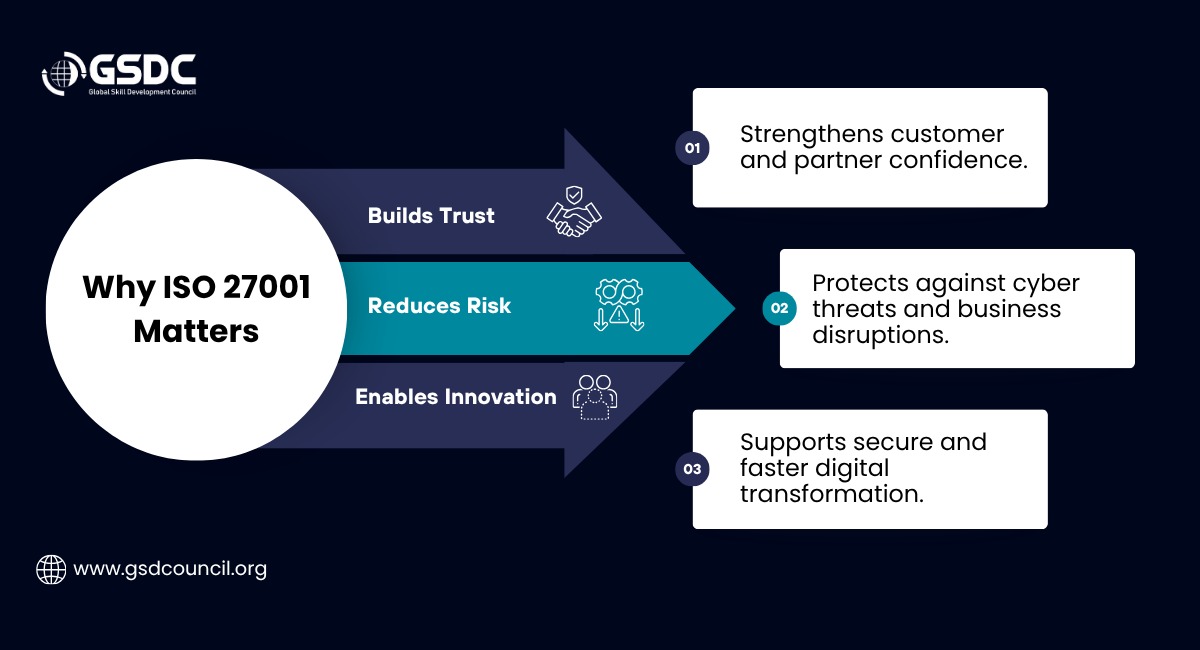
1. Builds Trust with Customers and Partners
ISO 27001 certification demonstrates that an organization has implemented internationally recognized controls to protect information.
This:
- Reduces customer concerns about data safety
- Accelerates vendor onboarding
- Improves business credibility
- Provides coma petitive advantage
In many cases, customers and partners now demand ISO 27001 certification before engaging.
2. Reduces Business Risks and Financial Losses
Cyber incidents are no longer rare. The question is not if but when an attack will occur.
ISO 27001 helps organizations:
- Prevent or reduce ransomware and data breaches
- Avoid financial losses from downtime or ransom payments
- Minimize legal liabilities
- Protect revenue streams
Paying ransom does not guarantee data recovery. Prevention and resilience are far more effective.
3. Enables Secure Innovation
Security is often seen as a “showstopper” that slows time-to-market. In reality, embedding ISO 27001 into digital initiatives enables:
- Faster innovation with fewer surprises
- Fewer post-launch vulnerabilities
- Reduced rework and security retrofitting
- Better alignment between business and IT
A product that is secure from design is always cheaper than securing it after deployment.
The Structure of ISO 27001: Clauses and Controls
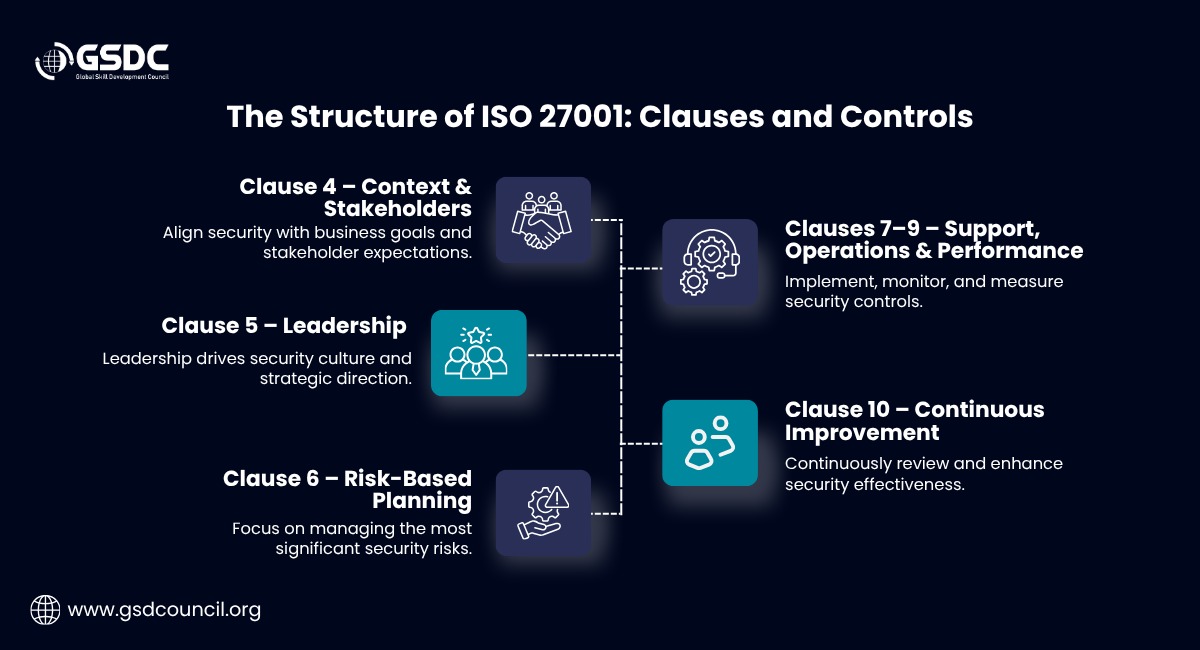
ISO 27001 consists of:
- Clauses 4–10: Management system requirements
- Annex A Controls: 93 controls (updated in 2022 from 114)
Key Clauses (4–10)
Clause 4 – Context & Stakeholders
Understand organizational objectives and stakeholder needs.
Security must align with business strategy and regulatory expectations (e.g., GDPR).
Clause 5 – Leadership
Without leadership support, no security program can succeed.
Leaders must integrate a digital transformation strategy with an information security strategy.
Clause 6 – Risk-Based Planning
Risk assessment ensures organizations prioritize the most critical vulnerabilities instead of wasting resources on low-impact issues.
Clause 7–9 – Support, Operations, Performance
Ensure that controls are implemented, monitored, and measured effectively.
Clause 10 – Continuous Improvement
Security is not static. Controls must be reviewed, tested, and enhanced continuously.
Annex A Controls: Four Domains
The 93 controls are grouped into four domains:
- Organizational Controls: Policies, asset management, supplier security, governance
- People Controls: HR screening, training, and disciplinary procedures
- Physical Controls: Building access, CCTV, and data center security
- Technological Controls: Access management, encryption, logging, monitoring, and secure development
Together, these ensure end-to-end protection of digital assets.
Business and Security Benefits of ISO 27001
- Secure, scalable, and trusted digital transformation.
- Competitive advantage through demonstrated security commitment.
- Resilience against cyber threats and operational disruption.
- Customer trust by protecting sensitive data.
- Alignment of security with business objectives, ensuring security is an enabler rather than a blocker.
How to Start Implementing ISO 27001: A Practical Roadmap
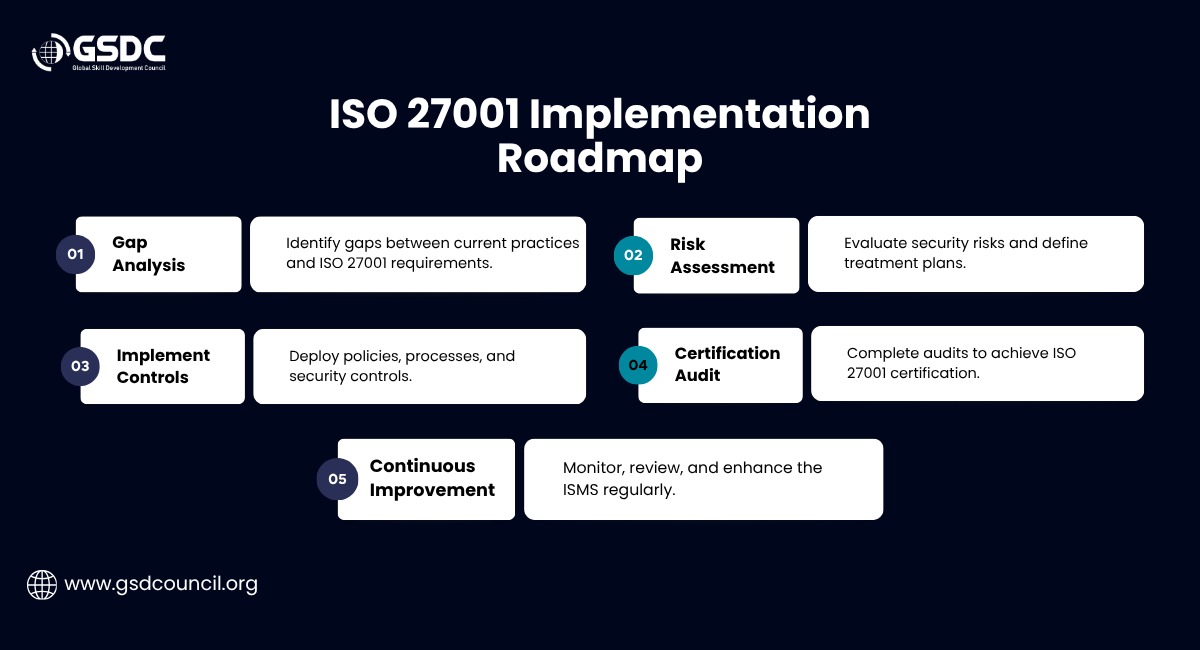
Implementing ISO/IEC 27001 requires a structured and risk-driven approach that integrates information security into daily business operations.
Below is a practical roadmap to guide organizations through successful implementation.
1. Gap Analysis
Begin by assessing your current security posture against ISO 27001 requirements. This involves reviewing existing policies, procedures, and technical controls to identify what already aligns with the standard and what is missing. A gap analysis helps prioritize actions, avoid redundant efforts, and build a focused implementation plan based on real organizational needs rather than assumptions.
2. Risk Assessment & Treatment
ISO 27001 is built on a risk-based framework. Organizations must identify key information assets, analyze threats and vulnerabilities, and assess the potential impact on business operations. Once risks are evaluated, appropriate treatment options are defined, whether to mitigate, transfer, accept, or avoid them. This ensures that security investments are driven by business risk rather than generic controls.
3. Implement Controls & Policies
Based on risk priorities, organizations implement suitable controls from ISO 27001 Annex A. This includes defining information security policies, access control mechanisms, incident response processes, data protection practices, and employee awareness programs. At this stage, security becomes operational and embedded within workflows rather than remaining a documentation exercise.
4. Certification Audit
After controls mature and stabilize, organizations undergo a certification audit. This includes a readiness review (Stage 1) followed by an effectiveness audit (Stage 2). Certification validates the organization’s commitment to managing information security systematically and builds trust with customers, partners, and regulators.
5. Ongoing Monitoring & Improvement
ISO 27001 is not a one-time activity. Continuous monitoring, internal audits, management reviews, and corrective actions ensure the ISMS evolves with emerging threats, new technologies, and business growth.
In essence, ISO 27001 implementation is a journey toward building a resilient, continuously improving information security culturenot just achieving a certificate.
Certified ISO 27001:2022 Lead Auditor from GSDC
The GSDC Certified ISO 27001:2022 Lead Auditor Certification equips professionals with the expertise to plan, conduct, manage, and report Information Security Management System (ISMS) audits in accordance with the latest ISO/IEC 27001:2022 standard.

The Certified ISO 27001:2022 Lead Auditor Certification covers risk-based auditing principles, Annex A controls, audit planning, evidence collection, nonconformity reporting, and continual improvement practices. Through practical, real-world scenarios, learners develop the skills needed to evaluate organizational compliance, strengthen information security governance, and support successful certification audits.
It is an ideal credential for information security professionals, auditors, compliance managers, consultants, and individuals leading ISO 27001 implementation and audit initiatives.
Conclusion
Digital transformation without security is a liability, not an asset. As organizations continue to innovate, migrate to the cloud, deploy AI, and automate services, cybersecurity must become an integral part of the business strategy, not an afterthought.
ISO/IEC 27001 provides the structure, governance, and controls needed to ensure that digital initiatives are not only fast and innovative but also secure, resilient, and trusted.
In a world where data is the new oil and cyber threats are inevitable, ISO 27001 is not just a standard, it is a strategic enabler for sustainable digital growth

Related Certifications
Stay up-to-date with the latest news, trends, and resources in GSDC
If you like this read then make sure to check out our previous blogs: Cracking Onboarding Challenges: Fresher Success Unveiled
Not sure which certification to pursue? Our advisors will help you decide!