How to Conduct a Data Protection Impact Assessment Before Launching a New Digital Service
Written by Matthew Hale
Launching a new digital service often involves collecting and processing personal data through user accounts, payment systems, analytics tools, APIs, and third-party platforms. Before the service goes live, organisations need to understand how this data will be used, where it will be stored, and what privacy risks could arise.
A Data Protection Impact Assessment (DPIA) helps identify these risks during the design and development stage. It allows teams to review data processing activities, evaluate potential harm to individuals, and introduce appropriate safeguards before users start using the service.
What Should a DPIA Cover Before Launch?
A DPIA should examine the complete data processing journey of a digital service. This includes:
- What personal data the service collects and why it is needed.
- How data moves between applications, databases, APIs, and third-party providers.
- Who can access the data and what permissions they have.
- How long personal data is stored and when it is deleted.
- What privacy risks could affect users.
- What technical and organisational controls will reduce those risks.
The assessment should involve relevant teams, including product development, IT, security, legal, and data protection professionals.
How to Conduct a DPIA: 7 Practical Steps
Step 1: Define the Service and Its Data Processing Activities
Defining the service is important because a DPIA needs a clear understanding of what is being assessed. Without knowing how the service works, its features, and the personal data involved, teams may overlook important processing activities or privacy risks.
Start by documenting how the digital service will work and where personal data is involved.
For example, a digital banking application may collect names, contact details, identity documents, transaction records, device information, and location data.
Document the following:
- Main features and functions of the service.
- Categories of personal data collected.
- Purpose of each processing activity.
- Individuals whose data will be processed.
- Internal systems and external service providers involved.
This establishes the scope of the assessment and helps identify processing activities that need closer review.
Step 2: Map Personal Data Flows Across Systems
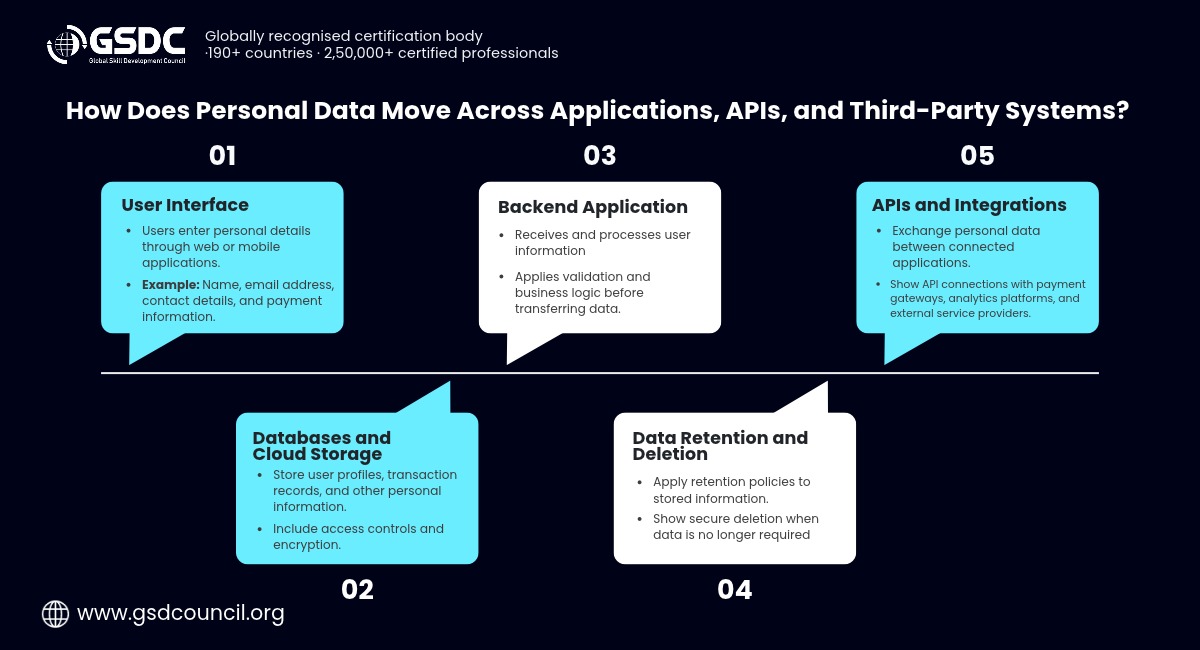
Mapping data flows is important because personal information rarely stays within one application. It may move between databases, cloud platforms, APIs, analytics tools, and external service providers. These transfers can create privacy risks if data is shared unnecessarily or stored in systems with weak controls.
Identify how personal data moves through the service, from collection to storage, access, sharing, and deletion.
Review the data flows between:
- User-facing applications and backend systems.
- APIs and connected business applications.
- Cloud storage and databases.
- Analytics and monitoring platforms.
- Payment gateways and third-party processors.
Pay particular attention to data shared with external providers. Check whether each integration receives only the information required for its function.
A data flow diagram can help teams identify unnecessary transfers, unclear data ownership, and systems where personal information may be exposed.
Step 3: Check Whether Data Collection Is Necessary
This step is important because collecting more personal data than required increases privacy risks and creates additional responsibilities for the organisation. Reviewing data collection helps ensure that every information field has a clear purpose and that the service does not gather unnecessary details.
For each data field, ask:
- Is this information necessary for the intended purpose?
- Can the service operate with less personal data?
- Is the data being used only for the purpose communicated to users?
- Are users informed about how their information will be processed?
- Is the proposed retention period justified?
For example, a basic account registration process may require an email address and password. Collecting location data or contact lists may not be necessary unless a specific feature requires it.
Reducing unnecessary data collection limits the amount of personal information that could be exposed in a security incident.
Step 4: Identify Potential Privacy Risks
Identifying privacy risks is important because technical weaknesses, excessive access, and uncontrolled data sharing can expose personal information or affect individuals' rights. Finding these issues before launch gives development and security teams an opportunity to address them during implementation.
Examine the service architecture and processing activities to identify situations that could affect users' privacy.
Common risks include:
- Excessive access permissions: Employees, applications, or APIs can access more personal data than their responsibilities require.
- Insecure data storage: Personal information is stored without appropriate encryption or access restrictions.
- Uncontrolled third-party sharing: External providers receive personal data without clearly defined responsibilities or safeguards.
- Weak authentication: Inadequate authentication controls allow unauthorised users to access accounts or sensitive information.
- Excessive data retention: Personal information remains in databases or backups longer than necessary.
- Automated decision-making: Profiling or automated decisions may affect individuals without appropriate transparency or safeguards.
For services using AI, also examine whether personal data is used in model inputs, stored in conversation history, or shared with external AI providers.
Step 5: Assess the Likelihood and Impact of Each Risk
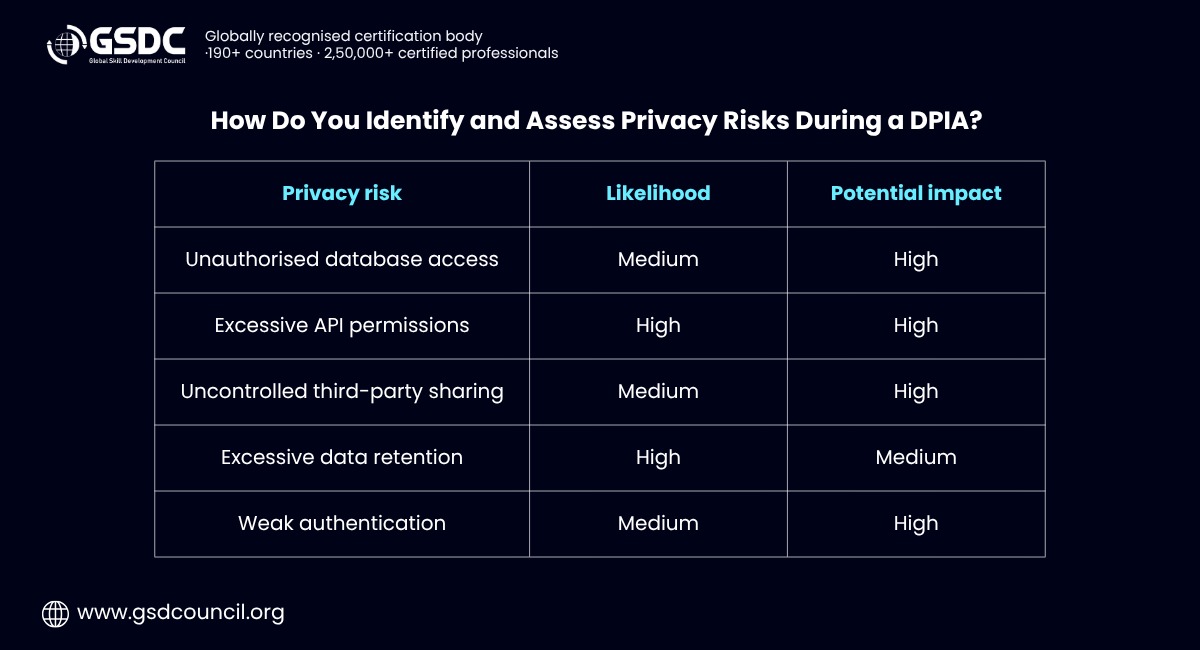
Not all identified risks present the same level of concern. Assessing their likelihood and impact helps organisations prioritise serious issues instead of treating every risk equally. It also provides a basis for deciding which safeguards are necessary before the service launches.
Consider:
- How easily could the risk occur?
- How many individuals could be affected?
- What type of personal data is involved?
- Could the issue cause financial loss, identity theft, discrimination, or loss of confidentiality?
- Are existing controls sufficient to reduce the risk?
Record the findings in a risk register.
Identified risk | Potential impact | Possible control |
| Unauthorised database access | Exposure of personal information | Role-based access control and encryption |
| Excessive API permissions | Unnecessary data disclosure | Restrict API scopes and permissions |
| Long data retention | Continued exposure of outdated information | Retention and deletion policies |
| Uncontrolled third-party sharing | Loss of control over personal data | Processor agreements and access reviews |
This assessment helps teams prioritise the risks that need attention before launch.
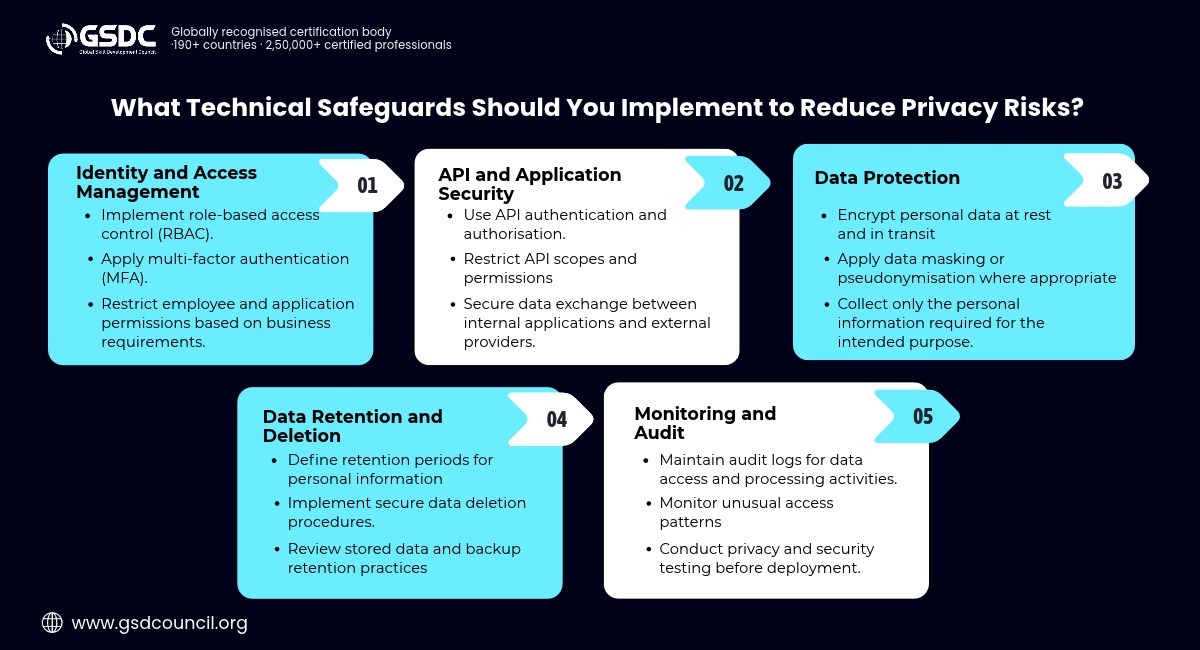
Step 6: Define Measures to Reduce Privacy Risks
Identifying risks is not enough. Organisations must decide how to address them and ensure that appropriate safeguards are included in the service design. This step is important because it turns the DPIA findings into practical actions that reduce the likelihood and impact of privacy issues.
Depending on the service, controls may include:
- Encryption for personal data in transit and at rest.
- Role-based access control and multi-factor authentication.
- API authentication, permission restrictions, and secure data exchange.
- Data masking or pseudonymisation where appropriate.
- Defined data retention and secure deletion procedures.
- Audit logs to monitor access and processing activities.
- Privacy and security testing before deployment.
- Clear agreements and responsibilities for third-party processors.
Assign responsibility for implementing each control. Record the expected completion date and evidence required to verify that the control is working.
Step 7: Review Residual Risks and Approve the DPIA
Even after safeguards are introduced, some privacy risks may remain. Reviewing residual risks is important because it helps determine whether the remaining exposure is acceptable or whether additional action is required. A service should not move towards launch with unresolved high risks that have not been properly addressed.
After the safeguards are implemented, reassess the remaining risks.
The review should confirm:
- Whether the identified risks have been reduced.
- Whether the required technical controls have been implemented.
- Whether data collection and retention remain justified.
- Whether third-party processing arrangements are documented.
- Whether any high risks remain unresolved.
The Data Protection Officer (DPO), where appointed, should provide advice and review the assessment. Relevant stakeholders should document their decisions before the service is approved for launch.
Under Article 36 of the GDPR, an organisation must consult the supervisory authority before processing begins if the DPIA indicates that processing would result in a high risk that cannot be sufficiently reduced.
Practical DPIA Example: Launching a Digital Banking Service
Consider a bank preparing to launch a mobile application that allows customers to open accounts, transfer money, and view transaction histories.
During the DPIA, the team identifies these risks:
Processing activity | Privacy risk | Required safeguard |
| Customer registration | Exposure of identity documents | Encryption and restricted access |
| Payment processing | Unauthorised transaction data access | Strong authentication and API security |
| Location-based features | Unnecessary location collection | Collect location only when required |
| Customer analytics | Excessive use of personal information | Data minimisation and pseudonymisation |
| Third-party integrations | Uncontrolled data sharing | Processor agreements and permission reviews |
Before launch, the organisation tests these controls, documents the remaining risks, and obtains the necessary internal approvals.
This allows the development team to address privacy issues before they affect customers.
Pre-Launch DPIA Checklist
Use this checklist to review whether the main assessment activities have been completed.
- All personal data collected by the service has been documented.
- Data flows between internal systems and third parties have been mapped.
- The purpose and necessity of each processing activity have been reviewed.
- Potential privacy risks have been identified and assessed.
- Access permissions and API integrations have been reviewed.
- Data retention and deletion procedures have been defined.
- Technical and organisational safeguards have been implemented.
- Remaining risks have been reviewed and documented.
- DPO advice and stakeholder approvals have been recorded, where applicable.
Develop Your Data Protection Knowledge with GSDC Certification
Conducting a DPIA requires an understanding of privacy regulations, personal data management, risk assessment, and organisational compliance responsibilities.
The GSDC Certified Data Protection Officer Certification is designed for professionals who want to develop knowledge of data protection principles, privacy management, and regulatory compliance.

Through this certification, professionals can develop their understanding of:
- Personal data protection principles and GDPR requirements.
- Data classification, access controls, and information security practices.
- Privacy risk assessments and data protection impact assessments.
- Data breach management, incident response, and compliance responsibilities.
Explore the GSDC Certified Data Protection Officer Certification.

Related Certifications
Frequently Asked Questions
A Data Protection Impact Assessment is a process used to identify and reduce privacy risks associated with personal data processing. It helps organisations assess how a planned activity may affect individuals and determine suitable safeguards.
A DPIA is required when processing is likely to result in a high risk to individuals' rights and freedoms. Examples include large-scale processing of sensitive personal data, systematic monitoring of publicly accessible areas, and certain forms of profiling or automated decision-making.
The organisation acting as the data controller is responsible for ensuring that the DPIA is conducted. The DPO, where appointed, should provide advice and monitor the assessment.
Yes. When a DPIA is required, it should be conducted before the processing begins. Completing it during the design and development stage gives teams time to address privacy risks before the service goes live.
Stay up-to-date with the latest news, trends, and resources in GSDC
If you like this read then make sure to check out our previous blogs: Cracking Onboarding Challenges: Fresher Success Unveiled
Not sure which certification to pursue? Our advisors will help you decide!