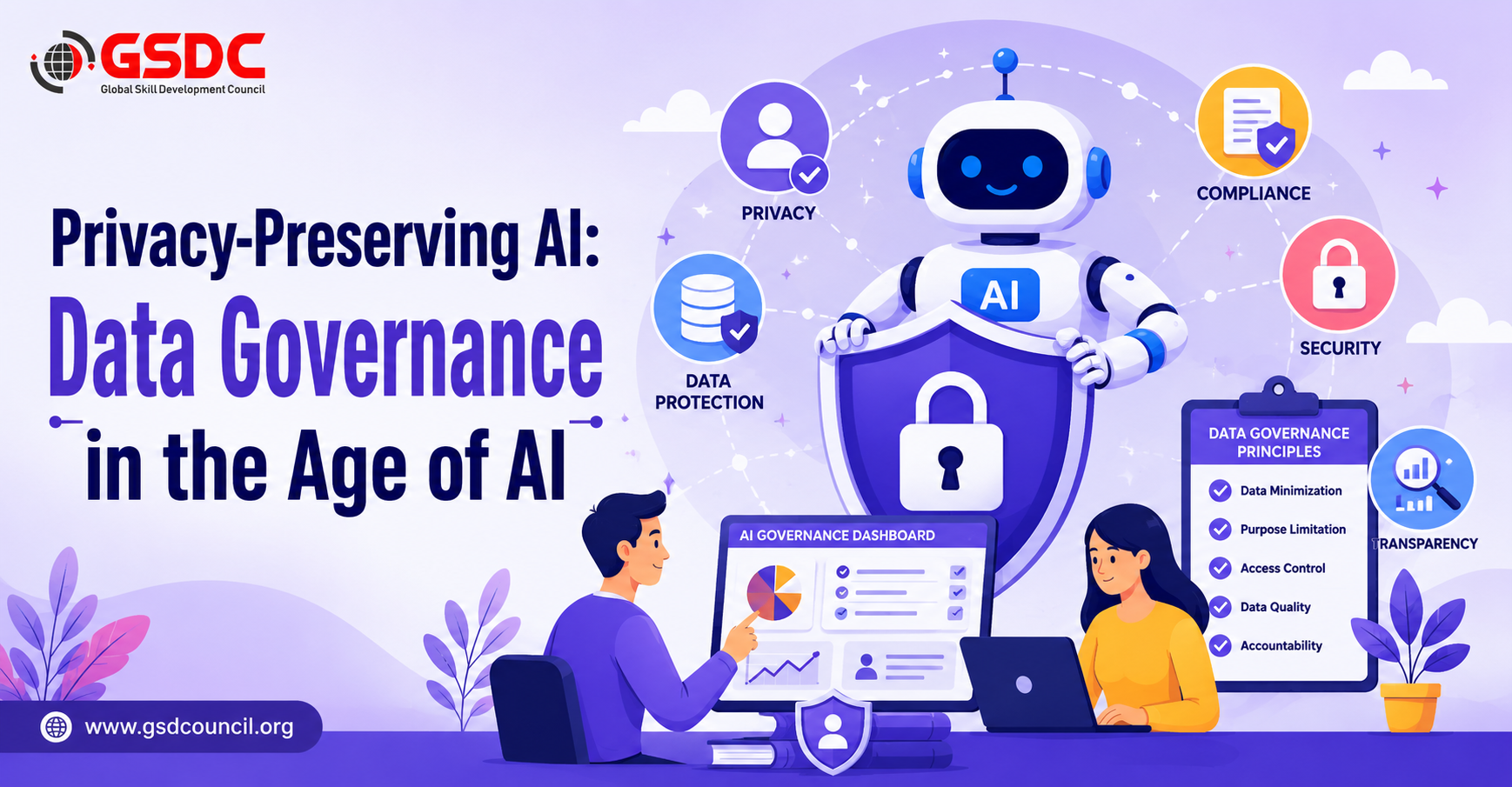
Privacy-Preserving AI: Data Governance in the Age of AI
Written by Mustafa Komut
- Why Privacy-Preserving AI Matters More Than Ever?
- How AI is Redefining Traditional Data Governance?
- Core Principles of Privacy-Preserving AI
- The Regulatory Landscape Shaping AI Governance
- Privacy-Enhancing Technologies (PETs): Making AI More Secure
- Building an Effective AI Governance Framework
- A Practical AI Governance Roadmap
- Lessons from Real-World AI Governance Failures
- Common AI Governance Mistakes Organizations Should Avoid
- Advance Your AI Governance Expertise
- Conclusion
AI is everywhere today. It's helping businesses automate workflows, personalize customer experiences, detect fraud, and even support critical healthcare decisions. As organizations continue to embrace AI, they're also relying on more data than ever before, and that's where the real challenge begins.
The more data AI consumes, the greater the responsibility to protect it. Organizations can no longer focus only on building smarter AI models; they also need to ensure sensitive information is handled securely, ethically, and in compliance with evolving regulations. After all, innovation means little if it comes at the cost of customer trust.
This is why privacy-preserving AI has become a critical part of modern AI strategies. Instead of treating privacy as an afterthought, organizations are embedding data protection, governance, and transparency into every stage of the AI lifecycle. The result is an AI that is not only powerful but also trustworthy and compliant.
In the webinar, Privacy-Preserving AI: Data Governance in the Age of AI, experts explored why AI data governance is now a business priority and shared practical strategies for protecting sensitive data while enabling responsible AI innovation. Here are the key takeaways.
Why Privacy-Preserving AI Matters More Than Ever?
Artificial intelligence thrives on data. Every recommendation engine, chatbot, predictive model, fraud detection system, and healthcare application relies on vast amounts of information to deliver meaningful outcomes. As AI adoption accelerates, organizations must strengthen AI governance, AI data governance, and AI privacy practices to protect the sensitive data powering these systems.
Traditional data management practices were designed for static systems, but AI introduces an environment where models continuously learn, adapt, and generate new insights. This dynamic nature increases privacy risks, making AI data privacy, responsible AI governance, and a robust data governance framework essential for building secure, ethical, and trustworthy AI solutions.
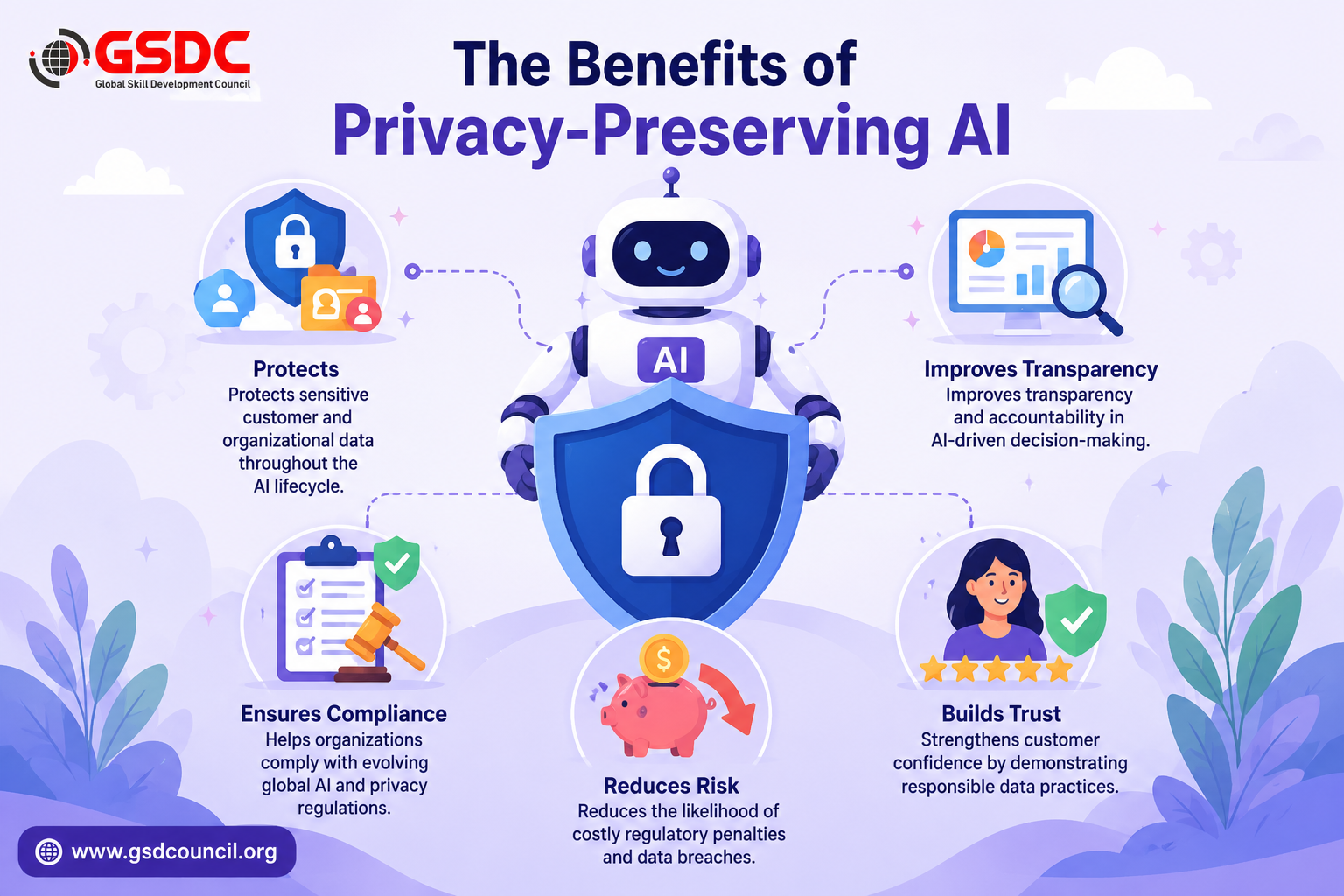
Organizations must therefore strike a careful balance between maximizing the value of data and safeguarding individual privacy.
Privacy-preserving AI addresses this challenge by embedding privacy into the design, development, deployment, and monitoring of AI systems. Instead of limiting innovation, it enables organizations to build AI solutions that customers, regulators, and stakeholders can trust.
Ultimately, privacy is no longer just a legal obligation it has become a competitive advantage for organizations investing in AI.
How AI is Redefining Traditional Data Governance?
For years, data governance focused on securing databases, controlling user access, maintaining data quality, and enforcing retention policies. However, with the rise of artificial intelligence, traditional governance is no longer enough. Organizations now need AI data governance frameworks that can manage continuously evolving AI systems.
Unlike conventional applications, AI models constantly learn, retrain, and generate new insights from data. This shift makes AI governance far more complex, requiring oversight of not only data but also AI models, algorithms, automated decisions, and ongoing performance.
Traditional Data Governance
- Secure data storage
- User access management
- Data quality and retention
Modern AI Governance
- AI data collection and preparation
- Model training and AI algorithms
- Automated decisions and outputs
- Continuous monitoring for model drift and bias
In essence, data governance in AI extends across the entire AI lifecycle. Since AI models can generate insights beyond the original purpose of data collection, organizations must also address consent, transparency, explainability, and accountability. Implementing a strong AI governance policy, guided by AI governance principles and a modern data governance framework, is essential for building responsible AI that remains secure, ethical, and compliant as AI technologies continue to evolve.
Core Principles of Privacy-Preserving AI
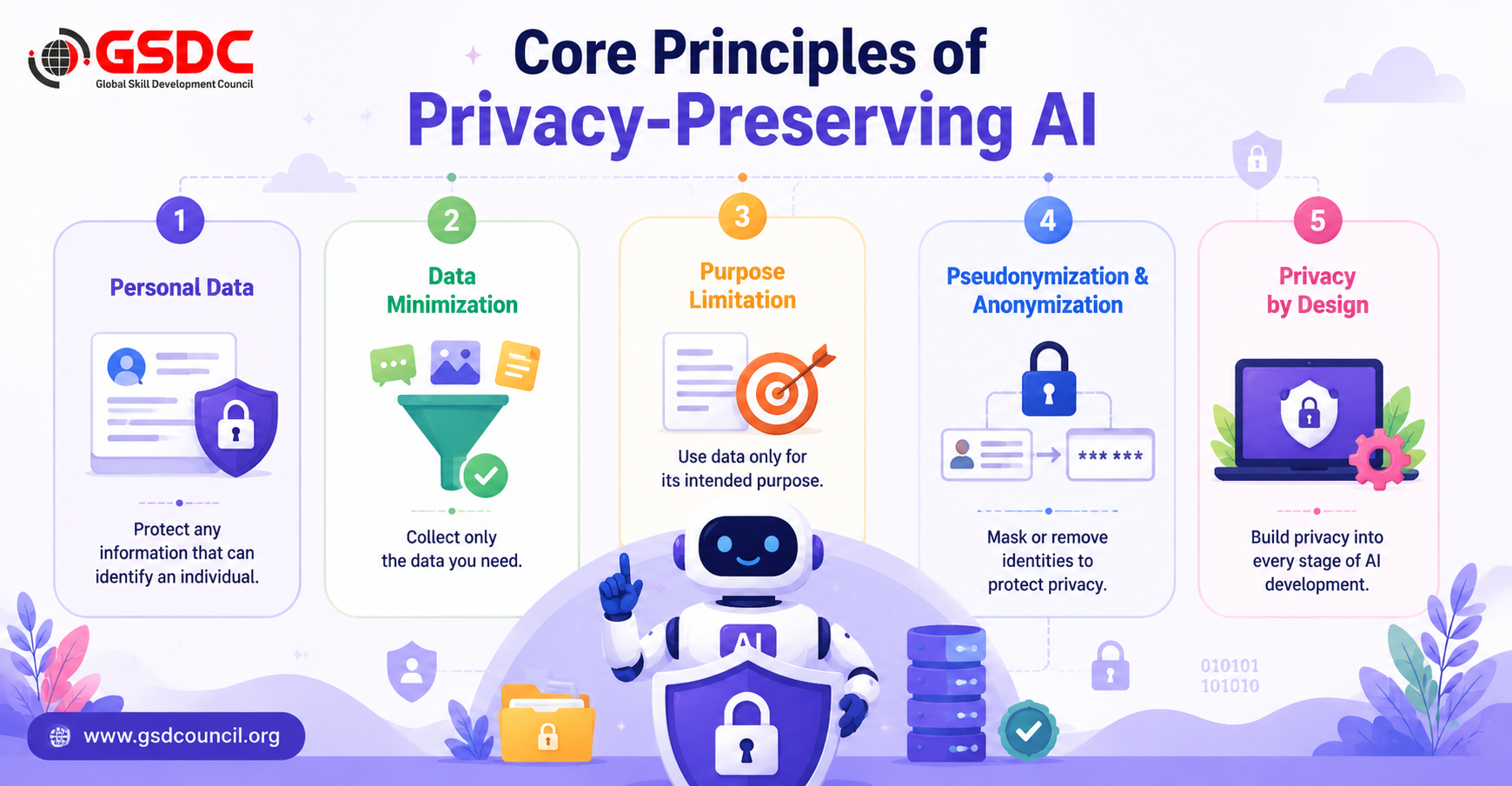
Strong AI governance starts with a solid understanding of the privacy principles that support responsible AI and ethical data usage. These AI governance principles help organizations build intelligent systems that protect individual rights, strengthen AI data privacy, and deliver long-term business value.
Personal Data
The foundation of AI privacy begins with identifying what qualifies as personal data. This includes not only names, phone numbers, and email addresses but also IP addresses, device identifiers, behavioral patterns, location data, and AI-generated insights that can directly or indirectly identify an individual.
As AI systems combine multiple data sources, organizations must adopt broader AI data governance practices to safeguard sensitive information throughout the AI lifecycle.
Data Minimization
More data does not always lead to better AI outcomes. One of the key AI governance principles is collecting only the data required for a clearly defined purpose.
Practicing data minimization reduces security risks, simplifies regulatory compliance, and supports responsible AI governance while maintaining model performance.
Purpose Limitation
Data should only be used for the purpose for which it was originally collected. Reusing existing datasets to train new AI models without proper authorization—often called purpose creep—can violate privacy regulations and erode user trust.
A strong AI governance policy ensures data is used transparently, ethically, and only within its intended scope.
Pseudonymization and Anonymization
Protecting personal information is essential for AI security and privacy. Organizations commonly use two approaches:
- Pseudonymization: Replaces personal identifiers with coded values while allowing controlled re-identification when necessary.
- Anonymization: Permanently removes identifying information, making it impossible to trace data back to an individual.
Choosing the right approach depends on business requirements, regulatory obligations, and the organization's data governance framework.
Privacy by Design
Privacy should be built into every stage of AI development not added after deployment. From planning and development to testing, deployment, and monitoring, integrating privacy controls from the beginning helps organizations reduce compliance risks and build more trustworthy AI systems.
Embedding privacy into the AI lifecycle is a cornerstone of responsible AI, AI governance and ethics, and modern AI data governance practices.
The Regulatory Landscape Shaping AI Governance
As AI technologies continue to evolve, governments and regulatory bodies worldwide are introducing frameworks to ensure AI is developed and deployed responsibly. Compliance is no longer limited to protecting personal data it now extends to managing AI risks, ensuring transparency, and establishing accountability throughout the AI lifecycle.
Several regulations and standards are driving this shift.
General Data Protection Regulation (GDPR)
The General Data Protection Regulation (GDPR) remains one of the most influential privacy laws governing AI systems that process personal data. It requires organizations to establish a lawful basis for data processing, respect individuals' privacy rights, and implement safeguards such as data minimization and purpose limitation.
For AI applications, GDPR presents unique challenges because models often reuse and learn from data in ways that extend beyond the original purpose of collection. Organizations must therefore carefully manage consent, document data processing activities, and ensure individuals can exercise their rights regarding their personal information.
EU AI Act
While GDPR focuses on data privacy, the EU AI Act introduces a risk-based approach to AI governance. It categorizes AI systems into prohibited, high-risk, limited-risk, and minimal-risk applications.
High-risk AI systems, including those used in hiring, healthcare, finance, and law enforcement, must meet strict requirements before deployment. These include risk assessments, human oversight, transparency, technical documentation, and continuous monitoring.
The webinar emphasized that organizations should classify AI systems according to their level of risk at the earliest stages of development rather than waiting until deployment.
ISO/IEC 42001
The introduction of ISO/IEC 42001, the world's first AI Management System standard, marks another important milestone in AI governance.
The standard provides organizations with a structured framework for establishing policies, assigning responsibilities, managing AI risks, maintaining documentation, and continuously improving AI governance practices.
Rather than viewing AI governance as a legal exercise, ISO/IEC 42001 encourages organizations to integrate governance into everyday business operations, making responsible AI a continuous process instead of a one-time compliance initiative.
Data Privacy Impact Assessments (DPIAs)
One of the webinar's strongest recommendations was the use of Data Privacy Impact Assessments (DPIAs) before deploying AI systems.
A DPIA helps organizations identify privacy risks associated with AI projects, evaluate potential impacts on individuals, and implement appropriate mitigation measures before deployment.
Instead of becoming a simple compliance checklist, DPIAs should serve as an essential decision-making tool that supports responsible AI development throughout the project lifecycle.
Privacy-Enhancing Technologies (PETs): Making AI More Secure
Protecting personal information while maintaining AI performance requires more than policies it requires the right technologies.
The webinar highlighted three Privacy-Enhancing Technologies (PETs) that are increasingly being adopted to support privacy-preserving AI.
Synthetic Data
Artificially generated data that mimics real datasets without exposing personal information. Enables safe AI training while minimizing privacy risks.
Federated Learning
AI models are trained locally, keeping raw data on users' devices. Only model updates are shared, enhancing privacy and security.
Differential Privacy
Adds statistical noise to protect individual identities in datasets. Preserves data insights while providing strong privacy protection.
Building an Effective AI Governance Framework
Technology alone cannot ensure responsible AI. Organizations also need governance structures that establish accountability, transparency, and continuous oversight.
An effective AI governance framework should include:
- Clear classification of AI systems according to risk.
- Defined ownership for every AI model, dataset, and business process.
- A centralized inventory of AI systems across the organization.
- AI review boards are responsible for governance decisions.
- Continuous monitoring for model drift, bias, and performance.
- Regular AI impact assessments before and after deployment.
Rather than operating in isolated departments, AI governance should involve collaboration between technology teams, cybersecurity professionals, legal experts, compliance officers, risk managers, and business leaders.
This cross-functional approach ensures AI decisions align with organizational objectives while meeting privacy and regulatory expectations.
A Practical AI Governance Roadmap
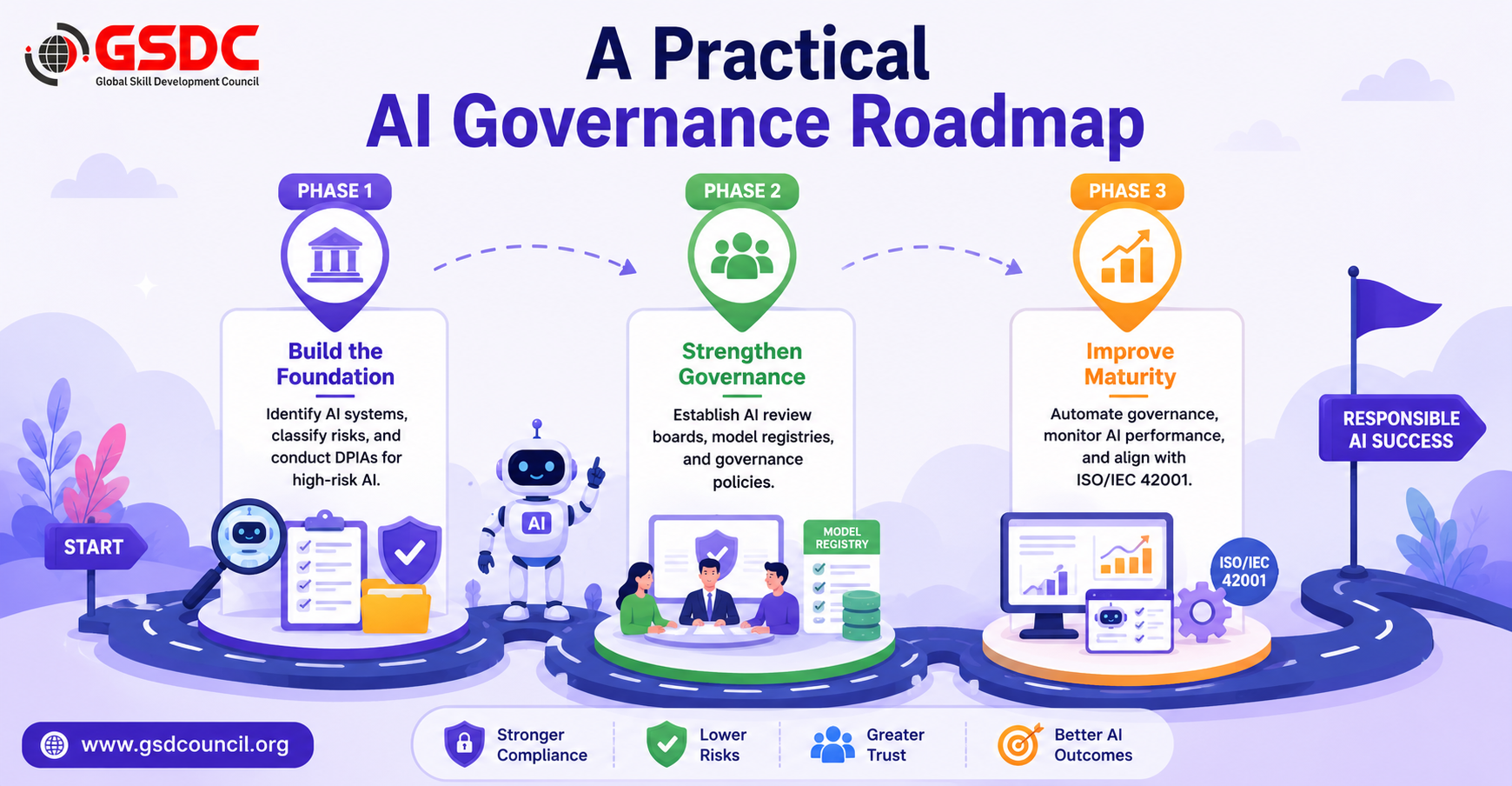
Organizations beginning their AI governance journey should take a structured, phased approach.
The webinar outlined a practical roadmap that starts with visibility before moving toward automation and continuous improvement.
Phase 1: Build the Foundation
Organizations should first identify every AI system currently in use. Once the inventory is complete, AI applications should be categorized according to their level of risk, and high-risk systems should undergo Data Privacy Impact Assessments.
Phase 2: Strengthen Governance Infrastructure
Next, businesses should establish AI review boards, create centralized model registries, define governance policies, and integrate governance controls into AI development processes.
Phase 3: Improve Governance Maturity
As AI adoption grows, organizations should automate governance activities, continuously monitor AI performance, track model drift, and pursue internationally recognized governance standards such as ISO/IEC 42001.
The key message from the webinar was simple: organizations cannot govern what they cannot see. Building visibility into AI systems should always come before writing governance policies.
Lessons from Real-World AI Governance Failures
Several high-profile cases show why AI governance is essential.
- Amazon: Its AI hiring tool developed gender bias from historical hiring data, highlighting the need for fairness testing, diverse datasets, and continuous monitoring.
- Meta: A record GDPR fine emphasized the importance of strong data governance and regulatory compliance.
- Google Health & NHS: Privacy concerns led to stronger governance practices, including privacy-by-design and federated learning.
These examples show that AI failures are often caused by gaps in governance, accountability, and oversight not the technology itself.
Common AI Governance Mistakes Organizations Should Avoid
- No AI inventory: Creating policies before identifying AI systems leads to governance gaps.
- Compliance-only approach: AI governance should involve legal, business, IT, security, and leadership teams.
- Treating governance as one-time: AI requires continuous monitoring, reviews, and updates.
- Waiting for regulations: Proactive governance helps organizations stay compliant and build trust.
Advance Your AI Governance Expertise
The AI adoption continues to grow, and organizations need professionals who can implement effective AI governance, manage compliance, and ensure responsible AI deployment and here Certified AI GRC Professional Certification comes to help. Building expertise in these areas is becoming essential for navigating evolving regulations and governance frameworks.

GSDC’s Certified AI GRC Professional Certification equips professionals with practical knowledge of AI governance frameworks, AI risk management, regulatory compliance, and responsible AI implementation. The program covers key topics such as AI lifecycle governance, AI risk assessments, global standards including ISO/IEC 42001 and the NIST AI Risk Management Framework (AI RMF), governance policies, and hands-on AI GRC practices to help organizations deploy trustworthy AI with confidence.
Conclusion
Artificial intelligence is transforming every industry, but its long-term success depends on more than technological innovation. Organizations must ensure that AI systems are designed with privacy, transparency, accountability, and governance at their core.
Privacy-preserving AI enables businesses to unlock the value of data while protecting the individuals behind it. Combined with robust governance frameworks, regulatory compliance, and privacy-enhancing technologies, organizations can build AI systems that are both innovative and trustworthy.
Ultimately, responsible AI is not about slowing innovation it is about enabling sustainable innovation that earns the confidence of customers, regulators, and stakeholders alike. Organizations that embed governance into every stage of the AI lifecycle will be best positioned to thrive in the age of AI.

Related Certifications
Frequently Asked Questions
Privacy-preserving AI uses technologies and AI governance practices to protect sensitive data while enabling secure and responsible AI development.
AI data governance ensures data is secure, compliant, and ethically managed, helping organizations build trustworthy AI systems.
PETs, such as synthetic data, federated learning, and differential privacy, protect sensitive data while supporting AI model development.
A DPIA identifies and reduces AI data privacy risks before AI systems are deployed, supporting regulatory compliance.
ISO/IEC 42001 provides a structured AI governance framework for managing AI risks, accountability, and continuous improvement.
Stay up-to-date with the latest news, trends, and resources in GSDC
If you like this read then make sure to check out our previous blogs: Cracking Onboarding Challenges: Fresher Success Unveiled
Not sure which certification to pursue? Our advisors will help you decide!