Leading Hybrid Human AI Teams: The Emotional Intelligence Playbook for Managers
Written by Emily Hilton
- Understanding Hybrid Human-AI Teams
- Why Emotional Intelligence in Leadership Matters in the AI Era
- The Emotional Intelligence Playbook for Managers
- How AI Is Changing the Managerial Skills Required for Leadership
- Practical Examples of AI and Leadership in the Workplace
- Developing Emotional Intelligence for AI Leadership
- Conclusion
Imagine managing a team where some members are human employees and others are AI-powered systems. One team member handles customer queries, another analyses business data, while an AI agent prepares reports, tracks project progress, and recommends decisions. Meanwhile, human employees bring creativity, experience, judgement, and interpersonal understanding to the same workplace.
This is no longer a distant workplace scenario. As organisations introduce AI into everyday operations, managers are beginning to coordinate work between people and intelligent systems.
But managing a hybrid team is different from managing a traditional workforce. Assigning tasks and tracking performance are no longer enough. Managers must understand where AI can contribute, where human judgement is necessary, and how employees feel about working alongside AI.
This is where emotional intelligence becomes increasingly important. Technology may improve productivity, but successful collaboration still depends on communication, trust, empathy, and responsible decision-making.
For modern managers, the challenge is not simply learning how to use AI. It is learning how to lead people in an environment where humans and AI systems work together.
Understanding Hybrid Human-AI Teams
Hybrid Human AI teams involve employees collaborating with AI tools and agents to achieve business goals. Unlike traditional teams, they combine human skills with AI-driven capabilities. This is an important aspect of leadership in the age of AI and effective human AI teaming.
For example, in a marketing team:
- AI analyses customer behaviour and content trends.
- AI agents generate campaign ideas and drafts.
- Content strategists review messaging and brand consistency.
- Managers evaluate performance and make strategic decisions.
While AI handles automation and data processing, humans contribute creativity, judgement, and contextual understanding. Managers must also address employee concerns about changing responsibilities, job security, and reliance on AI recommendations to ensure effective collaboration. Emotional intelligence for managers and effective AI change management help build trust and support successful Human AI Teams.
Why Emotional Intelligence in Leadership Matters in the AI Era
Emotional intelligence is the ability to recognize, understand, and manage emotions in oneself and others. In traditional workplaces, it helps managers resolve conflicts, motivate employees, and build positive relationships.
In AI-enabled workplaces, it becomes even more important. For example, when a company introduces an AI-powered customer support system, employees may worry about job security or changing responsibilities. An emotionally intelligent manager acknowledges these concerns, encourages open discussions, and helps employees adapt to the change.
This makes emotional intelligence essential for leading teams through technological transformation.
It helps managers:
- Recognise employee concerns about AI adoption.
- Communicate organisational changes more effectively.
- Encourage collaboration between employees and AI systems.
- Resolve disagreements about AI-generated decisions.
- Maintain employee confidence during workplace transformation.
- Build an environment where people feel valued despite increasing automation.
The goal is to ensure that technological progress does not come at the cost of human connection.
The Emotional Intelligence Playbook for Managers
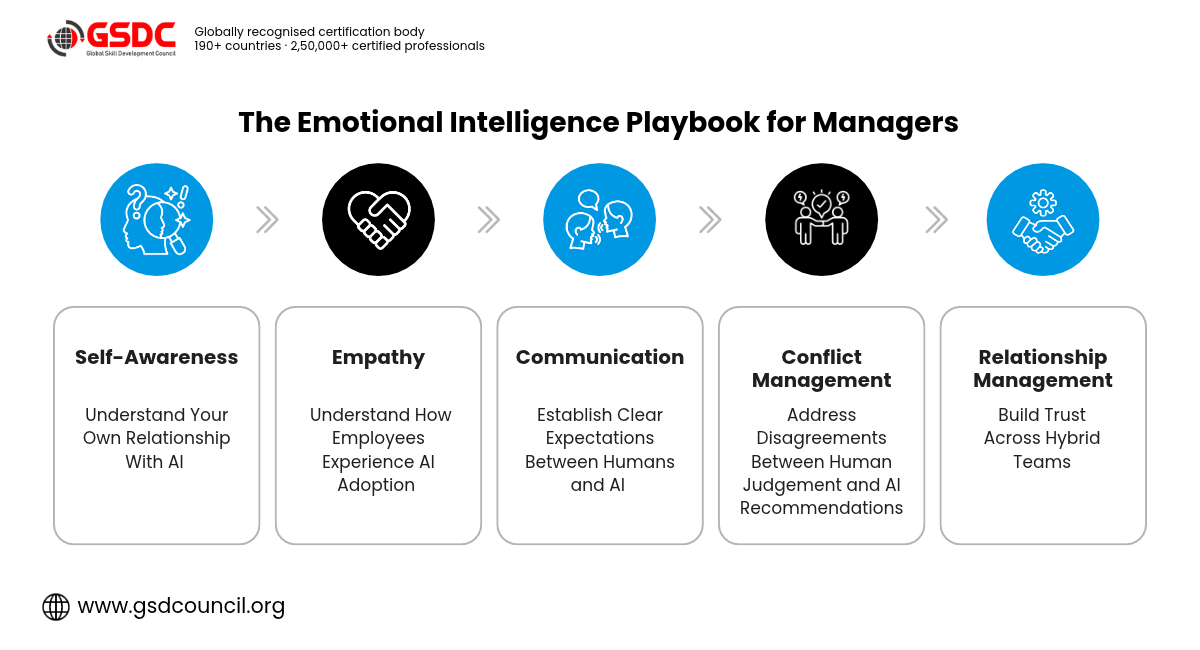
Leading hybrid teams requires managers to combine traditional leadership capabilities with a better understanding of AI-driven work environments.
The following emotional intelligence playbook highlights five important areas managers should focus on.
1. Self-Awareness: Understand Your Own Relationship With AI
Before leading employees through AI adoption, managers must understand their own attitudes towards the technology.
Some managers may be enthusiastic about automation and expect employees to adopt new tools immediately. Others may feel uncertain about AI systems making recommendations or performing tasks previously handled by experienced team members.
These attitudes can influence how they communicate with their teams.
Self-awareness helps managers identify their assumptions, concerns, and expectations before making decisions.
For example, a manager introducing an AI-powered reporting tool should consider whether they are evaluating employees fairly or simply expecting everyone to become productive with the new technology immediately.
They should also recognise that their own understanding of AI may be limited.
Practical steps include:
- Regularly evaluating personal assumptions about AI capabilities.
- Understanding the limitations of AI-generated outputs.
- Seeking feedback from employees during technology adoption.
- Being open about areas where additional learning is required.
Managers who demonstrate curiosity and adaptability create a workplace where employees feel more comfortable learning alongside AI.
2. Empathy: Understand How Employees Experience AI Adoption
Empathy is one of the most important emotional intelligence skills for managers.
Introducing AI can affect employees differently depending on their responsibilities, experience, and confidence with technology.
For example, an experienced customer support professional may feel uncomfortable when an AI agent begins handling routine customer interactions. A junior employee may welcome the same change because it reduces repetitive work and provides more opportunities to learn.
Managers should avoid assuming that everyone will respond to AI adoption in the same way.
Instead, they should create opportunities for employees to share their concerns, ask questions, and understand how their roles may evolve.
Some practical approaches include:
- Conducting regular one-to-one conversations.
- Asking employees which tasks they find repetitive or challenging.
- Explaining how AI will support existing responsibilities.
- Identifying opportunities for reskilling and professional development.
- Recognising employee contributions beyond automated productivity measures.
Empathy helps managers understand that AI transformation is not just a technology change. It is also a people and workplace change.
3. Communication: Establish Clear Expectations Between Humans and AI
Hybrid teams need clear communication about responsibilities, decision-making authority, and accountability.
In a traditional workplace, employees generally understand who is responsible for a particular task. However, when AI systems become part of the workflow, responsibilities can become less obvious.
Consider an AI agent that prepares financial reports. It collects information, identifies patterns, and recommends actions. A finance manager reviews the findings and approves the final report.
If these responsibilities are not clearly communicated, employees may assume that AI-generated information is automatically correct or that the system is responsible for the final decision.
Managers must establish clear expectations about:
- Which activities AI can perform independently.
- Which decisions require human approval.
- How employees should verify AI-generated information.
- Who is accountable for the final outcome.
- When an issue should be escalated to a human manager.
Good communication also means explaining why AI is being introduced rather than simply announcing that a new tool must be used.
When employees understand the purpose behind automation, they are more likely to participate constructively.
4. Conflict Management: Address Disagreements Between Human Judgement and AI Recommendations
One of the challenges of human AI teaming is that people may disagree with AI-generated recommendations.
For example, an AI recruitment tool may rank a candidate lower based on predefined evaluation criteria, while a hiring manager believes the candidate has relevant experience that the system has not adequately considered.
The manager must investigate the disagreement instead of automatically accepting either recommendation.
This requires emotional intelligence, critical thinking, and the ability to manage different perspectives.
A useful approach involves:
- Understanding the reasoning behind the AI recommendation.
- Reviewing the information and criteria used.
- Considering the human employee's perspective.
- Identifying missing information or potential bias.
- Making a decision based on evidence and organisational requirements.
Managers should create an environment where employees can question AI outputs without feeling that they are challenging technological progress.
Healthy disagreement can help organisations identify system limitations and improve decision-making processes.
5. Relationship Management: Build Trust Across Hybrid Teams
Relationship management involves creating positive working relationships, encouraging collaboration, and helping individuals work towards shared objectives. In leadership in the age of AI, managers must build confidence in the collaboration process and promote effective human AI teaming. Employees should understand that AI teammates are introduced to support specific responsibilities, not replace human contributions.
For example, an AI teammate may prepare the first version of a business presentation, while a human employee improves the narrative, adds industry knowledge, verifies information, and ensures alignment with organizational objectives. This approach helps create more effective human-AI teams, where both human expertise and AI capabilities contribute to better outcomes.
Managers can strengthen collaboration by recognising employee achievements, encouraging knowledge sharing, and making AI-related learning accessible to everyone. Applying emotional intelligence for managers helps leaders address employee concerns, build trust, and encourage confidence when working with an agentic workforce.
As part of effective AI change management, leaders should ensure employees feel comfortable using AI while retaining ownership of their expertise and professional judgement. An Emotional Intelligence Playbook can help managers develop these relationship-building skills and support successful leading in the age of AI.
How AI Is Changing the Managerial Skills Required for Leadership
As organisations adopt AI, managerial skills are expanding beyond traditional team coordination and performance management.
Managers increasingly need to understand how people, technology, and business processes interact.
Some of the most important capabilities include:
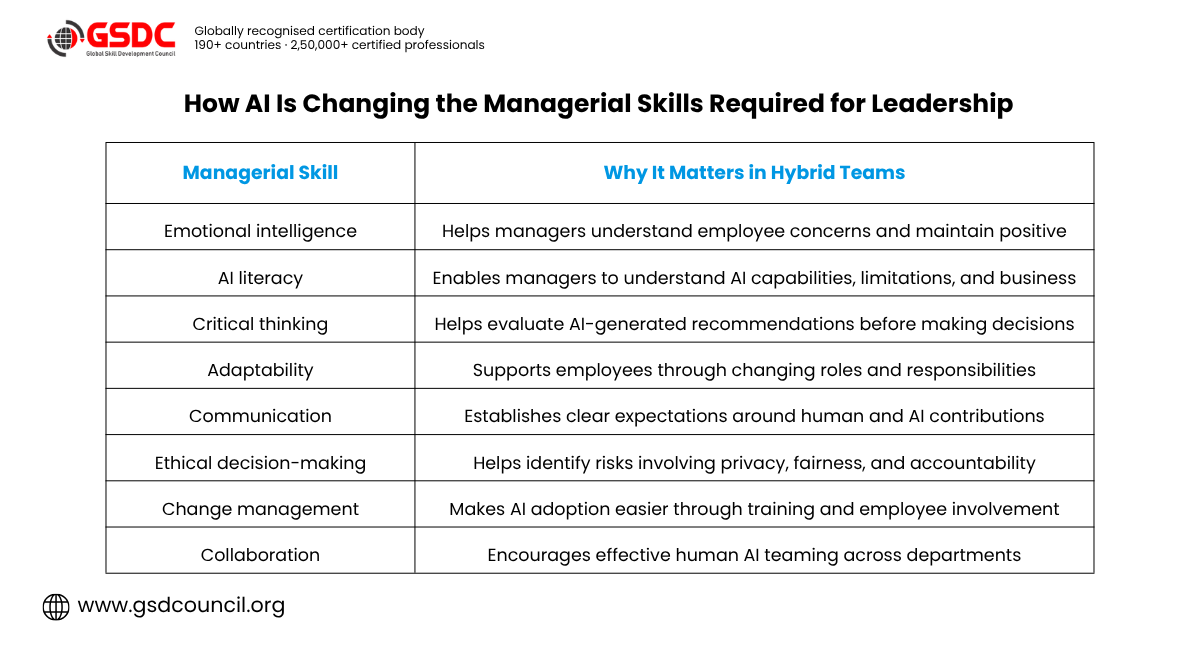
These capabilities demonstrate that successful AI leadership requires more than technical knowledge.
Managers must be able to connect technological opportunities with employee needs and organisational objectives.
Practical Examples of AI and Leadership in the Workplace
Example 1: AI in Customer Support and Project Management
A company introduces AI agents to handle routine customer enquiries, track project deadlines, and summarise meetings. During this transition, managers practising leadership in the age of AI focus on human AI teaming by training employees, addressing job-related concerns, and encouraging feedback. This approach to AI change management helps employees adapt to working alongside AI teammates while maintaining trust, communication, and accountability.
Example 2: AI in Human Resources
An HR department uses AI to organise applications and support recruitment. Managers responsible for building Human AI Teams ensure that hiring decisions involve human evaluation while maintaining fairness, transparency, and applicant data protection. Emotional intelligence for managers helps them recognise employee and applicant concerns, communicate expectations, and maintain responsible AI practices. An Emotional Intelligence Playbook can help leaders develop the skills needed to manage an agentic workforce while balancing automation with human judgement.
Example 3: AI in Employee Training and Development
An organisation introduces AI-powered learning platforms to recommend training programmes, identify skill gaps, and personalise employee development plans. Managers use AI for leaders solutions to understand learning needs while considering individual career goals and employee feedback. This approach to leading in the age of AI ensures that technology supports employee growth rather than replacing meaningful human guidance.
Developing Emotional Intelligence for AI Leadership
As AI becomes more integrated into business operations, managers need to strengthen the human skills that technology cannot replace. Emotional intelligence helps leaders understand employee concerns, manage workplace challenges, and build stronger collaboration between human teams and AI systems.
GSDC's Certified Emotional Intelligence Certification can help professionals develop essential skills such as self-awareness, empathy, effective communication, emotional regulation, and relationship management. These capabilities enable managers to understand different perspectives, handle conflicts constructively, and guide employees through organizational changes.
Pursuing an Certified Emotional Intelligence Certification can also help managers build a more people-focused leadership approach while adapting to AI-driven workplaces. By combining emotional intelligence with AI literacy and change management skills, professionals can become better prepared to lead hybrid teams, support employee development, and create a collaborative work environment where humans and AI work together effectively.
Conclusion
Leading hybrid Human AI teams requires a different understanding of leadership in the age of AI. Leading in the age of AI means recognising how AI can analyse information, automate repetitive tasks, and support decision-making while keeping human qualities such as empathy, communication, trust, and accountability at the centre. As organisations introduce AI teammates and build an agentic workforce, managers must focus on human AI teaming and effective AI change management to ensure employees and technology contribute meaningfully to organisational objectives.
Emotional intelligence for managers provides the foundation for successful Human AI Teams. By understanding employee concerns, managing disagreements, communicating expectations, and recognising human contributions, managers can make AI adoption more effective and sustainable. An Emotional Intelligence Playbook can help managers strengthen these capabilities and understand how to use AI for leaders while maintaining a balance between technological efficiency and human needs. The future of leadership will depend on how effectively managers bring people and technology together to achieve better outcomes.

Related Certifications
Stay up-to-date with the latest news, trends, and resources in GSDC
If you like this read then make sure to check out our previous blogs: Cracking Onboarding Challenges: Fresher Success Unveiled
Not sure which certification to pursue? Our advisors will help you decide!