Embedding Psychological Safety: Strategies for L&D Leaders
Written by Parul Parmar Ph.D
- Understanding Psychological Safety
- The 4 Stages of Psychological Safety
- Misconceptions About Psychological Safety
- Consequences of a Lack of Psychological Safety
- Why Psychological Safety Matters Today
- Business Benefits of Psychological Safety
- When Psychological Safety Is Missing: Organisational Lessons
- Important Considerations and Limitations
- Role Modelling: Learning from Leaders
- How Certified Learning & Development Professional (CLDP) Helps Build Psychologically Safe, High-Performing Workplaces?
- Conclusion
- FAQ’s
In modern organisations, performance is no longer driven only by strategy, systems, or skills. Increasingly, it is shaped by how safe people feel to speak, contribute, and challenge. This is why psychological safety at work has become a defining factor in how teams collaborate, innovate, and sustain performance. When employees hesitate to ask questions, admit mistakes, or share ideas, even the most well-designed processes fail to deliver results.
Today, psychological safety in the workplace is recognised not as a soft concept, but as a measurable driver of learning, innovation, and organisational resilience. It directly influences employee experience strategy, enabling environments where people feel valued, heard, and empowered to contribute meaningfully.
For L&D leaders, embedding psychological safety at workplace level is no longer optional it is a core component of modern L&D strategies aimed at building capability, engagement, and adaptability. Organisations that prioritise creating psychological safety in the workplace strengthen trust, accelerate learning, and foster a sustainable learning culture in the workplace.
Understanding Psychological Safety
So, what is psychological safety in the workplace?
The concept was introduced by Harvard professor Amy Edmondson, who defined it as:
“A shared belief within a team that it is safe to take interpersonal risks without fear of negative consequences, such as punishment or humiliation.”
In a psychologically safe workplace, employees feel free to:
- Ask questions
- Seek help
- Admit mistakes
- Share concerns
- Offer ideas
- Be their authentic selves
At its core, psychological safety addresses the invisible fears that shape workplace behaviour: fear of speaking up, fear of failure, fear of being judged, and fear of appearing incompetent. Removing these barriers strengthens organizational safety culture and supports a more inclusive workplace culture, where diverse perspectives are encouraged rather than suppressed.
The 4 Stages of Psychological Safety
To operationalise this concept, many organisations adopt the 4 stages of psychological safety, a practical framework for building trust progressively:
- Inclusion Safety: Individuals feel accepted and part of the team.
- Learner Safety: People feel safe asking questions, experimenting, and growing.
- Contributor Safety: Employees confidently apply skills and share ideas.
- Challenger Safety: Team members feel empowered to question assumptions and suggest improvements.
These stages closely align with the organisation's goals of innovation, agility, and continuous improvement.
Misconceptions About Psychological Safety
A common barrier to adoption is misunderstanding why psychological safety is important and what it actually means. It does not imply:
- Avoiding difficult conversations
- Lowering performance standards
- Being agreeable at all times
- Eliminating accountability
- Tolerating poor behaviour
Psychological safety does not create a “soft” organisation. Instead, it enables constructive discomfort, where people can challenge, debate, and improve without fear. High standards and psychological safety must coexist to drive performance, strengthen organizational safety culture, and support long-term business success.
Consequences of a Lack of Psychological Safety
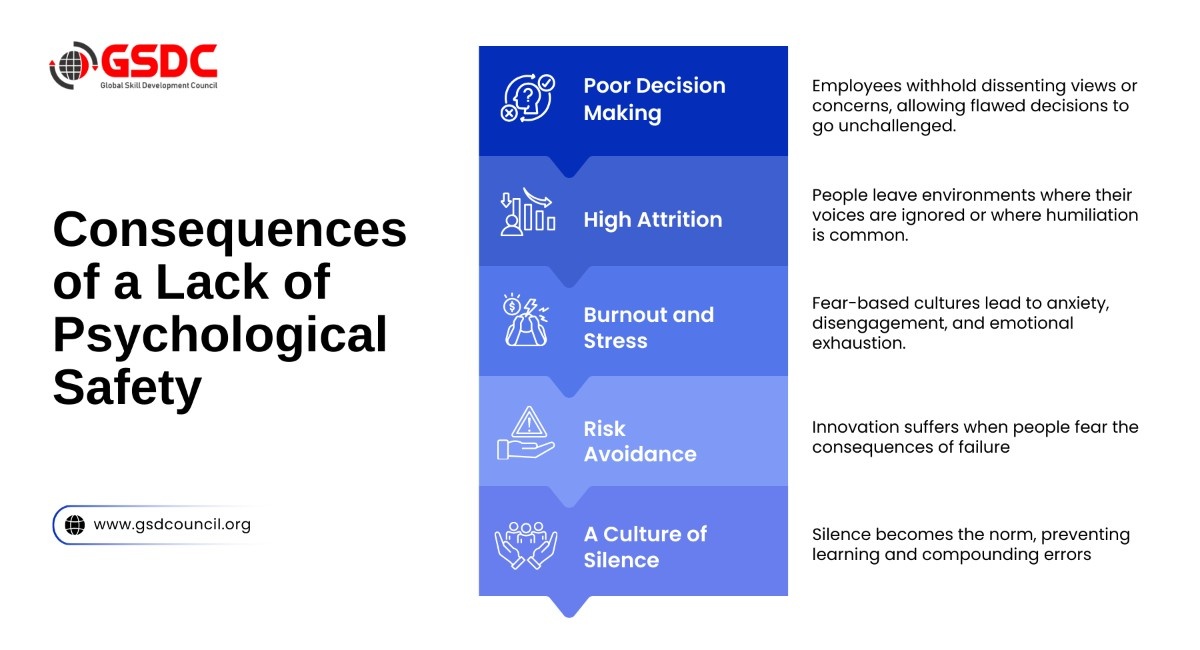
When psychological safety is absent, organisations face serious consequences:
1. Poor Decision-Making: Employees withhold dissenting views or concerns, allowing flawed decisions to go unchallenged.
2. High Attrition: People leave environments where their voices are ignored or where humiliation is common.
3. Burnout and Stress: Fear-based cultures lead to anxiety, disengagement, and emotional exhaustion.
4. Risk Avoidance: Innovation suffers when people fear the consequences of failure.
5. A Culture of Silence: Silence becomes the norm, preventing learning and compounding errors.
These outcomes directly undermine organisational performance and resilience.
Why Psychological Safety Matters Today
Psychological safety is especially relevant in today’s context due to several converging forces:
- Digital Transformation and AI: With AI, automation, and rapid change, employees face ambiguity and uncertainty. Psychological safety enables people to ask questions, admit what they don’t know, and contribute ideas without fear.
- Innovation as a Business Necessity: Innovation depends on unconventional thinking and challenging existing processes, both of which are impossible without safety.
- Mental Health as a Business Priority: Post-pandemic, employee well-being is a strategic issue. Safe environments reduce stress and normalise asking for help.
- Multigenerational Workforce: With Gen Z, Millennials, Gen X, and Baby Boomers working together, safety enables collaboration across diverse expectations and work styles.
- Talent Attraction and Retention: Employees increasingly choose organisations where they feel respected, heard, and psychologically secure.
Business Benefits of Psychological Safety
Research demonstrates that psychological safety leads to better organizational performance through nine specific outcomes. These outcomes consist of:
1. Turnover decreases
2. Employee engagement levels rise
3. Workers show increased ability
4. Employees develop better teamwork skills
5. Organizations experience higher output
6. Workers achieve higher job satisfaction
7. Employees face reduced stress levels.
The existence of psychological safety as a cultural benefit advances organizational performance through its function as a business driver.
When Psychological Safety Is Missing: Organisational Lessons
- Challenger Space Shuttle Disaster: Engineers raised concerns before launch, but felt pressured by leadership to remain silent. The result was the tragic loss of seven lives. Silence, driven by fear, proved catastrophic.
- Volkswagen Emissions Scandal: Employees followed unethical practices without challenging leadership, resulting in massive legal, financial, and reputational damage.
- Nokia’s Decline: Fear of speaking up prevented teams from questioning flawed strategies, even when market shifts were visible. The organisation failed not due to lack of talent, but lack of voice.
These cases highlight a critical truth: when people are afraid to speak, organisations fail quietly before they fail publicly.
Strategies to Inculcate Psychological Safety
Leaders should:
- Admit mistakes and model vulnerability.
- Use micro-behaviors to encourage daily small contributions.
- Celebrate team wins and maintain open communication.
Learning & Development (L&D) role:
- Train managers in response skills beyond intent.
- Embed psychological safety in onboarding.
- Promote reverse mentoring to bridge generational gaps.
Organizational systems must align to support psychological safety through:
- Measurement of participation, feedback quality, and safety surveys.
- Integration into leadership competencies and coaching.
- Safe forums for voice, skip-level meetings, pulse surveys, and embracing productive conflict.
Important Considerations and Limitations
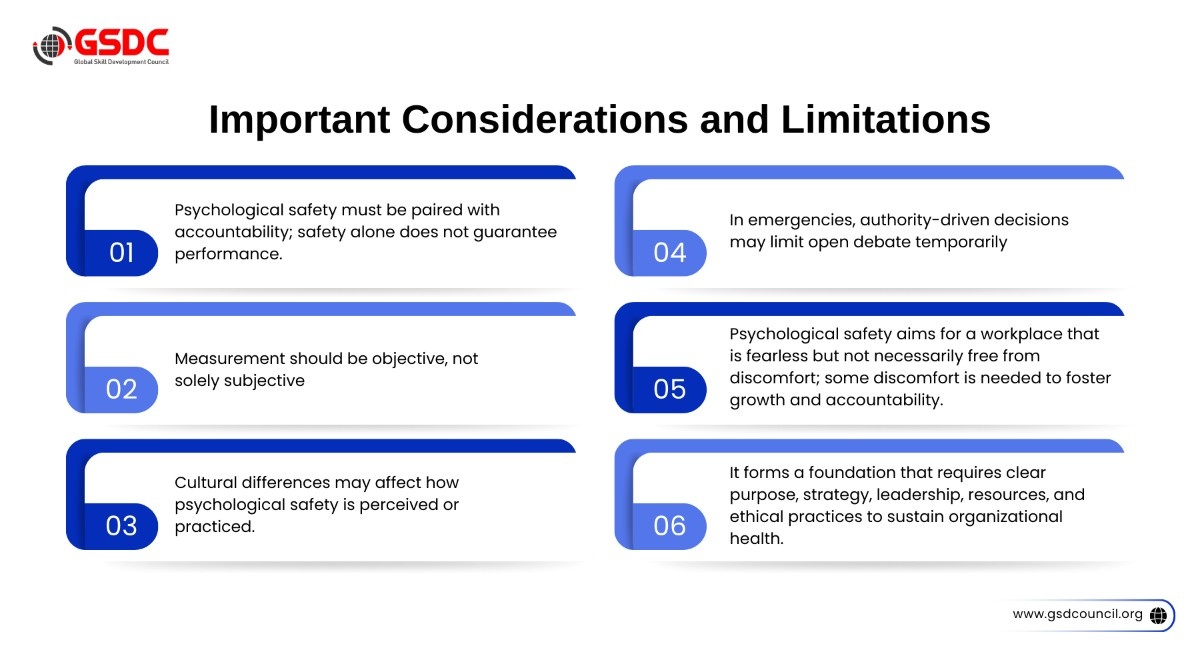
- Psychological safety must be paired with accountability; safety alone does not guarantee performance.
- Measurement should be objective, not solely subjective.
- Cultural differences may affect how psychological safety is perceived or practiced.
- In emergencies, authority-driven decisions may limit open debate temporarily.
- Psychological safety aims for a workplace that is fearless but not necessarily free from discomfort; some discomfort is needed to foster growth and accountability.
- It forms a foundation that requires clear purpose, strategy, leadership, resources, and ethical practices to sustain organizational health.
Role Modelling: Learning from Leaders
Coca-Cola: Turning Failure into Learning
When Coca-Cola’s CEO James Quincey acknowledged that a product decision failed due to reacting hastily to a competitor’s campaign, he publicly owned the mistake instead of deflecting blame. By framing failure as part of innovation, he reduced fear, encouraged experimentation, and reinforced that learning is more valuable than protecting one's image.
The famous case of Asoh’s Defence: Accountability in High-Risk Environments
In aviation, where safety is critical, a Japanese pilot, Kohei Asoh, openly accepted responsibility for misjudging a landing due to poor visibility rather than blaming systems. His transparency strengthened trust and reinforced a culture where reporting errors leads to prevention and learning, not punishment, an essential foundation for operational excellence.
How Certified Learning & Development Professional (CLDP) Helps Build Psychologically Safe, High-Performing Workplaces?
The Certified Learning Development Professional certification from GSDC provides L&D leaders with practical frameworks to create learning ecosystems that support psychological safety, team collaboration, and ongoing development. The certification strengthens the capability to align L&D strategies with business goals, enhance the employee experience, and build inclusive, future-ready cultures where individuals feel confident to learn, contribute, and innovate.
Key Benefits of CLDP Certification:
- Strategic L&D Alignment: The program teaches L&D professionals to create training programs that align with organizational objectives and performance standards.
- Enhanced Employee Experience: The organization develops training spaces that foster employee trust and active participation and safe work environments.
- Practical Learning Frameworks: The program provides participants with essential tools that enable them to develop organized educational programs that produce measurable learning results.
- Culture Transformation Skills: The program establishes a powerful learning environment that enables workers to acquire new skills and improve their performance through constant progress.
- Leadership-Ready Competencies: The program enhances three essential abilities, which include handling stakeholder relationships, developing organizational competencies, and nurturing employee talent.

Conclusion
The organization implements psychological safety as an essential cultural element that enables better innovation and employee engagement while maintaining long-term organizational success. The elimination of fear through psychological safety measures at work and in the workplace environment enables organizations to build a safer work culture, which upholds strict safety requirements. The establishment of psychological safety at work enables organizations to achieve three outcomes which include open communication, employee participation, and a strong learning culture in the workplace.
L&D leaders need to develop this mindset through targeted L&D strategies because it represents the core of modern employee experience strategies. The understanding of psychological safety benefits organizations that want to create an inclusive workplace environment, which enables their employees to learn, share ideas, and challenge existing concepts while their organization builds future-ready capabilities.
FAQ’s
1. What is psychological safety, and why is it important at work?
Psychological safety is a shared belief that employees can speak up, ask questions, admit mistakes, or share ideas without fear of punishment or humiliation. It fosters openness, innovation, collaboration, and better decision-making key drivers of organizational performance.
2. Does psychological safety mean avoiding accountability or being overly lenient?
No. Psychological safety is often misunderstood as being “soft.” It does not eliminate performance expectations or accountability. Instead, it creates an environment where individuals can discuss challenges honestly while still being held responsible for outcomes and standards.
3. What happens when psychological safety is missing in an organization?
Lack of psychological safety leads to silence, risk avoidance, hidden mistakes, poor decisions, disengagement, and higher attrition. Employees may avoid sharing concerns or innovative ideas, which can negatively impact productivity, morale, and long-term business success.
4. How can leaders build psychological safety within their teams?
Leaders can establish clear expectations, invite participation, listen actively, respond without blame, and model vulnerability by admitting their own mistakes. Encouraging dialogue, appreciating contributions, and handling feedback constructively are key behaviors that nurture trust.
5. How should managers handle low-performing employees while maintaining psychological safety?
Managers should address performance issues directly but respectfully through clear communication, guidance, and support rather than fear or humiliation. Psychological safety allows honest conversations about improvement while reinforcing expectations and accountability.

Related Certifications
Stay up-to-date with the latest news, trends, and resources in GSDC
If you like this read then make sure to check out our previous blogs: Cracking Onboarding Challenges: Fresher Success Unveiled
Not sure which certification to pursue? Our advisors will help you decide!