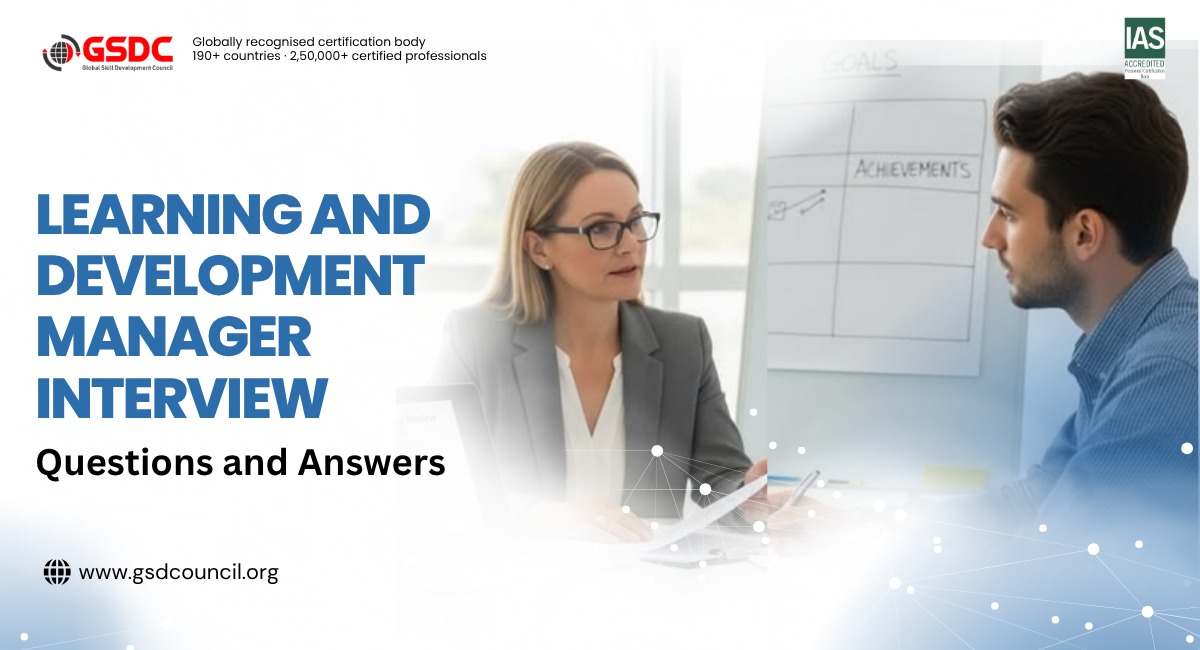
Learning and Development Manager Interview Questions and Answers
Written by Matthew Hale
- What Is Learning and Development?
- What Does a Learning and Development Strategy Include?
- Learning and Development Manager Salary and Career Path
- How to Use These L&D Manager Interview Questions
- Learning and Development Manager Interview Questions
- How to Prepare for an L&D Manager Interview
- Common Mistakes in L&D Manager Interviews
- L&D Certification: Where It Fits
- Final Thoughts
Learning and development (L&D) has become a strategic function, and hiring for it has become more demanding. Employers want an L&D manager who can link training to business results, work with data and use new technology responsibly. This guide covers 25 learning and development manager interview questions with sample answers, useful for candidates preparing for the role and for hiring teams building a structured interview.
The role is also growing. The U.S. Bureau of Labor Statistics reports a median wage of $133,000 for training and development managers, projects 6 percent growth from 2025 to 2035, faster than the average for all occupations, and expects about 4,100 openings a year.
What Is Learning and Development?
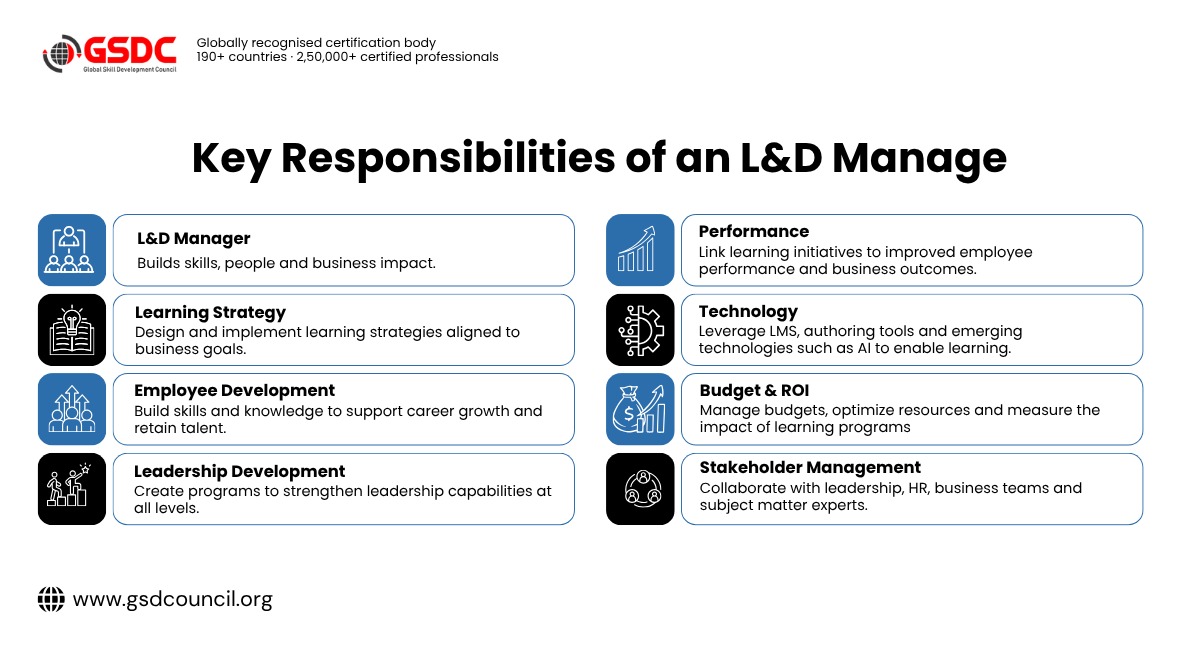
Learning and development is the organizational function that builds employee skills and knowledge so that people and the business can perform better. It covers onboarding, technical and compliance training, leadership development and career growth. A learning and development specialist designs, delivers and administers programs. The L&D manager sets the learning and development strategy, leads the team, manages budgets and proves business impact. The BLS lists training and development specialists at a median of $69,280, which shows the pay step that comes with moving into management.
What Does a Learning and Development Strategy Include?
A learning and development strategy links workforce skills to business goals. It typically covers a skills gap analysis, learning objectives, program design and delivery methods, technology, budget, measurement and a plan for continuous improvement. Interviewers often use the strategy question to judge whether a candidate thinks in terms of business outcomes or only course delivery.
Learning and Development Manager Salary and Career Path
The BLS puts the median learning and development manager salary at $133,000 a year, with the lowest 10 percent earning under $79,550 and the highest 10 percent above 233,600.Payishighestinprofessional,scientificandtechnicalservices(156,440), followed by management of companies (137,530)andfinanceandinsurance(133,600). Most employers expect a bachelor's degree and five years or more of related experience, often as a training specialist, instructional designer or HR professional, and some prefer a master's degree. Certification is not required, but it can show professional expertise.
How to Use These L&D Manager Interview Questions
The questions are grouped by theme. Sample answers are condensed, so candidates should add real projects, numbers and tools from their own experience. Hiring teams can use the same set as a scorecard for consistent interviews.
Learning and Development Manager Interview Questions
General Competency-Based Questions
1. How is a learning and development strategy designed?
A sound strategy starts with business objectives and a skills gap analysis, then combines blended learning, digital tools and leadership development, with measurable outcomes and a culture of continuous learning built in.
2. How are L&D initiatives aligned with organizational objectives?
Alignment starts with stakeholders: understand strategic priorities and workforce capabilities, tie each program to a business goal such as productivity or retention, then track progress and report results to sustain buy-in.
3. How are skill gaps in employees identified?
Skills assessments, performance reviews, manager feedback and data analytics expose gaps, while listening to employees and benchmarking against industry standards shape interventions for current roles and future growth.
4. How is the effectiveness of training programs measured?
Kirkpatrick's model measures reaction, learning, behavior and results. Post-training assessments, 360-degree feedback and performance metrics show the impact on individuals and on organizational KPIs.
Measurement frameworks are easier to discuss with formal grounding. Bodies such as the Global Skill Development Council (GSDC) publish L&D resources and offer an L&D certification track for professionals who want a structured way to build that knowledge.
Technical Expertise Questions
5. How can AI be incorporated into L&D programs?
AI supports adaptive learning paths, skills analytics, ROI measurement, chatbots for instant learner support and predictive analytics that flag future skill needs.
6. How is compliance training managed in a global organization?
An LMS standardizes the content, regional localization covers legal and cultural differences, and automated tracking and reminders keep completion on schedule, with engaging formats to lift participation.
7. Which metrics show L&D program success?
Participation, completion, satisfaction scores and pre- and post-assessments show learning. Long-term metrics such as behavior change, performance improvement and ROI prove value to stakeholders.
Leadership and Team Management Questions
8. How is a culture of continuous learning fostered?
Leadership support, accessible resources, recognition, self-directed learning and learning built into daily workflows make continuous growth part of the culture.
9. How are team members mentored and coached?
Scheduled one-on-ones, clear action items, targeted learning opportunities, autonomy and recognition build confidence and a growth mindset.
10. Which leadership style suits an L&D manager?
A collaborative, adaptive style works well: clear communication, shared decision-making, leading by example and an accountable, innovative culture aligned with organizational goals.
Strategic and Analytical Skills Questions
11. How are L&D budgets set?
Budgeting starts with historical spend, current needs and forecast demand, prioritizes high-impact programs and keeps stakeholders informed so allocations can be justified and adjusted as needs change.
12. How is change managed in L&D initiatives?
Communicate the purpose and benefits early, involve stakeholders, provide training and support, and use feedback loops to address resistance and refine the rollout.
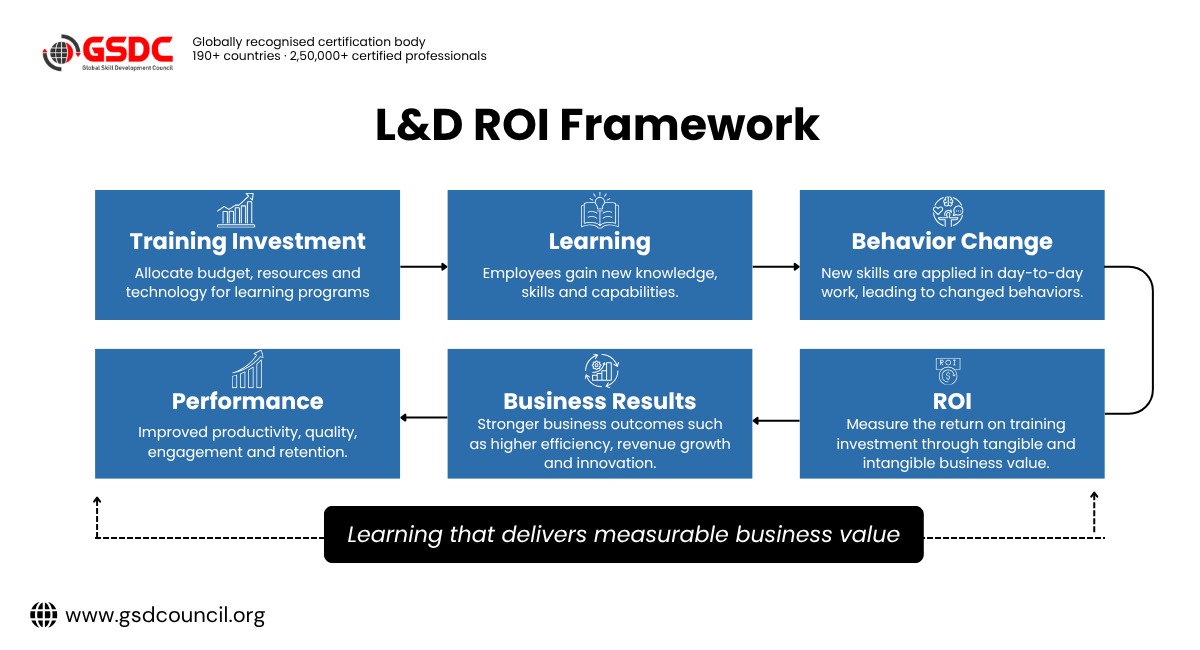
13. How is ROI evaluated for L&D investments?
Compare pre- and post-training performance metrics such as productivity, customer satisfaction and retention against training cost, then report the result to stakeholders as data.
ROI and impact questions are where formal training shows most clearly in an interview. A program such as the Certified Learning & Development Professional (CLDP) gives L&D practitioners a structured route through strategy, program design and measurement, which makes it easier to back answers with a recognized framework and real examples.
14. What are the latest trends in L&D?
Current trends include AI-driven adaptive learning, immersive AR and VR practice, gamification, microlearning and hybrid models that combine in-person and virtual learning.
Behavioral and Situational Questions
15. How is a major L&D challenge handled?
A common challenge is resistance to a new LMS. Awareness sessions, tailored end-user training and real success stories can raise adoption and satisfaction with learning resources.
16. How is low learner engagement handled?
Analyze feedback to find the barriers, then make content more interactive and relevant, add gamification, real scenarios and manager endorsement, and link learning to employee goals.
Collaboration and Stakeholder Engagement Questions
17. How are stakeholders engaged in L&D programs?
Engage stakeholders at the planning stage, align programs with their goals, share regular progress updates and back them with data to secure ongoing support.
18. How are conflicting stakeholder priorities resolved?
Prioritize by business impact so the highest-value initiatives go first, communicate regularly and manage expectations realistically.
Future-Ready Questions
19. What does the future of L&D look like?
Expect AI-driven personalization, immersive AR and VR practice and real-time microlearning built into work, with a focus on lifelong learning and continuous upskilling.
20. How are L&D strategies future-proofed?
Monitor trends continuously, align them with organizational goals and prepare through AI-driven insights, upskilling initiatives, scenario planning and strong stakeholder partnerships.
More L&D Manager Interview Questions
21. How is e-learning content created?
Content is built in modular pieces, each tied to one learning objective, using tools such as Articulate 360 and Camtasia. Strong modules are interactive, concise and accessible across devices, with quizzes, video and real-world scenarios that suit different learning preferences and support retention.
22. How does succession planning work in L&D?
L&D works with HR to identify critical roles and high-potential employees, then maps future organizational needs against current skills. Tailored development plans follow, with mentoring, stretch assignments and targeted leadership training that prepare people for the next level and build a talent pipeline.
23. What role does gamification play in learning?
Challenges, badges and leaderboards raise participation and retention, and they build healthy competition that fits the growing demand for interactive training. Gamification works best when the mechanics support a clear learning goal instead of decorating the content.
24. How are L&D programs made inclusive?
Inclusive design starts with accessible content that considers language, cultural relevance and varied abilities. Employees from different backgrounds should shape programs early, and flexible learning paths let people learn in the format and at the pace that suits them.
25. How are last-minute training requests handled?
Assess urgency against organizational priorities first. Then adapt existing templates and resources quickly and work with subject matter experts to keep quality high while meeting the deadline. Afterward, review whether the request points to a gap that planning should cover.
How to Prepare for an L&D Manager Interview
Preparation for learning and development roles combines business thinking with practical examples.
- Know the business: research the organization's goals, workforce and skills challenges so answers link learning to results.
- Prepare measurable stories: have two or three programs ready, each with the problem, the approach and the outcome in numbers.
- Revisit measurement models: be able to explain the Kirkpatrick levels and how ROI is calculated.
- Show technology fluency: be ready to discuss LMS platforms, authoring tools and how AI is changing content creation and personalization.
- Rehearse stakeholder scenarios: practice answers on competing priorities, tight budgets and resistance to training.
- Bring questions: ask about learning strategy, team structure and how L&D success is measured in the organization.
Common Mistakes in L&D Manager Interviews
- Describing activities, such as courses delivered, without any business outcome.
- Treating training completion as proof of learning.
- Ignoring budget and stakeholder realities in answers about strategy.
- Speaking about AI in general terms without a concrete use case.
- Claiming results without being able to explain how they were measured.
L&D Certification: Where It Fits
Credentials work best when they match the target role. For candidates weighing an L&D certification, the Global Skill Development Council (GSDC) offers the Certified Learning and Development Professional program. The BLS notes that certification is not required for training and development managers, though some employers prefer it and some positions require it. A practical sequence:
- Check the requirements: confirm any experience or education criteria for the chosen certification.
- Prepare and learn: courses, workshops and online sessions build knowledge and confidence.
- Join professional communities: networking and shared learning keep skills current.
Choose the right fit: compare certifications against career goals and real job listings.
Final Thoughts
L&D interviews reward candidates who connect learning to business outcomes and can back every claim with a real example. Prepare answers around strategy, measurement, technology and stakeholders, and the rest of the interview tends to follow.

Related Certifications
Frequently Asked Questions
It is the function that builds employee skills and knowledge through training, coaching and career development so people and the business perform better.
Specialists design and deliver programs. Managers set strategy, lead the team, control budgets and prove business impact.
The BLS reports a median of $133,000 a year for training and development managers in the US, with pay varying by industry and experience.
It can help show structured knowledge, especially when moving into management, though related work experience still carries the most weight.
Stay up-to-date with the latest news, trends, and resources in GSDC
If you like this read then make sure to check out our previous blogs: Cracking Onboarding Challenges: Fresher Success Unveiled
Not sure which certification to pursue? Our advisors will help you decide!