Top Companies Using Balanced Scorecard and What to Learn

Written by Matthew Hale
- What Is a Balanced Scorecard?
- Why Companies Use the Balanced Scorecard
- Top Companies Using the Balanced Scorecard
- Key Lessons from Companies Using Balanced Scorecard
- Why This Matters
- Career Relevance: Roles and Salary Insights
- Acquiring Relevant Skills for Balanced Scorecard Strategy Implementation
- Conclusion
In the early 1990s, organizations faced a common problem: a strategy looked good on paper but often failed in execution. To solve this, the Balanced Scorecard (BSC) was introduced as a way to bring clarity and structure to how businesses track and achieve their goals.
By combining four key perspectives: financial, customer, internal processes, and learning and growth, it gave leaders a more complete view of performance. Over time, the balanced scorecard strategy became less about measurement and more about execution.
Even today, its relevance hasn’t faded. More than 50% of large organizations use this framework, with adoption reaching up to 70% globally. In fact, studies also show that 77% of organizations find the Balanced Scorecard extremely or very useful.
This is why many companies that use balanced scorecard continue to stay aligned, execute better, and deliver consistent results.
What Is a Balanced Scorecard?
As organizations focused more on execution, one question became important—what is a balanced scorecard in business?
It is a system that helps organizations track performance beyond financial results by combining financial performance, customer experience, internal processes, and learning and growth into one view.
The balanced scorecard framework doesn’t create strategy—it helps structure and execute it in daily operations.
So, what is the purpose of a balanced scorecard?
It connects big goals with everyday actions, making strategy easier to manage and measure.
This is why the balanced scorecard approach plays a key role in balanced scorecard strategic planning, helping organizations stay aligned and focused.
Why Companies Use the Balanced Scorecard
As organizations began focusing more on execution, they needed a way to make strategy clearer and easier to track. This is where the Balanced Scorecard proved useful.
The benefits of balanced scorecard come from its ability to simplify strategy and make it actionable across the organization.
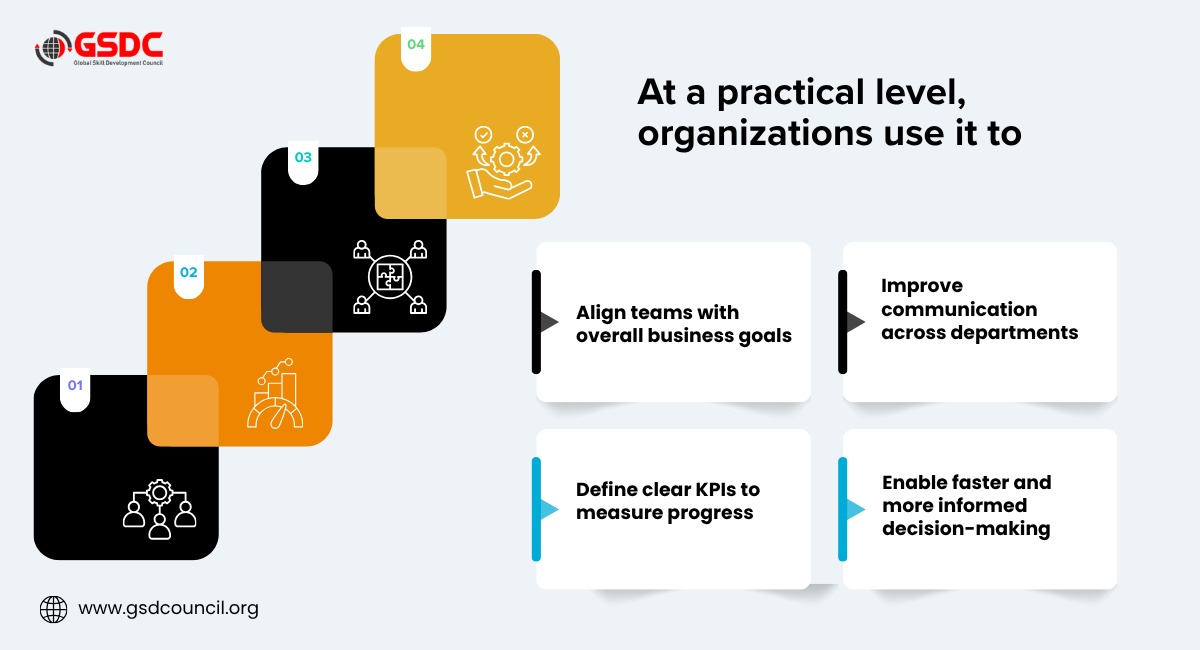
This practical value is reflected in real-world adoption. Studies show that around 73% of organizations consider the Balanced Scorecard very helpful in improving performance.
This is why balanced scorecard success is not just about having a strategy, but about how effectively it is executed every day.
Top Companies Using the Balanced Scorecard
The Balanced Scorecard concept has developed over time to become applicable not only in theory but also in practice. Presently, various renowned corporations are employing the Balanced Scorecard to establish an efficient process of execution. It is due to its growing usage that there has been a rising demand for positions like Certified Balanced Scorecard Professional.
1. Apple, Ford, and Hilton
Global brands like Apple, Ford, and Hilton are strong balanced scorecard examples. They use the framework to manage large, complex operations while staying aligned with their long-term strategy.
2. UPS
UPS stands out among companies that use balanced scorecard to drive transformation. It used the framework to shift from a traditional delivery business to a full supply chain solutions provider.
3. Government Organizations (Durham & Fort Lauderdale)
The balanced scorecard framework approach does not only apply to private organizations but even to cities such as Durham and Fort Lauderdale where it was used to enhance coordination and effectiveness.
Some of their priorities included:
- Better teamwork between departments
- More efficient resource utilization
- Improved delivery of services to the public
4. Nonprofits
The balanced scorecard approach is used by nonprofit organizations to evaluate their performance. It enables them to remain outcome-focused, open, and growing.
5. Educational Institutions (LSU College of Engineering)
Educational institutions are also practical balanced scorecard examples. They use it to improve enrollment, strengthen partnerships, and achieve better outcomes.
Across industries, these balanced scorecard examples show a common pattern—organizations that execute strategy well rely on structure, clarity, and measurable outcomes.
Key Lessons from Companies Using Balanced Scorecard
In all these instances, a definite trend emerges - organizations that succeed with the Balanced Scorecard approach it as a process tool rather than a measurement one. It has further raised the demand for systematic learning within organizations such as the Global Skill Development Council (GSDC).
1. Strategy Must Be Measurable
Successful organizations turn strategy into clear, trackable elements such as goals, KPIs, and action plans. This is the foundation of effective balanced scorecard strategic planning, where execution becomes practical rather than theoretical.
2. Alignment Is Important
Companies that use the balanced scorecard approach make sure that everyone from the team members to department heads to executives, is on the same page.
3. Data Helps Better Decisions
Organizations that have managed to successfully implement the balanced scorecard depend largely on data. They constantly measure their performance and tweak their strategy to accommodate any insights that may come out of such data. In actual fact, some 88% of organizations make use of it exclusively for implementing strategic decisions.
4. It Works Across Industries
Another key strength is its versatility. The model can be applied across various sectors and organizations, both large and small.
- More than 40 percent of Fortune 500 firms apply the model
- Approximately 44 percent of organizations in North America utilize the model
5. Continuous Improvement Matters
Companies that look at the future consider the implementation of the Balanced Scorecard as a continuous activity, where their scorecards will be frequently revised to reflect changes in their goals and the business environment.
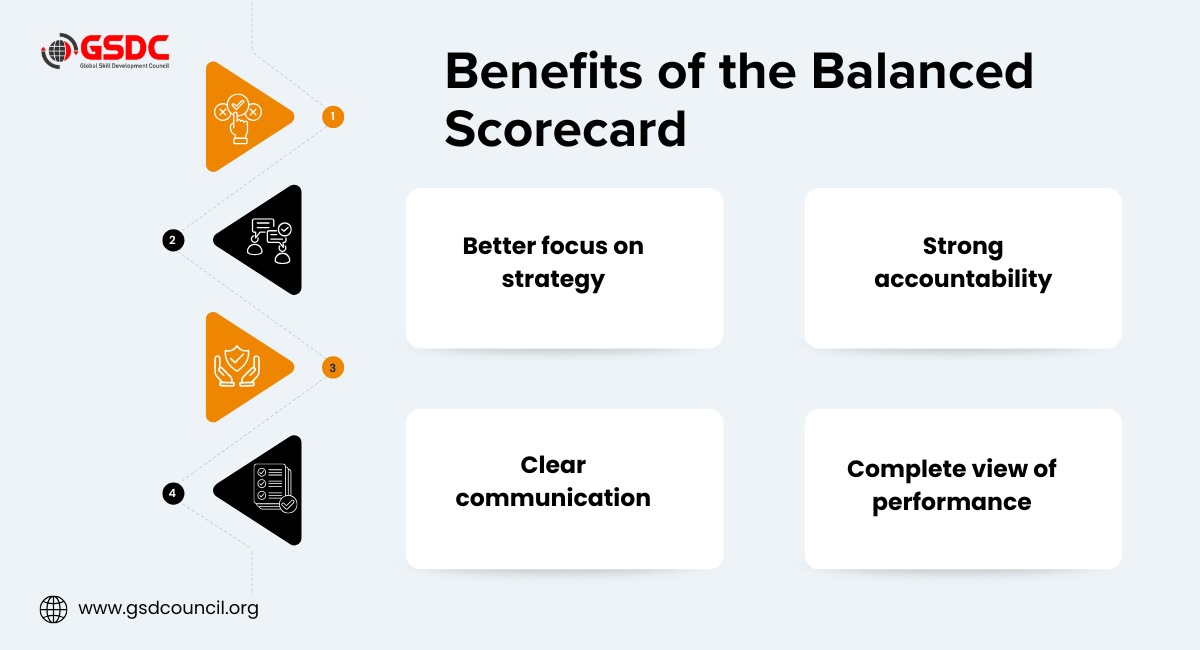
Together, these lessons show that balanced scorecard success comes down to how well organizations align strategy, data, and execution.
Why This Matters
In today’s world, being strategic alone is not sufficient. Most companies have figured out what they need to accomplish, but the tricky part is executing on their plans.
If alignment and progress are not in place, then even the best-laid strategies won’t succeed.
This is exactly where balanced scorecard strategy makes a difference. It brings structure, keeps teams aligned, and ensures that goals are not just defined—but consistently achieved.
Career Relevance: Roles and Salary Insights
With the increasing adoption of this model by many businesses, the demand for balanced scorecard jobs is rising in all areas of strategy and performance management.
Those with the knowledge base for this model usually hold positions like Strategy Manager, Business Analyst, and Performance Management Specialist, whose work impacts company performance and execution.
Job Role | Average Salary (USD) | Typical Range |
$24,000 | $14,000 – $36,000+ | |
$30,000+ | $23,000 – $50,000 | |
$26,000 | $18,000 – $60,000 | |
Business Analyst (Strategy) | $10,000 – $22,000 | Varies by experience |
Operations / Strategy Lead | $18,000 – $36,000 | Varies by industry |
These positions have high earnings, particularly as companies become increasingly concerned with results and execution. That is one reason why obtaining a balanced scorecard certification or a balanced scorecard professional certification could benefit your career and salary levels.
Acquiring Relevant Skills for Balanced Scorecard Strategy Implementation
With more firms embracing the Balanced Scorecard approach, there is a need to shift attention from understanding its definition to implementation.
This is where formal training comes in handy. Institutes such as the Global Skill Development Council (GSDC) provide professional training courses, such as the Certified Balanced Scorecard Professional course, to develop the skills necessary in the execution and implementation of the strategy.
For any person involved in strategy development, operational activities, and leadership in particular, acquiring these skills could be very significant.
Conclusion
The reason why Balanced Scorecard succeeds in its operations is because of addressing the challenge that exists in most businesses – that is, making strategy operational.
With successful implementation, proven success and balanced scorecard examples available, it remains a solid tool for organizations.
In brief, strategy is the plan while execution makes all the difference.

Related Certifications
Frequently Asked Questions
Stay up-to-date with the latest news, trends, and resources in GSDC
If you like this read then make sure to check out our previous blogs: Cracking Onboarding Challenges: Fresher Success Unveiled
Not sure which certification to pursue? Our advisors will help you decide!