Generative AI for ITSM Success: Case Studies and Real-World Impact
Written by Matthew Hale
- Why ITSM Needs a New Approach
- Case Study 1: Improving Knowledge Access With Semantic Search and Self-Service
- Case Study 2: Global Tools Manufacturer – Faster Onboarding, Smarter Support
- Case Study 3: Scaling Support With AI-Driven Virtual Assistance
- Broader Generative AI Use-Cases in ITSM
- Why the Certified Generative AI in ITSM Credential Matters
- Conclusion
ITSM teams don’t fear tough issues; they fear not having the right answer when they need it. Not due to lack of expertise, but because knowledge is scattered across old tickets, runbooks, PDFs, SharePoint folders, and endless chat threads. Even simple problems become slow to solve when information lives everywhere except where it’s needed.
This fragmentation becomes a real risk when speed matters. A basic VPN issue can take 20 minutes, and a priority-one outage can mean digging through multiple tools driving delays, frustration, higher MTTR, and more pressure on the IT service desk.
This is where generative AI transforms the process. Instead of manual searching, generative artificial intelligence connects information instantly, explains solutions in natural language, and guides teams step-by-step to resolve issues faster.
In short: generative AI doesn’t replace the IT service desk—it strengthens it.
Why ITSM Needs a New Approach
To understand the role of AI in ITSM, it helps to look at what modern IT service management teams are dealing with:
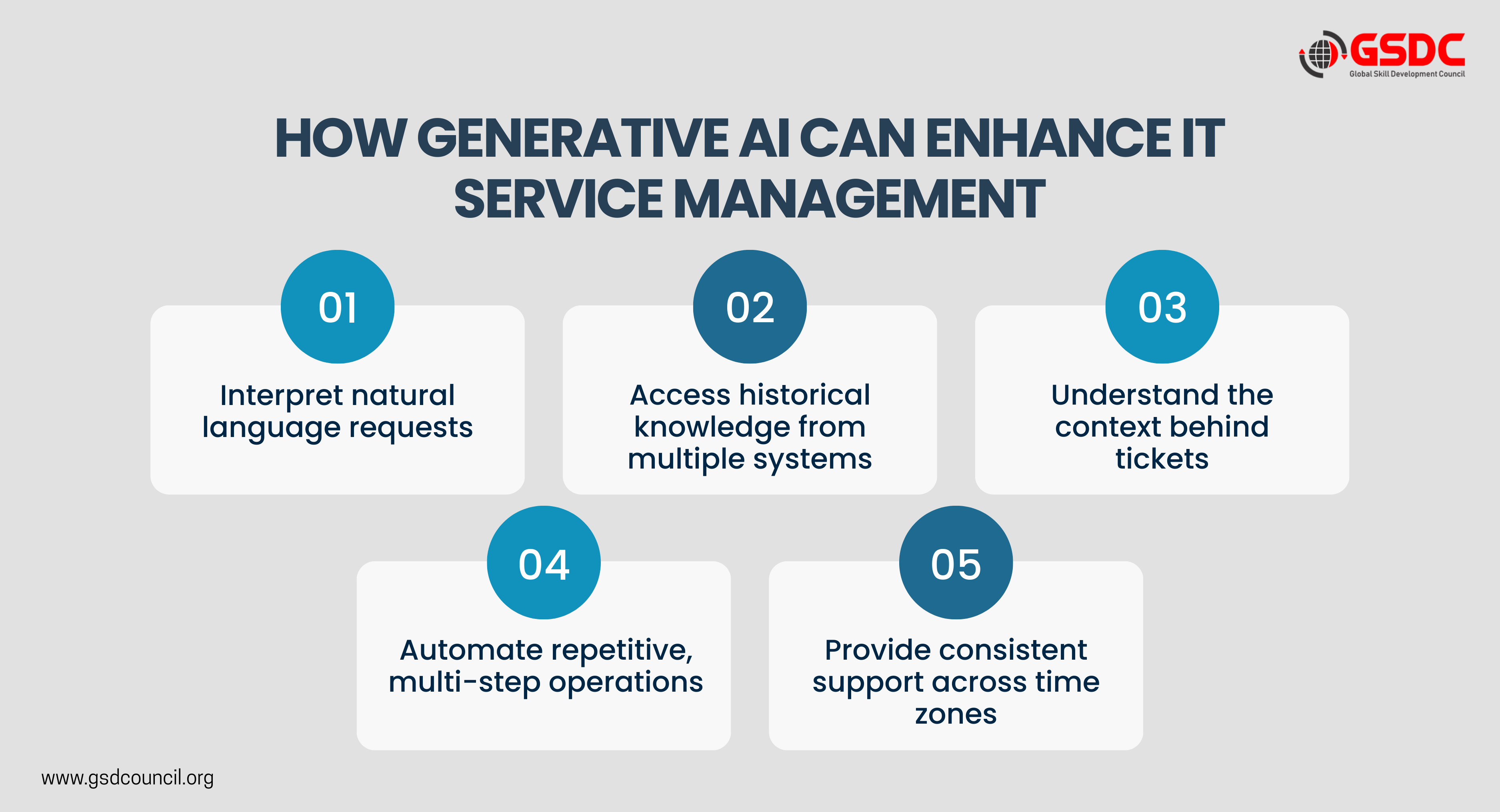
- Exploding ticket volumes: Driven by hybrid work, collaboration apps, and device sprawl
- Globally distributed users: With expectations for instant and personalised support
- Highly complex infrastructure: Cloud, SaaS, APIs, integrations, microservices
- Demand for proactive service: Users want issues resolved before they cause disruption
- Need for 24/7 continuity: Business operations never stop
Traditional ITSM practices-manual triage, static knowledge articles, and keyword search-simply cannot keep up. This is why generative AI in ITSM has become a defining trend.
As adoption grows, many professionals strengthen their basics through the Generative AI Foundation Certification, ensuring they understand generative AI meaning, responsible use, and practical application.
To explore how this looks in real-world scenarios, here are three expanded case studies showing how generative AI is transforming IT operations.
Case Study 1: Improving Knowledge Access With Semantic Search and Self-Service
A major insurance firm partnered with Orion Innovation to address a long-standing obstacle: knowledge scattered across too many systems.
Challenge: The insurer relied on a traditional ITSM platform, but the IT service desk was constantly overwhelmed.
Key problems included:
- Slow incident resolution: Engineers spent 40–60% of their time searching for information
- Outdated knowledge: Many articles hadn’t been reviewed for years
- Poor self-service adoption: Users didn’t trust the portal because search results were inconsistent
- High dependence on L1 agents: Even basic issues require human involvement
Additionally, the organisation had multiple repositories-SharePoint folders, outdated wiki pages, internal chat transcripts containing pieces of knowledge, but nothing was connected.
Solution: Orion Innovation designed a two-layer approach powered by generative AI in ITSM:
1. Semantic Knowledge Search
Unlike keyword search, semantic search understands the intent behind user queries.
- A query like “my laptop won’t connect to the office wifi” automatically maps to specific troubleshooting steps.
- The engine retrieved relevant runbooks, past ticket resolutions, and configuration notes.
- The system could differentiate similar-sounding issues (e.g., Wi-Fi authentication vs. firewall blocks).
2. AI Chatbot for Customer Service
A conversational assistant was added to the self-service portal:
- It guided users step-by-step
- Provided dynamic responses instead of static articles
- Solved common issues without human involvement
- Logged interactions back into the ITSM tool for continuous improvement
Impact:
The results were significant:
- ≈30% increase in IT productivity within the first 90 days
- Reduction in ticket backlog as self-service adoption increased
- Consistent and standardised answers regardless of which engineer handled the ticket
- Improved compliance through automated audit trails and data masking
Takeaway: This case underscores how generative artificial intelligence transforms fragmented knowledge into a unified, accessible asset-leading to faster resolution and reduced stress on the IT service desk.
Download the checklist for the following benefits:
⚡ Grab the Generative AI in ITSM Implementation Guide - totally free!
👇 Download the PDF and start transforming your service desk today.
Case Study 2: Global Tools Manufacturer – Faster Onboarding, Smarter Support
A global manufacturing organisation engaged HCL Technologies to solve a complex and costly challenge: variability in technical knowledge across regions.
Challenge: The company operated dozens of plants worldwide. Each region used a different combination of tools and knowledge repositories. As a result:
- New engineers took months to ramp up
- Ticket responses varied by region, even for identical issues
- Knowledge was duplicated-and sometimes contradictory
- Each plant depended heavily on senior engineers for escalation
- MTTR soared during high-impact outages
The organisation needed consistent, centralised intelligence without restructuring its entire ITSM architecture.
Solution: HCL Technologies implemented a RAG-based generative AI solution that unified knowledge from multiple systems, including:
- KEDB
- SOP documents
- Automated logs
- Historical incidents
- Email resolutions
- Runbooks
- Device configuration notes
How It Worked
- Engineers typed natural-language questions (“Why does machine controller E3 keep failing to restart?”).
- The generative AI engine instantly retrieved relevant past incidents, patterns, and resolutions.
- Engineers received step-by-step guidance with references to specific lines from runbooks.
- Feedback cycles trained the model over time, increasing accuracy.
Impact
- ~20% reduction in MTTR globally
- Over 80% positive feedback on GenAI-driven recommendations
- Huge improvement in onboarding: new engineers reached proficiency 40–50% faster
- Knowledge accuracy increased as outdated content was flagged automatically
- Cross-region support improved through unified guidance
Takeaway: This case demonstrates how AI in ITSM can create consistency across geographies, reduce knowledge silos, and improve operational resilience.
Case Study 3: Scaling Support With AI-Driven Virtual Assistance
High-volume operational environments as retail and food service-depend on fast, reliable IT support. A powerful example is Domino’s Pizza, which operates thousands of stores globally, each dependent on real-time technology.
Challenge
The IT service desk faced:
- Overwhelming volumes of repetitive requests
- Long queues during peak business hours
- High dependency on manual troubleshooting
- Lack of consistency across regions
- Increasing pressure for real-time support
With critical systems like POS, payment gateways, and kitchen devices at stake, delays meant revenue impact.
Solution: To streamline operations, Domino’s implemented a virtual agent powered by ServiceNow.
Capabilities Included:
- Natural language understanding
- Automated troubleshooting workflows (POS freezes, device resets, password resets)
- Intelligent routing when escalation was needed
- Access to real-time configuration and device data
- 24/7 availability with no additional staffing
The virtual agent acted like a digital teammate-handling thousands of repetitive tasks, while human agents focused on complex issues.
Impact:
- Over 50% reduction in live-agent interactions
- Faster response times during peak ordering hours
- Higher satisfaction across store managers and frontline employees
- Greater global consistency in support quality
- Reduced operational cost through automation
Takeaway: This case highlights the power of AI in ITSM when applied to environments where speed, consistency, and scale are critical.
Broader Generative AI Use-Cases in ITSM
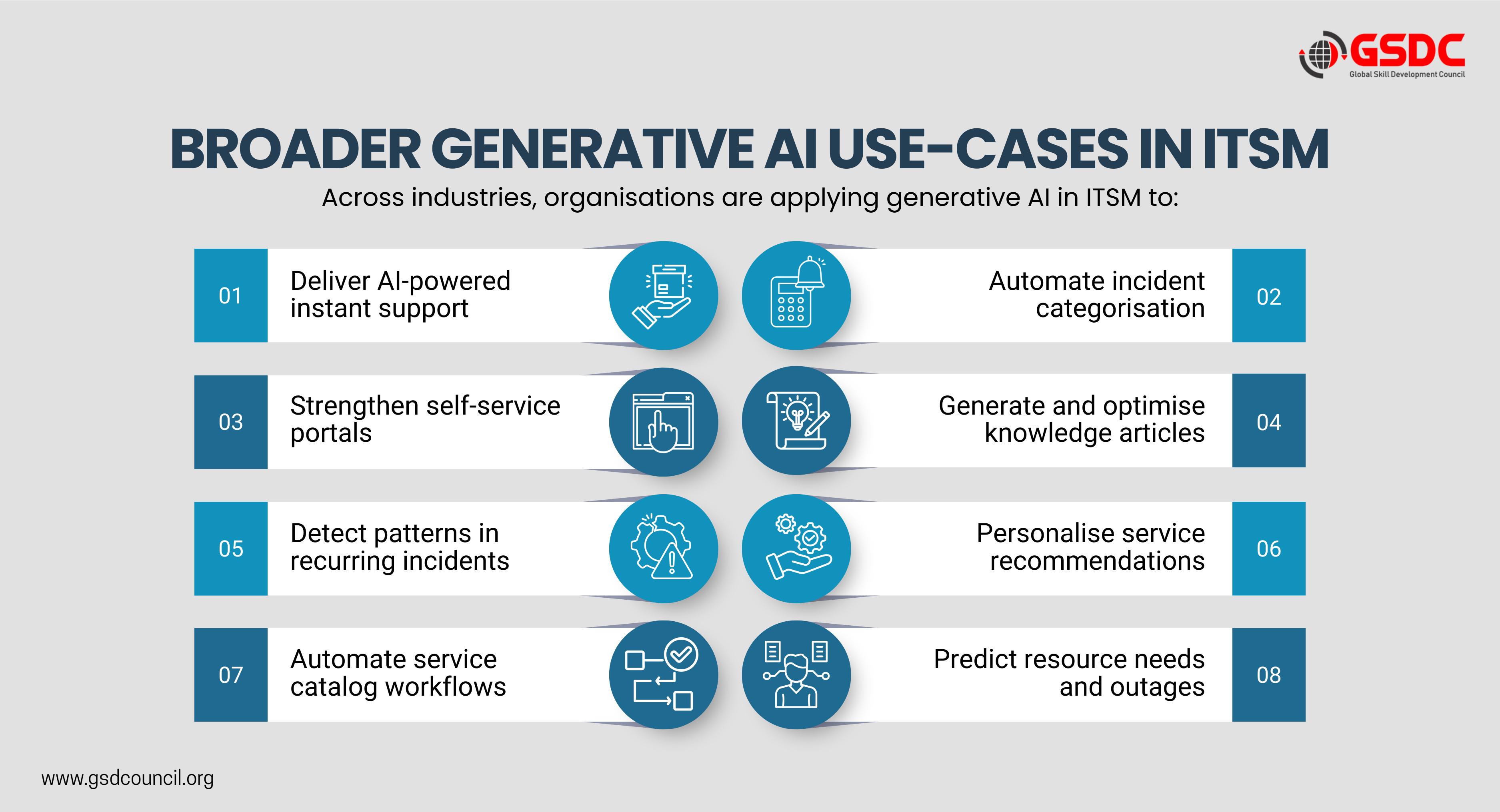 As these use cases mature, bodies like the Global Skill Development Council (GSDC) help shape global standards for ITSM and generative AI skills.
Building Your Generative-AI Powered ITSM Roadmap
A successful strategy for generative AI in ITSM includes:
1. Assess the Current State
Evaluate ticket volumes, MTTR, knowledge quality, onboarding challenges, and self-service adoption.
2. Define Target Outcomes
Be specific: faster resolution? Scaling service desk support? Cost reduction?
3. Organise Knowledge Assets
Clean, tag, and structure KEDB entries, runbooks, incident notes, SOPs.
4. Choose the Right Architecture
RAG models offer grounded, accurate answers built on enterprise data-not hallucinations.
5. Start With a Pilot
A PoC like the one from Orion Innovation can validate early benefits.
6. Build Governance & Risk Controls
Manage access, data privacy, hallucination detection, and compliance.
7. Scale Across ITSM Functions
Extend into change, problem management, DevOps, asset management.
8. Measure, Improve, Repeat
Track MTTR, FCR, satisfaction, self-service usage, and knowledge accuracy.
As organisations scale AI, many professionals pursue the Certified Generative AI in ITSM to align their skills with modern ITSM demands.
A Future-Ready Skillset for ITSM Professionals
To deliver results in an AI-enabled environment, ITSM teams need:
- Understanding of generative AI meaning and ITSM applications
- Ability to maintain accurate, structured knowledge
- Familiarity with AI governance, privacy, and risk
- Skills in analysing ITSM metrics and AI-driven insights
- Hands-on experience with automation and RAG workflows
- Strong change-management capabilities
This combination positions ITSM professionals for the next wave of digital transformation
Why the Certified Generative AI in ITSM Credential Matters
Generative AI is not just a tech-fad is reshaping how IT services are delivered, consumed, and managed. The “Certified Generative AI in ITSM” certification from the GSDC provides a rigorous, structured path to understanding:
- What generative AI means for ITSM and service desks.
- How to map knowledge, processes, and systems for AI-augmentation.
- How to deploy responsibly with governance, risk mitigation, and security baked in.
- How to measure, refine, and scale AI-driven ITSM solutions.
Whether you are an IT service manager, knowledge manager, support engineer, or service-desk lead, earning this certification positions you at the forefront of service-management innovation.
Conclusion
Generative AI is reshaping ITSM, and the results are already here. Case studies from Orion Innovation, HCL Technologies, and Domino’s Pizza reveal meaningful gains-from faster MTTR to smarter self-service and more accurate support.
GenAI isn’t replacing the service desk; it’s elevating it.
Those who embrace strong governance, processes, and skills now will lead the next wave of ITSM performance.

Related Certifications
Stay up-to-date with the latest news, trends, and resources in GSDC
If you like this read then make sure to check out our previous blogs: Cracking Onboarding Challenges: Fresher Success Unveiled
Not sure which certification to pursue? Our advisors will help you decide!