Guide for Chief Learning Officers to Build Learning Cultures
Written by Emily Hilton
Did you realize how rapidly everything at the workplace is changing skills, systems, and even whole job roles? In a scenario like this, the traditional training programs or annual workshops would not work anymore. Instead, what organizations genuinely require is a culture that is curious, experimental, and continuously learning.
And so, the Chief Learning Officer fits right into the picture. If you have ever asked yourself what a what is a Chief Learning Officer, consider them as the learning architects the ones orchestrating the people's transformation, retraining, and preparation for the future.
No matter if you are looking into this position for yourself or even thinking about the certification of a Chief Learning Officer, this guide will lead you through the ways of today’s CLOs who create learning cultures that are sources of innovation, flexibility, and everlasting success.
Understanding What a Learning Culture Truly Means
Before creating a learning culture, CLOs have to articulate it clearly first. A learning culture is a concept that spans far beyond the organization’s training program, it is more about making continuous learning the main attribute of the organization. It fosters curiosity, self-directed learning, exchanging feedback, and accepting mistakes as a part of the learning process.
Compared to conventional training, learning cultures not only allow but also encourage daily quests for knowledge and an all-time accessibility to it. This attitude gives birth to both innovation and steadfastness, particularly within the context of the ongoing changes in technology and business models. Savvy chief learning officers of the future understand that their duty is not to control training but to facilitate the creation of an environment where learning occurs naturally at all levels.
You have to read Learning and Development: Insights for deeper understanding to follow the trail of the modernization of learning being done by the modern organizations.
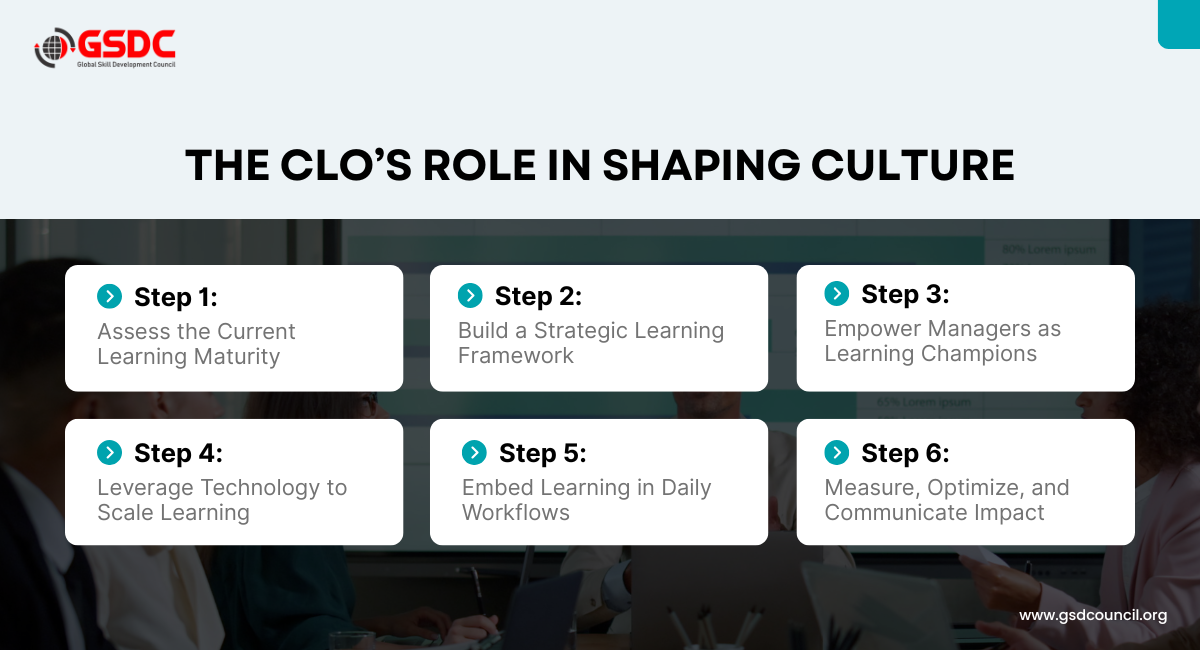
The CLO’s Role in Shaping Culture
 The role of a Chief Learning Officer has evolved dramatically in the last decade. It’s no longer limited to overseeing learning programs or compliance training. Today’s CLOs are strategic business partners who align learning with performance outcomes and corporate vision.
If you’re wondering what does a Chief Learning Officer do, the answer lies in integration connecting the dots between leadership, data, and employee capability. A skilled CLO fosters psychological safety, promotes collaboration, and ensures that learning is tied to organizational purpose.
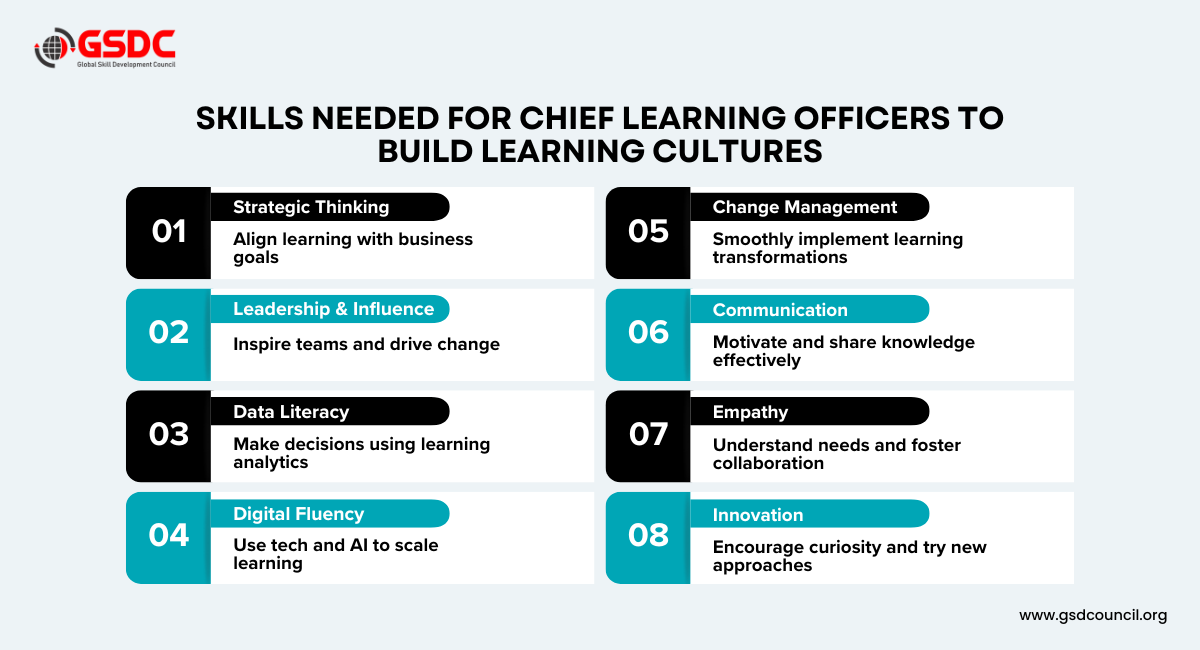
Modern Chief Learning Officer responsibilities include talent analytics, leadership development, digital learning strategy, and cross-functional collaboration. To perform these effectively, one must master essential Chief Learning Officer Skills like strategic thinking, data literacy, empathy, and technological fluency.
Step 1: Assess the Current Learning Maturity
Every great learning culture begins with honest evaluation. CLOs should start by assessing their organization’s learning maturity how learning currently happens, where it’s succeeding, and where it falls short.
This means running a learning culture audit, analyzing participation rates, engagement data, and content utilization. Tools like L&D analytics dashboards can reveal which teams are engaging most with learning opportunities and which remain passive.
Comparing your organization’s practices with frameworks such as the 70-20-10 model or ISO 30401 (Knowledge Management Standard) can give valuable benchmarks. This process helps CLOs move from assumptions to evidence the foundation of any effective strategy.
Step 2: Build a Strategic Learning Framework
Once assessment is complete, the next move is building a strategic learning framework aligned with business goals. A successful chief learning officer connects learning initiatives directly to measurable business outcomes such as productivity, innovation, and retention.
For those asking what is a Chief Learning Officer’s core function, this is it designing systems that translate learning into performance. Establish clear governance, define accountability, and ensure that leaders understand the strategic importance of learning.
Incorporate blended learning models, corporate academies, and role-based learning journeys. Many organizations like Microsoft and IBM have built internal “AI learning academies” to continuously upskill employees for future roles.
A Certified Chief Learning Officer often teaches these frameworks, enabling professionals to transform learning from an HR function to a business growth driver. You must go through GSDC’s certification for better understanding.
For further context, see Learning and Development Trends that shape modern upskilling frameworks.
Step 3: Empower Managers as Learning Champions
No culture can thrive if learning is siloed within HR. Managers play a vital role as micro-CLOs who shape the day-to-day learning environment.
CLOs should train managers to recognize learning moments in performance discussions, encourage knowledge sharing, and support learning goals in one-on-ones. Recognition systems that celebrate skill mastery, peer mentoring, and project-based learning make a big difference.
Empowering managers builds psychological safety and encourages continuous improvement. It also enhances collaboration a critical skill in hybrid and AI-driven work environments.
Step 4: Leverage Technology to Scale Learning
Technology is the CLO’s most powerful ally. Through learning experience platforms, CLOs can track progress, recommend content, and predict future skill needs using AI-based analytics. Integrating this with performance management systems ensures that learning is not an isolated activity but a seamless part of everyday work.
Modern Chief Learning Officer responsibilities include evaluating such tools and using analytics to make data-driven learning decisions. By using AI to curate relevant content, CLOs can make learning adaptive and predictive ensuring people learn exactly what they need, when they need it.
Step 5: Embed Learning in Daily Workflows
The next step is to make learning invisible yet impactful. Embedding learning in the flow of work means employees don’t have to step out of their day-to-day tasks to learn something new.
Learning nudges via Slack, Teams, or project management tools remind employees to practice micro-skills regularly. Peer learning, mentoring circles, and internal knowledge communities also help sustain engagement.
Step 6: Measure, Optimize, and Communicate Impact
Measurement is where strategy meets accountability. To sustain executive support, CLOs must tie learning outcomes to business results.
Key metrics can include engagement rates, completion ratios, skill adoption, and performance improvement. But true success lies in connecting these metrics with revenue growth, retention, and innovation.
If you’re curious about Chief Learning Officer salary ranges, remember that CLOs who can prove measurable impact through analytics and leadership influence tend to earn significantly higher packages often comparable to other C-suite leaders. As per report for the U.S. shows the average salary for a CLO is about US $273,419/year, with a typical range from ~$205,065 to ~$374,487.
For context, see Learning and Development Specialist Salaries to compare how CLO roles align with broader L&D compensation trends.
Overcoming Cultural and Organizational Barriers
 Even the best frameworks face obstacles. Some teams resist change, while others doubt the ROI of continuous learning. To overcome this, CLOs must build credibility through pilot projects and storytelling.
Start small: create a visible success story, such as a department that improved customer satisfaction through microlearning. Once results are clear, scale the approach across business units.
Chief learning officer’s should also ensure senior leadership advocates for learning. When executives model curiosity and skill development, employees follow suit. The CLO’s challenge is to turn learning from a “program” into a shared organizational value.
Download the checklist for the following benefits:
Get your hands on the CLO Blueprint and start applying proven strategies instantly.
Empower your organization to learn and grow! 💡
How Certified Chief Learning Officer Help Here?
The Chief Learning Officer Certification by GSDC brings up personnel with competencies and skills that can move learning and development strategies in organizations.
The Chief Learning Officer Certification program covers the Chief Learning Officer's main duties, L&D planning methods, and talent development systems.
Professionals will be able to increase their leadership credibility, deliver quantifiable learning outcomes, and align learning programs with the overall business objectives.
They will be participating in a cultural transformation toward a 'learning is your ego' mindset and therefore will be able to occupy the highest positions in that area of Chief Learning Officers.

Future Outlook: CLO as Culture Architect and AI Strategist
The future will be dictated by CLOs who merge technological foresight with human empathy. With the advent of AI and automation, the Chief Learning Officer's skills will need to change to data interpretation, AI literacy, and strategic communication.
CLOs of the future will be the ecosystem orchestrators who will be able to easily and quickly connect people, platforms, and insights to predict and prepare for skill gaps and thus to realize their emergence. So, in a way, the CLO becomes not only a learning leader but also a culture architect who fuels innovation and adaptability.
The ones who take a Chief Learning Officer certification now will be the ones to lead the companies in the transition for AI, skill democratization, and learning systems with agency, among others.
For a wider view of the career, have a look at Learning and Development Roles shaping the next generation of CLO pathways.
Moving Forward: Building a Self-Sustaining Learning Culture
Building a thriving learning culture isn’t a one-time project — it’s an ongoing movement. For any CLO, the roadmap is clear: assess → design → empower → scale → measure.
Whether you’re aspiring to this position or already serving as one, understanding what does a Chief Learning Officer do in today’s world means more than leading L&D it’s about shaping an adaptive, growth-centered organization.
As business models evolve, the Chief Learning Officer remains the guardian of curiosity, capability, and culture ensuring that learning is not just an activity but the heartbeat of transformation.

Related Certifications
Stay up-to-date with the latest news, trends, and resources in GSDC
If you like this read then make sure to check out our previous blogs: Cracking Onboarding Challenges: Fresher Success Unveiled
Not sure which certification to pursue? Our advisors will help you decide!