HR Analytics: How to Strengthen Your HR Role Through Insights
Written by Matthew Hale
- What Is HR Analytics and Why It Matters
- Core Skills Every HR Professional Should Develop
- Key Tools and Techniques for HR Analytics
- The Role of HR Analytics in Digital Transformation
- Turning Knowledge Into Impact
- Applying Analytics to Real HR Challenges
- Emerging Trends in HR Analytics
- Conclusion: Turn Data into Decisions
HR has always been about people - understanding what motivates them, helping them grow, and ensuring they thrive in the workplace. But in today’s business landscape, understanding people isn’t enough on its own. The ability to turn workforce data into actionable insights has become just as critical. The global HR analytics market, valued at USD 2.96 billion in 2022, is expected to reach USD 8.59 billion by 2030, growing at a CAGR of 14.8% - a reflection of how essential data-driven decision-making has become for HR.
For professionals already experienced in HR, analytics is not about starting over; it’s about taking the next step. It’s about seeing patterns before problems arise, predicting outcomes rather than reacting to them, and aligning people's strategies with organizational goals. By combining human understanding with data insight, HR analytics allows leaders to turn everyday workforce information into strategic decisions, making HR not just a support function, but a true driver of business success.
What Is HR Analytics and Why It Matters
HR Analytics involves gathering, analyzing, and interpreting workforce data to make informed HR and business decisions. It transforms everyday employee information - including performance, turnover, and engagement metrics - into actionable insights.
Why It Matters:
- Employee data is linked in a very clear way to company objectives and results of performance.
- The system allows HR decisions based on evidence to be taken, whereas before it was assumed that decisions were made by mere assumptions.
- It pinpoints the issues of recruitment, retention and productivity to have a better forecast of these aspects.
- Advanced metrics acts as a bridge between business intelligence and human resources, thus forming a base for strategic expansion.
- This practice strengthens the term "data-driven" which is very necessary for the existence of a culture of enhanced inclusion and are common denominators in all spheres of the organization.
Core Skills Every HR Professional Should Develop
As HR becomes increasingly analytical, professionals must balance people expertise with data fluency. Developing these skills allows HR leaders to connect workforce insights to tangible business outcomes.
Key HR Analytics Skills
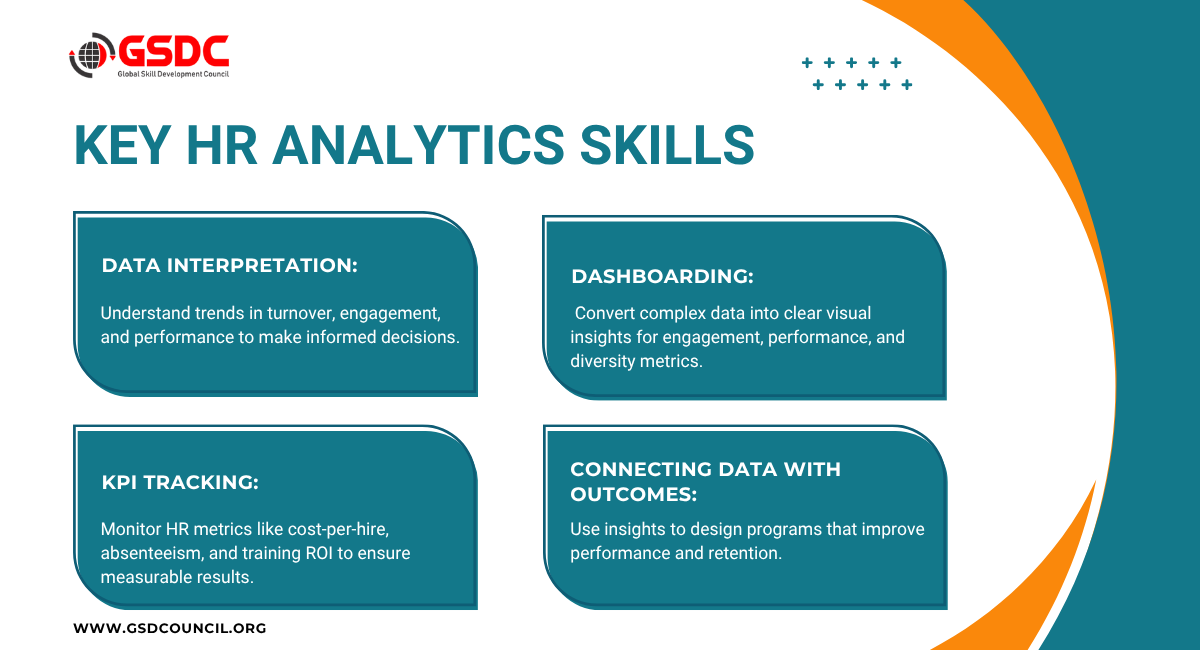
- Data Interpretation:
The ability to interpret workforce data allows HR professionals to uncover patterns in turnover, engagement, or performance. For example, one study reports that companies using advanced people analytics saw up to a 25% increase in productivity and as much as a 50% reduction in attrition.
Understanding the “why” behind the numbers helps make proactive, informed decisions that improve retention and employee satisfaction.
- Dashboarding:
Visualization tools enable HR professionals to transform complex data into simple, actionable insights. Dashboards that track engagement, performance, or diversity metrics help business leaders track progress and identify improvement areas. According to a recent review, fewer than 10% of organizations regard their analytics capability as strong.
- KPI Tracking:
Monitoring HR metrics and KPIs - such as cost‑per‑hire, absenteeism, training ROI, and employee engagement - ensures that strategies are measurable and impactful. Research shows that workforce planning solutions alone are expected to grow from USD 0.73 billion to USD 2.48 billion, highlighting the increasing emphasis on measurable outcomes in HR.
- Connecting Data With Outcomes
Linking workforce insights to business results is critical. For example, analyzing engagement and productivity together can help HR design programs that boost performance while reducing attrition - delivering measurable organizational impact rather than just reporting statistics.
For professionals looking to strengthen these skills and apply them strategically, programs like Certified HR Analytics 3.0 provide structured learning, practical frameworks, and real-world case studies to transform data into actionable business insights.
Key Tools and Techniques for HR Analytics
Mid-level HR professionals already leverage digital tools daily, but refining analytical expertise requires understanding how to extract deeper insights.
Essential Tools:
- Excel: It is the basic tool for structuring, purifying, and scrutinizing employee data. The use of PivotTables and Power Query thus becomes very efficient for quickly discovering patterns.
- Power BI: The need of the hour is interactive dashboards and this is what Power BI provides for HR metrics. Not only do they show HR metrics in real-time but also integrate various HR systems for easy KPI tracking.
- Tableau: This software is capable of creating user-friendly dashboards that help in understanding the performance, engagement, and diversity trend of the workforce.
- HR Dashboards: These are the data aggregators that bring together different streams of data, thus, providing a complete picture of workforce health and productivity.
Advanced Techniques:
- Predictive HR Analytics: These are the tools used to anticipate scenarios like the risk of employee turnover or the need for new hiring in the future.
- Workforce Planning: This is the process of matching workforce supply with demand. Through it, one can analyze skill gaps and trends in retirement to figure out that the right people have the right jobs at the right time.
Such instruments and methods not only raise the HR level of the routine reporting function but also make HR a strategic partner, thus, giving the possibility of proactive and evidence-based workforce decisions.
With GSDC, HR leaders can turn analytical expertise into measurable business impact.📥 Download the HR Analytics Starter Kit
The Role of HR Analytics in Digital Transformation
HR analytics is a critical enabler of digital transformation, aligning people, technology, and business strategy. It shifts HR from operational management to strategic influence.
- Strategic Workforce Planning: Predict talent needs, recognize skill shortages, and use workforce strategy to support business goals.
- Performance Optimization: Locate high performers, monitor engagement, and execute solutions that increase productivity.
- Talent Acquisition: Assess candidate quality, forecast success rates, and optimize recruitment strategies.
- Learning & Development: Calculate training ROI, customize programs, and ensure learning is aligned with business objectives.
- Retention & Engagement: Identify turnover risks, revealing disengagement patterns, and implementing retention strategies.
- Diversity & Inclusion: Monitor representation, pay equity, and promotion trends for fair HR practices.
- Decision Enablement: Real-time dashboards give leaders the power to make informed, data-backed decisions.
HR analytics ensures digital transformation is data-driven, where every decision contributes to measurable business impact.
Turning Knowledge Into Impact
Formal training helps HR professionals turn analytical understanding into tangible results. It sharpens data interpretation, deepens knowledge of HR metrics, and builds confidence in tools like Power BI, Tableau, and workforce analytics platforms.
Through case-based learning, professionals learn to:
- Translate workforce data into actionable strategies
- Apply predictive analytics to anticipate trends in hiring or retention
- Develop dashboards that inform strategic decisions
Building Credibility and Career Growth
Earning this certification demonstrates the ability to leverage data for strategic HR decisions, enhancing credibility and positioning professionals for leadership in analytics-driven HR.
Applying Analytics to Real HR Challenges
HR analytics is a practical tool for tackling persistent HR issues:
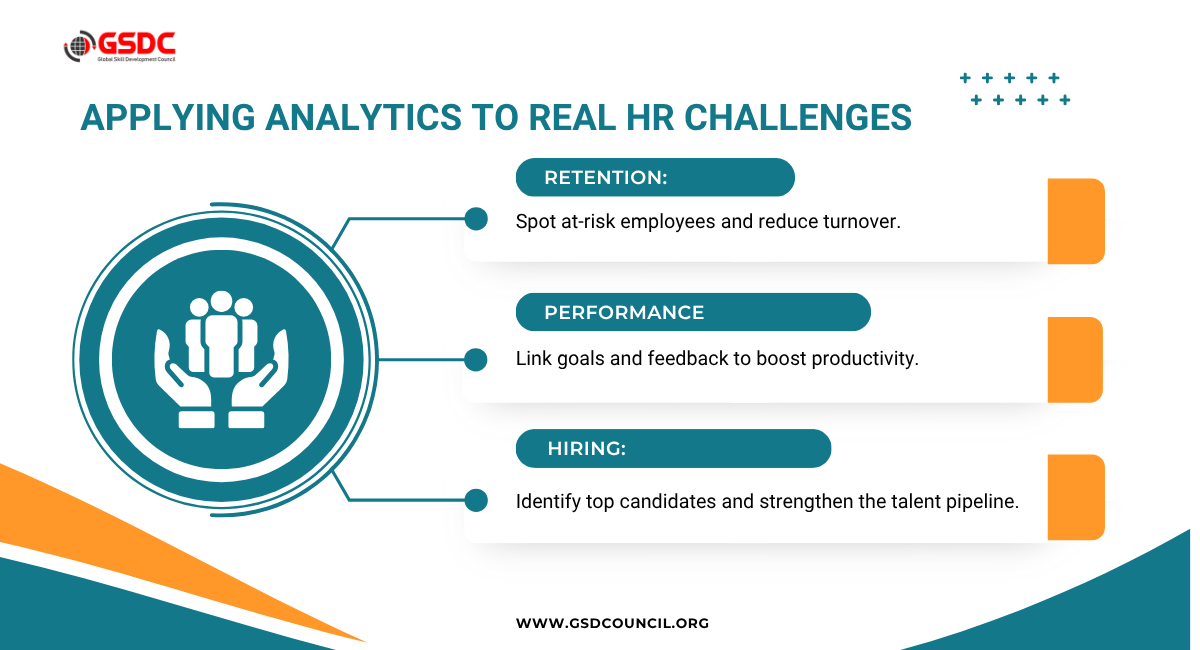
- Retention: Predictive analytics identifies employees at risk of leaving, allowing proactive retention interventions. Dashboards tracking tenure, promotion gaps, and engagement scores highlight flight-risk segments, reducing turnover costs and productivity disruption.
- Performance: Employee performance analytics link goal completion, learning uptake, and peer feedback to business outcomes. Insights drive targeted interventions, boosting productivity and engagement.
- Hiring: Data-driven recruitment evaluates past hire performance, turnover patterns, and source effectiveness. Predictive models highlight candidate profiles most likely to succeed, improving quality of hire, onboarding efficiency, and talent pipeline strength.
Using HR analytics demonstrates measurable business value - from reduced attrition and improved performance to smarter hiring decisions that strengthen organizational outcomes.
Emerging Trends in HR Analytics
HR analytics is becoming more and more sophisticated as it shifts from descriptive reporting to predictive and strategic foresight.
Major Changes to Monitor:
- AI-Powered Decision-Making: For example, AI can accurately predict attrition, quantify engagement, and even forecast skill requirements.
- Predictive Workforce Planning: They can predict hiring needs, monitor remotely working teams, and use talent strategy to support the business plan.
- Experience-Driven Analytics: Implementing data-driven approaches to employee health, motivation, and performance.
- Skills Intelligence: Identify the skills of the workforce to meet the business goals rather than linking them to a job.
- Ethical Analytics: Upholding the privacy and security of the data as well as responsible usage of it, when analytics becomes the core of the HR strategy.
These trends demonstrate how data-driven HR is becoming more and more predictive, people-centered, and strategically important, thus, professionals will be ready to lead digital transformation initiatives.
Certified HR Analytics 3.0 - For Data-Driven HR Leaders
The Certified HR Analytics 3.0 program by GSDC equips HR leaders to link insights with business outcomes. By combining analytical techniques with strategic workforce planning, it prepares professionals to drive HR transformation in a digital era.
Conclusion: Turn Data into Decisions
HR analytics bridges people's insights and business strategy. Professionals at the intermediate level have a unique opportunity to lead digital HR transformation, using data to drive measurable organizational impact.
By leveraging analytical tools, dashboards, and structured learning through programs like HR Analytics Certification Online, HR teams can implement data-driven practices that enhance retention, productivity, and workforce planning.
Leaders who integrate analytics into everyday decision-making create a more agile, insight-led HR function - where intuition is guided by evidence, and every strategy delivers measurable results.

Related Certifications
Stay up-to-date with the latest news, trends, and resources in GSDC
If you like this read then make sure to check out our previous blogs: Cracking Onboarding Challenges: Fresher Success Unveiled
Not sure which certification to pursue? Our advisors will help you decide!