Top Performance & Competency Interview Questions for 2026 Careers
Written by Matthew Hale
Modern organizations no longer evaluate performance by results alone. They focus on how results are achieved. That’s why top competency-based interview questions have become a standard part of HR, L&D, and leadership interviews.
Companies adopting a competency-based performance management system want professionals who understand behaviors, fairness, development, and long-term capability building. Knowing definitions is not enough-interviewers expect structured, practical answers.
This guide brings together essential performance & competency interview questions and answers to help you prepare with confidence for 2026 career opportunities.
Who Should Read This?
- HR professionals and HRBPs
- Learning & Development specialists
- Talent and OD professionals
- Line managers involved in appraisals
- Professionals planning a performance and competency career
- Aspiring certified performance consultants
What the Guide Covers
This guide includes 30 core performance and competency interview questions, along with an extended toolkit of 50+ questions and answers covering leadership, change culture, and advanced real-world applications.
What Is Competency in Performance?
Competency in performance refers to the skills, knowledge, behaviors, and attitudes that enable individuals to achieve results effectively.
In a competency-based performance management system, employees are assessed on:
- What they deliver (results)
- How they deliver it (behaviors)
This approach brings clarity, consistency, and fairness to performance evaluations.
Why Competencies Are Important
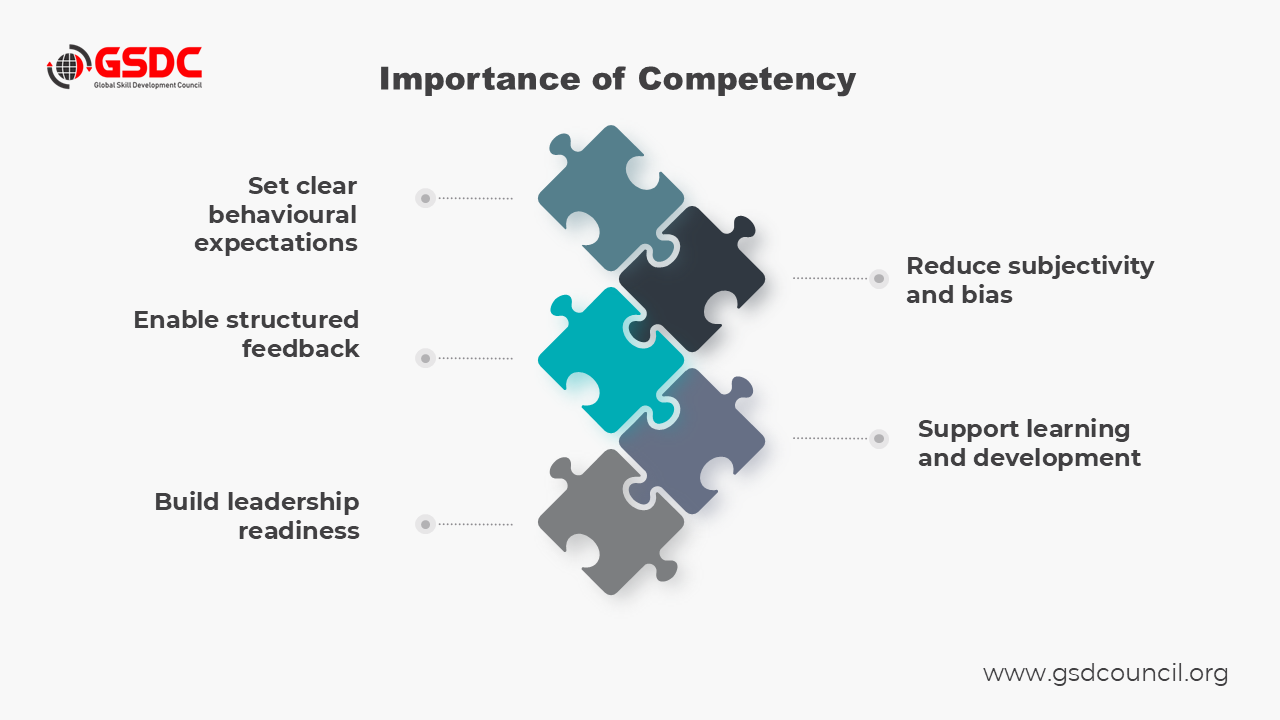
- Set clear behavioral expectations by defining how employees are expected to perform, not just what they must achieve
- Reduce subjectivity and bias through standardized, observable criteria that ensure fair evaluations
- Enable structured feedback by giving managers a consistent framework for meaningful performance discussions
- Support learning and development by clearly identifying skill gaps and guiding targeted improvement plans
- Build leadership readiness by developing behaviors essential for managing complexity and change
Competencies help organizations sustain long-term performance by strengthening capability, consistency, and accountability-not just short-term results.
Download the checklist for the following benefits:
Get easy answer frameworks, sample responses, and behavior cues you can use right away 🎯
Prep smarter and walk into your next interview with total confidence 🚀
Top Competency-Based Interview Questions & Answers
Foundational-Level Questions
1. What is performance management?
Performance management refers to a continuous process by which expectations are set, progress is checked, feedback is given, and development is supported to make sure that the individual's performance is in line with the organizational goals and assures long-term success.
2. What is competency in performance management?
It is the mention of a person's skills, knowledge, and the required behaviors the employees have to demonstrate while the results are achieved. Moreover, the statement explains that the work is done not the results only.
3. Why are competencies important in performance evaluation?
On the one hand, competencies maintain the required criteria for the evaluation and thus add to the evaluation's reliability. On the other hand, these criteria are standards through which the evaluator observes the employee's behavior, thus lowering the possibility that the evaluation will be biased. In addition, competencies give managers guidelines that allow them to judge the performance of their subordinates more objectively.
4. What is the difference between performance goals and competencies?
On the one hand, performance goals reveal what has to be achieved. On the other hand, competencies tell what employees are expected to do and how in order to achieve the goals efficiently.
5. What are performance-based competencies?
These are essentially characteristics expressed through the behavior of the person-and the examples could be such as communication, being accountable, co-operating, or deciding-which have direct influence upon the job and its results.
6. How do competencies support employee development?
They reveal the employee's abilities and also the areas where the employee is weak. These competencies then become the basis for personalized learning plans for the employees' career development through structured and measurable development trajectories.
7. What role does feedback play in competency-based performance management?
It gives through the feedback the emphasis that is needed to the most wanted characteristics, amends the gaps between the performance levels, plus it affords the service of the continuous improvement practice that, according to the employees, has to be related to the competencies given.
8. How do behavioral competencies influence performance
These are the types of behaviors that might be described as mutual help, taking on the changing situation, or trying to find an answer. Ultimately, they help to improve the teamwork, the productive use of time, and the general quality of work, which in turn leads to more stable results.
9. How do competencies improve fairness?
They lay out clear and uniform standards against which judgments will be made. At the same time, they cut down on the subjective judgment of assessors and make sure that stages in the assessment process and people being assessed will be treated equally, regardless of the different jobs or teams.
10. How do competencies align performance with business goals?
Employee competencies are associated with the company's goals; therefore, ensuring that the employees' behavior continues to be in line with the requirements of the business and consequently leads to the realization of the set targets.
Performance & Competency Interview Questions – Application Level
11. How do you design a competency-based performance management system?
One creates such a system by first identifying different competencies for each role that are in line with the overall business goals, then by setting objective metrics, training managers, and making sure continuous feedback and review cycles are in place.
12. How are competencies identified for roles?
The competency identification process includes aspects like job analysis, dialogues with stakeholders, studying top performers, aligning with the organizational strategy, and looking forward to the future.
13. How is fairness ensured in evaluations?
Fairness is achieved through well-established competencies, clear rating scales, multiple sources of evidence, and trained evaluators who are aware of personal bias and try to avoid it.
14. How do you manage underperformance using competencies?
The method includes, first of all, pinpointing specific areas where the employee lacks certain competencies, next giving targeted feedback, finally drawing up development plans and monitoring the employee's progress over time.
15. How are goals aligned with competencies?
The organization derives its goals from the strategy, and the competencies represent the required behaviors to perform the jobs both effectively and consistently.
16. How are performance-based competencies assessed?
Performance-based competencies may be evaluated through direct observation of behavior, structured feedback, performance assessments, along with supporting data that is linked to outcomes.
17. How is development measured?
First, development is measured through close monitoring of competency levels, then by using performance outcome indicators, and finally by readiness for higher roles.
18. What role do managers play?
Managers have the duty of being both coaches and evaluators: on one hand, they provide feedback and reinforce expected behaviors; on the other, they support employee development.
19. How are learning programs aligned with competency gaps?
Learning programs would be created after the gap assessment, with a clear link between learning and measurable improvements in competencies and performance.
20. How do competency frameworks reduce bias?
They lower bias risks in that they determine evaluation based on a set of criteria that are observable and verifiable, thus eliminating the evaluator's personal opinions and assumptions.
Advanced Performance & Competency Interview Questions
21. How does a competency-based performance management system support strategy?
This system ensures that the capabilities of the workforce are in line with the strategic objectives by facilitating the planning of the workforce, the development of the leadership, and the readiness for succession of the roles that are of most impact.
22. What challenges arise during implementation?
Among the challenges that are normally met, there is resistance to change, ill-defined competencies, disregarding the application, and a scarcity of managers who are capable.
23. How are competency frameworks kept relevant?
The relevance of the competency framework is maintained through regular review and update, which are always in line with the shifting business priorities, job requirements, and trends in the industry.
24. How does competency management support succession planning?
By doing so, it helps to find talents with high potential, know their level of readiness, and give a hint of their development needs for leadership positions in the future.
25. How does data improve performance and competency management?
By providing data on trends, gaps in capabilities, and the patterns of performance, data becomes a tool for informed decisions and continuous improvement.
26. What defines success in competency-based performance systems?
The main success features in such systems are better performance results, fewer skill gaps, more solid leadership pipelines, and higher employee engagement.
27. How is change managed during system transformation?
The process of managing change during system transformation involves different means, such as communication that is clear communication, training that is targeted training, leadership that is supported by sponsorship, and rollout that is phased and well-supported.
28. How does competency management build culture?
By doing so, the firm also features the traits of being accountable, being open to learning, and having uniform behavioral standards that, in turn, form a strong culture of performance-driven that is typical for the organization.
29. How does a certified performance consultant use competencies?
Competencies are employed by a performance consultant who is certified as a means to pinpoint problems relating to performance, create structured frameworks, and suggest strategies for improvement that are supported by data.
30. Why is performance and competency management a future-ready career?
What organizations increasingly need is reliable execution of work, good treatment of employees, and a ready workforce, which are essential features of competency management to be able to adapt to the constant change.
Performance & Competency Certification Advantage
Formal certification validates expertise in competency-based performance management systems, performance-based competencies, behavioral evaluation, and performance consulting.
The Global Skill Development Council (GSDC) Certified Performance & Competency Developer (CPCD) supports professionals seeking to grow into senior HR, performance management, and certified performance consultant roles by strengthening strategic and execution-focused capabilities.
Conclusion
Competency-based interviews assess your thinking, structure, decision-making maturity, and alignment with organizational values. Mastering top competency-based interview questions, understanding why competencies are important, and preparing clear, behavior-focused answers gives you a substantial competitive advantage.
Remember, interviewers aren’t only evaluating what you know-they’re assessing how you apply it in real situations. Your ability to articulate competencies, link them to outcomes, and demonstrate reflective learning can set you apart from other candidates.
Use this guide to practice thoroughly, refine your approach, and walk into your next interview confident, clear, and fully prepared to showcase your capabilities.

Related Certifications
Stay up-to-date with the latest news, trends, and resources in GSDC
If you like this read then make sure to check out our previous blogs: Cracking Onboarding Challenges: Fresher Success Unveiled
Not sure which certification to pursue? Our advisors will help you decide!