How AI for ITSM Helps Teams Work Faster, Reduce Rework
Written by Matthew Hale
- What Is AI for ITSM?
- What Is Generative AI in ITSM?
- Why Do IT Teams Struggle With Repetitive Tasks?
- How AI for ITSM Improves Efficiency in IT Operations
- How Does Generative AI in ITSM Work?
- How AI Reduces Repetitive Tasks for IT Teams
- Is AI Replacing IT Teams?
- The Future of Generative AI in ITSM
- Developing the Skills Needed for AI-Enabled ITSM
- Final Thoughts
The goal of today’s IT departments is to respond faster, spend less time on repetitive work, and make IT operations smoother. However, for many companies, this is still a goal and not a reality. Most of the IT work is consumed by responding to repetitive service requests, categorizing tickets, and resolving frequent issues. Manual processes cause service delays and additional pressure on support personnel, thereby postponing the window of value-added activities.
The growing digital workspace and increasing user demands mean that traditional IT service management is no longer sufficient. This is where AI for ITSM begins to transform the IT experience. With AI-powered solutions, doing mundane IT work becomes easier, service delivery gets better, and IT teams have more time for more valuable projects.
So how does this work in practice? What role do AI technologies, including Generative AI in ITSM, play in modern IT service management, and how can IT teams use them effectively?
What Is AI for ITSM?
AI for ITSM, in simple words, is all about leveraging artificial intelligence to make IT service management more seamless. It involves offloading some of the hard work from humans to computers to make IT teams deal with requests and issues in a more intelligent manner.
Using AI, teams can better understand what users want, route tickets automatically, identify potential issues before they become major ones, and perform simple tasks without involving humans. Most ITSM solutions already incorporate AI to enhance the performance of the service desk. When people ask which is the best AI for ITSM, it depends on how well it integrates with the existing environment.What Is Generative AI in ITSM?
Generative AI in ITSM is all about leveraging the latest and greatest AI models to generate human-like responses that can help with IT service management. Unlike traditional AI, which is largely limited to sorting things out or making predictions, generative AI can answer IT-related questions in simple English, provide solutions, generate knowledge content, and summarize problems.
To understand this better, it helps to know what generative AI technology is. It generates new content based on patterns learned from data. In ITSM, this means improved self-service and increased productivity for IT teams because it reduces manual labor.Why Do IT Teams Struggle With Repetitive Tasks?
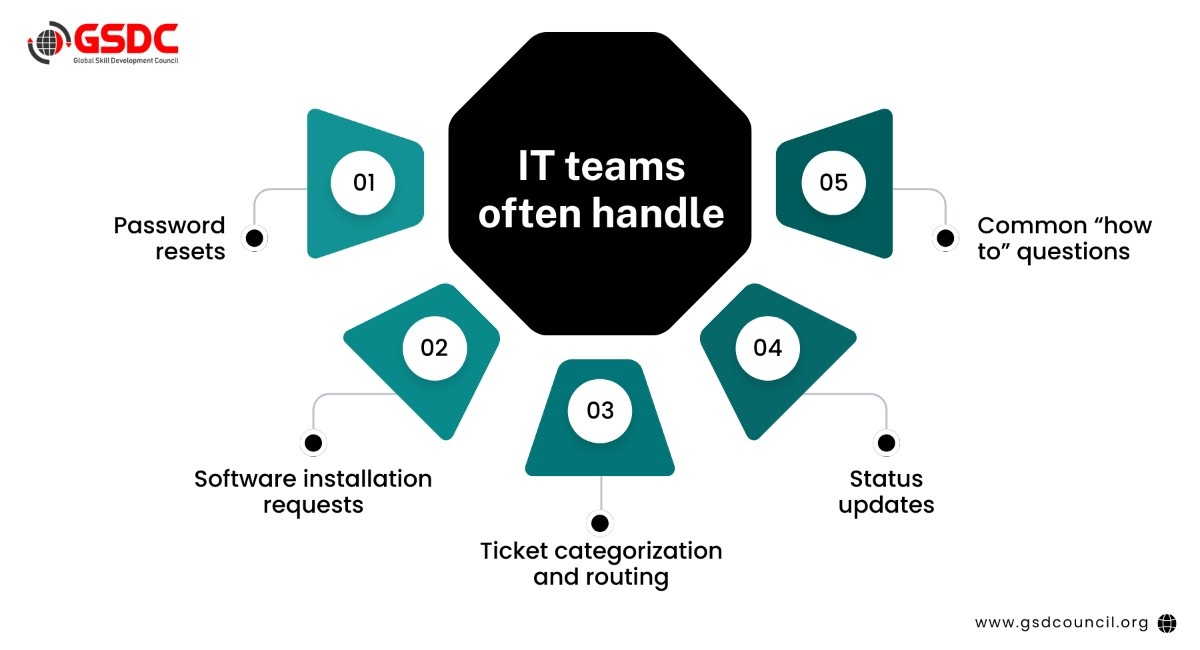
These tasks are important, but they take up a lot of time. Over time, they:
- Reduce the time available for critical issues
- Slow down response to complex problems
- Lead to frustration and burnout
How AI for ITSM Improves Efficiency in IT Operations
1. Automated Ticket Categorization and Routing
The AI can review a new ticket instantaneously, determine the type of ticket, and identify the purpose of the ticket based on keyword analysis, previous tickets, and stated user intent. In addition, the AI can:
- Automatically classify tickets
- Prioritize tickets for either priority or business impact
- Route tickets to the appropriate ITSM team or technician
This reduces delays caused by manual triage and helps critical issues reach the right people faster. Over time, AI for ITSM becomes more accurate as it learns from historical data and ticket outcomes.
Result: Faster response times, fewer handoffs, and less manual work for IT staff.
2. AI-Powered Virtual Agents and Chatbots
AI-powered virtual agents and chatbots act as the first point of contact for many IT requests. They can handle common tasks such as:
- Password resets
- VPN access
- Software access requests
- Basic troubleshooting steps
With Generative AI in ITSM, these chatbots go beyond scripted responses and understand natural language, providing more contextually relevant answers. The impact is a more human-like support experience and reduced user frustration. Result
Result: Users get instant support 24/7, and IT receives fewer mundane tickets.
3. Self-Service With Smart Knowledge Bases
AI enhances self-service portals by assisting users in finding the correct information independently. It does this by:
- Providing the most relevant help articles
- Answering questions asked in natural language
- Learning from past tickets and user behavior
The Generative AI can also be used to automatically create, summarize, and update knowledge articles. This keeps the information up-to-date and relevant.
Result: faster resolution of issues and an improved overall user experience.
4. Predictive Issue Detection
AI looks back at incidents, logs, and usage patterns to predict issues before they arise. It can:
- Identify patterns that lead to issues
- Predict issues before users experience them
- Identify unusual usage that may lead to an incident
By using predictive capabilities, IT departments can prepare for incidents before they snowball, as opposed to reacting to an incident.
Result: reduced downtime, fewer urgent notifications, and more consistent IT operations.
5. Workflow Automation in ITSM
AI optimizes workflows in ITSM processes, reducing manual work and improving efficiency. AI enables automation in tasks such as:
- Incident management
- Change approvals
- Service request handling
Envision AI performing tasks such as updating ticket status, sending notifications, and closing tickets when conditions are satisfied. Together with AI in ITSM, these functions open the door to efficient end-to-end service processes.
Result: faster processing, less downtime, and more consistent service delivery.
To acquire hands-on knowledge in workflow automation and AI in ITSM, consider learning paths and certifications offered by entities such as the GSDC (Global Skill Development Council).How Does Generative AI in ITSM Work?
Generative AI uses past tickets, solutions, and IT docs to assist users and IT professionals on a daily basis.
- It analyzes past data, such as tickets and solutions, to identify similar issues.
- It provides quick and accurate solutions to common service inquiries.
- It assists IT professionals in closing tickets quickly by suggesting possible solutions.
- It can write an effective summary of an incident and a ready-to-send response, which saves time.
- It continues to improve with time as more real-world data is fed into it.
How AI Reduces Repetitive Tasks for IT Teams
AI reduces repetitive work or manual tasks through automation of the routine job is a very large part of an IT team’s day. This allows the IT teams to shift from basic support activities to higher-value and more strategic work.
Below is a table that provides examples of how this shift occurs in real life.
|
How AI Reduces Repetitive Work |
What IT Teams Can Focus On Instead |
|
By automating the processing of simple high-volume tickets (like password resets and access requests) |
Solve complex technical problems that require human judgment |
|
Answer common questions by way of chatbots or self-service portals |
Improve the security posture of the organization and manage risk |
|
Update the status of tickets, log actions taken, and send routine notifications out |
Design and improve IT system and workflow processes |
|
Initiate automated actions (such as approvals, routing of tickets, and closing of tickets) |
Support the growth of the organization and assist with digital transformation projects |
|
Provide rapid recommendations to standard issues based on historical solutions |
Manage the service improvement initiative by solving problems before they begin |
|
Reduces manual handoffs by routing tickets to the right teams |
Cross-team collaboration and strategic planning for IT purposes |
To build the right capabilities for working with AI-powered service management tools, professionals can consider a generative AI in ITSM certification to gain practical knowledge and hands-on understanding of AI-driven IT service management.
Is AI Replacing IT Teams?
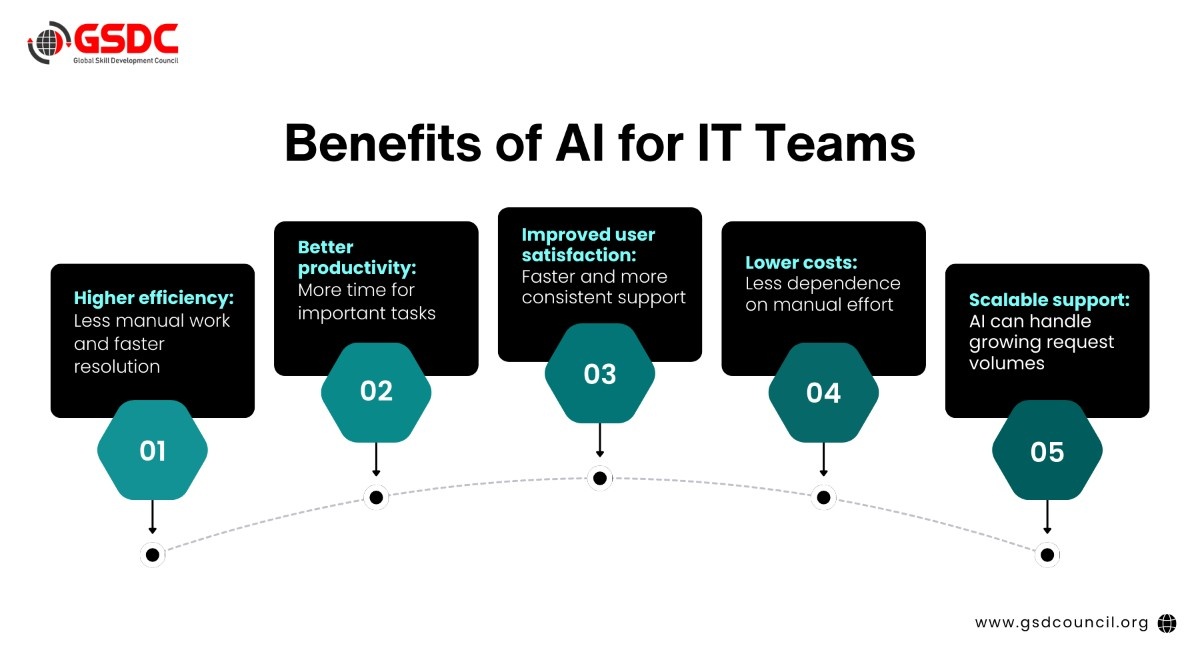
No. AI is designed to support IT teams, not replace them. Its main role is to take care of routine and repetitive tasks so that people can focus on work that needs human judgment and experience.
AI handles everyday activities such as basic ticket resolution and automation, while IT professionals focus on decision-making, solving complex problems, improving systems and processes, and working closely with stakeholders. The most effective ITSM environments combine AI-driven automation with human expertise to deliver better, more reliable IT services.
The Future of Generative AI in ITSM
Generative AI's role in ITSM will be continuously strengthened as the technology develops its capabilities and gains more users:
- Human-like and more customizable virtual assistants: Applications will communicate with users in a simpler, more conversational manner.
- Smarter issue resolution recommendations: AI can suggest a better way by getting knowledge from past data.
- More proactive and predictive operations: AI helps in identifying the issues before users get affected, thus avoiding interruptions.
- Intelligent automation of workflows: A great number of simple tasks will be executed automatically as the team focuses on the work that is most critical to them.
- Increasing scale of deployment and influence: Early adopters of Generative AI in ITSM will reap the benefits of being able to provide faster, more efficient, and more reliable IT services.
Early adopters of Generative AI in ITSM will reap the benefits of being able to provide faster, more efficient, and more reliable IT services.
Developing the Skills Needed for AI-Enabled ITSM
With AI becoming part of everyday IT service management, professionals need hands-on skills to stay relevant in a changing IT environment.
Obtaining a generative AI in ITSM certification from organizations such as the Global Skill Development Council (GSDC) can help IT professionals gain systematic knowledge and practical experience in AI-enabled IT service management. Such certifications provide training on how to work with AI, leverage it for improved service delivery, and work in harmony with AI-enabled solutions.
Final Thoughts
AI is increasingly influencing the way today’s IT teams function. By reducing mundane work, improving response times, and allowing for more intelligent workflows, AI enables IT professionals to work more effectively and devote their time to more strategic, business-enabling work.
As technologies and capabilities continue to develop, including Generative AI in ITSM, organizations that adopt AI in a thoughtful and practical way will be more ready for the future of IT service management. At the same time, IT professionals who develop expertise in AI-enabled ITSM will be poised to capitalize on these changes and move into more strategic roles within their organizations.

Related Certifications
Stay up-to-date with the latest news, trends, and resources in GSDC
If you like this read then make sure to check out our previous blogs: Cracking Onboarding Challenges: Fresher Success Unveiled
Not sure which certification to pursue? Our advisors will help you decide!