How HR Business Partners Collaborate with Leadership to Shape Strategy ?
Written by Emily Hilton
- Understanding the Modern HR Business Partner Role
- The HR Business Partner Model: A Strategic Foundation
- How HR Business Partners Influence Leadership Decisions
- HR Business Partner Responsibilities in Strategic Collaboration
- How HRBPs Shape Organisational Strategy with Leaders
- The Growing Demand for HR Business Partners
- Skills HR Business Partners Need to Work Effectively with Leadership
- Professional Growth: Why Certification Matters
- The Future of Strategic HR Partnership
- Closing Thoughts
In an environment where businesses are evolving faster than ever, organisations expect HR to move beyond traditional personnel management. They need strategic partners who understand the business end-to-end, anticipate challenges, and confidently influence high-level decisions. This is precisely where the HR Business Partner role becomes indispensable, connecting people strategy with business goals to drive organisation-wide impact.
But what is an HR Business Partner in modern terms? And how do HRBPs work directly with leadership teams to shape strategy? This blog offers you the evolving role, the HR business partner responsibilities, the HR business partner model, strategic partnership techniques, and how HRBPs use data, influence, and business insight to drive organisational success.
Whether you are exploring HR business partner jobs, preparing for HR business partner interview questions, or considering an HR business partner certification, this comprehensive guide equips you with a full understanding of how HRBPs and leaders collaborate to build future-ready organisations.
Understanding the Modern HR Business Partner Role
Before diving into leadership collaboration, you must clearly understand what is HRBP or what is an HR business partner today.
Traditionally, HR focused on hiring, compliance, and basic employee concerns. But the HR Business Partner role shifts the focus from administration to strategy.
An HRBP works as a consultant and advisor to senior leaders, ensuring that people strategies support organisational goals.
Key aspects of the HR Business Partner job description:
- Align HR strategy with business objectives
- Support organisational change and transformation
- Guide workforce planning and talent strategy
- Build leadership capability
- Use analytics to improve decision-making
- Serve as a bridge between employees, HR operations, and executive teams
This strategic orientation has increased demand for HR business partner training and HR business partner certification online, especially for professionals aiming to become a certified HR business partner.
The HR Business Partner Model: A Strategic Foundation
Most modern enterprises follow the HR business partner model, which consists of three HR pillars:
- HR Business Partners – drive strategy and consult with leaders
- HR Centers of Excellence (CoEs) – provide deep expertise (L&D, compensation, recruitment, etc.)
- HR Shared Services – handle operational work and employee queries
This structure allows HRBPs to focus on strategic work rather than administrative tasks, which is crucial for shaping organisational strategy with leaders.
How HR Business Partners Influence Leadership Decisions
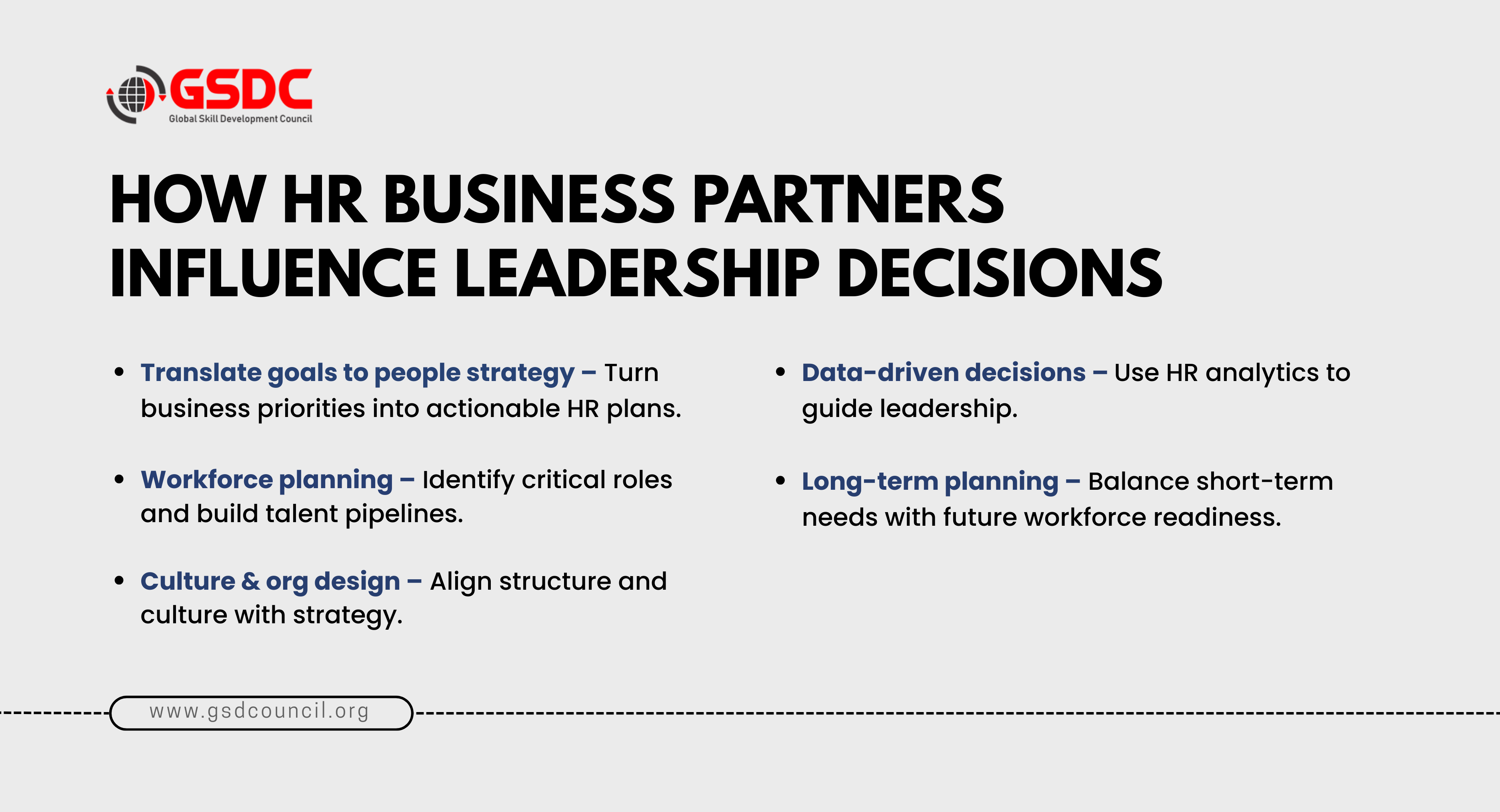
A. Translating Business Needs into People Strategy
Leadership teams often outline priorities like:
- revenue expansion,
- digital transformation,
- market growth, or
- restructuring.
The HRBP translates these into people strategies such as workforce planning, capability building, culture alignment, and organisational design.
For example:
If the business prioritises digital transformation, the HRBP must advise leadership on digital skills training, restructuring teams, and implementing change-management strategies.
B. Using HR Analytics to Guide Executive Discussions
Data-driven HR is now a non-negotiable expectation. HRBPs use analytics to guide decisions around:
- turnover and retention
- performance patterns
- workforce productivity
- skills gaps
- succession readiness
Executives rely heavily on these insights for strategic planning. This elevates the HRBP’s role from advisor to strategic partner.
C. Leading Workforce Planning with Leaders
HR Business Partners collaborate with leaders to forecast talent needs. This includes:
- identifying critical roles
- planning recruitment pipelines
- choosing talent sourcing strategies
- evaluating internal mobility options
Since leaders often focus on near-term goals, the HRBP ensures long-term workforce thinking remains on the table.
Download the HRBP Strategy Playbook and accelerate your strategic HR journey. 📥
Gain battle-tested frameworks for leadership alignment, analytics, talent strategy & change management. 📊
Turn conversations into influence and decisions into measurable business outcomes. 🎯
HR Business Partner Responsibilities in Strategic Collaboration
The following responsibilities define how effectively HRBPs shape strategy:
1. Organisational Development and Culture Shaping
HRBPs help leadership identify cultural barriers, assess engagement, and reinforce behaviours that support strategic direction.
For example, if the business aims for agility, the HRBP must promote agile mindsets, cross-functional work, and continuous learning.
2. Leadership Coaching and Capability Building
HR Business Partners act as coaches for leaders, especially when dealing with:
- conflict resolution
- team structure decisions
- performance management
- organisational change
This coaching strengthens leadership alignment and encourages consistent communication across the organisation.
3. Managing Change and Transformation
Whether it’s M&A, restructuring, or introducing new systems, HRBPs guide leaders on:
- communication plans
- employee impact analysis
- change readiness
- stakeholder alignment
Their goal is to reduce resistance and maintain productivity.
4. Talent Strategy and Succession Planning
HRBPs ensure leaders identify high-potential talent and prepare teams for future roles. They align leadership discussions with data-driven insights around performance and potential.
How HRBPs Shape Organisational Strategy with Leaders
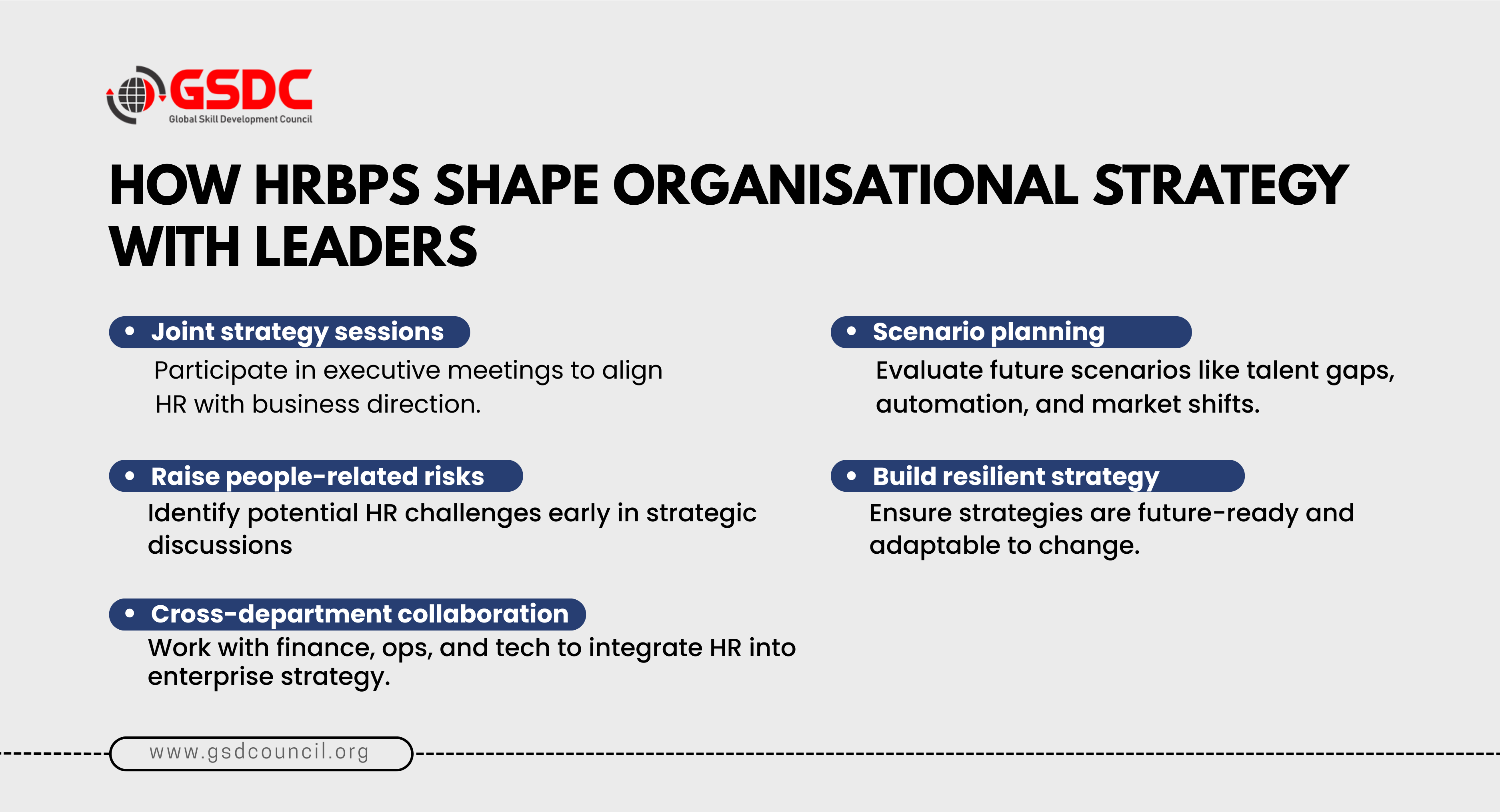
A. Joint Strategy Sessions
HRBPs frequently participate in executive meetings to understand direction, question assumptions, and raise people-related risks early.
B. Cross-departmental Collaboration
During enterprise strategy planning, HRBPs collaborate not only with leaders but also with finance, operations, and technology teams to create integrated strategies.
C. Scenario Planning
HR Business Partners help leaders evaluate multiple future scenarios, such as:
- talent shortages
- automation impact
- shifting customer expectations
- regulatory changes
This ensures the strategy is resilient and future-ready.
The Growing Demand for HR Business Partners
Because organisations increasingly require strategic HR capability, HR business partner jobs have become some of the most sought-after roles in HR. The rise of:
- hybrid work,
- workforce analytics,
- global talent competition,
- and business transformation
have increased the need for qualified HRBPs.
HR Business Partner Salary Trends
While HR Business Partner salary depends on geography and experience, HR Business Partners generally earn significantly more than traditional HR roles due to their strategic impact and business consulting skills.
Remote work trends have also increased demand for HR business partner remote jobs, as global companies seek strategic HR professionals anywhere in the world.
Skills HR Business Partners Need to Work Effectively with Leadership
To shape strategy, HRBPs must combine HR expertise with strong business acumen. Top skills include:
- Strategic thinking
- Data and analytics interpretation
- Talent and organisational development expertise
- Change-management capability
- Business communication
- Stakeholder influencing
- Understanding financial metrics
- Coaching and consultation
These skills are often part of modern HR business partner training programs and professional development pathways.
Professional Growth: Why Certification Matters
GSDC’s HR Business Partner Certification brings up-to-date the HR professionals with the necessary skills and knowledge to become strategic partners of the leadership.
The topics of the certification include workforce planning, talent strategy, HR analytics, change management, and leadership influence, which together help the HRBPs to create an impact in the organization.
The program is meant for professionals who will be facing real-world challenges and thus will increase their credibility in the top HR roles.
Key Benefits:
- An HR strategy aligned with business objectives is done effectively
- Points of Leadership influence and consultation skills development
- Data-driven HR decision-making is an area of expertise
- Career prospects and role readiness are improved
- Practical frameworks for the workforce planning & change management are acquired
Understanding these helps candidates align their experience with actual HR business partner responsibilities.

The Future of Strategic HR Partnership
As organisations continue adopting digital transformation, hybrid work, and workforce automation, HRBPs will play an even more influential role. Their ability to blend people expertise with business strategy makes them indispensable advisors to leadership.
Future HRBPs will be expected to:
- Lead AI-enabled HR transformation
- Use predictive analytics for workforce planning
- Drive capability building for emerging technologies
- Shape culture for agility and innovation
- Support globally distributed teams
The HRBP role will become more data-driven, business-focused, and leadership-aligned than ever.
Closing Thoughts
HR Business Partners have evolved into strategic contributors who collaborate deeply with leadership to shape organisational strategy. They translate business objectives into actionable people strategies, coach leaders, manage change, and use analytics to guide decisions. With growing demand for strategic HR capability, the role offers strong career growth, attractive HR business partner salary opportunities, and pathways like HR business partner certification to build expertise.
Whether you are exploring what is an HR business partner is, preparing for a new role, or seeking advancement as a certified HR business partner, mastering leadership collaboration is essential. In a world where people strategy is business strategy, HRBPs stand at the centre of organisational success.

Related Certifications
Stay up-to-date with the latest news, trends, and resources in GSDC
If you like this read then make sure to check out our previous blogs: Cracking Onboarding Challenges: Fresher Success Unveiled
Not sure which certification to pursue? Our advisors will help you decide!