Recruitment Planning 2026: A Simple Guide to Setting Hiring Goals

Written by Matthew Hale
Recruitment today is more unpredictable than ever. If you think back to the last role you tried to fill, you may remember shifting job briefs, candidates expecting instant information, or shortlists taking longer than anticipated. This is the new reality of hiring dynamic, complex, and constantly evolving.
To move confidently into 2026, organisations must shift from reactive hiring to recruitment planning that is strategic, data-informed, and aligned with business needs. A strong plan helps you stay focused, improve the quality of hire, and deliver a consistent candidate experience that does not crumble under pressure.
But before building a roadmap, understanding the forces reshaping recruitment is essential. These trends influence your workforce planning, talent needs, and overall talent acquisition planning, forming the foundation of how you design recruitment strategies for the coming year.
Trends Shaping Recruitment in 2026
1. Skills-Based Hiring Grows
Corporations are progressively opting for skills, portfolios, and verified capabilities rather than a formal degree. The demand for AI-related roles has increased by 21% while the requirements for degrees have gone down by 15%.
This change puts recruiters in a position to implement more robust assessment methods and create recruitment metrics that indicate capability rather than credentials.
2. AI Becomes Core to Hiring
Due to smaller teams and a larger number of applicants, AI is used for supporting activities like screening, matching, communication, and even early predictive hiring.
Usually, only 0.5% of applicants are moved to the later stages, which makes the process of automation very important in terms of efficiency and decision-making.
3. Remote & Hybrid Work Stay Strong
Positions that are friendly to remote work attract a wider and more diverse pool of talent, and this has an effect on the number of employees that can be hired by teams located in different parts of the world.
Virtual hiring and distributed workflows have become the main factors that influence sourcing strategy, interview design, and digital onboarding.
4. Talent Platforms Expand
The workforce on-demand networks, digital talent marketplaces, and specialized communities are becoming the most important recruitment channels.
These platforms allow companies to reach niche talents quickly and at the same time, improve their overall recruitment process.
5. Candidate Expectations Rise
Candidates demand faster communication, more transparent job descriptions, and smooth digital interactions. Good communication and well-organised processes have a direct effect on employer branding goals, candidate perception, and acceptance rates.
With these changes happening faster, numerous recruiters are taking up structured development programmes such as the Certified Recruitment Professional (CRP), which aims at enhancing modern hiring skills in AI, skills-based assessments, sourcing, and data-driven decision-making.Two Main Types of Recruitment Goals
To simplify the process of setting goals, split your recruitment goals into two basic categories. This helps you stay focused on who you hire and how you hire.
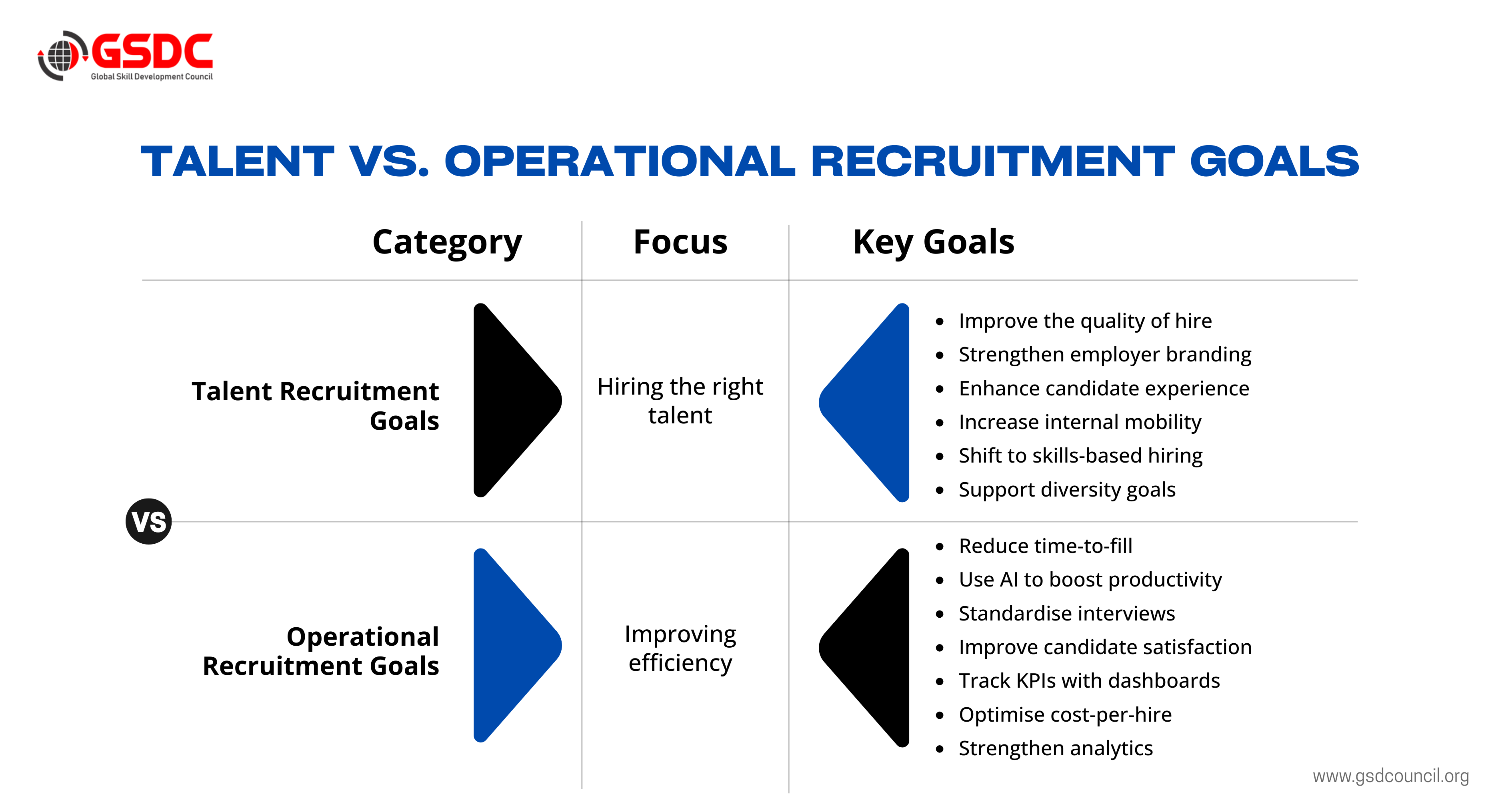
1. Talent Recruitment Goals
Focus: Attracting, evaluating, and hiring the right talent
- The main idea behind these goals is to emphasise the quality and the positive impact of the hires.
- Make the quality of hire better by sharpening screening and incorporating skills tests.
- Help employer branding through more accurate job posts and consistent brand messaging.
- Provide the candidate with an excellent experience through quick updates and clear timelines.
- Expand internal job movement to lower the need for external hiring.
- Move to skills-based hiring by using skills demonstration, tasks, and competency verification.
- Commit to diversity hiring goals by having more expansive sourcing and unbiased evaluation.
- Make hiring benefits long-term talent acquisition goals like creating future skill pipelines.
2. Operational Recruitment Goals
Focus: Improving hiring efficiency and workflow
- The main idea of these goals is to make your recruitment process quicker, more impartial, and more consistent.
- Shorten time-to-fill through the use of automation in the screening and scheduling processes.
- Enhance recruiter performance with the help of AI, thus giving the recruiter more time for engagement and sourcing activities.
- Standardise interviews to ensure the evaluations are fairer and reliable.
- Help candidates to be more satisfied with interviews by organising them properly and communicating in a timely manner.
- Create dashboards to monitor recruitment performance KPIs like conversion rates and offer acceptance.
- Make cost-per-hire more efficient by focusing on the best-performing sourcing channels.
- Improve recruitment analytics to facilitate better forecasting and decision-making.
- These two categories enable recruiters to arrange their priorities while being sure that there is a clear connection with business and headcount planning requirements.
These two categories allow recruiters to organise their priorities while ensuring clear alignment with business and headcount planning requirements.
Simple 10-Step Plan to Set Your Recruitment Goals for 2026
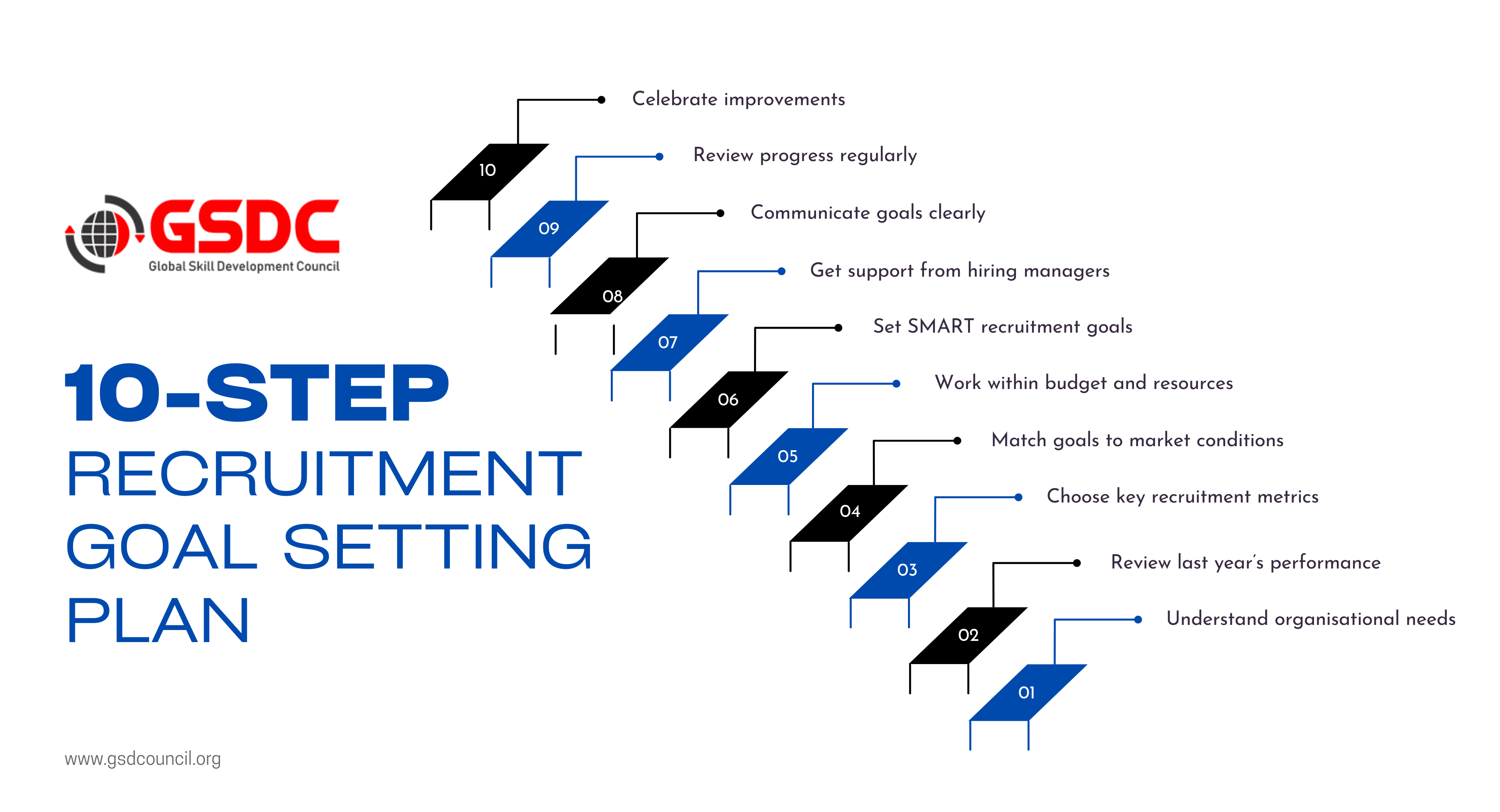
1. Understand Your Organisation’s Needs
- Assess hiring plans, skills gaps, and expansion priorities.
- Align these insights with broader workforce planning and hiring forecast requirements.
2. Review Last Year’s Performance
- Analyse time-to-hire, candidate feedback, and conversion rates using recruitment dashboard metrics and ATS data.
- Example: Improve response time so every candidate receives a reply within 48 hours.
3. Choose the Right Recruitment Metrics
- Select KPIs such as time-to-hire, recruitment KPIs, offer acceptance rate, candidate NPS, and interview-to-offer ratio.
- Example: Improve candidate satisfaction to NPS +50.
4. Match Your Goals to the Market
- Consider demand fluctuations, remote-work expectations, salary changes, and skill shortages.
- Example: Build a 500+ member talent pool for priority roles.
5. Work Within Budget and Resources
- Review your tech stack, recruitment team capacity, and available support tools.
- This ensures your goals remain achievable and aligned with business constraints.
6. Use the SMART Framework
- Ensure all goals are Specific, Measurable, Achievable, Relevant, and Time-bound.
- Examples:
Reduce screening time by 30% using AI
Lower engineering time-to-hire by 20% by December 2026
7. Get Support From Managers
- Engage hiring managers early so they share responsibility in interviews, assessments, and timely feedback.
8. Communicate Your Recruitment Goals Clearly
- Ensure your team understands key targets, expectations, timelines, and defined recruitment objectives.
9. Review Progress Regularly
- Monitor progress monthly or quarterly using recruitment analytics tools.
- Examples:
Achieve 25% internal hiring
Improve AI-assisted screening turnaround times
10. Celebrate Improvements
- Recognise team achievements, whether it's improved NPS, faster response times, or higher-quality shortlists.
📘 Get the Ultimate Talent Acquisition Strategy Guide for 2026
Skills Recruiters Need to Succeed in 2026
To meet future hiring demands, recruiters must strengthen:
- AI & Automation Skills – Mastering tools used for automated matching and communication
- Data-Driven Recruitment – Understanding dashboards, reports, and recruitment analytics
- Skills-Based Hiring Techniques – Assessing potential over degrees
- Communication & Candidate Care – Managing expectations and delivering clarity
- Sourcing Strategy Skills – Leveraging talent platforms, social sourcing, and referrals
- Business Understanding – Knowing how hiring impacts business goals
- Diversity Hiring Knowledge – Designing inclusive processes and ensuring equitable assessment
- Recruitment Planning Skills – Aligning talent needs with headcount planning and business forecasts
These capabilities support both short-term hiring execution and long-term recruitment process improvement.
How GSDC Supports Recruitment Professionals Preparing for 2026
As recruitment becomes more digital and skills-focused, professionals need to stay ahead. GSDC (Global Skill Development Council) supports this growth through modern recruiter development programs, including the Recruitment Professional Certification, which strengthens capabilities in AI-enabled hiring, competency evaluation, and smarter sourcing.
These programmes also guide recruiters pursuing certified recruiter and recruitment consultant pathways, helping them build confidence, improve execution quality, and stay aligned with the evolving expectations of today’s talent market.

Conclusion
Setting strong recruitment goals for 2026 is not just a planning exercise; it’s a strategic advantage. By aligning your goals with business needs, market shifts, and modern hiring practices, you build a recruitment function that performs consistently and delivers measurable value.
With clear recruitment performance metrics, stronger sourcing strategies, data-driven insights, and upgraded recruiter skills, your organisation can move into 2026 prepared, competitive, and ready to achieve meaningful hiring outcomes.

Related Certifications
Stay up-to-date with the latest news, trends, and resources in GSDC
If you like this read then make sure to check out our previous blogs: Cracking Onboarding Challenges: Fresher Success Unveiled
Not sure which certification to pursue? Our advisors will help you decide!