Navigating DPDP: Consent, Privacy, and AI in Healthcare
Written by Matthew Hale
- What Is the DPDP Act?
- Why DPDP Is Important for Healthcare Data Privacy
- What Changed with DPDP in Indian Healthcare?
- The 5 Main Rules of DPDP for Healthcare Organisations
- The One-Year Data Retention Rule
- How DPDP Affects AI in Healthcare
- Empowering Responsible AI with GSDC
- Final Thought: Building Trust in Digital Healthcare
The healthcare industry is going digital very rapidly. Now, Artificial Intelligence (AI in healthcare) supports physicians in detecting various diseases, preparing patient reports, studying pictures in healthcare, and maintaining patients’ records on the internet. This has resulted in making healthcare more convenient and efficient.
But with this digital shift comes a serious responsibility. When medical data and health records are stored digitally, they must be protected properly. Patient information is highly personal and sensitive, and even a small data breach can cause major harm.
This is why the Indian government has formulated the Digital Personal Data Protection (DPDP) Act, 2023, a legislation aimed at protecting patient confidentiality, securing healthcare data, and effectively managing digital consent.
What Is the DPDP Act?
DPDP Act is a legislation that defines the manner in which personal data and digital healthcare information is supposed to be collected, used, and protected in Indian society.
In simple words, it says: “Your personal data belongs to you, not to the hospital or app.”
This law applies to:
- Hospitals and clinics
- Diagnostic labs
- Health-tech platforms
- Insurance companies
- Mobile health apps
- Any organisation that processes digital personal data
Why DPDP Is Important for Healthcare Data Privacy
Healthcare data is very personal and private. All healthcare data related to any medical record, prescription, diagnosis, or health app is private. If such data is used improperly or leaked, it will affect patients’ trust in healthcare services for their entire lifetime. The DPDP Act has an important role in safeguarding this trust.
-
Protection of Patient Data
DPDP ensures hospitals and health organisations operate in a manner that is in line with the patient's data privacy. It turns data protection from a mere best practice into a legal requirement.
-
Secure Digital Health Records
The law requires that health care providers store and manage digital health records safely. The records should be managed with strong security to prevent unauthorised access or data breaches.
-
Transparent Use of Personal Health Information
Organisations must clearly explain why they are collecting patient data and how it will be used. Hidden or unclear data practices are no longer allowed.
-
Purpose-Based Data Usage
Under DPDP, patient information can only be used for the exact purpose for which consent was given. Data cannot be reused for other activities without fresh permission.
-
Clear and Informed Consent
Those whose data is to be collected or processed must be fully and properly informed beforehand. Consent should be obtained in a way that is simple and understandable and can be withdrawn easily at any time.
-
Privacy and Confidentiality
Healthcare data privacy and confidentiality are assured by DPDP. Patient information is made available only to authorised persons, and harsh punishments are meted out for the misuse of such information.
What Changed with DPDP in Indian Healthcare?
Patients frequently signing lengthy and complicated consent documents that they barely understood, especially in terms of how their data would be utilised, was a regular occurrence before the DPDP Act. The new law has radically changed healthcare data management practices for the better.
-
Clear Explanation of Data Usage
Hospitals and other health bodies are required to explain to patients in detail the reasons for requesting their data and the planned usage thereof. Generic or secretive data harvesting methods are not going to be tolerated anymore.
-
Easy and Simple Consent Process
Patients are now able to give or withhold their consent in a very direct and open manner. Consent documents have to be formulated in the language of everyday communication that any person can easily understand.
-
Right to Withdraw Consent
Patients have the authority to revoke their consent at any moment. Making it as easy as possible to grant permission, it is fair that it must be as easy to withdraw permission, too.
-
Better Accountability from Hospitals
With the enactment of the new law, healthcare providers are now required by law to keep patient records confidential and not to use them for any unapproved purposes. Thus, the possibility of the abuse of personal health records is diminished.
-
Improved Trust and Transparency
The data handling activities are accretive and patient-friendly owing to DPDP, which, in turn, enhances the confidence of patients in their healthcare providers and vice versa.
The 5 Main Rules of DPDP for Healthcare Organisations
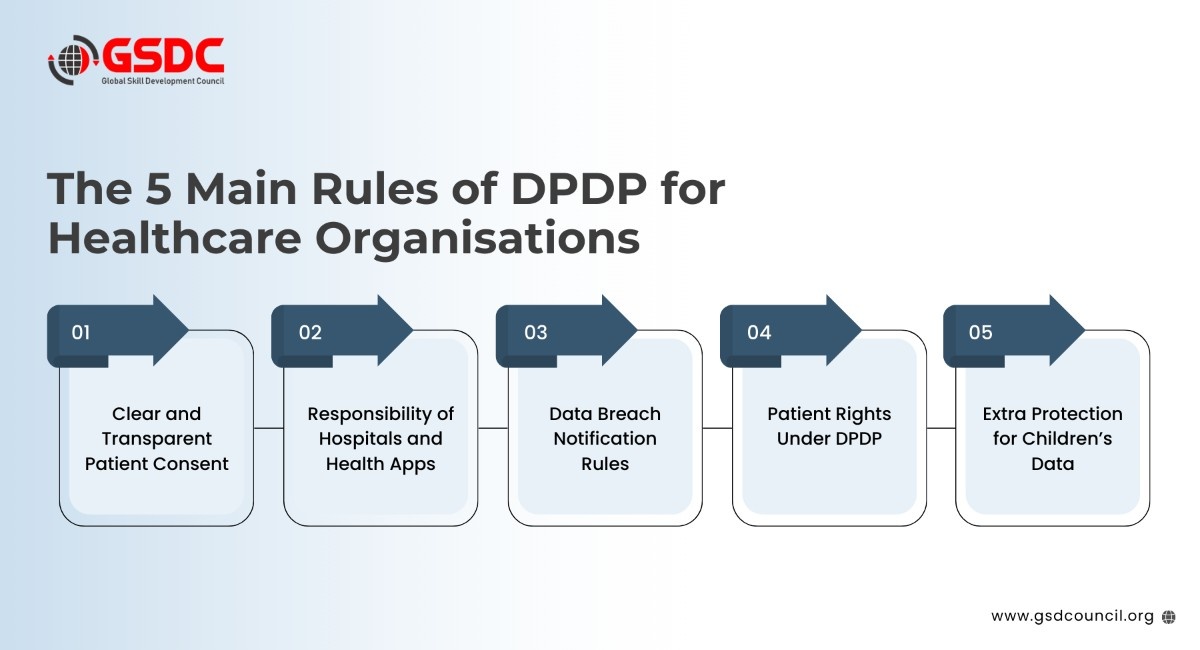
The DPDP Act brings about rules that must be followed by all hospitals, clinics, and even health-tech services. These rules ensure that patients’ data is handled safely and responsibly.
1. Clear and Transparent Patient Consent
The hospitals should clearly explain the following to the patients:
- What data is collected
- Why is the information required
- How the data will be used
Consent forms may no longer be long and complicated. They need to be simple, specific, and in a manner that will help the patients understand exactly what they are agreeing to.
2. Responsibility of Hospitals and Health Apps
Under DPDP rules, healthcare organisations must:
- Keep patient data secure
- Use data only for approved and stated purposes
- Delete personal data when it is no longer required
This rule strengthens healthcare cybersecurity, ethical data usage, and responsible data management.
3. Data Breach Notification Rules
In case of a health data breach:
- The hospital has to inform the Data Protection Board
- All patients have to be informed
- Such a process has to be achieved in a matter of 72 hours
This ensures promptness in acting, enhanced accountability, and transparency in the wake of any incident of data security breach.
4. Patient Rights Under DPDP
The Act entitled the patient to full control of his personal data. In this regard, every patient has the right to:
- Access their stored personal information
- Correct any false information.
- Request the deletion of their data
- File complaints if their data is misused
This, in turn, constitutes the backbone of rights that make patient privacy and data control a core constituent of India's digital healthcare system.
5. Extra Protection for Children’s Data
Children under the age of 18 follow these regulations:
- Parental consent must be obtained
- Health apps cannot rely on simple age checkboxes
- In medical emergencies, doctors can access data immediately
This ensures strong protection for pediatric healthcare data while still allowing urgent medical care when needed.
These five rules form the foundation of DPDP compliance in healthcare and help build a safer, more trustworthy digital health environment in India.
The One-Year Data Retention Rule
Under the DPDP Act, it is made sure that if the patient deletes their health application account or withdraws their consent, their health organisations are required to retain certain information for a period of at least one year.
-
Legal Compliance
Healthcare establishments and hospitals, in order to comply with the law, are required to preserve basic data records for at least a certain period. This is to ensure that they satisfy regulatory and legal obligations.
-
Medical Safety
Storing important details about patients for a period of one year ensures that a continuity of care link is maintained in case further care/references are required.
-
Audit and Accountability
Healthcare practitioners may be required to produce these records during audits, investigations, and resolving disputes. The one-year rule ensures that critical information is readily available upon request.
The rule tries to strike a balance between patient privacy and legal and medical responsibility. It prevents data from being stored indefinitely and also from being deleted too quickly.
How DPDP Affects AI in Healthcare
Artificial Intelligence (AI) is being used to revolutionise the medical diagnosis, treatment planning, and patient care processes. On the other hand, the DPDP Act is there to make sure that this change is done without violating patient privacy in any way.
-
No Secret Use of Patient Data
Hospitals and health tech companies are not allowed to use patient data without informing them to train AI models. Patient data can only be used if patients are well informed and have given their consent.
-
Clear Purpose for AI Data Usage
If patient data is to be used for AI, it has to be explicitly stated what is intended. Organisations have to state why they require patient data: for diagnosis, for research, or for training AI models.
-
Explicit Patient Consent
Before any of the patient's health data is used for AI-related purposes, a healthcare facility must get explicit consent from the patient. It is important to understand that consent for treatment cannot be confused with consent for AI usage.
-
Responsible and Secure Data Handling
AI systems are required to comply with data protection regulations strictly. If possible, the patients' identity has to be protected, and the data has to be placed in a way that prevents misuse or leakage.
By enforcing these rules, DPDP encourages responsible AI adoption, ethical data practices, and patient trust in digital healthcare.Empowering Responsible AI with GSDC
As healthcare becomes increasingly digital, professionals need the right skills to manage AI implementation, data privacy, and DPDP compliance. The Global Skill Development Council (GSDC) offers globally recognised certifications that help individuals and organisations stay future-ready.
The Generative AI In Healthcare Certification enables professionals to:
- Use Generative AI tools responsibly in healthcare
- Understand AI governance and data privacy
- Align AI solutions with DPDP regulations
- Promote ethical and transparent AI adoption
GSDC bridges innovation and responsibility-empowering professionals to adopt AI with confidence while protecting patient trust and data security.

Final Thought: Building Trust in Digital Healthcare
The DPDP Act is not about inhibiting technology and innovation either. The DPDP Act is about applying AI and digital technology and using health data in a safe, honest and ethical manner.
It is because DPDP provides a trustworthy healthcare system by maintaining proper consent, strong privacy, and good use of data.
When patients and their families know that their medical details are taken care of and valued, there is increased confidence in online healthcare, and that, in essence, is what the DPDP Act seeks to achieve in the country of India.

Related Certifications
Stay up-to-date with the latest news, trends, and resources in GSDC
If you like this read then make sure to check out our previous blogs: Cracking Onboarding Challenges: Fresher Success Unveiled
Not sure which certification to pursue? Our advisors will help you decide!