CAITP Career Roadmap: Salary, Roles, and Growth Path for AI Testers
Written by Emily Hilton
- 1. Understanding the Growing Demand for AI Testing Professionals
- 2. Roles for AI Testers: Career Opportunities to Explore
- 3. CAITP Career Roadmap: How to Build a Career in AI Testing
- 4. AI Tester Salary: What Can Professionals Expect?
- 5. Growth Path for AI Testers: From Beginner to Leadership
- 6. How the Certified AI Testing Professional Certification Supports Career Growth
- Conclusion
powered chatbots and recommendation engines to fraud detection systems and generative AI applications, businesses are increasingly depending on intelligent technologies. However, these systems introduce new quality challenges that traditional software testing methods cannot always address.
This shift is creating new opportunities for professionals interested in AI testing jobs. Companies need skilled testers who can evaluate model accuracy, identify data-related issues, detect bias, validate AI-generated responses, and ensure that intelligent applications perform reliably in real-world situations.
For software testers and quality assurance professionals, this creates an opportunity to move into specialised AI testing roles without completely changing their career paths. Understanding the available job opportunities, salary expectations, required skills, and professional development options can help them plan their next steps.
This guide explores the CAITP Career Roadmap, including the different roles for AI testers, salary expectations, and long-term growth opportunities.
1. Understanding the Growing Demand for AI Testing Professionals
Traditional software testing focuses on checking whether an application behaves according to predefined requirements. AI testing requires a broader approach because AI systems can produce different outputs depending on training data, user inputs, model behavior, and environmental conditions.
For example, a traditional application may return a fixed result when a user enters a particular value. An AI-powered chatbot, however, may generate different responses to similar questions. Testers must evaluate whether these responses are accurate, relevant, safe, unbiased, and consistent enough for the intended application.
This growing complexity is creating demand for professionals who understand both software quality assurance and AI behaviour.
According to the World Quality Report 2025, nearly 90% of organisations are pursuing generative AI in quality engineering, while only 15% have reached enterprise-scale deployment. This highlights the gap between AI experimentation and successful implementation, creating opportunities for quality professionals who can validate AI-powered solutions.
As a result, AI testing jobs are expanding across technology, banking, healthcare, retail, telecommunications, and other industries where businesses depend on reliable AI applications.
2. Roles for AI Testers: Career Opportunities to Explore
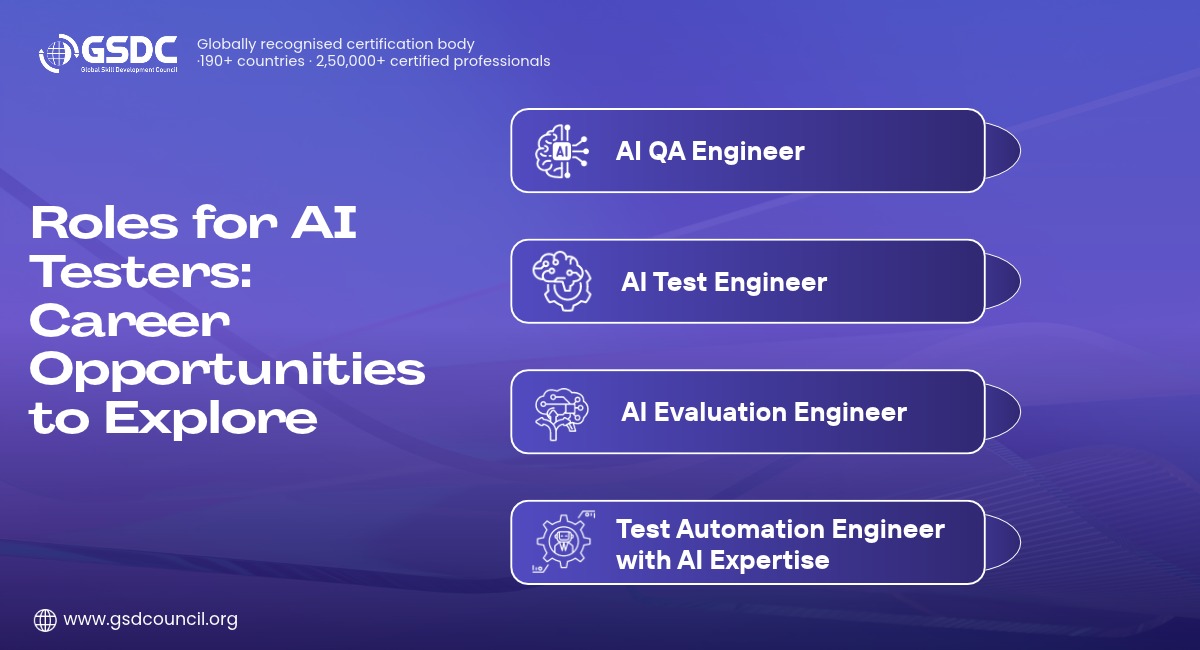
AI testing is not limited to one job title. Depending on their technical expertise, industry experience, and understanding of machine learning, professionals can explore several specialised positions.
- AI QA Engineer
An AI QA engineer focuses on maintaining the quality of applications that use artificial intelligence. Responsibilities include validating AI-powered features, checking model outputs, testing application workflows, and identifying defects.
They also work with developers and data scientists to ensure that AI functionality meets business requirements.
Key skills: Software testing, Python, API testing, automation frameworks, data validation, and AI fundamentals.
- AI Test Engineer
An AI test engineer designs and executes testing strategies specifically for AI-based applications. This includes evaluating model performance, testing training datasets, checking prediction accuracy, and identifying unexpected behaviour.
They may also develop automated testing frameworks to validate AI systems throughout their development lifecycle.
Key skills: Test automation, machine learning fundamentals, Python, statistical concepts, and model evaluation.
- AI Evaluation Engineer
An AI evaluation engineer focuses on measuring the quality of AI-generated outputs. This role is particularly relevant to generative AI applications, large language models, and conversational systems.
Professionals evaluate responses based on accuracy, relevance, factual consistency, safety, and adherence to instructions. They may also create evaluation datasets and benchmarks to compare model performance.
Key skills: Prompt testing, evaluation metrics, data analysis, critical thinking, and generative AI fundamentals.
- Test Automation Engineer with AI Expertise
This professional combines traditional test automation knowledge with AI-powered testing tools. Responsibilities include generating test cases, improving regression testing, identifying potential defects, and automating repetitive quality assurance activities.
Key skills: Selenium, Playwright, Python, CI/CD, automation frameworks, and AI-assisted testing tools.
These roles offer different entry points into the AI quality engineering field. Professionals should select opportunities based on their existing strengths and the technical responsibilities they want to develop.
3. CAITP Career Roadmap: How to Build a Career in AI Testing
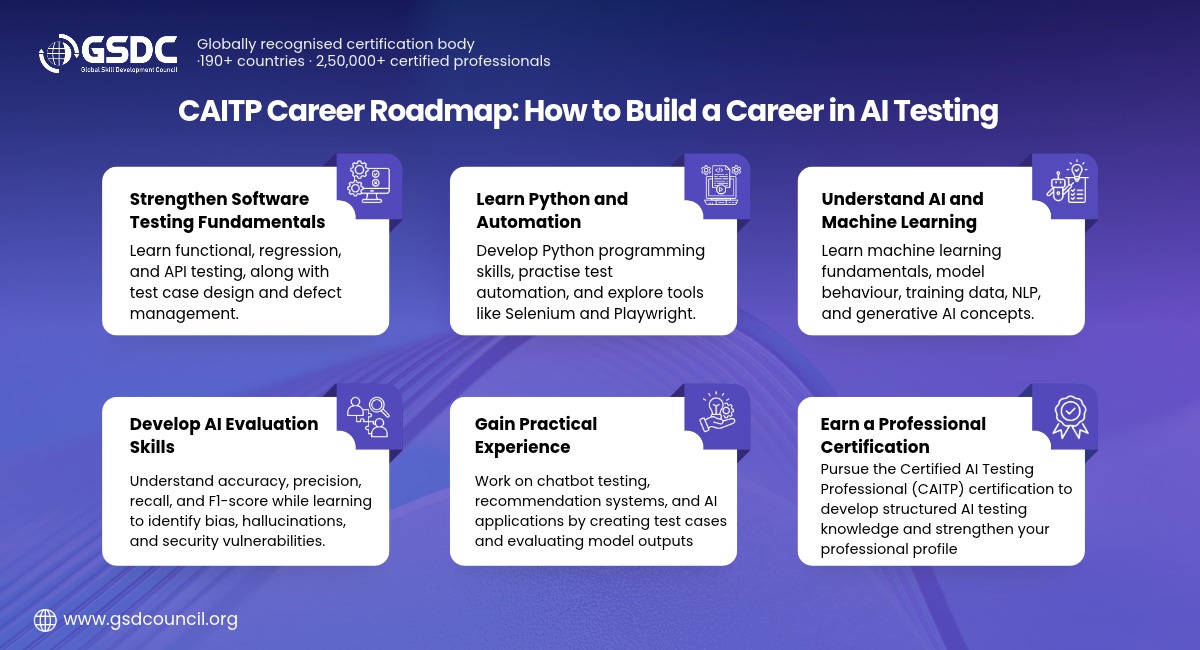
Moving into AI testing does not always require starting from the beginning. Professionals with experience in manual testing, automation, software development, or quality assurance can build on their existing knowledge.
A structured CAITP Career Roadmap can help professionals identify the skills they need and prepare for specialised positions.
Step 1: Strengthen software testing fundamentals
Start with functional testing, regression testing, API testing, test case design, and defect management. These fundamentals help professionals understand application behaviour and identify quality issues.
Step 2: Learn Python and automation
Develop basic programming skills using Python. Learn how to automate repetitive testing activities, validate application responses, and work with APIs. Familiarity with Selenium, Playwright, and other automation frameworks can also be useful.
Step 3: Understand AI and machine learning fundamentals
Learn how machine learning models work, how training data influences predictions, and why AI applications sometimes produce inaccurate results. Focus on supervised learning, unsupervised learning, natural language processing, and generative AI concepts.
Step 4: Develop AI evaluation skills
Understand how to measure model performance using precision, recall, accuracy, and F1-score. Learn to identify bias, hallucinations, inconsistent responses, and security vulnerabilities in AI applications.
Step 5: Gain practical experience
Work on small projects involving chatbot testing, recommendation systems, or AI-powered applications. Create test cases, document defects, and evaluate model outputs under different conditions.
Step 6: Earn a professional certification
Consider a specialised credential such as the Certified AI Testing Professional (CAITP) to develop structured knowledge of AI testing methodologies and demonstrate your commitment to professional development.
4. AI Tester Salary: What Can Professionals Expect?
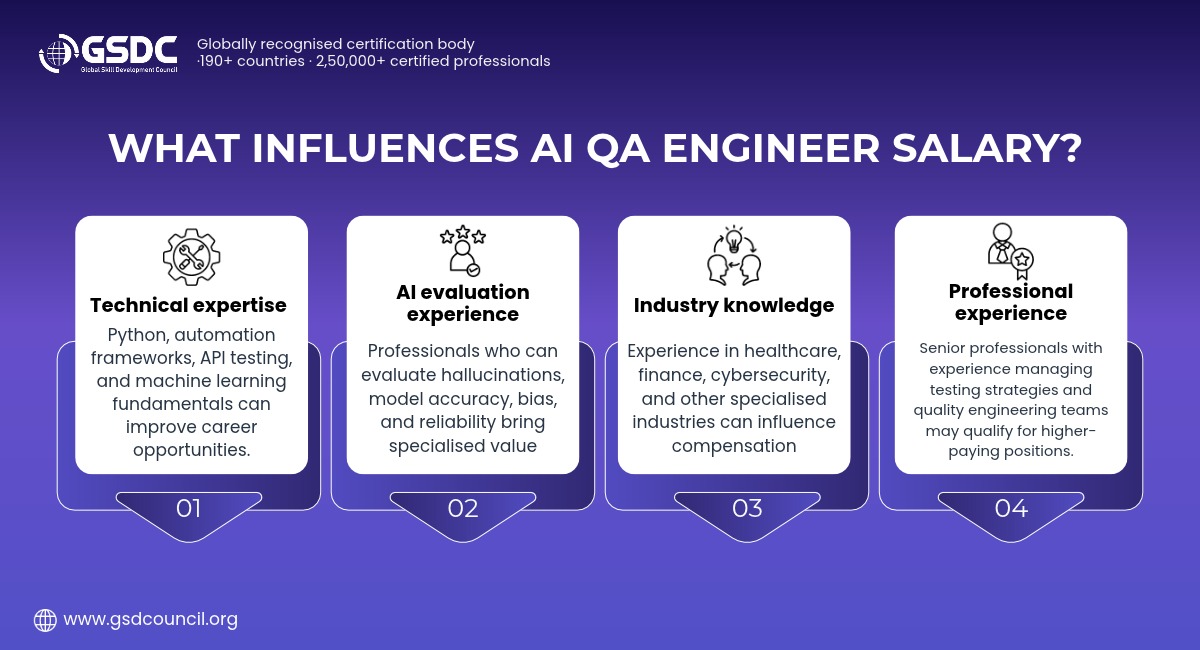
Salary is an important consideration when exploring AI testing as a career option. However, compensation varies depending on experience, technical expertise, industry, company size, and location.
Since AI testing is still an emerging specialization, dedicated salary benchmarks for every AI testing designation are limited. Professionals can use related quality assurance and Software Development Engineer in Test (SDET) salaries as reference points.
According to salary information, the typical SDET salary range in India is approximately ₹14.8 lakh to ₹16.4 lakh per year, based on around 4,600 reported salaries (2026 data). This provides a useful benchmark for understanding compensation in technical software testing roles.
ScrollTest
Here is how different career stages can influence salary expectations:
Career level | Indicative annual salary |
Entry-level QA / Testing | ₹3–6 LPA |
Automation QA Engineer | ₹5–10 LPA |
Mid-level SDET | ₹10–20 LPA |
Senior QA / SDET Engineer | ₹20–35 LPA |
QA Lead / Quality Architect | ₹25–40+ LPA |
Indicative Indian market ranges, not verified AI-specific salary averages. Actual compensation varies by employer, location, experience, and skills.
5. Growth Path for AI Testers: From Beginner to Leadership
The Growth Path for AI Testers can extend beyond traditional quality assurance positions. As professionals develop specialised knowledge, they can move into technical, analytical, and managerial roles.
A typical progression may look like this:
Junior QA Tester → Automation QA Engineer → AI QA Engineer → Senior AI Test Engineer → AI Quality Lead → AI Testing Manager
At the beginning, professionals focus on test execution, defect identification, and application validation. With experience, they take ownership of automation frameworks, AI model evaluation, and quality strategies.
Experienced professionals can also explore positions such as AI evaluation engineer, AI quality architect, and AI assurance specialist.
Leadership opportunities may involve developing organisation-wide AI testing standards, managing testing teams, coordinating with data science departments, and establishing quality governance practices.
Another growth opportunity is specialising in responsible AI testing. Professionals working in this area evaluate fairness, transparency, explainability, privacy, and security to ensure that AI applications meet organisational and regulatory expectations.
The long-term career potential depends on continuous learning and the ability to adapt to changing AI technologies.
6. How the Certified AI Testing Professional Certification Supports Career Growth
Developing AI testing expertise requires more than understanding traditional software quality assurance. Professionals must learn how intelligent systems behave, identify AI-specific risks, and apply appropriate testing techniques.
The Certified AI Testing Professional (CAITP) certification offered by the GSDC provides a structured learning pathway for professionals interested in AI quality assurance and validation.

The Certified AI Testing Professional (CAITP) covers important areas such as AI fundamentals, machine learning concepts, testing AI-specific quality characteristics, and evaluating model performance. It also introduces specialised methods, including adversarial testing, bias detection, back-to-back testing, A/B testing, and metamorphic testing.
The program is relevant to software testers, QA engineers, automation professionals, AI testing specialists, and individuals looking to expand their technical capabilities.
By pursuing the Certified AI Testing Professional credential, professionals can demonstrate their understanding of AI testing methodologies and strengthen their professional profiles. It can complement practical experience, help structure technical learning, and support career transitions into specialised AI quality engineering roles.
Conclusion
AI testing is creating new career opportunities for professionals who understand software quality and want to develop expertise in intelligent technologies. From AI QA engineer and AI test engineer positions to specialised AI evaluation and quality leadership roles, the field offers several directions for professional growth.
Building a successful career requires a combination of testing fundamentals, programming knowledge, AI evaluation techniques, and practical experience. Understanding salary benchmarks and available job opportunities can also help professionals make informed career decisions.
A structured CAITP Career Roadmap, supported by continuous learning and relevant certifications such as the Certified AI Testing Professional, can help professionals prepare for the changing demands of AI quality assurance.

Related Certifications
Frequently Asked Questions
A background in computer science, software engineering, information technology, or software quality assurance can be helpful. Knowledge of Python, software testing, machine learning fundamentals, and AI evaluation methods can improve job readiness.
Yes. As organisations introduce AI-powered applications, they need professionals who can evaluate accuracy, reliability, security, and fairness. AI testing offers opportunities for both experienced QA professionals and individuals developing specialised technical skills.
An AI QA engineer generally focuses on the overall quality of AI-powered applications, including workflows and functionality. An AI test engineer may work more closely with model validation, data testing, performance evaluation, and automated testing strategies. Responsibilities can overlap depending on the organisation.
Start by learning software testing and AI fundamentals. Develop skills in Python, prompt testing, evaluation metrics, and dataset analysis. Gain practical experience by evaluating chatbot responses, checking factual accuracy, and identifying bias or inconsistent model behaviour.
The Certified AI Testing Professional certification helps professionals develop structured knowledge of AI testing, model validation, quality evaluation, and AI-specific testing techniques. When combined with practical experience, it can support career development and demonstrate specialised knowledge to potential employers.
Stay up-to-date with the latest news, trends, and resources in GSDC
If you like this read then make sure to check out our previous blogs: Cracking Onboarding Challenges: Fresher Success Unveiled
Not sure which certification to pursue? Our advisors will help you decide!