What Is Toil in SRE? How to Measure and Eliminate It
Written by Matthew Hale
- What Is Toil in SRE?
- Why Toil Is a Problem for SRE Teams
- Common Sources of Toil in SRE
- How to Measure Toil in SRE
- How Incident Management Helps Reduce Toil
- Why Blameless Postmortems Matter
- A Simple Incident Postmortem Template
- Best Practices to Eliminate Toil in SRE
- Build Your SRE Expertise with an SRE Certification
- Conclusion
Site Reliability Engineering (SRE) focuses on building reliable, scalable, and efficient systems. While automation is a core principle of SRE, many teams still spend a significant portion of their time performing repetitive operational tasks that add little long-term value.
This type of work is known as toil.
Toil isn't always obvious. It often appears as recurring incident response, manual deployments, repeated service restarts, or responding to the same alerts every week. These tasks may be necessary to keep systems running, but they consume engineering time that could be spent improving reliability, automating workflows, or developing new capabilities.
As systems grow in complexity, unmanaged toil can lead to slower incident resolution, increased on-call workload, alert fatigue, and engineer burnout. It also makes it difficult for teams to focus on long-term reliability improvements.
This guide explains what toil in SRE is, why it matters, how to measure it, and the practical steps organizations can take to reduce it.
What Is Toil in SRE?
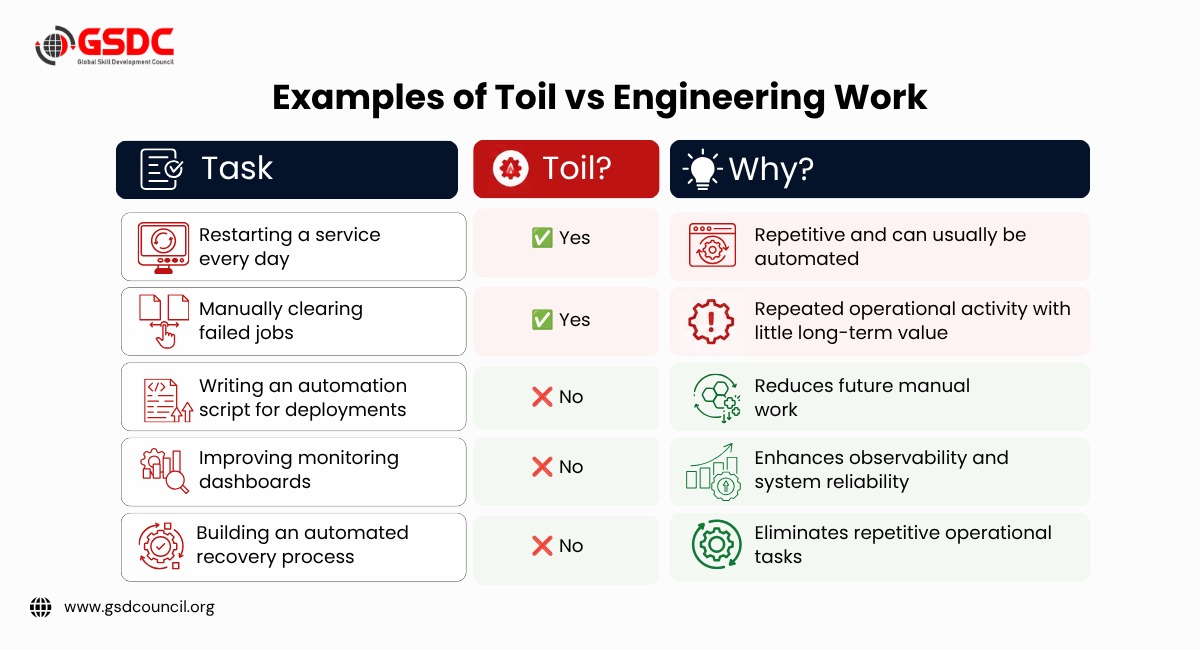
In Site Reliability Engineering, toil refers to repetitive, manual operational work that is necessary to keep services running but provides little long-term value. These tasks usually follow the same process every time, can often be automated, and do not improve the system itself.
Unlike engineering work, which focuses on building, improving, or automating systems, toil keeps engineers busy maintaining the current state of the service.
Some common examples of toil include:
- Restarting failed services every morning.
- Manually clearing message queues.
- Running the same deployment commands repeatedly.
- Responding to recurring alerts with identical fixes.
- Updating infrastructure through manual processes instead of automation.
Not every operational task is considered toil. Activities such as designing a monitoring strategy, improving deployment pipelines, or automating incident response contribute to long-term reliability and should be viewed as engineering investments rather than repetitive operational work.
Why Toil Is a Problem for SRE Teams
A small amount of operational work is expected in every production environment. The problem begins when repetitive manual tasks become a significant part of an engineer's workload.
Excessive toil affects both engineering productivity and service reliability in several ways.
1. Reduces Engineering Productivity
Every hour spent on repetitive operational work is an hour not spent improving systems, automating processes, or developing new features.
When engineers spend most of their time resolving recurring issues instead of preventing them, long-term reliability improvements are often delayed.
2. Increases On-Call Workload
On-call engineers frequently deal with repetitive alerts, manual recovery steps, and recurring operational issues.
Over time, this increases workload, disrupts focus, and makes on-call rotations more demanding than necessary.
Following strong on-call best practices, such as well-defined runbooks, automated remediation, and meaningful alerts, helps reduce unnecessary operational effort.
3. Leads to Alert Fatigue
Not every alert requires immediate action.
Poorly configured monitoring systems often generate excessive notifications, many of which are low priority or repeated versions of the same issue.
As alert volume increases, engineers may begin ignoring notifications or delaying responses, making it easier for critical incidents to go unnoticed.
Reducing unnecessary alerts is an important step in minimizing operational toil.
4. Increases MTTR (Mean Time to Recovery)
When incident response depends on manual troubleshooting and repetitive recovery steps, resolving production issues takes longer.
Higher MTTR (Mean Time to Recovery) means longer service disruptions, greater business impact, and increased pressure on engineering teams.
Automation, standardized runbooks, and effective incident management processes help reduce recovery time and improve overall service reliability.
5. Delays Automation Initiatives
Teams overwhelmed by operational work often struggle to find time for automation.
Ironically, the repetitive work consuming their time is often the very work that should be automated first.
Without dedicated effort to eliminate toil, organizations remain stuck in a cycle of manual operations.
6. Contributes to Engineer Burnout
Repeatedly performing the same operational tasks can become mentally exhausting.
Constant incident response, frequent interruptions, and overnight on-call responsibilities reduce job satisfaction and increase the risk of burnout.
Reducing toil allows engineers to focus on meaningful work that improves systems instead of repeatedly maintaining them.
Common Sources of Toil in SRE
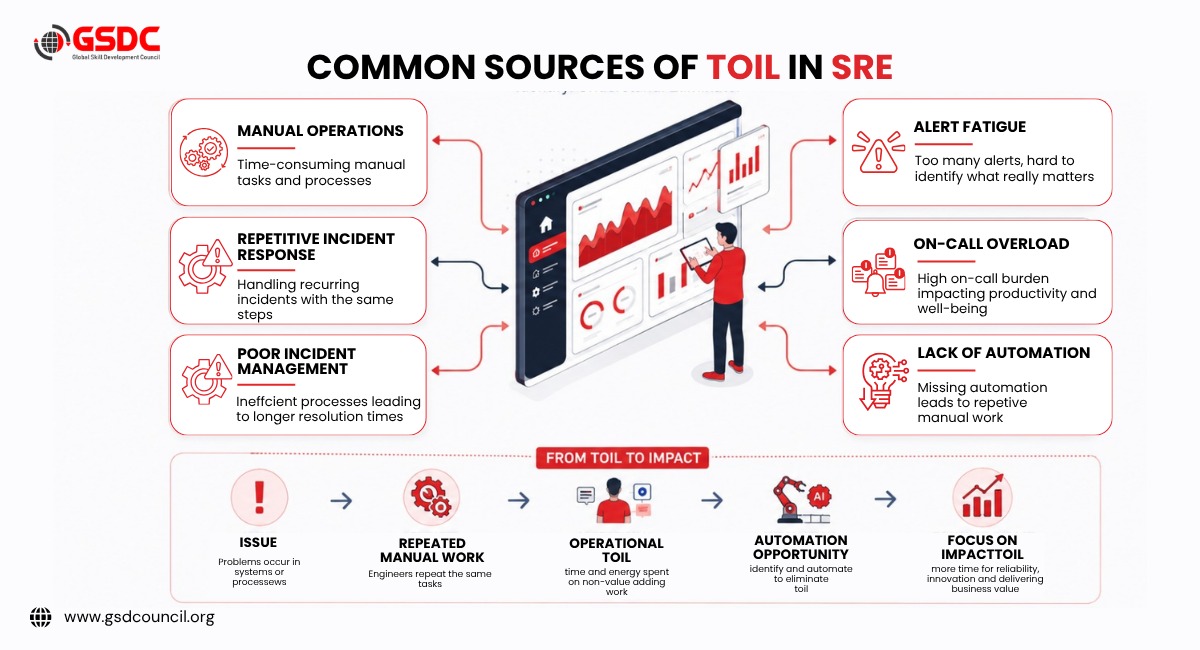
Toil doesn't always come from complex systems. In many cases, it develops because repetitive tasks are accepted as part of daily operations instead of being automated or redesigned.
Here are some of the most common sources of toil in Site Reliability Engineering.
1. Repetitive Incident Response
Incident response is a core responsibility of SRE teams, but repeatedly resolving the same incident is a clear sign of operational toil.
For example, if engineers follow the same recovery steps every time a service becomes unavailable, the issue is no longer the incident itself, it's the lack of a permanent solution.
Common examples include:
- Restarting the same application after every deployment.
- Manually clearing stuck jobs or message queues.
- Repeatedly resolving identical database connection issues.
- Following the same troubleshooting steps for recurring alerts.
Recurring incidents should be treated as opportunities for automation or system improvements rather than routine operational work.
2. Manual Operational Tasks
Many production environments still rely on manual processes for routine maintenance. While these tasks may appear simple, they become costly when performed frequently.
Examples include:
- Manual application deployments.
- Restarting services after failures.
- Renewing certificates manually.
- Cleaning temporary files or logs.
- Scaling infrastructure during peak traffic.
As these activities increase, engineering teams spend more time maintaining systems than improving them.
Whenever a manual task follows the same steps every time, it's worth evaluating whether it can be automated.
3. Poor Incident Management
An ineffective incident management process can significantly increase operational toil.
Without clear ownership, documented procedures, or standardized communication, engineers often spend valuable time figuring out what to do instead of resolving the issue.
Common challenges include:
- No defined incident response process.
- Missing or outdated runbooks.
- Manual communication across multiple teams.
- Unclear ownership during major incidents.
- Repeating the same troubleshooting steps for similar issues.
A structured incident management process reduces confusion and allows teams to respond more consistently.
4. Alert Fatigue
Monitoring systems are designed to detect issues early, but too many alerts can have the opposite effect.
When engineers receive hundreds of notifications every day, many of them become background noise. Important alerts are easily missed, response times increase, and unnecessary operational work becomes part of the daily routine.
Common causes of alert fatigue include:
- Duplicate alerts for the same issue.
- Alerts without clear action items.
- Incorrect threshold values.
- Monitoring metrics that don't impact users.
- Notifications that rarely require intervention.
Regularly reviewing and optimizing alert rules helps reduce unnecessary workload while improving incident response.
5. Inefficient On-Call Processes
On-call engineers should focus on resolving important production issues, not performing repetitive maintenance tasks.
However, many organizations overload their on-call teams with work that could be automated or handled during regular business hours.
Examples include:
- Responding to low-priority alerts overnight.
- Manually restarting services after known failures.
- Investigating recurring issues without permanent fixes.
- Following undocumented recovery procedures.
Following on-call best practices helps reduce unnecessary interruptions and improves the overall on-call experience.
Some recommended practices include:
- Create detailed runbooks for common incidents.
- Automate repetitive recovery tasks.
- Review on-call alerts regularly.
- Remove alerts that don't require immediate action.
- Conduct regular reviews of recurring incidents.
6. Lack of Automation
Many sources of toil exist simply because automation has never been implemented.
Tasks that are performed daily, weekly, or after every deployment are strong candidates for automation.
Examples include:
- Automated deployments instead of manual releases.
- Self-healing infrastructure for common failures.
- Automatic scaling during traffic spikes.
- Automated backups and recovery.
- Scheduled maintenance tasks.
Automation doesn't eliminate every operational task, but it significantly reduces repetitive work and allows engineers to focus on improving system reliability.
How to Measure Toil in SRE
Reducing toil starts with understanding how much of it exists.
Without measurable data, it's difficult to determine whether operational improvements are actually reducing repetitive work.
The following metrics can help teams identify and track operational toil.
1. Percentage of Engineering Time Spent on Toil
One of the simplest ways to measure toil is to estimate how much engineering time is spent on repetitive operational work.
For example:
- 20% - Routine operational tasks
- 50% - Feature development
- 30% - Reliability improvements and automation
If engineers consistently spend a large portion of their time on repetitive maintenance instead of engineering work, operational toil is likely becoming a bottleneck.
Many mature SRE teams aim to keep toil below 50% of an engineer's workload, with a strong focus on continuously reducing it over time.
2. MTTR (Mean Time to Recovery)
MTTR (Mean Time to Recovery) measures how quickly a team restores a service after an incident.
A consistently high MTTR often indicates that incident response depends on manual investigation, undocumented procedures, or repetitive recovery steps.
Reducing toil through automation, better monitoring, and standardized runbooks helps shorten recovery times and improve service availability.
3. Number of Recurring Incidents
When the same incident occurs repeatedly, it often points to unresolved operational toil.
Instead of asking:
"How many incidents did we resolve?"
Ask:
"How many of these incidents have happened before?"
Recurring incidents usually indicate opportunities for:
- Automation
- Better monitoring
- Improved system design
- Permanent fixes instead of temporary workarounds
4. Alert Volume
The number of alerts generated each day is another useful indicator of operational toil.
A high alert volume doesn't necessarily mean the system is unreliable,it may simply indicate that monitoring rules need improvement.
Track metrics such as:
- Alerts per engineer
- Actionable vs. non-actionable alerts
- Duplicate alerts
- False-positive alerts
Reducing unnecessary alerts helps engineering teams focus on incidents that genuinely require attention.
5. Manual Operational Activities
Another effective way to measure toil is by tracking how often engineers perform manual operational tasks.
Examples include:
- Manual deployments
- Manual service restarts
- Manual infrastructure changes
- Manual database maintenance
- Manual rollbacks
If these activities occur frequently, they should be evaluated for automation.
How Incident Management Helps Reduce Toil
Every incident is an opportunity to improve system reliability. An effective incident management process not only restores services quickly but also helps prevent the same issues from happening again.
Without a structured process, teams often resolve incidents using temporary fixes. While the immediate problem is solved, the underlying cause remains, leading to repeated incidents and more operational toil.
A well-defined incident management process helps teams:
- Respond to incidents faster with clear roles and responsibilities.
- Follow standardized runbooks instead of relying on individual knowledge.
- Improve communication during major incidents.
- Identify recurring issues that require permanent fixes.
- Create action items that reduce future manual work.
The goal of incident management isn't just to restore a service. It's to reduce the amount of repetitive operational work required to keep that service running.
Why Blameless Postmortems Matter
Once an incident is resolved, the next step is understanding why it happened and how to prevent it from happening again.
This is where a blameless postmortem becomes valuable.
A blameless postmortem focuses on improving systems and processes rather than assigning responsibility to individuals. Instead of asking who made a mistake, the discussion centers on why the system allowed the incident to occur and what changes can reduce the likelihood of it happening again.
A productive postmortem should answer questions such as:
- What triggered the incident?
- Why wasn't the issue detected earlier?
- Which manual steps increased recovery time?
- Could any part of the response be automated?
- Were the existing runbooks accurate and complete?
- What improvements will prevent this incident from recurring?
This approach encourages open discussions, improves learning across teams, and helps identify opportunities to reduce operational toil.
A Simple Incident Postmortem Template
Using a consistent incident postmortem template makes reviews more effective and ensures important details are captured after every incident.
A typical template should include:
Section | Purpose |
| Incident Summary | Brief overview of what happened. |
| Timeline | Key events from detection to resolution. |
| Impact Assessment | Services, users, or business processes affected. |
| Root Cause | Primary reason the incident occurred. |
| Resolution | Steps taken to restore the service. |
| Lessons Learned | Key observations from the incident. |
| Action Items | Tasks to prevent similar incidents. |
| Automation Opportunities | Manual steps that can be automated to reduce future toil. |
Best Practices to Eliminate Toil in SRE
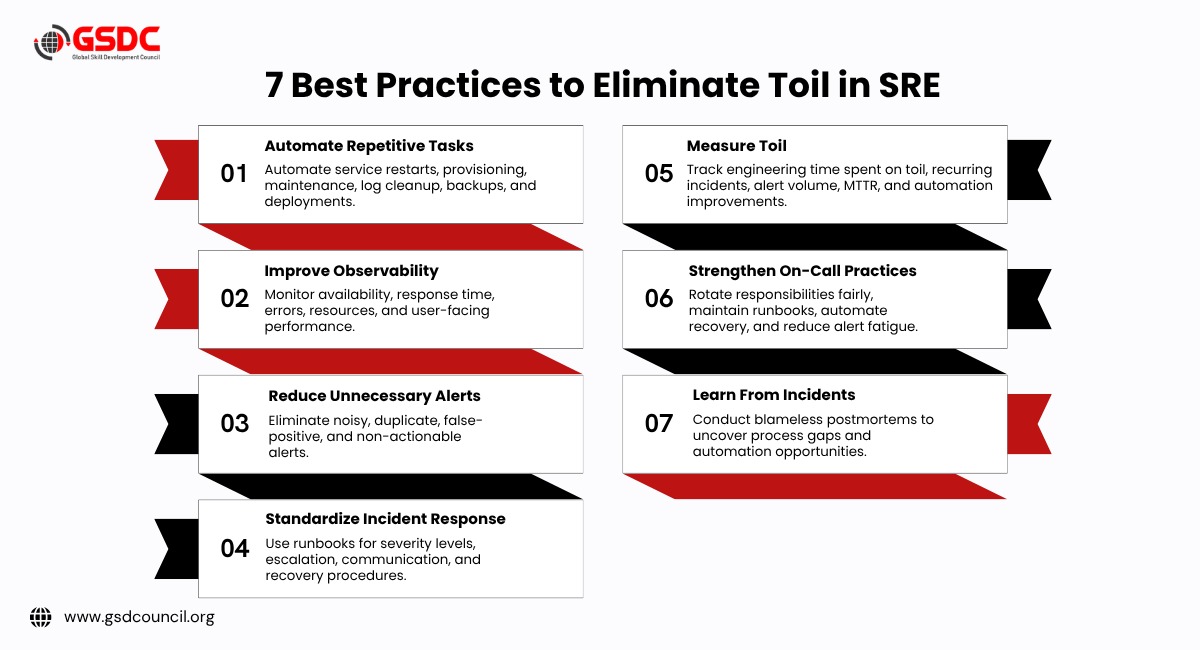
Reducing toil is an ongoing process rather than a one-time project. High-performing SRE teams regularly review their operations, automate repetitive tasks, and improve their workflows to minimize unnecessary manual effort.
Here are some best practices that can help.
1. Automate Repetitive Tasks
If a task follows the same steps every time, it should be evaluated for automation.
Common candidates include:
- Service restarts
- Infrastructure provisioning
- Routine maintenance
- Log cleanup
- Backup verification
- Deployment processes
Automation reduces manual effort, improves consistency, and allows engineers to focus on higher-value work.
2. Improve Observability
Better observability helps teams identify problems before they become incidents.
Monitor metrics that reflect the health of the service, such as:
- Service availability
- Response time
- Error rate
- Resource utilization
- User-facing performance
Effective observability reduces troubleshooting time and supports faster incident resolution.
3. Reduce Unnecessary Alerts
Every alert should have a clear purpose.
Review monitoring rules regularly and remove alerts that:
- Never require action.
- Frequently generate false positives.
- Duplicate existing notifications.
- Don't affect service reliability.
Fewer, high-quality alerts help engineers focus on issues that genuinely require attention.
4. Standardize Incident Response
Engineers shouldn't have to decide the response process during an incident.
Create standardized runbooks that clearly define:
- Incident severity levels
- Response procedures
- Escalation paths
- Communication guidelines
- Recovery steps
Standardized responses reduce confusion and improve consistency across the team.
5. Review Incidents Regularly
Every production incident provides valuable insights.
Conduct regular blameless postmortems to identify:
- Repeated manual work
- Process gaps
- Missing automation
- Monitoring improvements
- Documentation updates
Small improvements after each incident can significantly reduce operational toil over time.
6. Improve On-Call Practices
A well-designed on-call process helps engineers respond effectively without creating unnecessary workload.
Some useful on-call best practices include:
- Rotate on-call responsibilities fairly.
- Keep runbooks updated.
- Reduce low-priority alerts.
- Automate common recovery actions.
- Review recurring incidents after each on-call cycle.
The objective is to ensure on-call engineers spend their time resolving meaningful incidents rather than repetitive operational tasks.
7. Track Toil as an Engineering Metric
Toil should be measured just like availability, latency, or MTTR (Mean Time to Recovery).
Useful metrics include:
- Percentage of engineering time spent on toil
- Number of recurring incidents
- Manual operational tasks completed each month
- Alert volume
- Average MTTR
- Number of automation improvements implemented
Tracking these metrics helps teams understand whether operational improvements are reducing repetitive work over time.
Build Your SRE Expertise with an SRE Certification
Reducing toil is one of the core skills SRE professionals need to develop. If you want to go beyond understanding toil and build practical expertise in Site Reliability Engineering, automation, monitoring, incident management, and reliability practices, consider earning a Site Reliability Engineering (SRE) Foundation Certification from GSDC.
Why Choose an SRE Certification?
A Site Reliability Engineering (SRE) Certification can help you build practical knowledge of the principles and practices used to improve system reliability and reduce operational toil.
- Understand SRE Fundamentals: Learn core SRE principles, practices, and responsibilities.
- Learn How to Reduce Toil: Identify repetitive operational work and apply automation to eliminate it.
- Master SRE Metrics: Understand SLIs, SLOs, SLAs, and error budgets to measure and manage reliability.
- Strengthen Incident Management Skills: Learn practical approaches to incident response, troubleshooting, and post-incident reviews.
- Improve Automation & Monitoring: Understand how automation and observability can reduce manual work and improve system performance.
- Build Reliability-Focused Skills – Develop the knowledge needed to design and maintain more reliable, scalable systems.
- Validate Your SRE Knowledge: Earn a recognized certification that demonstrates your understanding of Site Reliability Engineering practices.
- Advance Your Career: Strengthen your profile for roles involving SRE, DevOps, cloud operations, and IT reliability.
Becoming SRE certified can help you demonstrate your understanding of modern reliability practices and show employers that you have the knowledge to support stable, scalable, and efficient systems. It also gives you a structured understanding of areas such as toil reduction, automation, observability, incident management, and SRE metrics that are increasingly important in modern IT environments.
Conclusion
Toil is an unavoidable part of running production systems, but it should never become the primary focus of an SRE team's workload.
Recurring manual tasks, repeated incidents, excessive alerts, and inefficient operational processes are all indicators that systems can be improved. By identifying these patterns, measuring their impact, and investing in automation, organizations can reduce operational overhead while improving reliability.
Effective incident management, blameless postmortems, and strong on-call practices play an important role in this process. They not only help teams recover from incidents faster but also uncover opportunities to eliminate the repetitive work that causes them.
The most successful SRE teams don't aim to handle more toil, they work continuously to reduce it. Every manual task that is automated, every recurring incident that is permanently resolved, and every improvement made after a postmortem allows engineers to spend more time building reliable systems instead of repeatedly maintaining them.

Related Certifications
Frequently Asked Questions
Toil in SRE refers to repetitive, manual, and operational work that is necessary to keep a system running but provides little long-term value. Examples include repeated service restarts, manual deployments, recurring incident fixes, and responding to repetitive alerts. SRE teams aim to reduce toil through automation and better processes.
Excessive toil consumes engineering time that could otherwise be spent on automation, system improvements, and reliability initiatives. It can also increase on-call workload, contribute to alert fatigue, increase MTTR, delay engineering work, and contribute to engineer burnout.
No, it is difficult to eliminate toil completely because some operational work will always be required in production environments. The goal of SRE is to keep toil under control and continuously reduce unnecessary repetitive work through automation, better tooling, and improved processes.
No. Automation should be used where it provides real value and reduces repetitive effort or risk. Some tasks require human judgment and should remain manual. The goal isn't “automate everything” but to ensure engineers spend their time on work that requires engineering judgment and creates lasting value.
An SRE certification can help professionals build structured knowledge of Site Reliability Engineering principles, including toil reduction, automation, observability, incident management, SRE metrics, and reliability practices. It can also demonstrate SRE knowledge to employers and support career development in SRE, DevOps, cloud, and infrastructure roles.
An SRE Certification can be useful for SRE professionals, DevOps engineers, software engineers, system administrators, cloud professionals, IT operations teams, and infrastructure professionals. It is also suitable for professionals looking to transition into SRE or strengthen their existing reliability engineering skills.
Stay up-to-date with the latest news, trends, and resources in GSDC
If you like this read then make sure to check out our previous blogs: Cracking Onboarding Challenges: Fresher Success Unveiled
Not sure which certification to pursue? Our advisors will help you decide!