Top 10 HR Challenges and How to Solve Them
Written by Matthew Hale
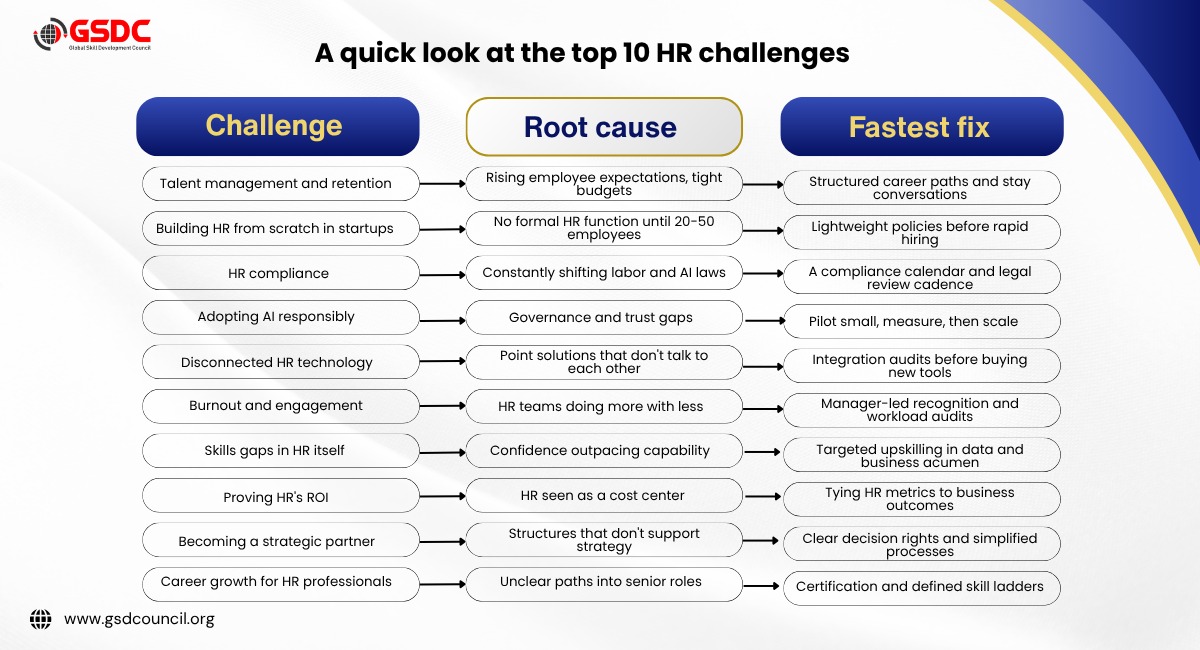
- 1. The challenges of talent management haven't gone away; they've just changed shape
- 2. HR challenges in startups: building the plane while flying it
- 3. HR compliance challenges are multiplying faster than most teams can track
- 4. The challenges of AI in HR go beyond "should we use it"
- 5. HR technology trends: too many tools, not enough integration
- 6. Burnout isn't just an employee problem; HR is burning out too
- 7. HR skills haven't kept pace with what the job now demands
- 8. Proving HR's value is still an uphill climb
- 9. Becoming a true strategic partner is still more talk than reality
- 10. HR professionals need clearer paths for their own careers
- Where a credential like Certified HR Professional fits in
- The bigger picture: HR challenges and solutions rarely come one at a time
If you work in HR, you already know it hasn't been a quiet stretch. Budgets are tighter, employees expect more, and AI has landed on every HR leader's desk whether they asked for it or not. According to Gallup's State of the Global Workplace report, global employee engagement has fallen to 20%, its lowest level since 2020, and now costs the world economy an estimated $10 trillion a year in lost productivity. That single number sums up most of the HR challenges on this list: people are checking out, budgets haven't grown to match what it would take to bring them back, and HR is stuck in the middle trying to hold it all together.
The good news is that none of these problems are unsolvable. They're just different from the ones HR teams were solving five years ago. This guide walks through the ten HR challenges we're seeing most often right now, what's actually causing them, and what HR teams are doing to fix them.
Let's get into each one, along with practical, doable solutions.
1. The challenges of talent management haven't gone away; they've just changed shape
Attracting and retaining good people is still the number one item on most HR leaders' lists, and it's one of the most persistent challenges of talent management right now. What's changed is why it's hard. It's no longer just about writing a competitive offer. Candidates now compare flexibility, growth opportunities, and company reputation before they even apply.
Retention is the other half of this problem, and it's expensive to get wrong. Estimates vary by role and seniority, but commonly cited industry research puts replacement costs anywhere from roughly a third of an employee's annual salary for entry-level roles to several times that for specialized or senior ones, once you count lost productivity, recruiting time, and onboarding. Workday's own research found that in 75% of industries, companies saw voluntary turnover increase year over year among their best performers, which is exactly the group you can least afford to lose.
What's working:
- Regular "stay interviews" instead of only exit interviews, so you catch flight risk before someone resigns
- Transparent, structured career paths so employees can see what growth actually looks like
- Pay benchmarking at least once a year, since misaligned compensation is one of the quietest reasons people leave
For HR professionals, solving retention challenges also requires strong skills in employee engagement, workforce planning, and talent management. Global Skill Development Council (GSDC) offers certification programs that can help HR professionals build structured knowledge and strengthen their capabilities across these areas, supporting more informed talent management decisions.
2. HR challenges in startups: building the plane while flying it
HR challenges in startups look nothing like the ones a 2,000-person enterprise deals with, and the scale problem starts earlier than most founders expect. Research tracking hundreds of growing companies puts the average first dedicated HR hire somewhere between 40 and 50 employees, with nearly all companies having at least one HR FTE by the time they hit 100. Until then, whoever is running HR is usually doing it alongside three other jobs, with no playbook and no legacy systems to fall back on.
The common mistakes are predictable: informal verbal agreements instead of documented policies, no consistent onboarding, and compliance getting bolted on only after something goes wrong. The fix isn't to build enterprise-grade HR on day one. It's to put a handful of lightweight, non-negotiable basics in place early.
Start with:
- A written employee handbook, even a short one, covering leave, conduct, and pay
- A basic applicant tracking process so hiring decisions aren't scattered across email threads
- One clear point of contact for HR questions, even if that person wears five other hats
3. HR compliance challenges are multiplying faster than most teams can track
HR compliance challenges used to mean staying current on labor law and payroll tax changes. Now add data privacy rules, evolving AI regulations like the EU AI Act, and a patchwork of state-level employment laws, and it's easy to see why compliance keeps HR leaders up at night. This is also one of the areas where global HR challenges hit hardest, since a rule change in one country can mean a completely different set of obligations for a distributed team.
The teams handling this well aren't the ones with the biggest legal budgets. They're the ones with a system for staying ahead of changes instead of reacting to them.
Practical steps:
Build a compliance calendar that flags renewal dates, filing deadlines, and policy review cycles
Assign compliance ownership to a specific person or team, not "HR in general"
Loop in legal counsel before rolling out new AI tools that touch hiring or performance decisions, not after
4. The challenges of AI in HR go beyond "should we use it"
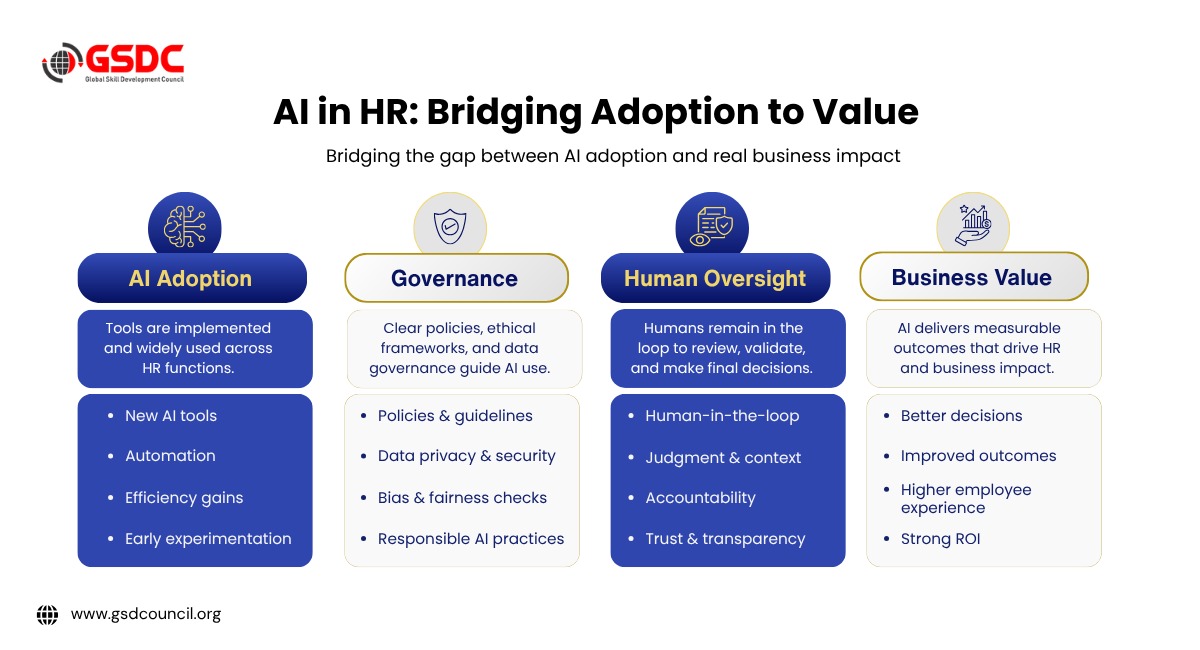
Almost every HR conversation these days eventually turns to AI, and the challenges of AI in HR are less about resistance and more about execution. Adoption has moved fast: McKinsey's global AI research found that 88% of companies now use AI in at least one business function. But adoption and value aren't the same thing. A separate Gartner survey of 114 HR leaders found that most of them, 88%, say their teams haven't yet seen significant business value from the AI tools they've rolled out specifically within HR.
That gap usually comes down to three things: messy underlying data, unclear governance, and tools that were adopted before anyone defined what success should look like. When people talk about AI in HR trends, this is really the story underneath the headlines: less hype, more discipline about where AI actually earns its place.
How to close the gap:
- Pick one high-friction, low-risk process (like resume screening or scheduling) to pilot first
- Set a clear owner and success metric before rollout, not after
- Keep a human in the loop for any decision that affects pay, hiring, or termination
For HR professionals looking to build the skills needed to navigate AI adoption responsibly, a Certified HR Professional credential can provide structured learning across areas such as HR technology, governance, and strategic decision-making. This can help professionals approach AI adoption with a stronger understanding of both its opportunities and its implications for the workforce.
5. HR technology trends: too many tools, not enough integration
One of the biggest HR technology challenges right now isn't a lack of tools, it's too many of them that don't talk to each other. Recruiting lives in one platform, payroll in another, performance reviews somewhere else entirely. HR teams end up re-entering the same data three or four times, which eats hours that could go toward actual strategic work.
Among the HR technology trends that matter most right now, consolidation is at the top. Rather than adding another point solution, more HR teams are auditing what they already own and either integrating it properly or replacing it with something that fits their existing stack.
Before buying anything new, ask:
- Does this integrate cleanly with our existing HRIS and payroll systems?
- Who owns data accuracy across these tools?
- Will this reduce manual work, or just add another login?
6. Burnout isn't just an employee problem; HR is burning out too
Talk to HR professionals about HR challenges today, and burnout comes up almost immediately, and it isn't limited to the rest of the workforce. Gallup's global workplace data found that worldwide employee engagement has fallen to its lowest level since 2020, with 56% of employees describing themselves as struggling rather than thriving. Manager engagement has dropped even further, from 31% a few years ago to 22% today, and that matters because a disengaged manager tends to produce a disengaged team underneath them, HR managers included.
This matters because a stretched-thin, disengaged HR team can't do much to fix engagement everywhere else in the business. You can't pour from an empty cup, and HR leaders are increasingly realizing that fixing their own team's workload is step one, not an afterthought.
Where to start:
- Audit which HR tasks are purely administrative and automate or delegate them
- Set realistic staffing ratios instead of absorbing growth without adding headcount
- Make manager-led recognition a habit, not a once-a-year event, since it's one of the cheapest ways to lift engagement
7. HR skills haven't kept pace with what the job now demands
Among current HR trends and challenges, the skills gap inside HR itself is one of the least talked about and most consequential. Deloitte's Global Human Capital Trends report, based on a survey of more than 9,000 business and HR leaders across 89 countries, found that only 14% of leaders feel adept at designing effective collaboration between people and AI, even as that's quickly becoming one of the most important skills HR is expected to bring to the table.
If you're wondering what HR skills are most in demand right now, the honest answer is a mix: data literacy, change management, and enough technical fluency to evaluate AI tools without needing an engineer to translate for you. These sit alongside the traditional HR skills and responsibilities like employee relations and policy design, they don't replace them.
Closing the gap:
- Build short, focused learning tracks around data interpretation and HR analytics
- Rotate HR staff through cross-functional projects with finance or operations
- Treat certification and structured upskilling as a budget line, not a nice-to-have
8. Proving HR's value is still an uphill climb
One of the more frustrating HR management challenges is that HR's best work is often invisible. The resignation that never happened, the lawsuit that was avoided, the culture problem that got fixed before it became a headline, none of that shows up neatly on a dashboard. That makes it hard to defend HR budgets when leadership is looking for line-item ROI.
The teams that solve this stop reporting HR activity (how many trainings ran, how many roles filled) and start reporting HR outcomes tied to the business: retention cost avoided, time-to-productivity for new hires, engagement scores mapped against turnover.
Reframe your reporting around:
- Cost per hire versus cost of turnover, side by side
- Engagement trends mapped against team-level performance
- Time saved through process or technology changes, in hours or dollars
9. Becoming a true strategic partner is still more talk than reality
The future of HR has been "strategic partner" for over a decade now, but plenty of teams still spend most of their time on administrative work instead. Part of the issue is structural. Even when an organization's HR structure looks like it supports strategy on paper, unclear decision rights and weak internal systems keep HR reacting to problems instead of getting ahead of them.
Among the top HR trends worth watching, this shift from reactive to proactive HR is probably the most important one, because it's the difference between HR that responds to what the business needs and HR that shapes it.
Getting there requires:
- Clarity on who actually owns which HR decisions, documented, not assumed
- Simplifying internal processes before adding new strategic initiatives on top of a broken foundation
- A seat at planning conversations early, not after headcount and budget decisions are already made
10. HR professionals need clearer paths for their own careers
It's worth pointing out that HR professionals are dealing with their own version of the talent challenges they manage for everyone else. Anyone researching an HR career path online quickly finds a confusing mix of generalist and specialist tracks, with little consistency in how companies define seniority or what is an HR professional actually expected to know at each level.
Structured, recognized credentials help here. A well-regarded HR professional certification gives both the individual and their employer a shared benchmark for skill and readiness, which matters more as HR roles keep absorbing new responsibilities around data, technology, and compliance. Organizations like GSDC offer certification paths built around exactly the skills covered in this list: HR analytics, compliance, and strategic HR management, giving professionals a structured way to close the gaps that hold careers back.
If you're mapping out your own growth:
- Identify whether you want to go deep (specialist) or broad (generalist), since the skill sets diverge
- Pursue certification in areas where you're weakest, not just where you're already strong
- Find a mentor or peer network outside your own company for perspective on where the field is heading
Where a credential like Certified HR Professional fits in
Reading through all ten of these challenges, a pattern shows up more than once: HR is expected to operate like a specialist function in talent, compliance, technology, and strategy, without always having formal training to back all of that up. That's part of why bodies like the Global Skill Development Council (GSDC) put together structured credentials such as the Certified HR Professional designation, built around exactly that mix of end-to-end capability. For someone juggling several of the challenges above at once, it's less about adding another line to a resume and more about having a recognized way to formalize skills that are often picked up informally, under pressure, on the job.
The bigger picture: HR challenges and solutions rarely come one at a time
What makes this moment different isn't any single item on this list. It's that most HR teams are dealing with several of these at once: an AI rollout, a compliance update, and a retention problem, all in the same quarter, with the same headcount they had two years ago. That's exactly why treating these as isolated fires rarely works. The teams that are holding up best have picked one or two priorities from this list, fixed the foundation there, and let the improvements ripple outward instead of trying to solve everything simultaneously.
If there's one thread running through all ten of these HR challenges, it's this: the function that used to be about paperwork and process is now expected to be equal parts data analyst, technologist, and strategist. Investing in your own skills is quickly becoming as important as any tool or policy change you make for your team.

Related Certifications
Frequently Asked Questions
An HR professional's job now spans recruitment, employee relations, compliance, compensation, and increasingly, data analysis and technology evaluation. The scope has widened well beyond traditional hiring and policy administration, which is part of why structured HR skills and responsibilities frameworks have become more relevant.
Data literacy, change management, and AI governance are the fastest-growing skill demands, alongside long-standing core skills like employee relations, conflict resolution, and policy design.
HR professional salary varies widely by seniority, specialization, and region. In practice, professionals with data analytics skills, compliance expertise, or a recognized certification tend to be better positioned for the higher-paying roles at each level, though the certification itself is one factor among several rather than a guaranteed pay bump.
The future of HR points toward a smaller share of time spent on administrative tasks and a larger share on workforce planning, data-driven decisions, and change management, as automation and AI absorb more routine work.
For most professionals, yes. A recognized HR professional certification, such as those offered through GSDC, provides a structured way to validate skills employers are actively looking for, which can support both promotions and career transitions within HR.
Stay up-to-date with the latest news, trends, and resources in GSDC
If you like this read then make sure to check out our previous blogs: Cracking Onboarding Challenges: Fresher Success Unveiled
Not sure which certification to pursue? Our advisors will help you decide!