25 FDE Interview Questions: Guide for Forward Deployed Engineers

Written by Emily Hilton
Forward Deployed Engineers (FDEs) are becoming increasingly important as organizations look for professionals who can connect software engineering, AI, data, and real-world business needs. Unlike traditional software engineers, FDEs often work directly with customers or internal teams to understand complex problems, build technical solutions, deploy them in real-world environments, and continuously improve those solutions.
As demand for AI-powered products and enterprise technology grows, understanding what is a forward deployed engineer, what the role involves, and how to prepare for FDE interviews has become increasingly valuable for technology professionals.
This guide covers 25 FDE interview questions, including technical, problem-solving, behavioral, AI, deployment, and customer-facing scenarios.
What Is a Forward Deployed Engineer?
A Forward Deployed Engineer is a technical professional who works closely with customers or business teams to solve specific problems using software, data, AI, and engineering solutions.
The forward deployed engineer role combines elements of software engineering, solution architecture, consulting, product development, and customer success. Instead of developing a product in isolation, the engineer works close to the end user and adapts technology to real-world requirements.
A forward deployed engineer may analyze customer requirements, build prototypes, integrate APIs, develop applications, work with data pipelines, deploy solutions, troubleshoot production issues, and communicate technical decisions to non-technical stakeholders.
What Does a Forward Deployed Engineer Do?
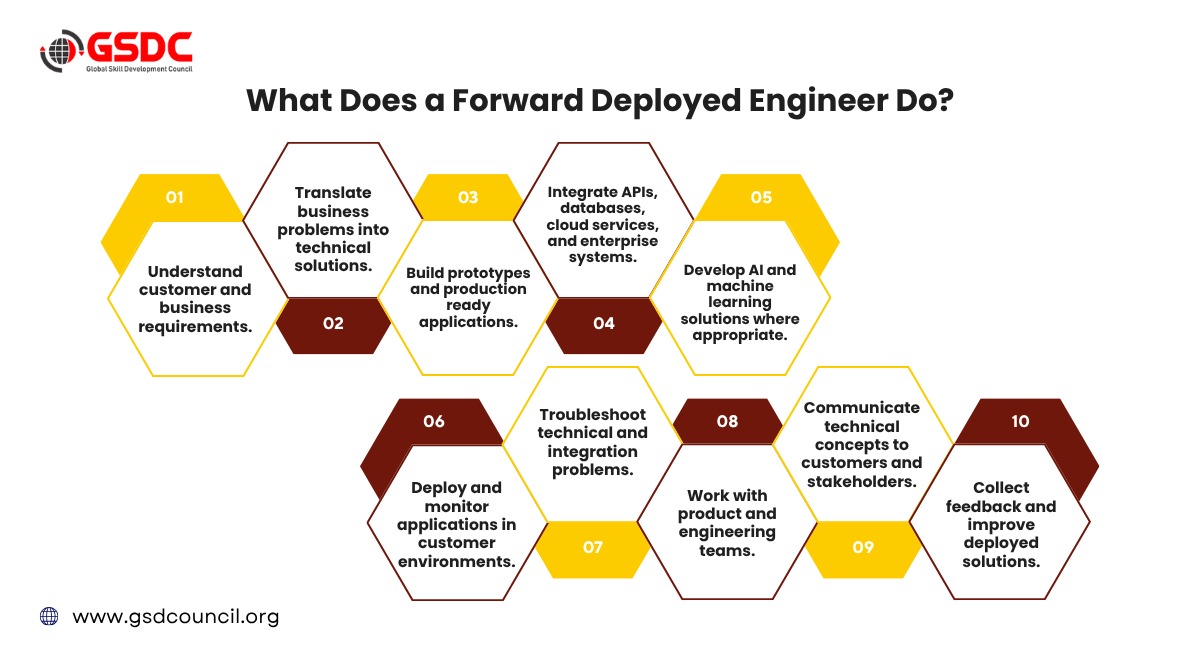
The responsibilities can vary depending on the organization and product. However, a typical FDE may:
- Understand customer and business requirements.
- Translate business problems into technical solutions.
- Build prototypes and production-ready applications.
- Integrate APIs, databases, cloud services, and enterprise systems.
- Develop AI and machine learning solutions where appropriate.
- Deploy and monitor applications in customer environments.
- Troubleshoot technical and integration problems.
- Work with product and engineering teams.
- Communicate technical concepts to customers and stakeholders.
- Collect feedback and improve deployed solutions.
The role requires strong technical knowledge as well as communication, adaptability, and problem-solving skills.
25 FDE Interview Questions and Answers
The following FDE interview questions are designed to help candidates prepare for different stages of an FDE hiring process.
1. What is a Forward Deployed Engineer?
A Forward Deployed Engineer is a technical professional who works directly with customers or business teams to design, build, customize, and deploy technology solutions for specific requirements.
The role combines software engineering with customer-facing problem solving. An FDE typically needs to understand both the technical architecture and the business context behind a problem.
2. What does a Forward Deployed Engineer do?
A Forward Deployed Engineer identifies customer problems, translates them into technical requirements, develops solutions, integrates systems, deploys applications, and helps ensure that the solution works effectively in a real-world environment.
The role may involve coding, debugging, data analysis, API integration, cloud deployment, AI implementation, and stakeholder communication.
3. How is an FDE different from a traditional software engineer?
A traditional software engineer generally focuses on building and maintaining products according to predefined technical and product requirements.
An FDE usually works closer to customers and real-world use cases. The engineer may need to rapidly understand unfamiliar requirements, build prototypes, customize solutions, and deploy them in different environments.
The key difference is the degree of customer interaction and problem ownership.
4. Why is the Forward Deployed Engineer role becoming popular?
The role is becoming popular because organizations increasingly need technical professionals who can move quickly from technology development to practical implementation.
AI platforms, enterprise software, cybersecurity products, data platforms, and cloud solutions often require customization before they can deliver value to customers. FDEs help bridge this implementation gap.
5. What technical skills should a Forward Deployed Engineer have?
A strong FDE typically needs knowledge of:
- Programming languages such as Python, JavaScript, Java, or similar technologies.
- APIs and system integration.
- Databases and SQL.
- Cloud platforms.
- Git and software development workflows.
- Data processing.
- Application deployment.
- Debugging and troubleshooting.
- AI and machine learning fundamentals when relevant.
The exact technical requirements depend on the organization and product.
6. How would you approach a new customer problem?
An effective approach begins with understanding the business problem rather than immediately writing code.
The engineer should identify the desired outcome, users, existing systems, constraints, data sources, security requirements, and success metrics.
The problem can then be broken into smaller technical components before selecting an appropriate solution.
7. How would you translate a business requirement into a technical solution?
The engineer should first clarify the business objective and expected outcome.
Next, functional and technical requirements should be identified. The engineer can then evaluate available systems, data, APIs, infrastructure, and implementation constraints.
A prototype or proof of concept can be developed when appropriate before moving toward a production-ready implementation.
8. How would you handle an unclear customer requirement?
An FDE should avoid making assumptions when requirements are unclear.
The engineer should ask targeted questions, identify the underlying business objective, document assumptions, and confirm priorities with the stakeholder.
A small prototype can also help stakeholders visualize the proposed solution and provide more precise feedback.
9. How would you prioritize multiple customer requirements?
Requirements should generally be prioritized according to business impact, urgency, technical feasibility, dependencies, and effort.
Critical production issues or requirements directly affecting business outcomes may receive higher priority than cosmetic improvements.
Clear communication is important when certain requests cannot be delivered immediately.
10. How would you build a quick prototype?
The engineer should first define the smallest version of the solution that can validate the core idea.
Only essential functionality should be implemented initially. Existing libraries, APIs, frameworks, and reusable components can accelerate development.
Once the prototype validates the approach, the solution can be redesigned or hardened for production.
11. How would you debug an application that works locally but fails in production?
The engineer should compare the local and production environments systematically.
Configuration variables, dependencies, permissions, network access, database connections, authentication, environment variables, resource limits, and logs should be examined.
Observability tools and application logs can help identify where the production behavior differs from the local environment.
12. How would you troubleshoot an API integration problem?
The engineer should first verify the API endpoint, request method, authentication, headers, parameters, payload, and expected response.
Logs and API testing tools can help isolate the problem. Network connectivity, rate limits, permissions, and API version compatibility should also be checked.
The issue should then be reproduced in a controlled environment before implementing a fix.
13. What is API integration, and why is it important for FDEs?
API integration allows different software systems to communicate and exchange data.
It is important for FDEs because customer environments frequently contain multiple enterprise systems. APIs can allow a newly developed solution to interact with CRM systems, databases, cloud platforms, internal applications, and third-party services.
14. What database technologies should an FDE understand?
An FDE should understand relational databases such as PostgreSQL or MySQL and have a working knowledge of SQL.
Depending on the project, knowledge of NoSQL databases, vector databases, caching systems, and data warehouses may also be useful.
More important than knowing a particular database product is understanding data modeling, queries, indexing, transactions, and performance fundamentals.
15. What is your approach to writing production-ready code?
Production-ready code should be reliable, maintainable, testable, secure, and observable.
The engineer should consider error handling, logging, testing, documentation, configuration management, security, scalability, and deployment requirements.
Code quality becomes especially important when a prototype is being converted into a long-term customer solution.
16. How would you design a scalable solution?
The engineer should first understand expected traffic, data volume, latency requirements, availability expectations, and growth projections.
The architecture can then be designed using appropriate components such as load balancing, caching, asynchronous processing, database optimization, containers, and cloud infrastructure.
Scalability should be considered without unnecessarily increasing system complexity.
17. How would you secure a customer-facing application?
Security should be incorporated from the beginning rather than treated as a final step.
An FDE should consider authentication, authorization, encryption, secrets management, input validation, access controls, secure API design, logging, vulnerability management, and data privacy.
Customer security requirements and organizational policies should also be followed.
18. How would you handle sensitive customer data?
Sensitive customer data should be handled according to applicable security policies, contractual requirements, and privacy regulations.
The engineer should minimize unnecessary data access, use appropriate encryption and access controls, avoid exposing sensitive information in logs, and ensure that data is stored and transferred securely.
19. What is deployment, and why is it important?
Deployment is the process of making an application or solution available in a target environment where users or systems can access it.
For an FDE, deployment is particularly important because building a solution is only part of the job. The solution must operate reliably within the customer's technical environment.
20. What cloud technologies should an FDE know?
An FDE benefits from understanding major cloud concepts including compute, storage, databases, networking, identity and access management, containers, monitoring, and serverless services.
Knowledge of platforms such as AWS, Microsoft Azure, or Google Cloud can be useful depending on the organization.
21. What is an AI Forward Deployed Engineer?
An AI Forward Deployed Engineer applies software engineering and AI capabilities to solve customer-specific business problems.
The role may involve integrating large language models, developing AI agents, building retrieval-augmented generation systems, connecting enterprise data sources, evaluating model performance, and deploying AI applications.
22. How would you build an AI solution for a customer?
The engineer should first determine whether AI is actually appropriate for the problem.
The next steps would include identifying available data, defining the expected output, selecting an appropriate model or approach, designing the application architecture, creating an evaluation process, and testing the solution against realistic use cases.
Security, privacy, reliability, cost, and human oversight should also be considered.
23. What is RAG, and when would you use it?
Retrieval-Augmented Generation, or RAG, combines information retrieval with generative AI.
It can be useful when an AI application needs to answer questions using organization-specific or frequently changing information that may not be contained in the model's original training data.
24. How would you evaluate an AI application's performance?
Evaluation should be based on measurable criteria relevant to the use case.
These may include accuracy, relevance, factuality, latency, cost, robustness, safety, and user satisfaction.
A combination of automated evaluation and human review can provide a more complete assessment.
25. How would you reduce hallucinations in an AI application?
The engineer can reduce hallucinations by grounding model responses in reliable data, improving prompts, using retrieval systems where appropriate, applying structured outputs, validating responses, and introducing human review for high-risk decisions.
Evaluation datasets should also be used to identify recurring failure patterns.
Skills Required to Become a Forward Deployed Engineer
Candidates preparing for fde engineer interview questions should develop a balanced skill set.
Technical Skills
A strong technical foundation may include:
- Programming and scripting
- Data structures and algorithms
- APIs and integrations
- SQL and databases
- Cloud computing
- Git and CI/CD
- Containers and deployment
- System design
- Debugging
- AI and machine learning fundamentals
Business and Communication Skills
Technical knowledge alone may not be sufficient for an FDE role.
Candidates should also develop:
- Customer communication
- Requirements gathering
- Presentation skills
- Problem-solving
- Stakeholder management
- Business analysis
- Documentation
- Prioritization
- Adaptability
How to Prepare for FDE Interview Questions
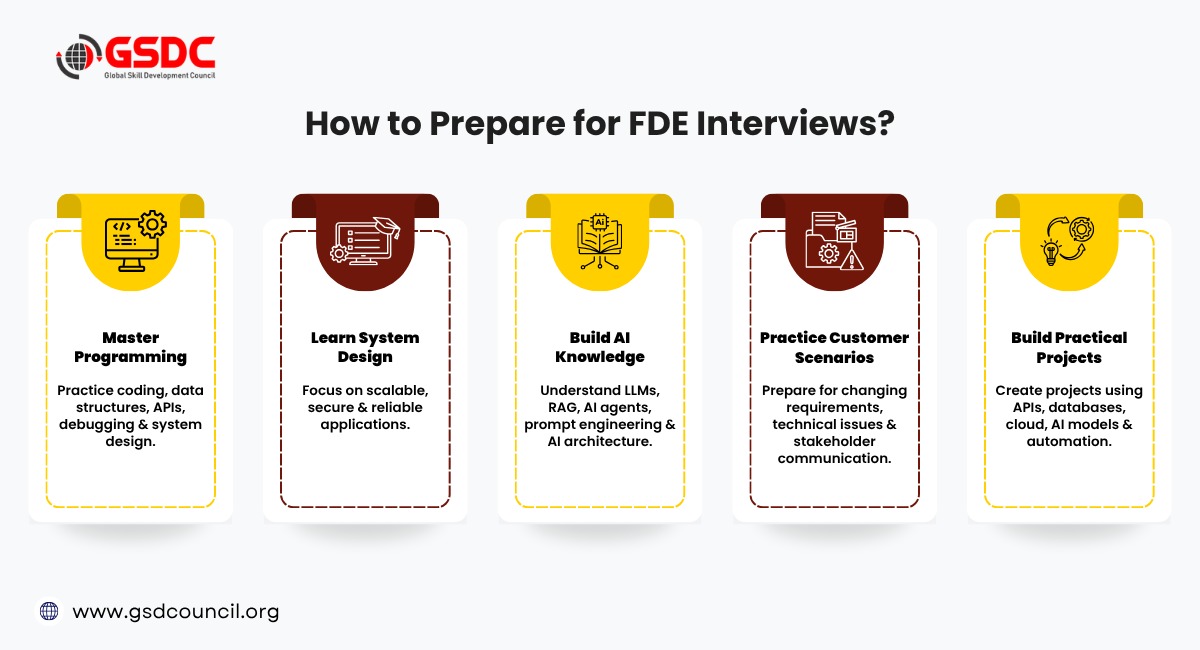
Preparing for forward deployed engineer interview questions requires a combination of technical practice and real-world problem solving.
1. Strengthen Programming Fundamentals
Candidates should practice programming concepts, data structures, algorithms, APIs, debugging, and software design.
2. Practice System Design
Candidates should learn how to design applications that are reliable, secure, scalable, and maintainable.
3. Develop AI Knowledge
For an AI forward deployed engineer position, candidates should understand LLMs, RAG, AI agents, model evaluation, prompt engineering, AI application architecture, and responsible AI practices.
4. Practice Customer Scenarios
Candidates should prepare for situations involving unclear requirements, changing priorities, production incidents, technical disagreements, and stakeholder communication.
5. Build Practical Projects
Hands-on projects can demonstrate the ability to move from an idea to a working solution.
Candidates can build applications involving APIs, databases, cloud deployment, AI models, RAG pipelines, or automated workflows.
Forward Deployed Engineer Certification
Build Skills for the FDE Career Path
A Certified Forward Deployed Engineer Certification can help professionals validate relevant technical and practical capabilities while building confidence for modern engineering roles.
The GSDC certification ecosystem emphasizes practical learning, hands-on application, and industry-relevant skills. For professionals interested in AI-enabled FDE roles, developing capabilities across software engineering, AI tools, problem-solving, and solution implementation can strengthen career readiness.
Certification can complement hands-on projects and professional experience by demonstrating structured knowledge and a commitment to continuous learning. Candidates should select certifications that align with their target FDE specialization and combine them with real-world projects to build a stronger professional portfolio.
Conclusion
Preparing for fde interview questions requires more than memorizing technical definitions. Candidates need to demonstrate how they approach ambiguous problems, communicate with customers, build practical solutions, work across teams, and deploy technology in real-world environments.
The Forward Deployed Engineer role is particularly suited to professionals who enjoy combining engineering with problem-solving and customer interaction. As enterprise AI adoption continues to grow, FDEs can play an important role in turning complex technologies into useful business solutions.
Candidates preparing for fde engineer interview questions should therefore focus on three areas: strong technical fundamentals, practical project experience, and the ability to understand and solve customer problems effectively.

Related Certifications
Frequently Asked Questions
A Forward Deployed Engineer is a technical professional who works closely with customers or business teams to build and deploy customized technology solutions.
The role involves understanding customer problems, developing technical solutions, integrating systems, deploying applications, troubleshooting issues, and communicating with stakeholders.
Not necessarily. Professionals with backgrounds in software engineering, data engineering, AI, solutions engineering, cloud computing, or related technical fields may transition into FDE roles.
AI knowledge is increasingly valuable, particularly for FDE roles involving AI products, LLM applications, automation, RAG systems, and AI agents.
Demand can vary by market and company, but the growth of enterprise AI and customized technology deployments has increased interest in customer-facing technical engineering roles.
Stay up-to-date with the latest news, trends, and resources in GSDC
If you like this read then make sure to check out our previous blogs: Cracking Onboarding Challenges: Fresher Success Unveiled
Not sure which certification to pursue? Our advisors will help you decide!