10 Learning & Development Metrics That Your CEO Actually Cares About

Written by Kate Sullivan
The Learning and Development landscape of businesses has become a strategic engine for driving growth and performance. CEOs no longer just care about training completion rates; they want to see real, measurable impact: increased productivity, enhanced skills, and contributions to the bottom line.
For learning and development specialists, this shift means moving beyond traditional metrics and focusing on insights that clearly show how learning translates into performance and business results.
Whether you’re crafting training programs, evaluating learning platforms, or setting effective L&D objectives, understanding which metrics resonate with leadership is essential for securing executive buy-in and demonstrating the value of your initiatives.
This blog discusses the top 10 L&D metrics that truly capture a CEO’s attention, complete with examples, actionable insights, and tips to maximize their impact.
Understanding the Importance of L&D Metrics
First, let us understand the significance of measuring learning outcomes before we move to the specific metrics. Metrics give actionable insights, creating a bridge between learning initiatives and real business impact. To get more details, you must go through GSDC’s certification.
In addition, they lead the learning and development experts to discover the effective areas, improve the programs, and also prove that learning investments yield measurable results. Organizations can track their learning and development metrics to connect learning with business objectives, raise employee productivity, and provide ROI to top management. Here, a Certified L&D Analytics & Metrics Professional allows you to understand the core of metrics.
This groundwork simplifies the interpretation of learning metrics examples, the assessment of program effectiveness, and the making of future learning initiative decisions through the improvement of decision-making.
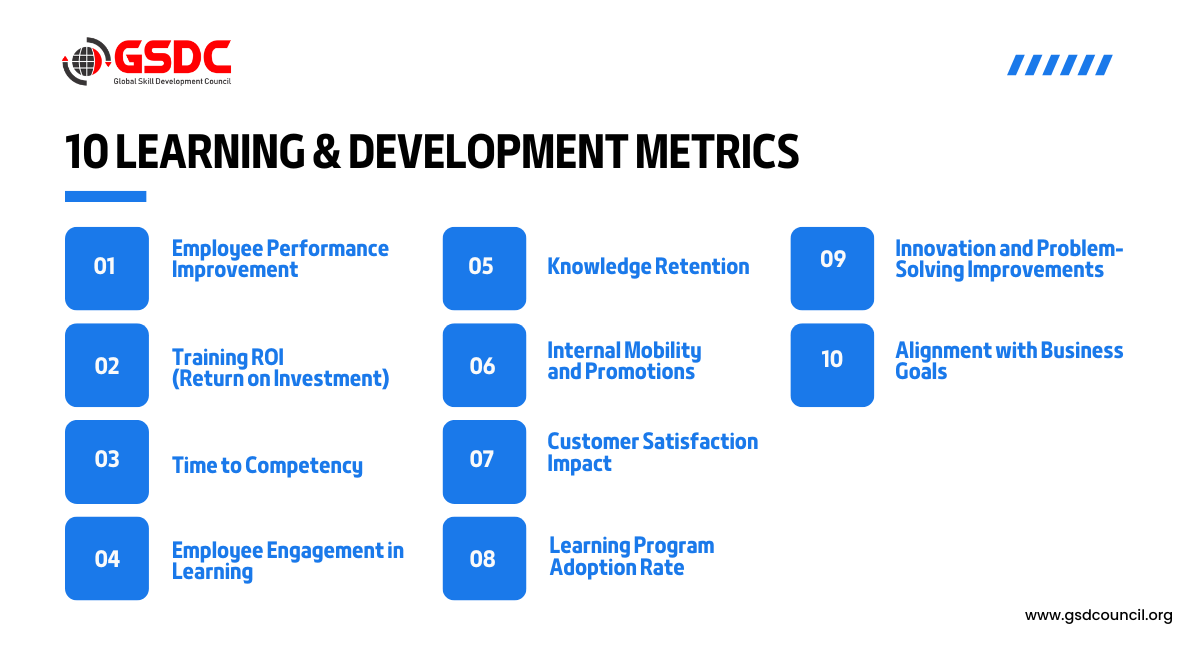
1. Employee Performance Improvement
CEOs want results, and the most direct way to measure the impact of training is through employee performance improvement. This metric evaluates whether learning interventions translate into better job performance.
For instance, if a sales training program increases deal closure rates or a leadership program boosts team efficiency, these improvements become clear indicators of learning effectiveness. Many learning and development platforms now offer analytics dashboards to track performance metrics pre- and post-training.
Tracking performance improvement also provides insights into which learning resources are most effective. For learning and development specialists, this helps prioritize programs that deliver measurable ROI.
2. Training ROI (Return on Investment)
Every CEO wants to see a return on investment. Calculating Training ROI involves comparing the cost of learning initiatives against the value they generate, like increased productivity, revenue, or reduced errors.
A simple example: if a software training program costs $50,000 and reduces process errors, saving the company $200,000 annually, the ROI is clear. This metric resonates with leadership because it directly links learning to the company’s financial performance.
Learning metrics examples like ROI also help justify budget allocations for future programs and demonstrate the strategic value of L&D efforts.
3. Time to Competency
How long does it take an employee to become fully productive after training? Time to competency measures the speed at which learners acquire critical skills. CEOs care about this metric because faster onboarding and skill acquisition translate into quicker results for the business.
For learning and development specialists, reducing time to competency is often achieved through blended learning, microlearning, and optimized learning and development platforms that provide targeted, just-in-time learning resources.
4. Employee Engagement in Learning
High engagement in learning programs signals that employees are motivated, interested, and likely to apply what they’ve learned. Metrics such as course completion rates, active participation, discussion forum activity, and feedback surveys give insights into engagement levels.
CEOs value this metric because engaged learners are more productive, retain knowledge longer, and are less likely to leave the organization. Leveraging learning and development resources that are interactive and relevant can drive engagement, helping learning and development specialists meet both learner and business needs.
5. Knowledge Retention
It’s not enough for employees to complete training; they must retain and apply knowledge effectively. Knowledge retention metrics assess how well learners remember and use new skills over time.
Assessments, follow-up quizzes, and practical assignments can track retention. For leadership programs, retention can be measured through real-world application, like leading successful projects or coaching team members. This ties directly into metrics for leadership development programs and demonstrates the effectiveness of your learning initiatives.
6. Internal Mobility and Promotions
A key indicator of L&D success is whether learning programs support career progression. Tracking internal promotions, lateral moves, and skill-based mobility provides a clear picture of learning impact.
CEOs appreciate this metric because it highlights how learning contributes to succession planning, talent retention, and building a strong leadership pipeline. This aligns with learning and development success metrics and shows the strategic contribution of L&D.
7. Customer Satisfaction Impact
When learning programs focus on client-facing roles, customer satisfaction becomes a vital metric. Improvements in service quality, problem resolution, and overall customer experience demonstrate that learning initiatives are producing tangible business outcomes.
Measuring customer satisfaction through surveys, Net Promoter Scores (NPS), or feedback mechanisms can link L&D programs directly to business success. Learning and development specialists can use this data to optimize programs and ensure learning and development resources are aligned with business goals.
8. Learning Program Adoption Rate
A learning program is only valuable if employees actually use it. Learning program adoption rate measures how many employees access and complete training initiatives.
High adoption indicates relevance, usability, and accessibility of learning content. For learning and development specialists, analyzing adoption rates across different learning and development platforms helps identify areas for improvement and ensures employees engage with critical learning resources.
9. Innovation and Problem-Solving Improvements
Learning programs are not merely a way to goodie up with knowledge; they should also promote creativity and critical thought. Through the observation of the advancements in employees' abilities to solve problems, their creativity, and their process optimization, it becomes evident that the employees are using their skills to create value for the business.
This is especially the case for the programs that aim at enhancing leadership or technical skills. Metrics such as new successful projects or more efficient work can be used to measure the impact of learning and development, thus highlighting the strategic importance of L&D even more.
10. Alignment with Business Goals
Ultimately, CEOs want learning programs that align with strategic objectives. This metric evaluates whether L&D initiatives support company priorities like digital transformation, revenue growth, or operational efficiency.
When programs are clearly linked to business outcomes, it strengthens the case for continued investment in learning. Tools and dashboards offered by learning and development platforms can help track alignment, providing a clear picture for executives and enabling learning and development specialists to report tangible results.
Download the checklist for the following benefits:
🚀 Grab your free L&D Cheat Sheet and boost your program’s impact!
📥 Download now and start impressing your CEO today!
GSDC’s Certified L&D Analytics & Metrics Professional
For learning and development specialists aiming to demonstrate measurable business impact, GSDC’s Certified L&D Analytics & Metrics Professional program is a game-changer. This certification equips professionals with the skills to track learning & development metrics, interpret data effectively, and align L&D strategies with organizational goals.
By mastering L&D analytics & metrics certificate concepts, participants can confidently measure performance improvement, ROI, knowledge retention, and adoption rates, ensuring their learning initiatives truly move the needle. For anyone looking to advance their career, this learning and development certification provides a robust framework to become a recognized L&D analytics expert.

Moving Forward
Measuring the success of learning and development success metrics is not an alternative anymore; it is mandatory. The value of learning and development programs, their alignment with business goals, and measurable outcomes that are of interest to CEOs can all be demonstrated by concentrating on these 10 metrics.
Choosing the proper learning and development platforms, learning and development resources, and certifications, such as Certified L&D Analytics & Metrics Professional, guarantees that learning programs are not only effective but also strategically important, thereby converting data into action and training into quantifiable business results.

Related Certifications
Stay up-to-date with the latest news, trends, and resources in GSDC
If you like this read then make sure to check out our previous blogs: Cracking Onboarding Challenges: Fresher Success Unveiled
Not sure which certification to pursue? Our advisors will help you decide!