Autonomous AI Agents: Running Businesses Without Micromanagement
Written by Emily Hilton
Imagine a work environment where approvals are no longer stuck in inboxes, processes are not waiting for human prompts, or decisions are made the moment the data changes. This is not the stuff of some futuristic dream or scenario; this is what is being created in the world of autonomous AI agents
These systems are no longer limited to supporting employees. They are actively running workflows, making decisions, and improving outcomes with minimal human intervention. This shift is redefining how organisations approach enterprise automation, AI-powered decision making, and large-scale digital workforce automation.
Through the use of adaptive agentic AI systems, businesses are shifting from a world of rules to a world where AI learns and adapts for optimal results in an adaptive environment. This is the juncture that many executives have reached with AI adoption – from tinkering with AI tools to implementing AI systems for direct optimization of their businesses.
What Are Autonomous AI Agents?
Autonomous AI agents refer to intelligent systems that are engineered to function independently to a significant extent.
Essentially, these systems are capable of:
- Comprehending business objectives
- Designing the strategies
- Carrying out the decisions by communicating with other systems
- Adapting and evolving with new data continuously
Unlike conventional AI co-pilots or rule-based automation, these agents adjust to evolving environments, changes in data patterns, and business constraints. They are not just following the instructions; they evaluate the circumstances, select the best options, and enhance their performance gradually.
Consequently, they make the transition from just assisting humans to becoming real autonomous digital workers within the company. This trend marks the rise of agentic AI systems, where AI is not only reactive but proactive and offers tangible business outcomes.
The Five Levels of AI Agent Autonomy
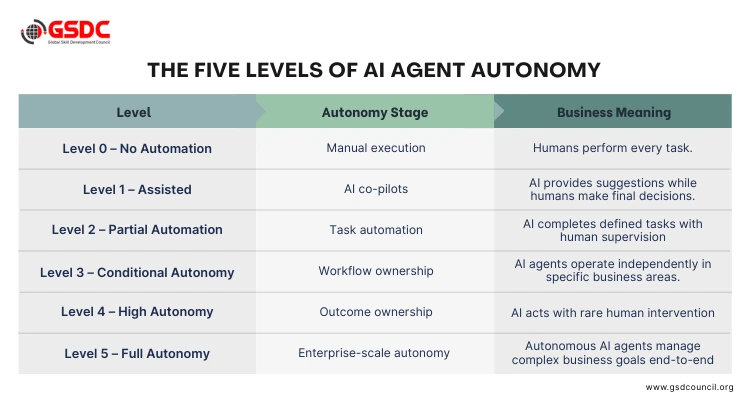
AI autonomy is not a binary concept but rather a spectrum. Knowing this development is crucial for creating a scalable AI maturity model and setting a practical AI adoption strategy.
-
Level 0 - No Automation (Manual execution)
At this stage, there is no implementation of AI agents or any form of automation. Operations are carried out manually; the process is slow, prone to mistakes, and highly dependent on the availability of humans.
-
Level 1 – Assisted (AI co-pilots)
At this level, AI co-pilots assist employees with recommendations, predictive insight, or even content suggestions. But still, humans are entirely responsible for approvals and execution, which includes accountability.
-
Level 2 - Partial Automation (Task automation)
At this level, the AI systems start executing routine tasks like data processing, scheduling, or reporting. Process automation is introduced at the beginning level; however, human intervention is still needed for the validation of the result.
-
Level 3 - Conditional Autonomy (Workflow ownership)
At this stage, the AI agents are capable of independently managing routine operations such as customer routing for support or invoice processing. The early agentic AI systems are able to adjust to fluctuations in the environment while still operating within the set business rules.
-
Level 4 – High Autonomy:(Outcome ownership)
In this scenario, the role of artificial intelligence goes beyond the automation of business processes and shifts towards the control of business results. Autonomous artificial intelligence agents are responsible for monitoring business metrics, making decisions, and requiring human intervention only for exceptions or governance purposes.
-
Level 5 - Full Autonomy (Enterprise-scale autonomy)
Complete AI autonomy characterizes this stage when autonomous systems coordinate across departments, optimize enterprise-wide operations, and drive large-scale enterprise automation with minimal human intervention.
This is where the management of tasks transitions from running the organization to governing. With the growth of organizations from these levels, the involvement of people moves from executing tasks directly to governance, policy-making, and oversight, marking a major breakthrough in the transformation of the AI workforce.
The GSDC (Global Skill Development Council) provides organizations with knowledge on how to responsibly develop and manage agent AI systems in the course of this increasingly autonomous process.
Why AI Guardrails Are Non-Negotiable
AI guardrails are a set of technical, operational, and governance controls that guide how autonomous AI agents behave in real business environments. They define what AI systems are allowed to do, how the decisions are monitored, and how risks are managed.
-
Rising autonomy increases risk
As AI autonomy grows, the consequences of errors, bias, or misuse multiply. Hence, such deployments must be supported by AI governance frameworks and AI accountability structures.
-
AI ethics and responsible decision making
Guardrails enable AI to behave in accordance with ethics, ensuring that it does not cause any negative consequences or results.
-
Explainable AI / AI explainability for transparency
With explainability in the context of artificial intelligence, organizations are able to determine the rationale behind the behavior of their artificial intelligence systems, thus allowing for the acceptance of these systems.
-
AI auditing and transparency for trust
With built-in monitoring, AI auditing, and transparency mechanisms, enterprises can track decisions, detect anomalies, and maintain operational confidence.
-
Bias prevention and regulatory compliance
Guardrails help eliminate unfair bias and ensure compliance with industry standards and legal requirements.
-
Safe AI-powered decision making at scale
Rather than slowing innovation, guardrails make AI-powered decision-making reliable, predictable, and safe enough to scale across the enterprise.
An Agentic AI Expert Certification helps build practical capability in designing, governing, and deploying responsible agentic AI systems with strong guardrails.
Download the checklist for the following benefits:
⚡ Make faster, real-time business decisions with AI — download the execution guide.
🚀 See how autonomous AI agents actually run workflows — get the enterprise AI toolkit.
Where Autonomous AI Agents Are Already Delivering Value
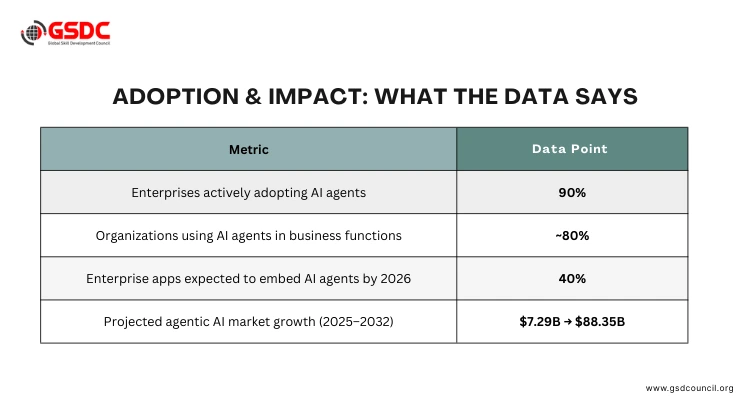
Autonomous AI agents are progressively becoming the core of different workflows; in effect, they are fast decision-making tools powered by AI, and drivers of real enterprise automation.
-
End-to-End Process Automation
Autonomous AI agents fully automate entire processes involving multiple tools and systems far beyond the abilities of scripts and rule-based bots.
For example, Moveworks’ AI assistants are able to solve IT and HR tickets in large enterprises by themselves, thereby resulting in reduced workload for the help desk team and faster resolution times.
-
Enterprise Automation at Scale
By reducing manual intervention, the systems promote large-scale enterprise automation and enhance speed, accuracy, and cost efficiency of enterprise operations.
For Example, JPMorgan Chase is utilizing AI-based systems to review contracts and track transactions so that risk patterns in a massive dataset can be detected in a faster manner.
-
Real-Time Business Decisions
By constantly observing live data sources, autonomous AI agents make immediate AI-based decisions ranging from the routing of customer complaints to adjusting supplies within the chain.
For Example, Microsoft Copilot Agents enable automation of highly timely processes like lead prioritization and onboarding on enterprise platforms.
-
Intelligent Strategic Execution
In high-autonomy environments, agentic AI systems support planning, forecasting, and resource optimization-genuine partners in business leadership.
For Example, Intuit buildsAI agents into its financial platforms to drive forecasting, business optimization, and proactive operational guidance.
These examples illustrate that autonomous software agents are already present in the operational environment of an organization and can add real value by intelligently automating processes and decision-making.
Building Agentic AI Readiness with GSDC
Organisations race toward AI systems with higher autonomy, the question that really sets companies apart is not technology, but rather, it is capability. The Global Skill Development Council (GSDC) Agentic AI Expert Certification is a response to this gap.
This will empower an organization and a professional to comprehensively grasp the design, governance, and scaling of agentic AI systems in a responsible manner. The program is highly detailed about the hands-on implementation of real-world autonomous AI agents, which also involves the discussion of levels of autonomy, governance frameworks, ethical deployment, and enterprise integration.
Final Thoughts
Artificial intelligence agents are already propelling the concept of enterprise automation. Nevertheless, for long-term success in the field of artificial intelligence, it is not merely the technology that needs to be strong; rather, there are requirements for proper AI governance structures, AI accountability, and responsible artificial intelligence autonomy.
With AI ethics, Explainable AI / AI Explainability, and AI auditing & Transparency built in, organizations are empowered to scale their Agentic AI with confidence. The authentic competitive advantage comes from Speed meeting Sustainable levels of Trust, and a sound Agentic AI Foundation on which the enterprise can depend.

Related Certifications
Stay up-to-date with the latest news, trends, and resources in GSDC
If you like this read then make sure to check out our previous blogs: Cracking Onboarding Challenges: Fresher Success Unveiled
Not sure which certification to pursue? Our advisors will help you decide!