Agentic AI in Cybersecurity: How It Works and Why It Matters
Written by Matthew Hale
- What Is Agentic AI in Cybersecurity?
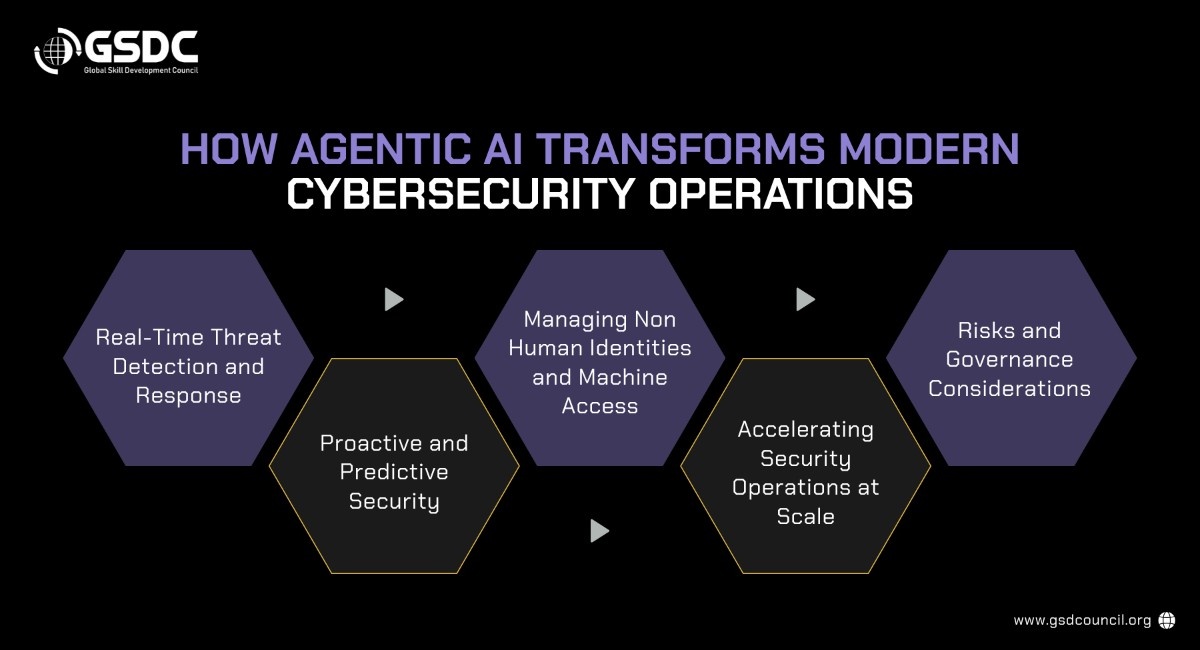
- Real-Time Threat Detection and Response
- Proactive and Predictive Security
- Managing Non-Human Identities and Machine Access
- Accelerating Security Operations at Scale
- Risks and Governance Considerations
- The Future of Cybersecurity with Agentic AI
- Equipping Professionals for Agentic AI-Driven Security
- Final Thoughts
We're experiencing an AI revolution that's going to fundamentally reshape the way we work, build products, and make decisions. However, this has also led to a change in how cyberattacks are being conducted. Attackers nowadays leverage automation and AI not only to act rapidly but also to extend their operations and remain unnoticed for a longer time. For security teams that are already overburdened, the conventional tools and manual processes for dealing with incidents can no longer suffice.
This is where agentic AI in cybersecurity comes in. It enables organizations to move from simple reactions to threats and risks toward a state of defense that is autonomous, ‘smart,’ and self-driven.
In this blog, we break down what is agentic AI, what does agentic AI mean for cybersecurity teams, how agentic AI works in real-world security environments, and why it’s becoming essential for defending modern digital systems.
What Is Agentic AI in Cybersecurity?
The popular question within the industry is what is agentic AI, and more specifically, what does agentic AI mean for security teams?
In simple terms, agentic AI refers to AI systems that are capable of planning, deciding, and taking actions on their own to reach a target. Therefore, for cybersecurity teams, agentic AI refers to AI agents working similarly to digital security operators who are constantly monitoring for potential issues, identifying threats, and resolving them with little or no human intervention.
Understanding what is agentic AI in this context helps organizations see why agentic AI in cybersecurity represents a major shift from tool-based automation to goal-driven autonomous defense.
Real-Time Threat Detection and Response
One of the most valuable uses of agentic AI in cybersecurity is real-time threat detection and response. Since attacks become faster and more sophisticated, nowadays, the conventional signature-based tools that were focused on known patterns usually leave gaps in detection.
1. Continuous monitoring at scale
Agentic AI systems scan through endpoint, cloud application, network, and identity threat elements to identify threats as they emerge.
2. Behavior-based threat detection
Agentic AI can also help discover zero-day and sophisticated threats by concentrating on unusual behaviors.
3. Faster identification of subtle signals
This also enables detection by combining weak signals, which could result in an improved understanding of impact and dwell time.
4. Smarter incident correlation
Rather than a series of disconnected alerts, agentic AI links events into a single, understandable attack storyline for fast decision-making.
5. Automated, machine-speed response
After a threat is verified, agentic AI can immediately initiate containment measures such as isolating a device or blocking traffic, etc., within minutes.
For teams who are interested in knowing more about how agentic AI works, the simple fact is that it is a constant loop, sense, reason, act, that provides real-time visibility and response, even in the most complex, multi-layered situations.
As more organizations engage these capabilities, formalized models of learning and best practices, such as those offered by the Global Skill Development Council (GSDC), can help teams gain the skills needed to utilize these capabilities within security scenarios.Proactive and Predictive Security
Security leaders are increasingly asking what role does agentic AI play in cybersecurity beyond incident response. The value lies in its ability to predict and prevent threats before they disrupt operations. Unlike traditional security, which reacts after a breach, agentic AI uses predictive analytics to anticipate risk and guide early action.
1. Autonomous threat hunting
Agentic AI analyzes historical attack data and live signals to uncover hidden risks across environments.
2. Continuous exposure management
Predictive systems identify misconfigurations and weak controls before attackers exploit them, reducing attack surface risk.
3. Attack path simulation
Agentic AI models likely attack paths to highlight high-risk areas and prioritize remediation.
4. Early detection of advanced tactics
By combining predictive analytics with behavior-based detection, agentic AI surfaces lateral movement and privilege escalation earlier than traditional tools.
This shows what role agentic AI plays in cybersecurity for long-term resilience: shifting security from reactive firefighting to a predictive, risk-aware defense posture.Managing Non-Human Identities and Machine Access
As automation and AI continue to grow, non-human identities (NHIs)APIs, service accounts, bots, and machine agents may even outnumber human users, thus silently enlarging the attack surface. Normally, these identities have constant access with very little monitoring, thus they become targets for attackers.
1. Visibility into machine identities
Agentic AI in cybersecurity helps to discover and catalog NHIs across cloud, applications, and infrastructure, helping to increase visibility as these environments change quickly.
2. Behavior-based monitoring of access
Agentic AI, by monitoring the behavior of machine identities, can determine suspicious activities that may lead to compromised or stolen credentials.
3. Enforcing least privilege
Agentic AI detects overprivileged or inactive machine accounts and suggests (or carries out) access restrictions to lower the risk of lateral movement.
4. Securing autonomous workflows
With the increase of AI agents and automation, agentic AI manages machine-to-machine trust, thus allowing autonomous systems to function within pre-determined security limits.
This highlights what role agentic AI plays in cybersecurity beyond threat detection - extending security controls to the fast-growing world of machine identities. For professionals responsible for identity, access, and AI governance, gaining formal grounding through an agentic AI professional certification can help build the skills needed to manage these emerging risks effectively.Accelerating Security Operations at Scale
With alert volumes rising and security talent in short supply, many teams are exploring what platforms use agentic AI for cybersecurity to modernize SOC operations. While platforms vary, the core value of agentic AI in cybersecurity is clear: reduce noise and speed up response at scale.
1. Automated alert triage
Agentic AI triages a high volume of alerts to identify those that really matter; thus, human security operations center (SOC) teams can concentrate on actual risks instead of false positives.
2. Faster investigations through correlation
Agentic AI correlates signals across different tools, identities, endpoints, and cloud environments; thus, it is able to convert the initially disorganized alerts into simple and understandable incident stories.
3. Scalable, machine-speed response
Agentic AI may be used to execute response playbooks, e. g., device isolation or access revocation, over large environments for uniform response as infrastructure grows.
4. More time for high-value work
Through performing the repetitive tasks, agentic AI allows analysts to dedicate time for more advanced threat analysis, threat modeling, and security strategy.Risks and Governance Considerations
With the rise of adoption, the question that leaders need to address is what agentic AI means from a governance and accountability angle. At the speed of a machine, autonomous security agents can act; however, without the appropriate controls, they may be able to bring new operational and compliance risks.
1. Clear accountability
Ownership should be clarified for autonomous actions, especially when it comes to high-impact decisions such as blocking access or isolating critical systems.
2. Transparency and auditability
Actions of AI have to be explainable and traceable. Therefore, they should be supported by a strong audit log for investigations and regulatory purposes.
3. Human-in-the-loop controls
Involve humans where decisions are crucial so that human intervention can prevent business operations from being interrupted due to false positives.
4. Data protection and compliance
Develop strong data governance and data privacy practices to securely manage telemetry and identity data.
This governance focus shows what role agentic AI plays in cybersecurity beyond technology alone - it must be deployed with the same rigor as any critical security control.
The Future of Cybersecurity with Agentic AI
Looking ahead, agentic AI in cybersecurity is set to become a foundational layer of modern security architectures as defenders adopt autonomous capabilities to counter AI-driven attacks.
- Agentic AI will evolve from isolated tools into an embedded, intelligent security layer across detection, response, identity, and cloud environments.
- Autonomous agents will enable faster, more adaptive defenses across cloud-native, hybrid, and AI-driven systems.
- Agentic AI will play a growing role in securing non-human identities and governing machine-to-machine access.
- Continuous, AI-driven risk assessment and compliance monitoring will replace periodic, manual security reviews.
Equipping Professionals for Agentic AI-Driven Security
For professionals ready to go beyond theory, the GSDC CGAIC programme lets you build agentic ai security tools hands-on including autonomous threat detection pipelines, deep RL incident responders, and OWASP LLM audit kits with 12 portfolio-ready artifacts you can show employers.
Agentic AI is poised to be a driving factor of modern cybersecurity strategies; practitioners need to be equipped with the skills to create, operate, and control autonomous AI systems.
The Global Skill Development Council (GSDC) has an Agentic AI Professional Certification program, which assists participants in gaining hands-on knowledge about the agentic AI concept, working principles of agentic AI, and the application of agentic AI in the cybersecurity landscape.
Final Thoughts
The current cyber threats are too sophisticated to be mitigated through small solutions. The emergence of agentic AI in cybersecurity has, for the first time, represented a real shift: a transition from being slow, human-led, and reactive to being autonomous and intelligent with “machine speed.”
Organizations that understand what is agentic AI and invest early in agentic AI in cybersecurity capabilities will be better positioned to reduce incident impact, improve operational efficiency, and build sustainable cyber resilience in an AI-driven world.

Related Certifications
Stay up-to-date with the latest news, trends, and resources in GSDC
If you like this read then make sure to check out our previous blogs: Cracking Onboarding Challenges: Fresher Success Unveiled
Not sure which certification to pursue? Our advisors will help you decide!