The EU AI Act Explained: Why ISO/IEC 42001 Matters for AI Compliance
Written by Matthew Hale
- Why This Matters Beyond Europe
- The Four AI Risk Categories, With Real Examples
- A Real-World Scenario: What "High Risk" Actually Looks Like
- The 2026 Timeline Reset - Don't Read It as a Delay
- What Organizations Need to Do Now
- Where ISO 42001 Fits In
- How ISO 27001 Supports AI Governance
- Why AI Governance Skills Are Becoming Essential
- Turn AI Governance Knowledge into Practical Expertise
- Final Thoughts
Job postings are changing shape. Roles that used to say "ISO 27001 experience preferred" now also mention AI governance, regulatory readiness, and risk management for automated systems. That shift isn't random - it's a direct result of the EU AI Act, and it's reshaping what companies expect from compliance, security, and data professionals everywhere, not just in Europe.
Regulations rarely create entirely new job categories overnight. This is one of the rare cases where that's actually happening. This blog walks through what the Act requires, who it affects, and how frameworks like ISO 42001 and ISO 27001 fit into building a genuine governance program - not just a checklist.
Why This Matters Beyond Europe
It's tempting to read "EU AI Act" and assume it's someone else's problem. It isn't.
The Act applies to any AI system whose output reaches a person in the EU - regardless of where the company that built it is headquartered. A hiring platform built in California, a chatbot developed in India, or a credit-scoring model trained in Singapore can all fall under its scope if EU users are affected.
Beyond that legal reach, multinational companies are increasingly adopting EU AI Act principles as their internal baseline for responsible AI, simply because it's easier to run one governance standard globally than different ones per region. That's why "EU AI compliance" has quietly become a global conversation, not a regional one.
The Four AI Risk Categories, With Real Examples
The Act takes a risk-based approach, sorting every AI system into one of four tiers. Definitions alone can feel abstract, so here's what each tier looks like in practice:
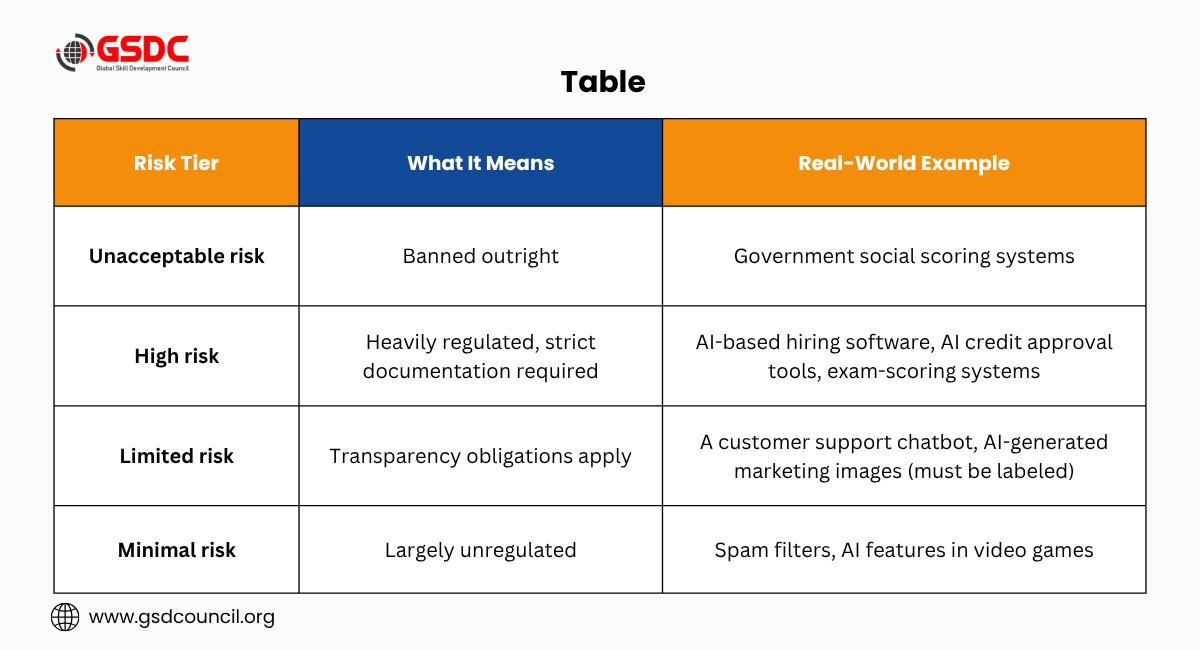
Most companies are surprised to find they're already running "limited risk" systems - even something as ordinary as a chatbot on a website triggers transparency obligations under the Act.
A Real-World Scenario: What "High Risk" Actually Looks Like
Imagine a multinational retailer deploying an AI tool to screen job applicants across its European offices. Under the EU AI Act, that system is classified as high risk because it directly affects people's access to employment.
That classification isn't a formality; it triggers real obligations. The organization has to document how the model works, assess it for bias against candidates, keep detailed audit records, and make sure a human can meaningfully review or override the system's decisions. ISO 42001 gives the organization a structured way to manage those activities consistently across teams and time, while ISO 27001 strengthens the security and data controls underneath the whole system - protecting the candidate data the model is trained and run on.
That's the pattern worth remembering: the law defines what has to happen, and management-system standards define how it happens, day to day.
The 2026 Timeline Reset - Don't Read It as a Delay
On May 7, 2026, EU lawmakers reached a provisional agreement on the Digital Omnibus on AI that pushed back some of the toughest deadlines. High-risk standalone systems (recruitment tools, credit scoring, education, law enforcement) now have until December 2, 2027 instead of August 2, 2026. AI embedded inside regulated products, like medical devices or vehicles, has until August 2, 2028.
That's not a reprieve, though. Several obligations are already active and untouched by the delay:
- The ban on prohibited AI practices has applied since February 2, 2025
- Rules for general-purpose AI model providers have applied since August 2, 2025
- General transparency obligations - disclosing that someone is interacting with AI - still apply from August 2, 2026; only the more specific synthetic-content labeling requirement was pushed to December 2, 2026
- A new ban on AI-generated non-consensual intimate imagery also takes effect in December 2026
The penalties are serious enough to get anyone's attention: the most severe violations can reach €35 million or 7% of global annual turnover - higher than GDPR's own maximum of €20 million or 4%.
The extra runway is time to build real governance capability - not a reason to set the topic aside. And because formal adoption of the Omnibus was still being finalized as of mid-2026, it's worth checking the current status against the Act's official implementation tracker before locking any compliance calendar to these dates.
What Organizations Need to Do Now
Strip away the legal language, and high-risk obligations come down to a repeatable process:
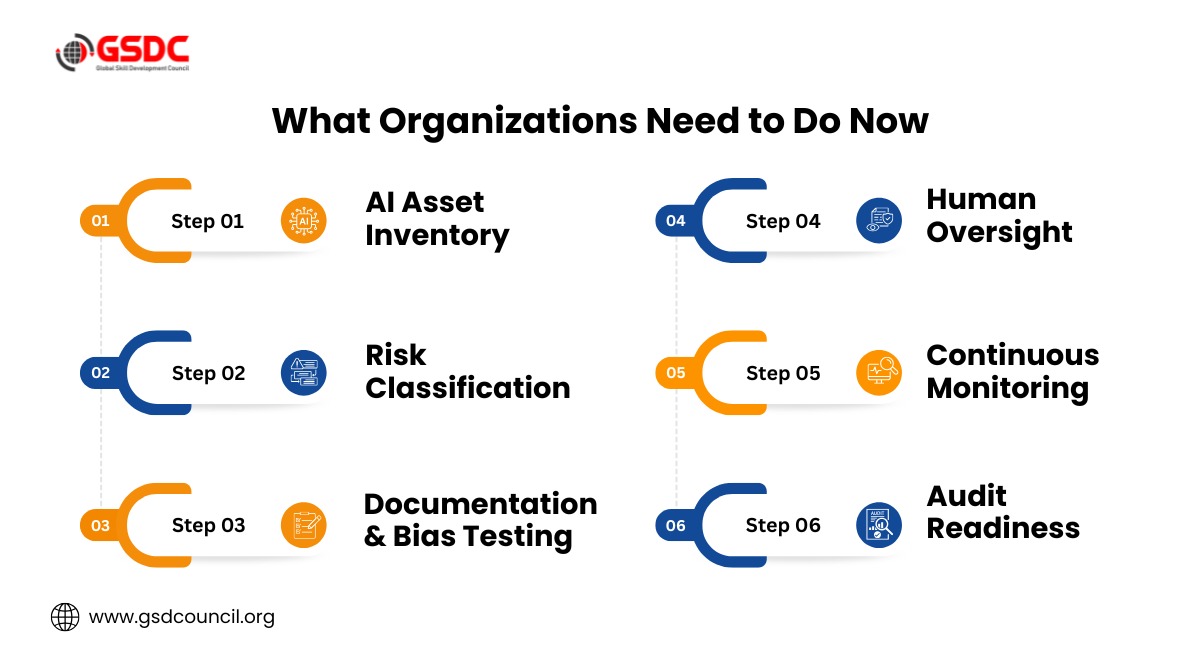
In practice, that means:
- Inventory first. List every AI model, agent, and tool in use, and classify each by risk tier.
- Check your data. Training and testing datasets need to be examined for bias, with a way to catch and correct it over time.
- Document with evidence, not paperwork. Regulators aren't looking for a folder of forms - they want proof that documentation matches what's actually running in production today.
- Keep a human in the loop. High-risk systems require a person who can intervene and override an automated decision.
- Handle transparency separately. Even "limited risk" tools - chatbots, AI-generated content - need clear disclosure that a person is interacting with AI, and synthetic content needs to be labeled.
- Monitor continuously. A one-time compliance sprint doesn't hold up; regulations, data, and models all drift over time.
That last point is where most programs quietly fail. A model that was accurate and compliant in January can look very different by September if it's been retrained or its data dependencies shifted - and a static spreadsheet won't catch that. This is exactly the challenge outlined in Alation's practical guide to EU AI Act compliance, which frames the issue as a systems problem rather than a documentation problem.
Where ISO 42001 Fits In
Here's a distinction worth understanding early: the EU AI Act tells organizations what they legally must achieve. It doesn't tell them how to run the day-to-day work of getting there.
That's the gap ISO/IEC 42001 is built to close. A few key facts about the standard:
- It's the world's first international standard for AI management systems, published by ISO in December 2023.
- It specifies requirements for establishing, implementing, and continually improving a structured AI management system.
- It covers risk management, AI system impact assessments, and lifecycle management.
- As ISO itself explains, it doesn't replace laws or regulations - it gives organizations the operating framework to meet compliance obligations more consistently.
Think of the Act as the legal target and ISO 42001 as the operating system that helps you hit it, again and again, without reinventing the process for every new AI project. Organizations that already run a management-system standard tend to find ISO 42001 far easier to adopt, because they've done this kind of structured, auditable governance before.
Auditing against this standard is its own skill set - one covered in credentials like the Certified ISO 42001:2023 Lead Auditor certification, for anyone who wants to go from understanding the framework to being able to formally assess it.
How ISO 27001 Supports AI Governance
That's where ISO 27001 comes in. It's the internationally recognized standard for information security management - the framework organizations use to protect data, manage risk, and prove security maturity to regulators and clients.
AI systems don't exist in isolation from the data and infrastructure around them. A few things worth knowing about how the two connect:
- The Act's data governance requirements - provenance tracking, quality checks, bias controls - are dramatically easier to satisfy when the underlying data is already governed under an ISO 27001-aligned security program.
- In practice, many organizations now run ISO 27001 (security), ISO 42001 (AI management), and EU AI Act compliance (legal obligation) as three layers of the same governance stack, rather than three separate projects.
- That overlap is also why ISO 27001 skills are increasingly showing up as a preferred qualification in AI governance and compliance job postings - auditors who understand security controls have a head start when they move into AI-specific governance work.
That auditing skill set has its own formal path too, through credentials like the Global Skill Development Council's Certified ISO 27001:2022 Lead Auditor certification, for professionals who want to move from understanding the standard to being qualified to audit against it.
Why AI Governance Skills Are Becoming Essential
None of this happens automatically. Organizations need people who can read a regulation, translate it into a working process, and audit whether it's actually being followed - across data, security, and AI systems at once.
That's created real demand for a few overlapping skill sets:
- Professionals who understand risk classification and AI compliance frameworks
- Auditors with ISO 27001 or ISO 42001 lead auditor training, who can formally assess whether a governance program holds up
- Generalists in AI governance and responsible AI practice, who can bridge legal, technical, and security teams
If you're an ISO 27001 lead auditor considering where to specialize next, or a compliance professional weighing whether a formal credential is worth it, this is one of the faster-growing corners of the compliance field right now - and it's still early enough that certified professionals stand out.
Turn AI Governance Knowledge into Practical Expertise
Understanding the EU AI Act is only the first step. Organizations also need professionals who can assess AI governance processes, identify compliance gaps, and conduct effective audits.
With GSDC's Certified ISO 27001:2022 Lead Auditor certification, you'll develop the practical skills to audit information security management systems and help organizations strengthen the security foundation their AI governance and regulatory readiness depend on.
Final Thoughts
Regulations rarely create new professions overnight. The EU AI Act is one of the rare exceptions. As organizations race to build trustworthy AI, technical expertise alone is no longer enough. The professionals who can combine AI knowledge with governance, security, and compliance will be the ones shaping how AI is deployed - not just how it's developed.
Whether you're preparing to implement ISO 42001, strengthen your ISO 27001 auditing capabilities, or build broader expertise in AI governance, investing in structured learning today can help you stay ahead of evolving regulations and growing industry expectations.

Related Certifications
Frequently Asked Questions
Yes, and this catches a lot of people off guard. The EU AI Act doesn't care where your company is registered - it cares where your AI system's output lands. If your hiring tool, chatbot, or credit-scoring model touches someone based in the EU, you're in scope. So a startup in Austin or a bank in Mumbai can't assume EU AI act compliance is someone else's problem just because their headquarters sit outside Europe. A lot of global firms are now treating the Act's requirements as their default standard everywhere, just to avoid running two different rulebooks.
Think of it this way: ISO 27001 security standards protect the data and infrastructure an AI system runs on, while ISO 42001 governs how the AI system itself is built, monitored, and audited. They're not competing standards - they overlap. A lot of organizations pursuing iso 27001 ai compliance are now layering ISO 42001 on top, because regulators and clients increasingly want proof that both the data and the model behind it are properly governed, not just one or the other.
More than most people expect. It's not just about labeling deepfakes. If you're running a customer-facing chatbot, generating marketing content with AI, or using emotion-recognition tools, you generally need to disclose that people are interacting with AI, not a human. These eu ai act transparency requirements apply even to "limited risk" systems, which is why so many companies with fairly ordinary AI tools - not just the high-risk ones - still have compliance work to do.
The path is fairly linear: start with foundational information security knowledge, move into ISO 27001 internal auditor training, then pursue a formal iso 27001 lead auditor certification that covers audit planning, evidence-gathering, and reporting. From there, most people build experience auditing alongside a certification body before stepping into full lead auditor roles. As for whether it pays off - iso 27001 lead auditor jobs are genuinely growing, especially as companies pair security audits with AI governance work, and the certification is usually the thing that gets your resume past the first filter.
Honestly, this is a good moment to get in. AI governance certification is one of those rare credentials that's in demand before the market is saturated with people who have it. If you're building out an eu ai act compliance checklist for your organization, or just trying to figure out where your career fits into all this eu ai compliance work, getting certified now - while the field is still forming - puts you ahead of a wave that's clearly coming, not chasing one that's already crested.
Stay up-to-date with the latest news, trends, and resources in GSDC
If you like this read then make sure to check out our previous blogs: Cracking Onboarding Challenges: Fresher Success Unveiled
Not sure which certification to pursue? Our advisors will help you decide!