Agentic AI vs Traditional PMO: Redesigning Governance for Autonomous Delivery Teams
Written by Emily Hilton
- Understanding Traditional PMO Governance
- What Is Agentic AI Governance?
- Agentic AI vs Traditional PMO: Key Governance Differences
- Why Traditional Project Governance Needs Transformation
- Building an Agentic AI Project Governance Framework
- How AI Is Changing Project Management Office Operations
- Will AI Replace Project Managers?
- How GSDC Helps Professionals Prepare for AI-Driven Project Management
- Conclusion
Project management is changing as organizations increasingly adopt artificial intelligence to manage complex workflows, automate decisions, and improve delivery outcomes. Traditional Project Management Offices (PMOs) have long provided structure through planning, reporting, resource allocation, risk management, and performance monitoring. However, as organizations introduce autonomous AI agents into project environments, traditional governance approaches are facing new challenges.
Unlike conventional automation, Agentic AI systems can analyze information, make decisions, execute tasks, and adjust their actions based on changing conditions. This creates new opportunities for faster project delivery but also introduces questions about accountability, decision authority, transparency, and risk management.
The shift toward Agentic AI governance requires organizations to rethink how their Project Management Office operates. Rather than simply monitoring human-led teams, modern PMOs must establish governance structures that support collaboration between people and autonomous delivery teams
Understanding Traditional PMO Governance
A traditional Project Management Office provides centralized oversight to ensure projects align with organizational objectives, budgets, timelines, and quality standards. It establishes processes that help project managers coordinate activities, monitor progress, manage risks, and report performance.
A conventional PMO governance structure generally depends on predefined approval processes, reporting schedules, management reviews, and escalation procedures. Project managers and delivery teams follow established guidelines, while the PMO monitors whether projects meet organizational expectations.
The main responsibilities of a traditional PMO include:
- Project Planning: Establishing project schedules, milestones, budgets, and resource requirements.
- Performance Monitoring: Tracking project progress through reports, KPIs, and performance reviews.
- Risk Management: Identifying potential issues and coordinating mitigation activities.
- Resource Management: Allocating employees, budgets, and tools across projects.
- Compliance and Standards: Ensuring teams follow organizational policies and project management methodologies.
These activities form the foundation of a traditional project governance framework. While this approach provides consistency and accountability, it can become slow when projects require frequent decisions, continuous adjustments, and real-time coordination.
What Is Agentic AI Governance?
Agentic AI governance refers to the policies, controls, decision-making structures, and accountability mechanisms that guide autonomous AI agents operating within organizational workflows.
In project environments, AI agents can perform activities such as updating project schedules, identifying delivery risks, coordinating tasks, analyzing performance data, and recommending corrective actions. Depending on their permissions, they may also execute approved actions without waiting for continuous human instructions.
This changes the role of governance. Instead of controlling every individual task, organizations must define what AI agents can access, decide, execute, and escalate.
An effective AI PMO establishes boundaries for autonomous operations while ensuring that important decisions remain transparent, explainable, and aligned with business objectives.
For example, an AI agent managing a software development workflow might identify a delay in testing, review available resources, recommend reallocating tasks, and update the delivery schedule within its approved authority. If the change affects project costs or contractual commitments, it can escalate the decision to a human project manager.
This approach makes Agentic AI in project management more structured and accountable.
Agentic AI vs Traditional PMO: Key Governance Differences
Traditional PMOs and AI-enabled governance models share the same objective: delivering projects successfully. However, their operating approaches are different.
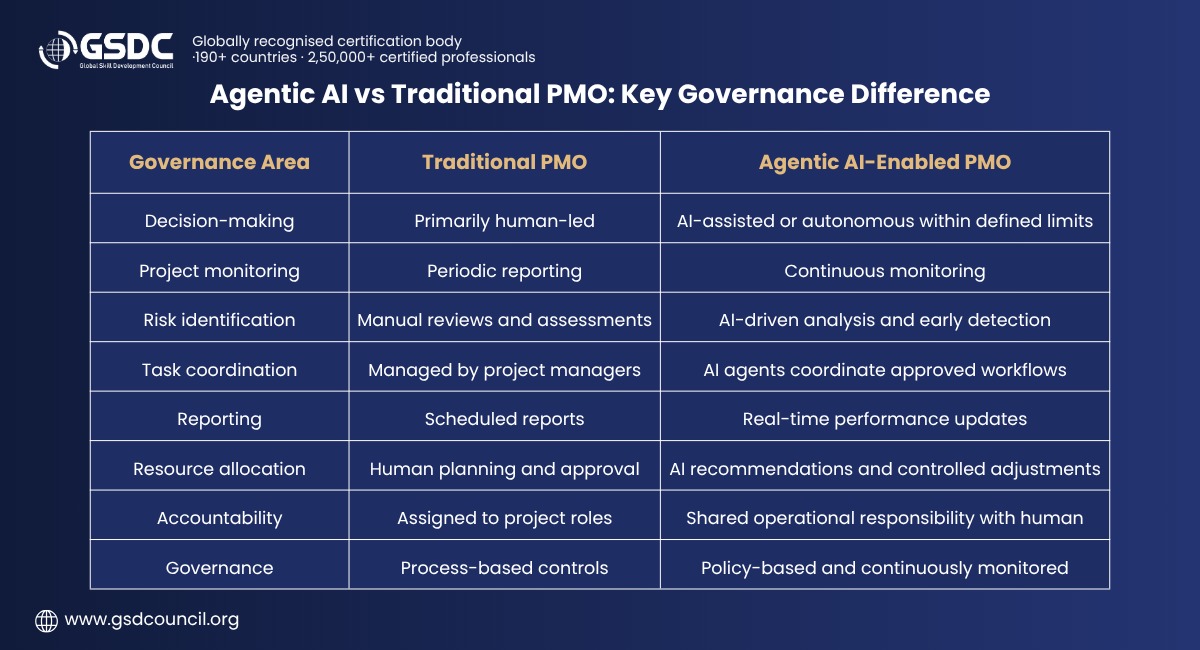
The biggest difference is the movement from periodic oversight to continuous governance. Traditional PMOs often identify problems during scheduled reviews, whereas an AI-enabled PMO can detect potential issues as they emerge.
However, autonomy does not eliminate the need for human accountability. It makes clearly defined decision boundaries even more important.
Why Traditional Project Governance Needs Transformation
Traditional governance models were designed around human decision-making, predictable approval structures, and scheduled reporting. Autonomous delivery teams introduce a different operating environment.
Several factors are driving PMO transformation.
1. Faster Decision-Making Requirements
AI agents can analyze project information and respond to changing conditions much faster than traditional reporting cycles. Organizations need governance structures that allow low-risk decisions to happen quickly without unnecessary approval delays.
2. Increasing Project Complexity
Modern projects involve multiple teams, cloud platforms, AI systems, external vendors, and interconnected workflows. Managing these dependencies manually can become difficult. AI agents can monitor dependencies and identify potential delivery issues.
3. Continuous Risk Monitoring
Traditional project governance often relies on periodic risk assessments. Agentic AI can continuously evaluate project information to identify emerging risks, resource shortages, and schedule conflicts.
4. Greater Need for Transparency
Autonomous systems must operate within clear boundaries. Organizations need visibility into what agents are doing, why decisions are being made, and when human intervention is required.
These changes require organizations to move beyond conventional PMO best practices and develop governance approaches suitable for intelligent and autonomous delivery environments.
Building an Agentic AI Project Governance Framework
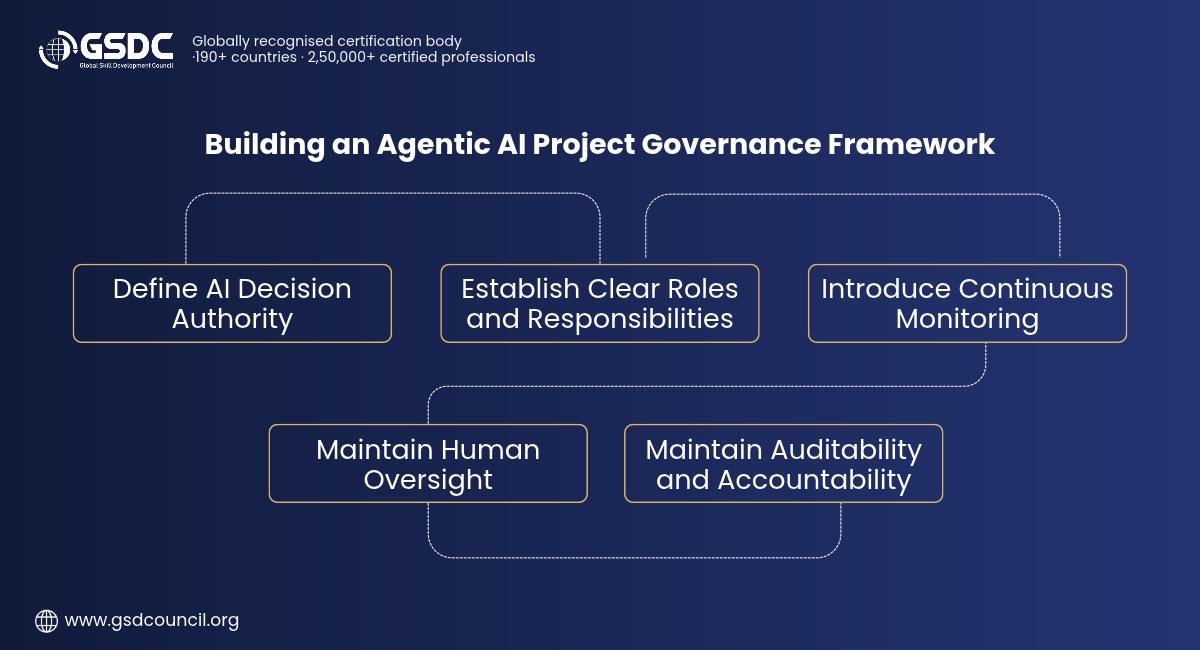
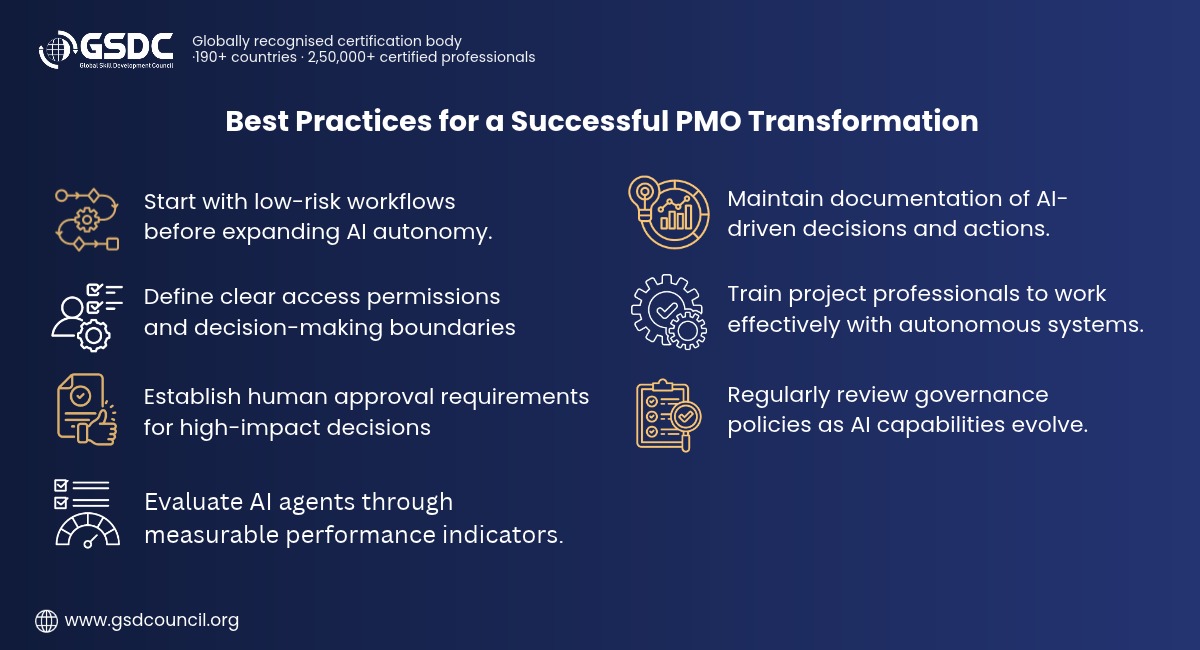
Organizations adopting Agentic AI need a structured governance model that balances autonomy with control. A modern project governance framework should define how AI agents operate, how decisions are monitored, and who remains accountable for outcomes.
The following practices can help organizations redesign their PMO framework.
1. Define AI Decision Authority
Not every project decision should be delegated to AI agents. Organizations should classify decisions according to their business impact and risk level.
For example, an AI agent may automatically update task statuses or identify schedule conflicts. However, decisions involving major budget changes, contractual commitments, compliance requirements, or strategic priorities should require human approval.
2. Establish Clear Roles and Responsibilities
As AI agents become part of delivery teams, organizations must redefine traditional PMO roles and responsibilities.
Project managers should focus on strategic decisions, stakeholder communication, delivery priorities, and exception management. PMO leaders should establish governance policies, monitor performance, and ensure alignment with business objectives.
AI agents can support execution activities such as reporting, task coordination, dependency tracking, and risk identification.
3. Introduce Continuous Monitoring
An AI-enabled PMO should monitor project performance continuously rather than relying exclusively on weekly or monthly reports.
Organizations can track delivery progress, agent activity, decision accuracy, resource utilization, and risk indicators through centralized dashboards.
4. Maintain Human Oversight
Human oversight should remain a core part of agentic AI governance. Organizations need escalation mechanisms for uncertain decisions, unexpected outcomes, sensitive information, and high-impact activities.
5. Maintain Auditability and Accountability
Every important AI-driven action should have an identifiable record. Organizations should maintain decision logs, approval histories, agent permissions, and performance records.
These practices help ensure that autonomous operations remain traceable and aligned with organizational policies.
How AI Is Changing Project Management Office Operations
The adoption of AI in project management is changing how PMOs handle everyday responsibilities. Instead of spending significant time collecting information and preparing reports, project professionals can focus more on decision-making and business outcomes.
Modern AI project management tools can support several activities:
- Automated Reporting: Generating project summaries, identifying deviations, and presenting performance insights.
- Predictive Risk Management: Analyzing historical and current project data to identify potential delivery risks.
- Intelligent Scheduling: Recommending schedule adjustments based on resource availability and task dependencies.
- Workflow Coordination: Using AI agents to coordinate approved tasks across teams and systems.
- Resource Optimization: Identifying resource constraints and suggesting better allocation strategies.
With AI project management capabilities, PMOs can improve operational visibility and reduce repetitive administrative work.
However, organizations should distinguish between conventional AI project management tools and agentic systems. Traditional AI tools generally provide predictions, recommendations, or automated assistance. Agentic AI can go further by planning and executing multi-step activities within defined permissions.
This distinction is important when implementing agentic AI in project management.
Will AI Replace Project Managers?
One common question emerging from this transformation is: Will AI replace project managers?
AI is likely to automate several repetitive responsibilities associated with project management, including status reporting, schedule tracking, meeting summaries, and routine task coordination.
However, project management involves much more than administrative activities. Managing stakeholder expectations, resolving conflicts, understanding business priorities, negotiating resources, and making complex decisions require human judgment.
The future project manager AI relationship is therefore more likely to involve collaboration than complete replacement.
Project managers will increasingly work alongside AI systems, using automation to manage operational activities while focusing on leadership, communication, strategic planning, and accountability.
The future of project management will depend on how effectively professionals combine human expertise with intelligent systems.
How GSDC Helps Professionals Prepare for AI-Driven Project Management
As AI becomes increasingly integrated into enterprise delivery environments, project management professionals need to understand how intelligent systems support planning, execution, governance, and decision-making.
GSDC offers learning and certification opportunities that help professionals develop knowledge of AI applications, emerging technologies, and modern management practices. These learning pathways can support professionals looking to understand the relationship between AI, business operations, and project delivery.
Here, Agentic AI Professional Certification will help professionals build knowledge of AI governance and intelligent project management, which can help professionals prepare for evolving PMO responsibilities and contribute to organizations adopting autonomous delivery models.
The Agentic AI Professional Certification also helps professionals understand how autonomous AI agents can support complex business processes, streamline workflows, and improve decision-making. It covers key concepts related to agentic AI applications, governance, and responsible implementation, helping project management professionals develop relevant knowledge to navigate the shift towards AI-driven and autonomous project environments.
Conclusion
The shift from traditional PMO structures to Agentic AI governance represents a significant change in how organizations manage projects. Traditional governance provides the foundation for accountability, standardization, and control, while agentic systems introduce continuous monitoring, intelligent coordination, and autonomous execution.
The goal is not to remove the Project Management Office but to evolve its responsibilities. A modern AI-enabled PMO must establish clear decision boundaries, maintain human oversight, monitor autonomous activities, and ensure that AI-driven actions support organizational objectives.
Organizations that successfully combine structured project governance with responsible AI autonomy will be better positioned to manage complex projects and build more adaptive delivery teams.

Related Certifications
Frequently Asked Questions
A traditional PMO relies primarily on human-led planning, reporting, and decision-making. An AI PMO uses artificial intelligence and autonomous agents to support project monitoring, coordination, risk identification, and selected execution activities.
Agentic AI governance refers to the policies, permissions, accountability structures, and monitoring mechanisms that control how autonomous AI agents perform project-related activities.
Agentic AI can manage selected workflows and execute approved tasks autonomously. However, complex decisions involving budgets, business priorities, stakeholder relationships, and organizational risks still require human oversight.
Project managers will need knowledge of AI applications, data interpretation, AI governance, risk management, stakeholder communication, and strategic decision-making. They should also understand how to collaborate with autonomous AI systems.
Organizations should begin by identifying suitable workflows, defining AI decision authority, establishing human approval requirements, implementing continuous monitoring, and maintaining audit trails. Gradual implementation helps organizations introduce autonomy while maintaining accountability.
Stay up-to-date with the latest news, trends, and resources in GSDC
If you like this read then make sure to check out our previous blogs: Cracking Onboarding Challenges: Fresher Success Unveiled
Not sure which certification to pursue? Our advisors will help you decide!