"Smart" to "Autonomous": The Agentic Revolution on the Factory Floor
Written by Pratik Sheth
- From Automation to Agentic Manufacturing
- The Four Pillars of an Industrial AI Agent
- How an Agentic Factory Makes Decisions
- The Full Technology Stack Behind Agentic Manufacturing
- Real-World Manufacturing Applications
- Why Data Is the Real Competitive Advantage
- A Practical Roadmap to Agentic Manufacturing
- The Organizational Challenge: People and Change Management
- The Future: From Copilots to Self-Orchestrating Factories
- Build Expertise with GSDC’s Agentic AI Certification
- Conclusion
Manufacturing has undergone several waves of technological transformation. From rigid automation and programmable logic controllers (PLCs) to IoT-enabled smart factories, predictive analytics, and AI-powered copilots, each generation has made industrial operations more connected and intelligent.
But the next shift is fundamentally different.
The industry is moving from systems that monitor, analyze, and recommend toward systems that can perceive, reason, plan, and act autonomously. This emerging model, known as agentic manufacturing, is changing how factories approach maintenance, quality control, production scheduling, supply chains, energy management, and operational decision-making.
The recent webinar, “Smart” to “Autonomous”: The Agentic Revolution on the Factory Floor, includes how agentic AI can transform traditional smart factories into self-orchestrating industrial environments, while also addressing the challenges of safety, accountability, cybersecurity, data, and human oversight.
From Automation to Agentic Manufacturing
The evolution of industrial automation can be viewed as a progression through several stages.
During the 1980s and 1990s, factories primarily relied on rigid automation, including PLCs, fixture-based systems, and industrial robots. These systems were highly effective at performing predefined tasks but had limited flexibility.
The 2000s and 2010s introduced the smart manufacturing era. IoT sensors, connected equipment, and condition-monitoring technologies enabled organizations to collect far more information from machines and processes. Machine learning subsequently made it possible to analyze this information and introduce predictive analytics.
More recently, AI copilots have helped operators interpret data and make better decisions. However, these systems still generally depend on humans to initiate actions or approve recommendations.
Agentic AI in manufacturing introduces a different operating model.
The key distinction is intent. Traditional systems wait for instructions or react when predefined thresholds are crossed. An AI agent, by contrast, can be given a goal and continuously monitor its environment, reason about changing conditions, plan an appropriate response, and execute actions.
This creates a closed-loop system in which AI is no longer simply answering questions about the factory it is actively participating in operating it, paving the way toward autonomous manufacturing and advanced AI in industrial automation.
The Four Pillars of an Industrial AI Agent
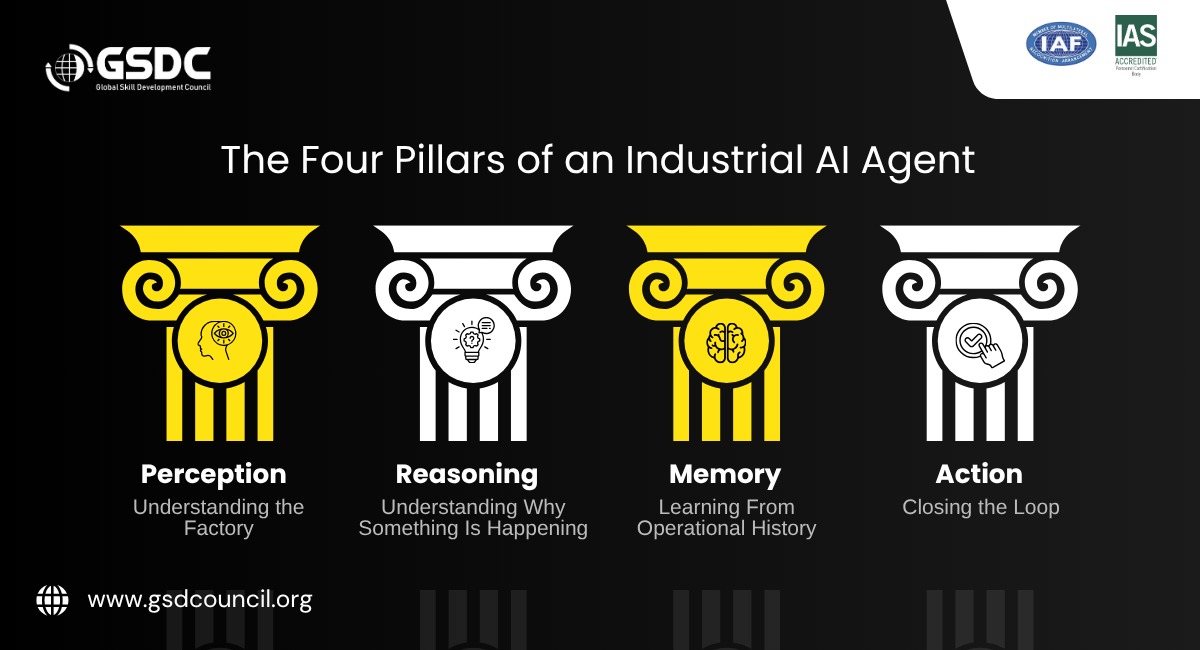
Agentic manufacturing depends on four interconnected capabilities: perception, reasoning, memory, and action.
1. Perception: Understanding the Factory
The first requirement is the ability to perceive what is happening on the factory floor.
Industrial agents can combine information from computer vision, vibration sensors, acoustic systems, temperature sensors, machine data, ERP systems, and other operational sources. Instead of analyzing a single data stream, the agent can build a broader picture of the factory environment.
This allows it to recognize patterns and anomalies that may not be obvious when individual systems are viewed separately.
2. Reasoning: Understanding Why Something Is Happening
Perception alone is not enough. An agent must determine what an observation means.
Foundation models, physics-aware models, time-series models, and planning systems can help an agent investigate potential causes. For example, if a motor begins vibrating differently, the system should not simply identify an anomaly. It should consider whether the underlying problem is bearing fatigue, misalignment, overheating, or another fault.
This reasoning capability moves industrial AI beyond simple threshold-based alerts.
3. Memory: Learning From Operational History
Industrial environments generate enormous amounts of historical information. Agents can use this information as operational memory.
Memory may include previous equipment failures, maintenance records, fault signatures, production events, process parameters, and historical outcomes. Shared world models, knowledge graphs, and digital twins can provide additional context.
The result is an AI system that can compare a current situation with what has happened previously instead of treating every event as an isolated incident.
4. Action: Closing the Loop
The final pillar is action.
An industrial agent must be capable of translating its decisions into operational activities. Depending on the use case and safety level, this might involve creating a maintenance work order, scheduling a technician, changing a production sequence, communicating with suppliers, or issuing commands through industrial control systems.
This is where agentic manufacturing differs most significantly from conventional AI analytics: the system can move from insight to execution.
How an Agentic Factory Makes Decisions
The agentic operating cycle can be understood as a continuous loop:
Observe → Understand → Plan → Simulate → Act → Learn
Agents continuously ingest information from the factory, interpret the context, identify anomalies, determine possible actions, and test potential decisions where appropriate.
Digital twins play an important role here. Before an action is executed on physical equipment, an agent can evaluate its potential consequences in a simulated environment.
Once an action is approved according to the organization's autonomy and safety rules, the agent executes it and records the decision, outcome, and confidence level.
This creates a system capable of responding to operational events far faster than a human-only workflow.
The Full Technology Stack Behind Agentic Manufacturing
Agentic manufacturing is not simply a matter of connecting a large language model to a factory.
A complete AI in manufacturing architecture typically includes several layers.
At the top is the business goal layer, which defines objectives such as productivity, safety, quality, compliance, and cost.
Below that sits the orchestration layer, which coordinates multiple specialized agents. Maintenance, quality, scheduling, supply chain, energy, and safety agents may need to collaborate rather than operate independently.
The reasoning layer interprets problems and develops plans using foundation models, physics-aware models, and specialized planners.
The memory and world-model layer provides historical context through systems such as digital twins, knowledge graphs, and operational data stores.
The perception layer processes information from sensors, cameras, machines, and enterprise systems.
At the bottom is the actuation and control layer, which connects decisions to PLCs, robots, machines, and other physical systems.
This architecture resembles a corporate hierarchy: strategic objectives are established at the top, while lower layers translate those objectives into operational actions, supporting autonomous manufacturing and advanced AI in industrial automation.
Real-World Manufacturing Applications
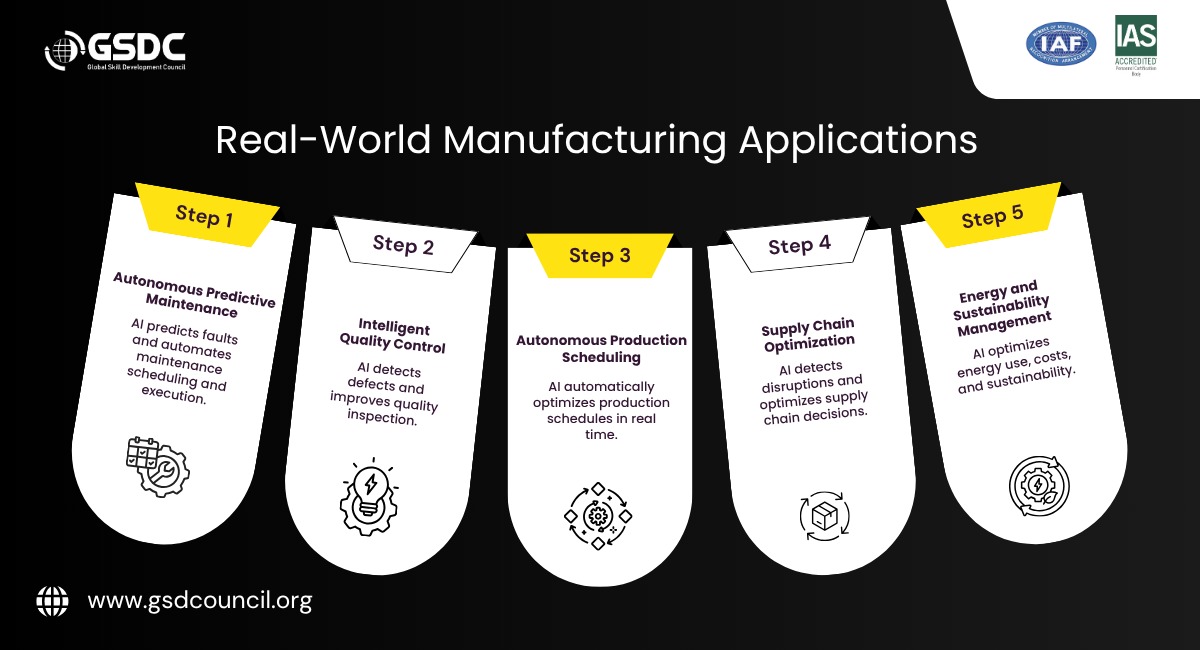
The potential of agentic AI becomes clearer when applied to specific factory operations.
Autonomous Predictive Maintenance
Traditional predictive maintenance alerts a technician when a machine shows signs of deterioration. An agentic system can take the process several steps further.
An agent can combine vibration, thermal, acoustic, and historical data to identify a potential fault. It can reason about the likely cause, create a maintenance work order, identify a technician with the required skills, order the replacement component, and schedule the repair during an appropriate downtime window.
The webinar highlighted a BMW example involving hundreds of machines, where autonomous overhaul scheduling reportedly contributed to a substantial reduction in unplanned downtime and significant annual savings.
The broader lesson is important: predictive maintenance becomes far more valuable when prediction is connected directly to operational execution.
Intelligent Quality Control
Quality inspection is another area where agentic systems can augment human capabilities.
Computer vision systems can inspect products continuously without experiencing fatigue. When the system identifies a concentration of defects, it can dynamically increase inspection density and investigate potential process causes.
The goal is not necessarily to eliminate human inspectors. Instead, AI can handle repetitive inspection while people move toward higher-value responsibilities such as process improvement, exception handling, and complex quality decisions.
Autonomous Production Scheduling
Manufacturing schedules are constantly disrupted by machine breakdowns, urgent orders, labor availability, supplier delays, and changing energy costs.
An autonomous scheduling agent can evaluate these variables simultaneously and rapidly resequence production jobs.
Rather than relying on a planner to manually rebuild a schedule after every disruption, the agent can continuously optimize the production plan against changing constraints.
Supply Chain Optimization
Agentic AI can also extend beyond the factory boundary.
Agents can monitor supplier information, shipping data, and external events to identify potential disruptions. They can then evaluate alternatives and recommend or initiate changes to sourcing, logistics, or production plans.
This moves supply chain management from reactive response toward proactive risk management.
Energy and Sustainability Management
Factories consume significant amounts of energy, making energy optimization an important application.
Energy agents can analyze equipment power consumption, identify deviations from expected baselines, shift energy-intensive operations toward favorable periods, and coordinate renewable energy or battery usage.
This can simultaneously support cost reduction and sustainability objectives.
Why Data Is the Real Competitive Advantage
One of the most important messages from the webinar was that the competitive advantage will not necessarily come from access to a particular AI model.
Large language models are increasingly accessible to organizations around the world. What differentiates one manufacturer from another is its proprietary operational data.
Agentic systems require historical machine information, process parameters, maintenance records, fault signatures, production data, and reliable action logs.
A strong industrial data foundation should therefore include several years of operational time-series information, detailed process logs, labeled fault signatures, and immutable records of system decisions.
Without this foundation, even an advanced AI model may struggle to understand the specific behavior of a manufacturing environment.
A Practical Roadmap to Agentic Manufacturing
Organizations do not need to transform an entire factory overnight.
The webinar proposed a phased approach.
The first phase focuses on building the foundation. Organizations should connect sensors and enterprise systems, improve data quality, and establish a baseline digital twin.
The second phase involves selecting a single domain, such as predictive maintenance, and operating the agent in shadow mode. The system makes recommendations without directly controlling equipment. This provides an opportunity to validate performance and build organizational trust.
The third phase introduces supervised autonomy, allowing agents to perform carefully selected low-risk tasks while maintaining human oversight and an immediate override mechanism.
Once individual agents have demonstrated reliability, organizations can introduce multi-agent coordination, connecting maintenance, quality, scheduling, supply chain, energy, and other functions.
The final phase is continuous improvement. Agents can learn across plants, while human workers increasingly focus on exceptions, complex decisions, system governance, and improvement initiatives.
The Organizational Challenge: People and Change Management
Technology is only one part of the transformation.
Manufacturing organizations must also prepare their workforce for a different relationship with AI. Employees may be concerned that automation will eliminate their roles. Successful implementation therefore requires clear communication about how responsibilities will change.
Instead of replacing every human task, AI in manufacturing can remove repetitive monitoring and administrative work, allowing employees to focus on higher-value activities such as troubleshooting, process optimization, safety management, and strategic decision-making.
The future factory is therefore not necessarily a factory without people. It is a factory where people spend less time reacting to routine events and more time managing exceptions and improving the system.
The Future: From Copilots to Self-Orchestrating Factories
The manufacturing industry is moving toward a future in which humans establish objectives and constraints while AI agents coordinate increasingly complex operational activities.
The transition will not happen uniformly across every industry or facility. Automotive and electronics manufacturers may adopt advanced autonomy sooner because of their highly digitized environments, while sectors with more complex safety or regulatory requirements may progress more cautiously.
The important shift is conceptual.
Manufacturers should begin thinking beyond “How can AI help my employee make a decision?” and start asking “Which operational decisions can an AI agent safely manage within clearly defined boundaries?”
That change in mindset is at the heart of the agentic revolution.
Build Expertise with GSDC’s Agentic AI Certification
GSDC’s Agentic AI Certification helps professionals develop practical knowledge of agentic AI, autonomous systems, AI-driven decision-making, and responsible implementation.
This Agentic AI Certification complements the shift toward agentic manufacturing by building skills needed to understand, deploy, and manage AI agents while balancing automation, human oversight, safety, and business objectives.

Conclusion
The shift from smart to agentic manufacturing moves AI in manufacturing from monitoring and recommending to reasoning, planning, and acting. Agentic AI in manufacturing enables AI agents to make decisions and execute approved actions with greater autonomy, creating a pathway toward autonomous manufacturing and dark factory and lights out manufacturing environments. However, successful adoption requires strong data, digital twins, cybersecurity, safety controls, and human oversight. Organizations can start with low-risk use cases, validate results, and gradually increase autonomy as trust grows.
The key question is no longer “What if AI could run parts of the factory?” but “When will our factory be ready to use AI agents safely?”

Related Certifications
Frequently Asked Questions
Agentic manufacturing uses AI agents that can perceive, reason, plan, and act toward defined factory goals with less human intervention.
Smart manufacturing monitors data and provides insights. Agentic AI goes further by making decisions and executing approved actions within defined safety boundaries.
Key challenges include legacy systems, fragmented data, limited labeled data, cybersecurity risks, workforce adoption, and safe integration with physical equipment.
In some low-risk scenarios, yes. However, autonomy should increase gradually. Safety-critical operations require strong controls, human oversight, override mechanisms, and escalation procedures.
Start with a focused use case such as predictive maintenance. Run the agent in shadow mode first, validate its recommendations, then introduce supervised autonomy before expanding to broader multi-agent operations.
Stay up-to-date with the latest news, trends, and resources in GSDC
If you like this read then make sure to check out our previous blogs: Cracking Onboarding Challenges: Fresher Success Unveiled
Not sure which certification to pursue? Our advisors will help you decide!