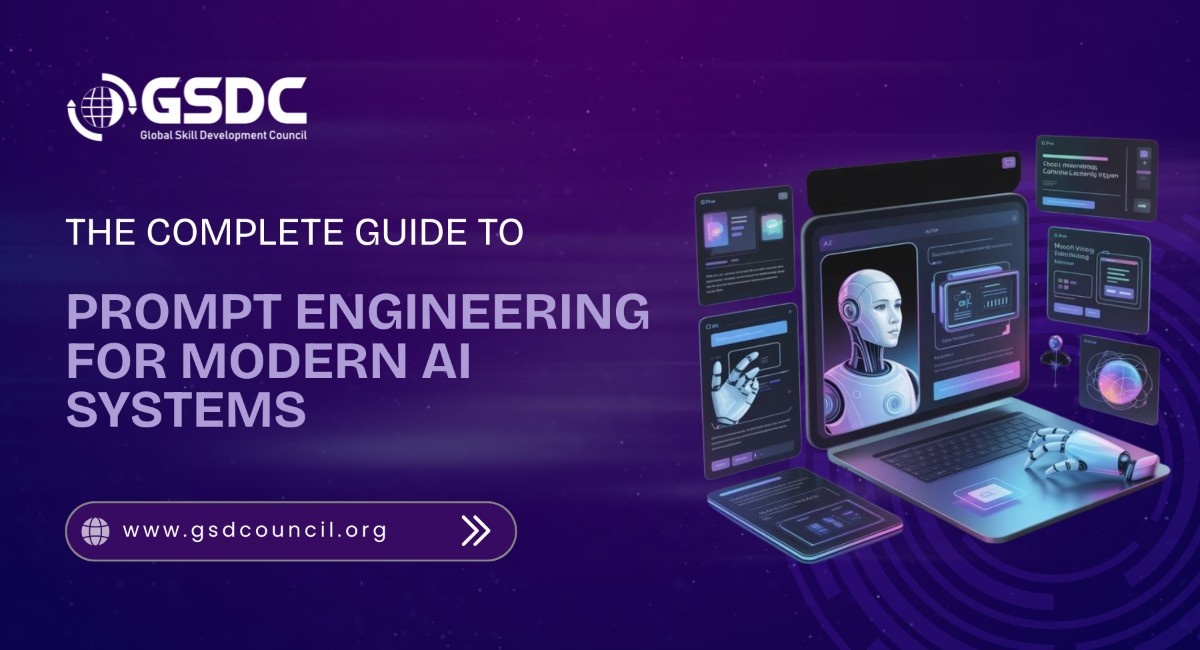
The Complete Guide to Prompt Engineering for Modern AI Systems
Written by Emily Hilton
- What Is Prompt Engineering?
- How AI Models Interpret Prompts?
- Core Techniques of Prompt Engineering
- Prompt Engineering in Real-World Use Cases
- Career Outlook: What Is a Prompt Engineer?
- Prompt Engineering Salary Outlook
- Certification and Professional Growth
- Challenges and the Future of Prompt Engineering
- Conclusion: Why Mastering Prompt Engineering Is Essential
Artificial intelligence is no longer a futuristic concept; it is now embedded into everyday business workflows, digital tools, and decision-making systems. From chatbots and content generators to code assistants and analytics platforms, generative AI is reshaping how professionals work. At the center of this transformation lies a critical yet often misunderstood skill: prompt engineering.
This prompt engineering guide examines how carefully structured instructions, known as prompts, can significantly enhance AI outputs. Whether you're a marketer, developer, analyst, or business leader, understanding what is prompt engineering guide material can give you a competitive edge. It enables you to transform AI from a generic tool into a precision instrument for productivity, creativity, and strategy.
Modern organizations are already investing in prompt engineering certification programs and standardized prompt engineering frameworks to ensure consistent, high-quality AI usage. As AI systems evolve, professionals who master this skill will not only save time but also unlock smarter insights, reduce errors, and enhance decision-making.
This guide covers prompt engineering basics, real-world techniques, best practices, career prospects, and why learning prompt for AI strategies is becoming an essential digital competency.
What Is Prompt Engineering?
At its core, prompt engineering is the practice of designing structured inputs that guide AI models to generate accurate, relevant, and context-aware responses. A prompt can be a simple question, a multi-step instruction, or a detailed scenario that shapes how an AI system processes and responds to information.
If you're searching for a clear explanation of whatprompt engineeringguide material typically covers, it begins with the idea that AI systems do not think, but rather predict. The quality of their output depends heavily on the clarity, structure, and intent of the input they receive. This makesprompt engineering basics fundamental to successful AI adoption.
A well-designed prompt for AI typically includes:
- Context (background information)
- Task definition (what the AI should do)
- Output format (how the result should look)
- Constraints (length, tone, scope, or rules)
These components form the foundation of modern prompt engineering frameworks, helping teams standardize how they interact with AI systems across business functions.
How AI Models Interpret Prompts?
To use AI effectively, it’s important to understand how models interpret instructions. AI systems process text probabilistically, meaning they predict the next word or token based on patterns in their training data. This makes prompt structure a determining factor in response quality.
Zero-Shot vs. Few-Shot Prompting
- Zero-shot prompting: Asking a question without examples.
- Few-shot prompting: Providing sample outputs to guide behavior.
Both are essential elements in prompt engineering guidelines used across industries.
Chain-of-Thought Prompting
This method encourages AI to reason step-by-step, improving logical accuracy for tasks like math, planning, and diagnostics. It’s a key technique highlighted in advanced prompt engineering frameworks.
Role & Persona Prompting
Assigning a role such as “act as a cybersecurity analyst” or “respond like a senior marketer” improves relevance. This technique forms a core part of prompt engineering guide best practices.
Core Techniques of Prompt Engineering
Clarity and Specificity
Ambiguous instructions produce unreliable results. Clear objectives, defined scope, and direct language significantly enhance output quality. This is one of the most important prompt engineering basics to master.
Format and Output Control
Explicitly defining the desired format, such as tables, bullet points, summaries, or code blocks, ensures consistent responses. This technique is essential for teams building scalable prompt engineering frameworks.
Context and Examples
Providing background information and sample outputs improves alignment. Few-shot examples serve as learning signals for AI and are a cornerstone of prompt engineering guide best practices.
Iterative Refinement
Effective prompts evolve through testing. Professionals refine inputs, track outputs, and store high-performing prompts into reusable libraries. This process follows practical prompt engineering guidelines used in enterprise AI environments.
Advanced Strategies
- Prompt chaining: Breaking large tasks into smaller steps.
- Meta-prompting: Asking AI to generate optimized prompts.
- Scaffolding: Layering prompts for complex workflows.
These advanced methods are increasingly standardized within professional prompt engineering frameworks.
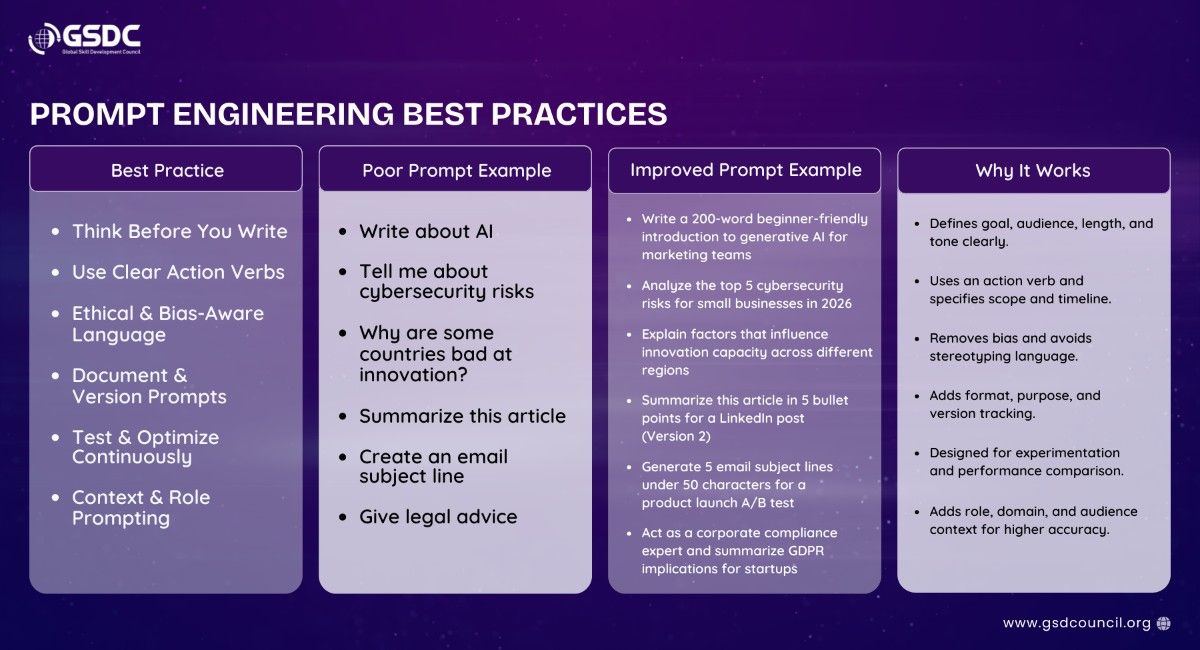
Prompt Engineering in Real-World Use Cases
Content Creation
Marketers use prompt for AI strategies to generate blogs, ads, emails, and SEO content with a consistent tone and messaging. By defining audience personas, brand voice, and output format, teams can produce high-quality content faster. Structured prompting also reduces revisions and ensures compliance with brand guidelines.
Software Development
Developers rely on prompt engineering to generate clean code, debug errors, and document APIs efficiently. Well-crafted prompts help AI understand technical requirements, programming language constraints, and performance goals. This improves development speed, reduces manual effort, and enhances software reliability.
Data Analysis
Analysts use structured prompts to summarize large datasets, detect patterns, and generate actionable business insights. By specifying analytical goals, metrics, and output format, prompts transform raw data into executive-ready reports. This accelerates decision-making and reduces dependency on manual data processing.
Customer Support
AI chatbots trained with prompt engineering guidelines deliver faster and more accurate responses to customer queries. Role-based prompts and escalation rules help bots handle complex scenarios while maintaining a human-like tone. This improves customer satisfaction, reduces response time, and lowers operational costs.
Multimodal AI
Prompt engineering extends beyond text into image, audio, and video generation for creative workflows. Creative teams use structured prompts to control visual style, branding elements, and narrative tone. This ensures consistent design outputs across campaigns and enhances creative productivity.
Across all these applications, standardized prompt engineering frameworks ensure consistent results, improved accuracy, and measurable ROI. They allow organizations to scale AI adoption responsibly while maintaining quality, compliance, and performance benchmarks.
Career Outlook: What Is a Prompt Engineer?
As organizations integrate AI into operations, a new role has emerged: the prompt engineer. But what is a prompt engineer, and why is this role growing so fast?
A prompt engineer is a professional who designs, tests, and optimizes prompts to maximize AI performance across use cases. Their responsibilities include:
- Developing a standardized prompt for AI templates
- Testing prompt variations
- Ensuring ethical and compliant outputs
- Documenting workflows
- Integrating AI into business systems
If you're wondering what does a prompt engineer do, the role blends technical logic, communication skills, and domain expertise.
Prompt Engineering Salary Outlook
The prompt engineering salary varies by region and industry, but globally it ranges from mid-level tech salaries to senior AI architect compensation. As demand increases, salary growth is expected to accelerate.
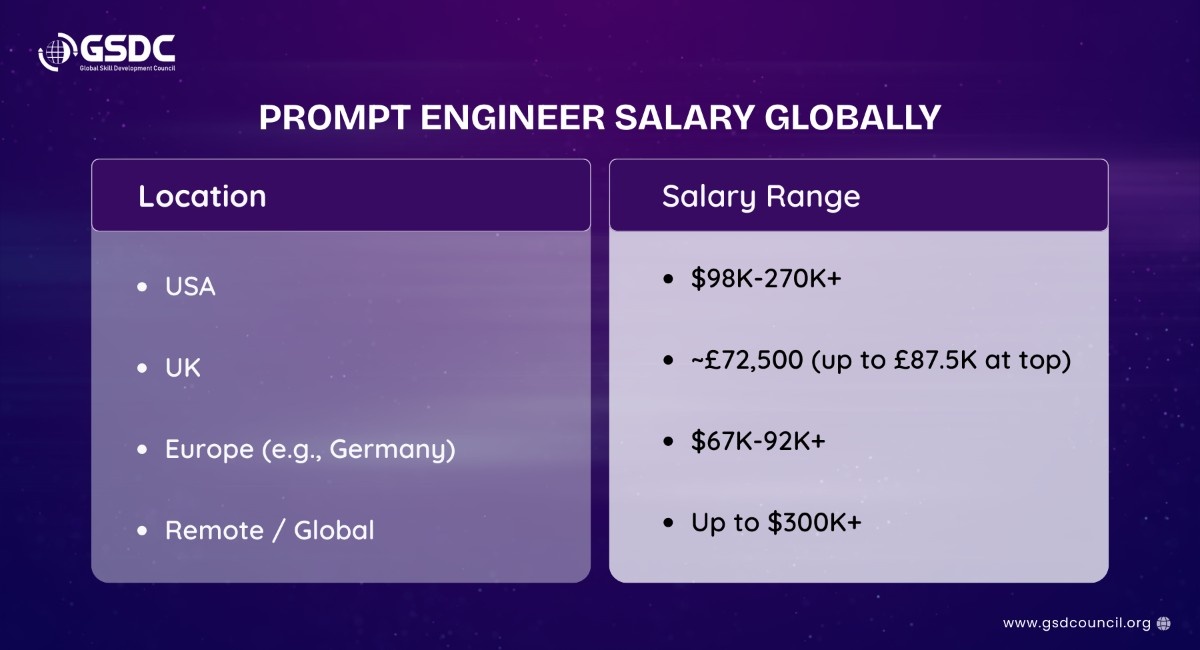
The location of your employment determines your salary amount. The technology companies and consulting firms pay higher salaries for artificial intelligence experts. Startups provide lower salary packages, but they counter this disadvantage by offering growth potential and equity ownership to their employees. The advertising, media, and gaming sectors now employ prompt engineers to develop their content and product design work.
Certification and Professional Growth
Many professionals pursue prompt engineering certification programs to validate their expertise. Certifications demonstrate proficiency in prompt engineering basics, frameworks, and best practices, helping professionals transition into AI-driven roles faster.
Here, GSDC’s Prompt Engineering Certification validates practical skills in prompt design, ethics, and optimization, helping professionals strengthen credibility, accelerate AI careers, and stay competitive in an evolving digital workforce.

Challenges and the Future of Prompt Engineering
Key Challenges
- Ambiguity leading to hallucinated outputs
- Model bias and ethical risks
- Over-dependence on unverified AI results
These issues highlight why standardized prompt engineering guidelines are critical for enterprise deployment.
The Future
The future of prompt engineering includes:
- AI-assisted prompt generation
- Auto-optimization of prompts
- Integration into no-code AI platforms
- Formalization into corporate training programs
As AI becomes more autonomous, prompt engineering frameworks will evolve into governance tools that define how organizations interact with intelligent systems.
Conclusion: Why Mastering Prompt Engineering Is Essential
Prompt engineering is no longer an optional technical trick; it is a foundational digital skill. This prompt engineering guide has shown how structured inputs improve accuracy, productivity, and strategic decision-making.
By mastering prompt engineering basics, following prompt engineering guide best practices, and applying ethical prompt engineering guidelines, professionals can transform AI into a powerful business asset.
Whether you're exploring what is prompt engineering guide resources for learning or planning a career shift into AI, developing expertise in prompt engineering frameworks opens doors to innovation, leadership, and global career opportunities.
With rising demand for certified professionals, competitive, prompt engineering salary ranges, and growing adoption across industries, there has never been a better time to start learning.
AI may be intelligent, but only well-crafted prompts make it truly powerful.

Related Certifications
Stay up-to-date with the latest news, trends, and resources in GSDC
If you like this read then make sure to check out our previous blogs: Cracking Onboarding Challenges: Fresher Success Unveiled
Not sure which certification to pursue? Our advisors will help you decide!