Building Data-Aware AI Agents with Effective Prompt Engineering
Written by Matthew Hale
- Why Data-Aware AI Agents Matter
- The Role of Prompt Engineering in AI Agent Performance
- Prompt Engineering as a Core Skill
- Step 1: Personalizing the Core ChatGPT Environment
- Step 2: Using Connectors for Data-Aware AI
- Step 3: Building Custom GPTs
- A Practical Example: A Sales Operations Analyst Agent
- Who Can Benefit from Data-Aware AI Agents and Prompt Engineering
- Smarter Decision-Making Through Structure and Precision
- The Next Phase: AI as a Partner
- Professional Reasons for Selecting GSDC to Develop AI Skills
- A New Era of Intelligent Workflows in Conclusion
- FAQs
AI is rapidly becoming the engine behind modern decision-making. Yet, how well it comprehends the data, context, and goals of the organization using it will determine its impact. For this reason, data-aware AI agents are revolutionizing teamwork. They bring together information, reasoning, and automation in a way traditional tools never could.
At the core of these intelligent systems is prompt engineering. AI is directed to think more clearly, respond more accurately, and execute tasks with purpose by well-structured prompts.
Furthermore, businesses can now create AI agents that are customized to their workflows without encountering technical obstacles thanks to Custom GPTs' expanding capabilities.
The GSDC Studio: AI Implementation Series explores how these elements come together to create smarter, faster, and more reliable AI-driven decisions.Why Data-Aware AI Agents Matter
General AI models are powerful but still operate as generalists. Without context, they rely on patterns instead of purpose.
Data-aware AI agents operate differently. They use data-driven AI logic, connect to your tools, and understand your workflows. This allows them to act like specialized team members.
These agents become more reliable when they are:
- Connected to your tools: Enabling email, calendars, files, and work apps gives AI real information to work with. This forms the basis of context-aware AI.
- Trained on your datasets: Reports, playbooks, SOPs, and documentation allow deeper reasoning and clearer interpretation.
- Aligned with internal goals: Agents follow your strategic direction, preferred workflows, and communication style.
With this foundation, AI can analyze sales performance, summarize documents, monitor updates, draft reports, and create insights instantly.
Custom GPTs enable this by allowing users to define roles, upload data, set permissions, and configure backend instructions. This is the practical path to building AI agents with real business value.The Role of Prompt Engineering in AI Agent Performance
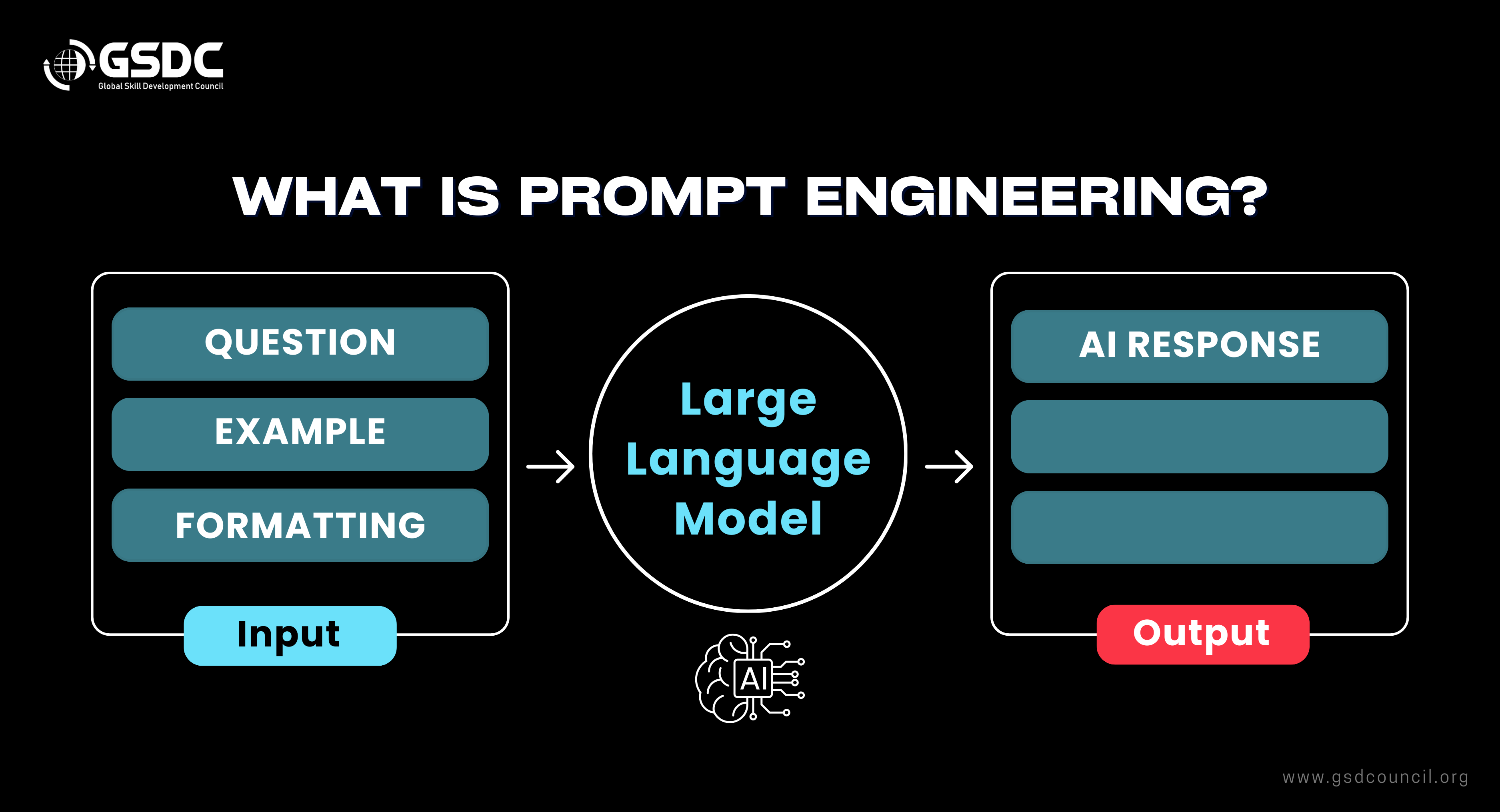
Prompt engineering is more than asking better questions. It is a structured way of guiding AI reasoning, ensuring clarity, accuracy, and relevance.
Prompt engineering organizes how AI thinks. Without structure, the AI guesses. With structure, the AI reasons.
A strong prompt answers key questions:
- Who should the AI act as?
Roles shape tone, expertise, and the point of view the AI uses.
- Why does the task matter?
Purpose prevents generic responses and ensures outputs stay aligned with objectives.
- What should the AI produce?
Format, tone, structure, and length create consistency and usability.
- Who is the audience?
Information is framed differently depending on the reader.
These elements form the foundation of understanding what prompt engineering is, how to prompt AI effectively, and how to apply AI prompt optimization.
They are also essential for anyone exploring prompt engineering jobs, prompt engineering salary prospects, or how to become a prompt engineer.Prompt Engineering as a Core Skill
Prompt engineering is often misunderstood as creative wording. In practice, it is a communication strategy that shapes how AI processes information and executes tasks.
A well-designed prompt answers:
- Who is the AI supposed to be?
A sales analyst, researcher, advisor, strategist, or technical support assistant.
- What is its purpose?
Analyze data, summarize content, provide insights, or automate workflows.
- What should it deliver?
Action items, trend reports, one-page summaries, challenges, or recommendations.
- Who will read the output?
Senior leaders, internal teams, customers, or external partners.
- What tone is required?
Professional, concise, analytical, conversational, or persuasive.
These details activate deeper reasoning. They are the foundation of generative AI prompt engineering, advanced prompt engineering techniques, and prompt design best practices.
When prompts follow this structure, AI becomes a predictable and strategic partner.
Step 1: Personalizing the Core ChatGPT Environment
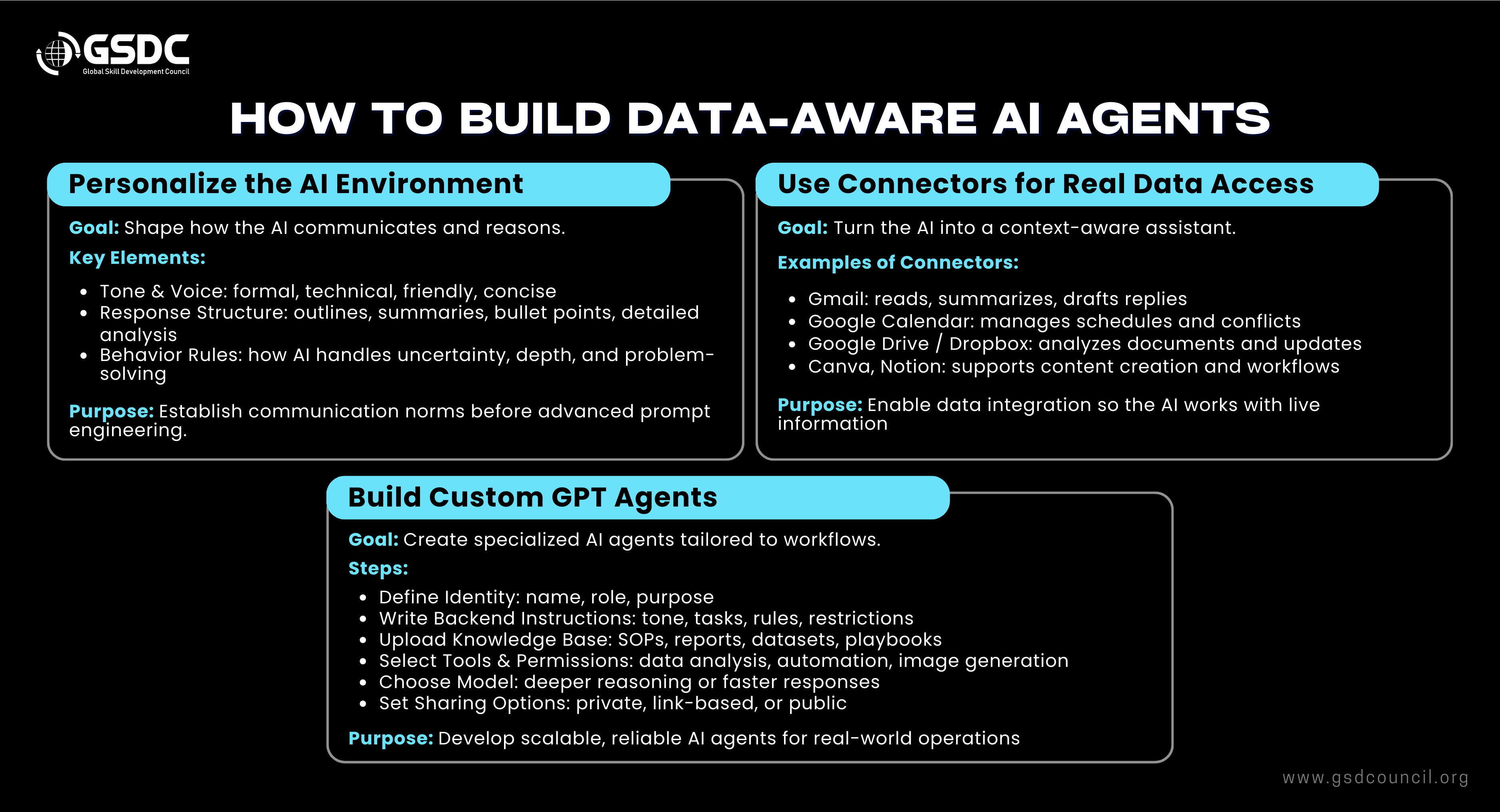
Before building custom agents, it helps to personalize the ChatGPT interface. Personalization shapes how the AI communicates, reasons, and formats responses.
This step establishes communication norms.
- Tone and voice preferences: You can request outputs that are formal, technical, friendly, or concise.
- Response structure: The AI can default to outlines, bullet points, detailed explanations, or summaries.
- Behavioral guidelines: You can define how the AI handles uncertainty, depth of reasoning, and problem-solving.
These adjustments prepare the system for more advanced prompt engineering practices and support anyone learning from a structured prompt engineering guide.
These prompt structures form the foundation. Now the AI environment needs to be tailored so every interaction reinforces those rules.
Step 2: Using Connectors for Data-Aware AI
Connectors allow the AI to access real data across your ecosystem. When enabled, the AI works with live information rather than hypothetical scenarios.
Connectors support data integration in AI workflows.
Examples include:
- Gmail: AI reviews messages, drafts responses, identifies priorities, and summarizes threads.
- Google Calendar: AI manages schedules, tracks conflicts, and supports planning.
- Google Drive or Dropbox: AI analyzes files, monitors updates, and produces reports.
- Canva, Notion, and other tools: AI helps teams create content and maintain organized workflows.
This makes the AI a context-aware assistant capable of supporting real operations.
Step 3: Building Custom GPTs
Custom GPTs allow anyone to design specialized AI agents with specific roles, instructions, and data access. This is where building AI agents becomes practical and scalable.
The process includes several structured steps:
- Define the Agent's Identity: Name the agent clearly and describe what it is designed to do.
- Write Backend Instructions: Define tone, goals, tasks, reasoning rules, restrictions, and expected outputs.
- Upload the Knowledge Base: Add SOPs, reports, playbooks, datasets, and documents the AI should learn from.
- Select Tools and Permissions: Enable features like data analysis, image generation, or automation when needed.
- Choose the AI Model: Advanced models support deeper thinking and longer reasoning chains.
- Set Sharing Preferences: Agents can be private, shared via link, or published publicly.
A Practical Example: A Sales Operations Analyst Agent
A sales operations analyst agent shows how custom GPTs can support business decision-making.
The representative is able to:
- Analyze quarterly sales data: It identifies top-performing regions and notable trends.
- Evaluate challenges: It highlights obstacles and explains factors affecting performance.
- Make suggestions: It provides practical methods for upcoming enhancements.
- Generate leadership-ready summaries: Concise, polished, and alignment with executive expectations characterize the outputs.
Who Can Benefit from Data-Aware AI Agents and Prompt Engineering
These skills are useful in a variety of occupations. Anyone who handles information, workflows, or communication can benefit.
- Managers and executives in business: AI agents accelerate reporting and decision-making.
- Teams in charge of sales, operations, and strategy: Automated analysis and suggestions boost productivity.
- HR and L&D professionals: AI helps with training workflows, policy explanation, and onboarding.
- Researchers and analysts: AI simplifies data synthesis and comparison.
- Entrepreneurs and freelancers: Agents automate repetitive tasks and improve productivity.
Students and those just starting their careers: High-demand positions, such as prompt engineering jobs with competitive salary prospects, are accessible to those with knowledge of prompt engineering.
Knowing advanced prompt engineering techniques, AI prompting, and how to build an AI agent becomes a strategic advantage as the use of AI grows.Smarter Decision-Making Through Structure and Precision
Modern decision-making demands clarity, speed, and context. Data-aware AI agents supported by well-designed prompts deliver these advantages.
Teams gain:
- More reliable outputs: Clear rules improve accuracy and consistency.
- Faster workflows: Complex tasks are automated or accelerated.
- Better alignment: AI follows organizational frameworks and tone.
- Improved communication: Outputs match the needs of specific audiences.
The Next Phase: AI as a Partner
AI is evolving from a support tool to a regular operational partner. Agents will take on more tasks as their reasoning gets better.
Examples include:
- AI manages emails by drafting, summarizing, and prioritizing messages.
- Document monitoring: AI creates summary reports and keeps track of updates.
- Training and onboarding: AI guides new employees through resources and processes.
- By analyzing data and generating insights, AI supports research.
Professional Reasons for Selecting GSDC to Develop AI Skills
Professionals in a variety of fields are realizing how crucial prompt engineering, AI agent design, and data-aware workflows are becoming. These capabilities are becoming essential for anyone looking to work effectively with advanced AI systems or lead digital transformation efforts.
By providing resources and learning pathways that are in line with actual industry demands, GSDC continues to support this transition. The Certified AI Tool Expert is one such path providing real-world training in AI agent development, prompt optimization, and structured frameworks used in modern businesses.
This certification helps professionals strengthen their expertise and stay competitive in an evolving AI-driven landscape.
A New Era of Intelligent Workflows in Conclusion
AI is no longer only used for basic tasks. It has sophisticated analysis, interpretation, recommendation, and execution capabilities.
Data-aware agents and clear prompt structures anchor this new era of intelligent work.
Businesses that master the design and management of these systems will function more effectively, move more quickly, and make wiser decisions.
The future of work is structured, data-driven, and deeply integrated with AI.
It begins with carefully designed prompts, clarity, and purpose.
FAQs
1. How safe is my data when connecting email inboxes or custom AI tools?
Data safety cannot be guaranteed fully because AI practices and regulations are still evolving. Avoid uploading highly sensitive data and control what information you choose to connect.
2. Where are files uploaded to a custom GPT stored?
Files are uploaded through the Configure section and stored in secure global data centers. These centers handle large-scale AI workloads, though exact physical locations are not disclosed.
3. Should confidential files be added to a custom GPT?
Confidential files may be used if the GPT is private or shared only with trusted users. Extremely sensitive data should be avoided to minimize risk.
4. What happens if someone else accesses my custom GPT link?
Anyone with the link can use the GPT exactly as designed. This supports collaboration but requires caution if the GPT contains internal information.
5. Should all tools be enabled when building a custom GPT?
Not necessarily. Turning on every tool may slow the agent. Enable only the tools that support the GPT’s purpose, such as data analysis.

Related Certifications
Stay up-to-date with the latest news, trends, and resources in GSDC
If you like this read then make sure to check out our previous blogs: Cracking Onboarding Challenges: Fresher Success Unveiled
Not sure which certification to pursue? Our advisors will help you decide!