Why Agentic AI Is the Next Big Step After Prompt Engineering?
Written by Maya Mishra
- From Prompt Engineering to Agentic AI: The Evolution
- What is Agentic AI?
- Key Features That Differentiate Agentic AI from Prompt-Only AI
- The Role of Prompt Engineering in Agentic AI
- Architectures & Design Patterns of Agentic AI
- Use Cases & Applications of Agentic AI
- Challenges, Risks, and Ethical Considerations
- The Future of Agentic AI
- Agentic AI Certification for Professionals
- Conclusion
Imagine an AI that doesn’t just respond to your instructions but plans its own strategy, chooses the right tools, learns from mistakes, and iterates autonomously. That’s the leap we’re witnessing today from prompt engineering to Agentic AI.
Prompt engineering helped unlock the potential of Large Language Models (LLMs), enabling them to generate human-like text, perform reasoning, and adapt to structured tasks. But as powerful as it is, prompting or traditional AI has limits: it’s static, brittle, and dependent on human guidance at every step.
Enter Agentic AI, a paradigm shift where models evolve from passive responders into autonomous agents. They perceive goals, design plans, execute actions, and refine themselves in real-time.
Agentic AI transforms passive LLMs into autonomous, goal-directed systems, equipped with planning, memory, tool integration, and feedback loops. This blog examines why Agentic AI is significant, how it operates, and its implications for the future of AI.
From Prompt Engineering to Agentic AI: The Evolution
Prompt engineering became the foundation of modern AI interactions. By crafting clever instructions, developers could make LLMs summarize papers, write code, or generate marketing copy. Certifications, such as a prompt engineering certification even helped professionals transition into prompt engineering jobs.
However, prompting faces critical limitations:
- It struggles with multi-step reasoning and goal persistence.
- Outputs vary, requiring repeated human oversight.
- It cannot autonomously decide what to do next.
What is Agentic AI?
At its core, Agentic AI refers to AI systems capable of perceiving their environment, setting goals, planning, acting, and adapting without step-by-step human control.
Core components include:
- Goal-setting & planning: breaking down objectives into executable tasks.
- Self-reflection & iterative reasoning: identifying mistakes and correcting them.
- Tool and API integration: using calculators, databases, or coding environments.
- Memory & state persistence: retaining context across sessions.
- Multi-step decision-making: executing long workflows without interruption.
This creates a mental model: Perception → Reasoning → Action → Feedback loop.
Agentic AI examples:
- Autonomous coding assistants that debug and deploy software.
- AI research agents are conducting literature reviews.
- Customer service bots manage end-to-end issue resolution.
This evolution showcases how Agentic AI works not as a script executor but as a dynamic collaborator.
Key Features That Differentiate Agentic AI from Prompt-Only AI
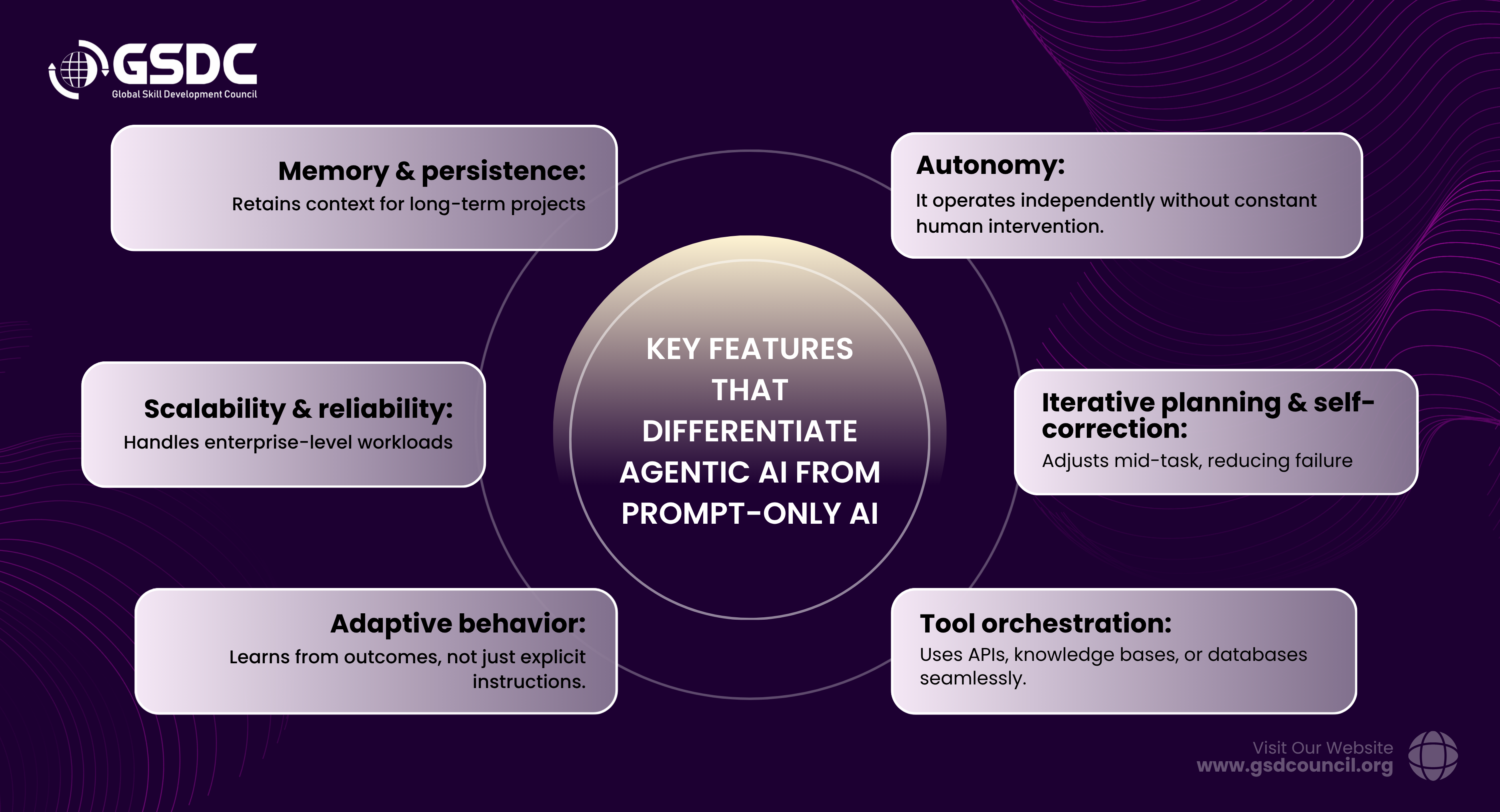
What does Agentic AI do differently?
- Autonomy: Unlike prompt-only AI, which requires constant human input, Agentic AI can operate independently once given a goal. It proactively decides the next steps, reducing the need for micromanagement and enabling end-to-end task execution.
- Iterative Planning & Self-Correction: Instead of producing a single static output, Agentic AI continuously evaluates its own progress. It identifies mistakes, revises strategies mid-task, and adapts dynamically, ensuring higher accuracy and reliability.
- Tool Orchestration: Agentic AI integrates seamlessly with APIs, databases, and external systems to extend its capabilities. For example, it can query a knowledge base, fetch real-time data, or run code without direct user intervention.
- Memory & Persistence: While typical prompt-based systems may forget context once the first interaction has been completed, in the Agentic AI paradigm, memory is conserved through the multitude of tasks and sessions. Such long-term state persistence enables it to proficiently handle complex multi-staged projects.
- Scalability & Reliability: Agentic AI can address operational workload demands that require stability and precision. It can manage multiple tasks simultaneously and recover from errors with more robustness than prompt-only systems.
- Adaptive Behavior: Instead of following instructions literally, Agentic AI learns from feedback and outcomes to optimize its strategies over time. This is the very nature of emergent behaviors, which can be quite different from those explicitly programmed.
The Role of Prompt Engineering in Agentic AI
With the above discussion, one may consider prompt engineering unnecessary, which is not in fact the case. In Agentic AI for Project Management systems, prompts were meant to be the agents' operating rules. Instead of asking a one-off question, developers prepare agentic prompts that contain:
- System prompts: Establishing an agent's identity, ethics, or constraints.
- Instructions for tool use: Guiding agents on how and when to call APIs.
- Feedback protocols: Teaching agents when to self-reflect.
- Multi-agent orchestration: Laying down the rules of engagement between multiple agents.
Challenges include over-constraining autonomy (making agents too rigid) or prompt ambiguity (leading to failure).
Thus, prompt engineering certification still provides vital skills, only now it fuels agentic orchestration instead of single-step instructions.
🚀 Ready to master Agentic AI?
Architectures & Design Patterns of Agentic AI
Agentic AI relies on robust frameworks and modular architectures, often including:
- Planner: Decomposes goals into subtasks.
- Executor: Runs actions and interacts with tools.
- Memory: Stores knowledge and task state.
- Tool Interface: Connects APIs, databases, or real-world systems.
Popular design patterns:
- ReAct (Reason + Action loops).
- Chain-of-thought with self-reflection.
- Scratchpads for iterative reasoning.
- Supervisor layers for monitoring and error recovery.
These agentic AI frameworks enable reliability in real-world deployments.
Use Cases & Applications of Agentic AI
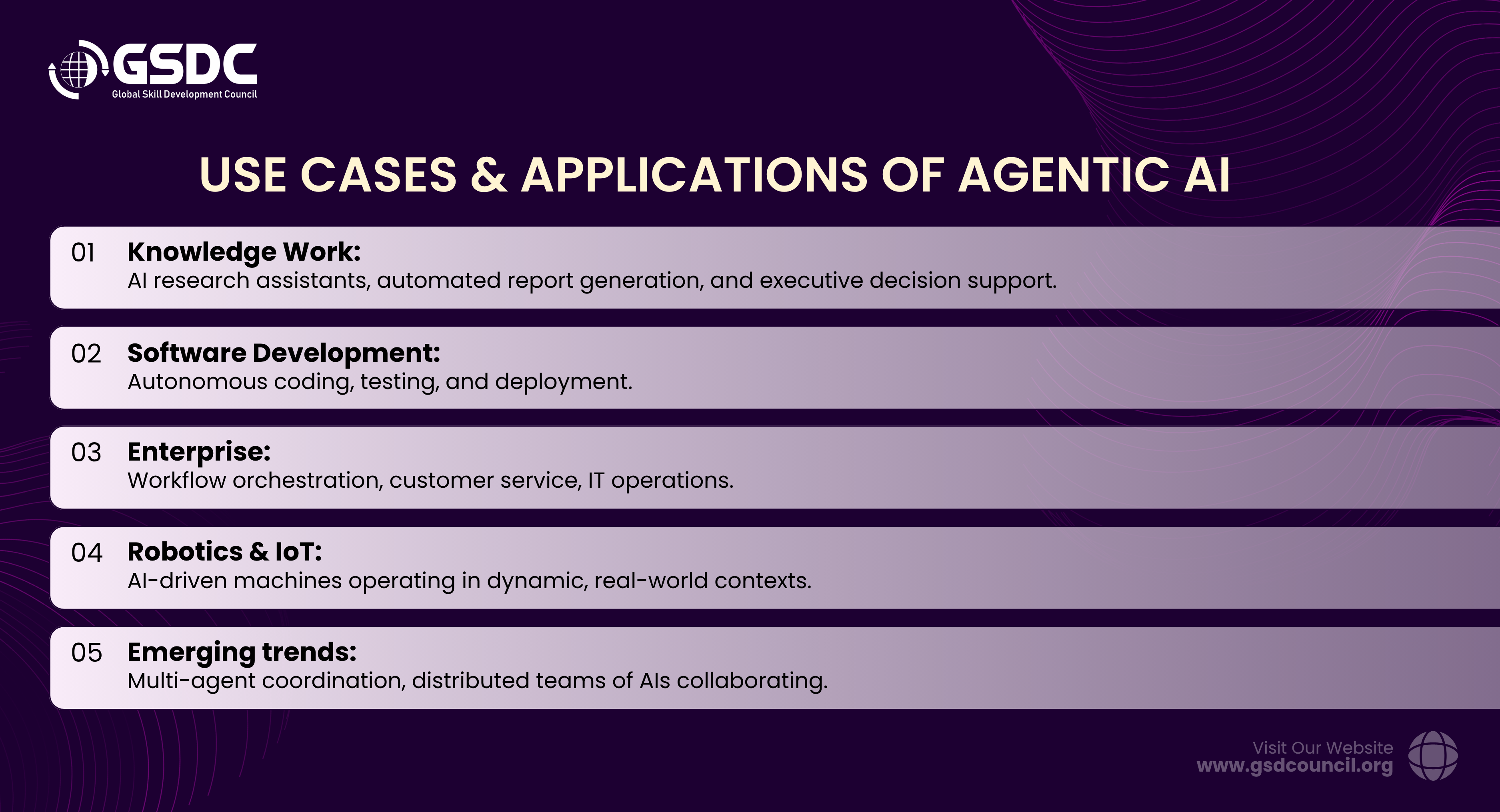
The rise of agentic AI tools is transforming industries by enabling systems that can act autonomously, adapt to feedback, and collaborate with humans or other agents.
These capabilities go far beyond traditional prompt-based outputs, offering scalable solutions that redefine productivity and innovation.
-
Knowledge Work
One of the most immediate agentic AI use cases is in knowledge-intensive domains. Research assistants powered by Agentic AI can autonomously collect, analyze, and summarize information across vast datasets.
-
Software Development
In engineering, Agentic AI is evolving into a co-developer. Instead of simply generating code snippets, autonomous coding agents can design, test, debug, and even deploy software pipelines. These agents integrate with repositories, run unit tests, and self-correct errors, which explains why Agentic AI is important for accelerating innovation in software industries.
-
Enterprise Operations
Businesses are leveraging Agentic AI for end-to-end workflow orchestration, customer service automation, and IT management. Imagine a customer support bot that not only answers queries but also accesses backend systems, triggers workflows, and resolves issues without escalation. This level of autonomy reduces costs while improving efficiency and customer satisfaction.
-
Robotics & IoT
In physical environments, Agentic AI empowers robots, drones, and IoT devices to operate independently. From warehouse automation to autonomous vehicles, these agents perceive real-world conditions, make real-time decisions, and adapt dynamically.
-
Emerging Trends
Looking ahead, multi-agent coordination will unlock distributed AI teams collaborating on complex problems. Such ecosystems illustrate the agentic AI future of work, where AI agents and humans co-create solutions across industries.
In short, why use Agentic AI becomes clear: it enables adaptive, goal-driven systems that handle complexity, scale, and autonomy far beyond the reach of prompt-only AI.
Challenges, Risks, and Ethical Considerations
Autonomy introduces risks:
- Misalignment: Agents following undesired objectives.
- Hallucinations: The compound of several errors across multiple steps of reasoning.
- Security issues: If attacks are prompt injection, misuse of APIs, or unauthorized access.
- Ethics and Accountability: Who bears responsibility when an agent makes a harmful decision?
- Cost and compute overhead: Agents consume many more resources.
- Debugging and Transparency: It is still difficult to understand AI reasoning.
Addressing these challenges is critical to building safe, trustworthy agentic AI frameworks.
The Future of Agentic AI
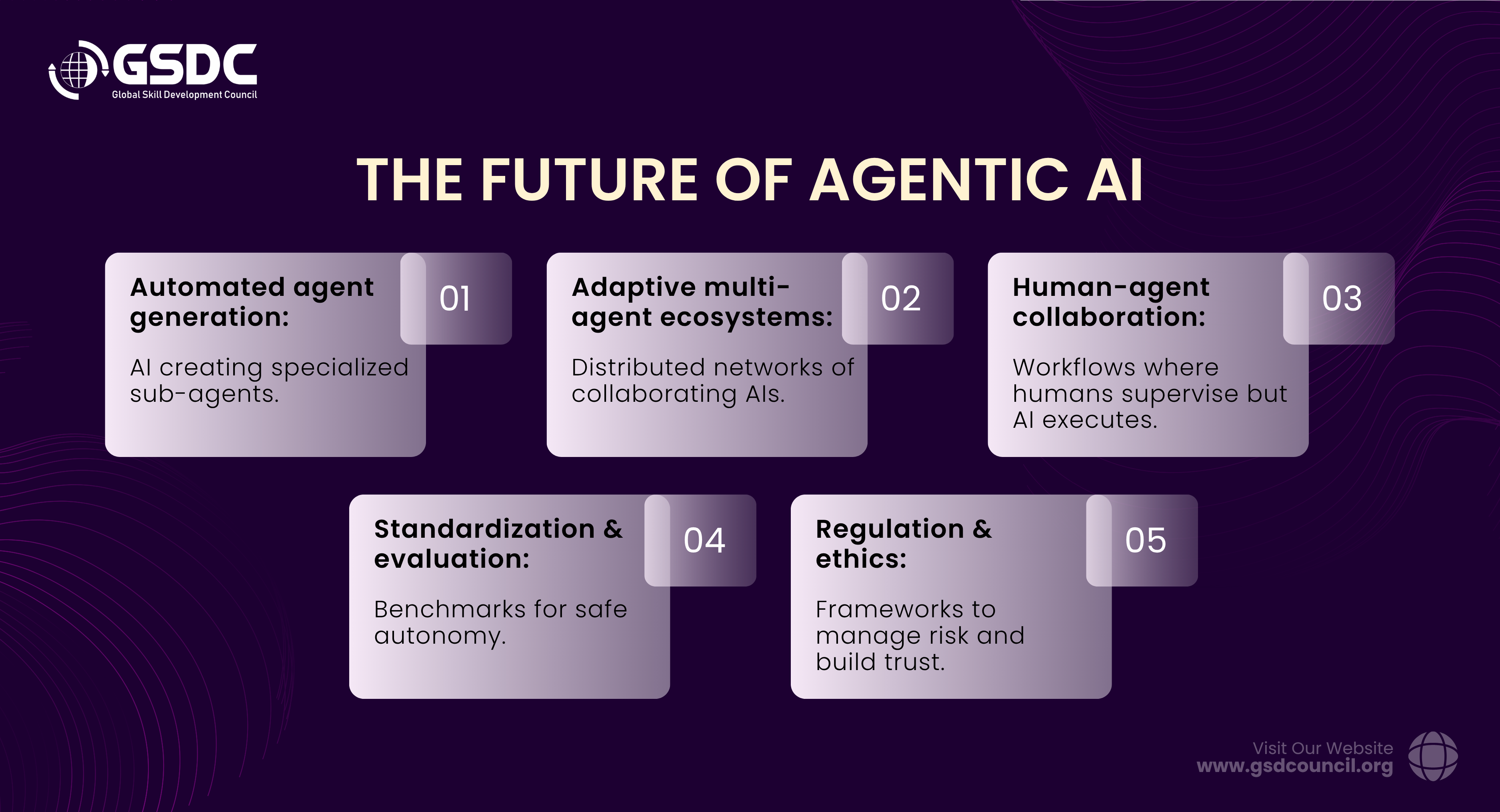
The journey from prompt engineering to Agentic AI is just the beginning. As we look ahead, the future of Agentic AI is not only about smarter assistants but about ecosystems of autonomous agents shaping how humans and machines collaborate. Let’s break down the most significant trends.
1. Automated Agent Generation
In the near future, we won’t always need developers to handcraft agents. AI itself will generate specialized sub-agents tailored for a task. For example:
- A research agent could spin up sub-agents for data collection, analysis, and summarization.
- A coding agent might spawn debugging or testing sub-agents automatically.
- Enterprises could dynamically create agents for new projects without developer intervention.
This ability makes Agentic AI self-scaling, adjusting to workload complexity on demand. It also answers a key question: what will AI do in the future? It will create other AIs to extend its own capabilities.
2. Adaptive Multi-Agent Ecosystems
Today, most Agentic systems operate as single agents, but the future lies in multi-agent ecosystems. These networks will mimic organizational structures: some agents specialize in tasks, others coordinate, while a few act as supervisors.
- Collaboration: Agents communicate, negotiate, and resolve conflicts without human micromanagement.
- Specialization: Finance agents, HR agents, IT agents each skilled in its domain.
- Emergence: Unexpected problem-solving behaviors arise as agents adapt collectively.
This distributed model is the foundation of agentic AI future trends, potentially powering everything from corporate workflows to global supply chain automation.
3. Human-Agent Collaboration
The most impactful transformation will be how humans and agents work together. Unlike today’s assistants that wait for prompts, future agents will act like proactive teammates:
- They suggest strategies, flag risks, and execute tasks independently.
- Humans provide oversight and final judgment, ensuring accountability.
- Workflows shift from commanding AI to co-supervising projects with AI.
This blurs the line between “tool” and “colleague,” shaping the agentic AI future of work. Imagine product teams where human managers set high-level goals, and AI agents plan marketing campaigns, write code, and coordinate logistics all autonomously.
4. Standardization & Evaluation
As Agentic AI grows in complexity, measuring and benchmarking autonomy becomes critical. Just as prompt engineering evolved through best practices, agentic systems will require:
- Standard benchmarks: How reliable is an agent across multi-step tasks?
- Evaluation metrics: Measuring adaptability, ethical compliance, and recovery from errors.
- Interoperability standards: Enabling agents from different agentic AI frameworks to work together.
Without standardized evaluation, scaling Agentic AI across industries will remain risky. Certification bodies and industry alliances are already exploring frameworks much like the prompt engineering certification wave that validated human skills, only now for autonomous systems.
5. Regulation & Ethics
Finally, no discussion of the future for AI is complete without addressing governance. With autonomy comes accountability risks:
- What if an agent makes a harmful financial or healthcare decision?
- How do we prevent prompt injection or tool misuse at scale?
- Who is liable when autonomous systems act beyond intent?
Regulatory frameworks will need to balance innovation with oversight. Ethical AI design, transparency requirements, and human-in-the-loop mandates will become core to Agentic AI deployment. Governments, enterprises, and certification bodies will likely play equal roles in shaping a trust framework for safe adoption.
What will AI do in the future? It will no longer be just a tool but a collaborator. The agentic AI future of work envisions AI teams that brainstorm, execute, and deliver results alongside humans.
Agentic AI Certification for Professionals
The GSDC Agentic AI Certification seeks to legitimize your expertise in what we should call the next wave of AI autonomous goal-oriented systems that go beyond mere prompt engineering. This certificate endows the professional with knowledge in-demand agent design, orchestration, tool integration, memory management, and multi-agent collaboration.
Holding GSDC’s international credential validates one's experience with agentic AI frameworks, tools, and use cases, and one is very well able to identify and resolve some business and technical problems with them. Become an artificial intelligence professional or machine learning engineer, developer, researcher, or enterprise leader; this certification puts you ahead of the curve in the future of AI and future work.

Conclusion
From prompt engineering to Agentic AI, the development is very apparent: the shift is from command-response systems toward full autonomy with reflection. Prompt engineering jobs will still be there, but now more are in agentic orchestration, framework design, and multi-agent ecosystems.
The next decade will, thus, see a surge in Agentic AI certification programs that will prepare professionals for this shift, just as prompt engineering certification did beforehand.
Simply stated, why Agentic AI matters is because it forms the future for AI, redefining what does AI do and further expanding what will AI do in the future. As companies, developers, and researchers embrace agentic AI tools, frameworks, and use cases, we are not just asking AI to respond- we're teaching it to think, act, and evolve.

Related Certifications
Stay up-to-date with the latest news, trends, and resources in GSDC
If you like this read then make sure to check out our previous blogs: Cracking Onboarding Challenges: Fresher Success Unveiled
Not sure which certification to pursue? Our advisors will help you decide!