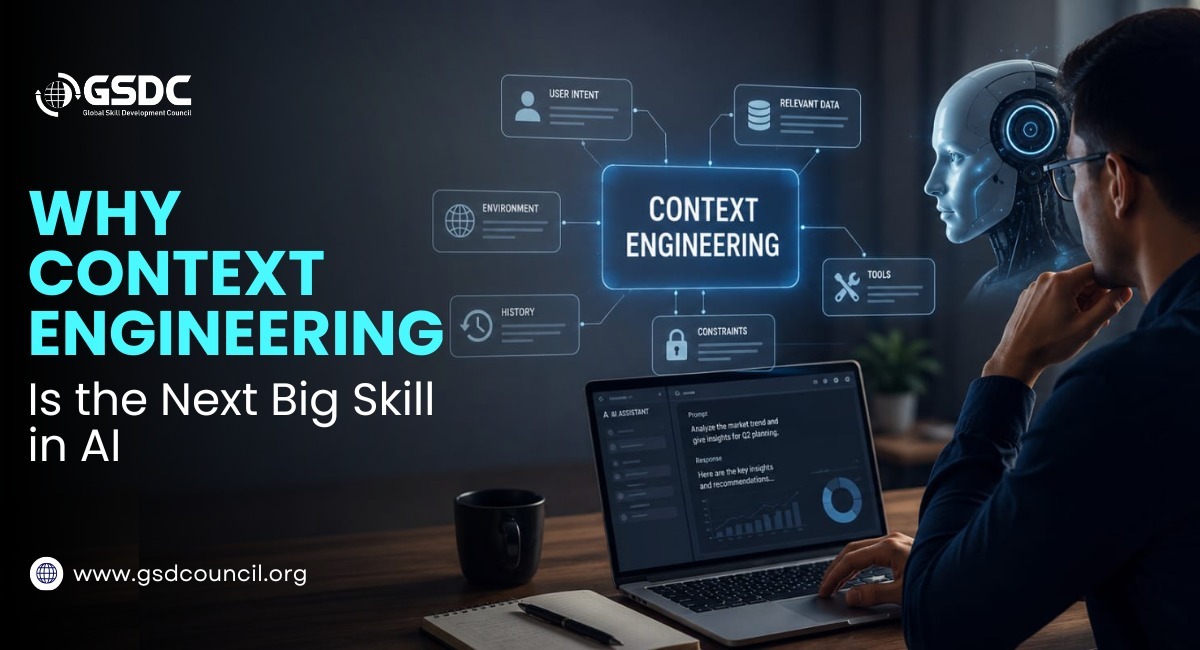
Why Context Engineering Is the Next Big Skill in AI
Written by Matthew Hale
Introduction
Artificial Intelligence is changing the way people work. Businesses are using AI to write content, answer customer questions, analyze data, automate daily tasks, and support decision-making. As AI becomes a regular part of business operations, the expectations from AI systems are also increasing.
Many professionals started by learning prompt engineering, which focuses on writing better prompts to get better responses from AI models. While this skill is still useful, it is no longer enough for building reliable AI applications. Modern AI systems need much more than a good prompt. They need the right information, instructions, business rules, user preferences, and relevant knowledge to produce accurate and consistent results.
This is where context engineering comes in. It is becoming one of the most valuable AI skills because it helps AI understand what information matters before generating a response.
In this blog, you will learn what is context engineering in AI, why it is becoming an essential skill, how it is different from prompt engineering, and why professionals should start learning it today.
What Is Context Engineering in AI?
The context engineering definition is simple. Context engineering is the process of providing an AI model with the right information, instructions, and background so it can generate accurate, relevant, and useful responses.
Instead of only writing a prompt, context engineering focuses on everything the AI needs to understand before answering a question or completing a task.
In AI context engineering, the goal is to give the model enough knowledge to make better decisions. This may include company documents, previous conversations, user preferences, policies, workflows, or examples.
For example, imagine two customer support AI assistants.
The first assistant only receives the prompt:
"Help this customer with their refund."
The second assistant receives the same prompt, but it also has access to the company's refund policy, the customer's purchase history, warranty details, and previous conversations.
Even though both assistants receive the same prompt, the second assistant will almost always provide a better and more accurate response because it has the right context.
This example shows what is context engineering in AI. It is not about asking better questions. It is about giving AI the right information before it starts working.
As businesses build smarter AI applications and AI agents, context engineering is becoming one of the most important skills for AI professionals.
Why Context Matters More Than Prompts
A prompt tells AI what you want. Context tells AI what it needs to know.
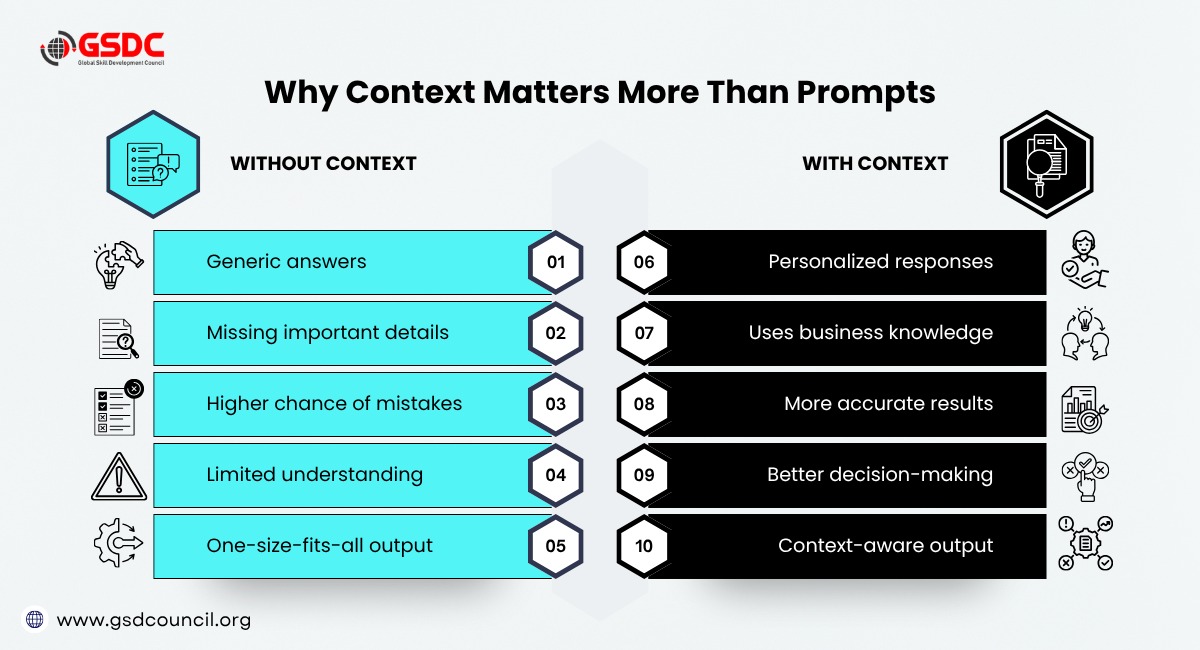
Many people believe that writing better prompts is the secret to getting better AI responses. In reality, even the best prompt cannot produce good results if the AI does not have enough information.
For example, consider this prompt:
"Prepare a project status report."
Without context, the AI does not know:
- Which project?
- Who is the audience?
- What is the project timeline?
- What risks exist?
- What format should the report follow?
Now imagine providing additional context.
- Project name
- Current milestones
- Budget status
- Team updates
- Reporting template
- Stakeholder expectations
The prompt remains exactly the same, but the output becomes much more useful.
This is why businesses are moving beyond prompt engineering. They need AI systems that understand the complete situation before generating responses.
As AI agents become more common, providing the right context has become more important than writing creative prompts.
Why Context Engineering Is Becoming the Next Big AI Skill
The demand for AI skills is growing quickly, but companies are looking for professionals who can build AI systems that deliver reliable results. This is one of the biggest reasons why context engineering is gaining attention across industries.
Here are seven reasons why this skill is becoming so valuable.
1. AI Agents Depend on Context
Modern AI agents perform tasks instead of simply answering questions. They can schedule meetings, analyze documents, create reports, manage workflows, and interact with multiple systems. As these agents take on more responsibilities, they need access to the right information to perform their tasks accurately.
To complete these tasks correctly, AI agents need access to the right context. Without proper context, they may produce incorrect answers, miss important details, or generate incomplete results. Professionals who understand effective context engineering for AI agents can help these systems work more accurately, consistently, and efficiently.
Here are some ways context helps AI agents perform better:
- Provides relevant business information: AI agents can use company policies, product details, and internal documentation to generate accurate responses.
- Understands user needs: Access to user preferences and previous interactions helps AI agents deliver more personalized results.
- Improves decision-making: Better context allows AI agents to make informed decisions instead of relying on assumptions.
- Reduces errors: Supplying complete and updated information minimizes incorrect responses and unnecessary revisions.
- Maintains consistency: AI agents follow the same business rules and standards across different tasks and departments.
- Supports complex workflows: Context enables AI agents to handle multi-step processes such as onboarding employees, processing customer requests, or managing projects.
- Increases productivity: When AI agents have the information they need, they complete tasks faster and require less human intervention.
2. Businesses Need Reliable AI Results
Businesses are using AI to support important operations across different industries. It is helping customer support teams answer queries, assisting finance teams with data analysis, supporting healthcare professionals with information, helping legal teams review documents, and improving software development processes. As AI becomes part of these critical business functions, accuracy becomes more important than speed.
If AI generates incorrect information, it can lead to poor decisions, unhappy customers, financial losses, or compliance issues. This is why businesses cannot rely on AI that simply provides quick responses. They need AI systems that deliver accurate, relevant, and consistent results every time.
This is where context engineering plays an important role. By providing AI with business rules, company policies, internal documents, standard operating procedures, and other relevant information, organizations can help AI generate responses that are aligned with their requirements. Instead of making assumptions, AI can use the available context to produce more reliable and trustworthy outputs.
Here are some ways context engineering helps businesses achieve reliable AI results:
- Improves accuracy: AI uses relevant information to generate responses that are more precise and dependable.
- Follows company policies: Business rules and internal guidelines help AI provide responses that align with organizational standards.
- Reduces compliance risks: AI can reference regulations, policies, and legal requirements before generating responses.
- Creates consistent outputs: Teams receive standardized responses across departments, regardless of who uses the AI system.
- Supports better decision-making: AI can analyze the right information and provide recommendations based on complete business context.
- Builds customer trust: Accurate and reliable responses improve customer satisfaction and confidence in AI-powered services.
- Minimizes costly mistakes: Better context reduces errors that could lead to financial losses, operational delays, or rework.
3. AI Projects Are Becoming More Complex
AI projects have changed significantly over the past few years. Earlier, many AI applications were simple chatbots that answered basic questions or generated text based on a user's prompt. Today, businesses expect AI to do much more. Modern AI systems can connect with databases, business applications, cloud platforms, internal documents, APIs, and external tools to complete complex tasks.
As AI projects become more advanced, managing the information that AI receives also becomes more challenging. AI needs the right data at the right time to understand the task and generate accurate results. This requires professionals who know how to organize, manage, and deliver the right context to AI models. That is why context engineering has become an important part of modern AI development.
Here are some reasons why complex AI projects rely on context engineering:
- Connects multiple data sources: AI can access information from databases, documents, business software, and other systems to complete tasks more effectively.
- Handles complex workflows: AI can support multi-step processes that involve different departments, applications, and business rules.
- Keeps information organized: Context engineering ensures AI receives only the most relevant information instead of unnecessary or outdated data.
- Supports enterprise AI applications: Large organizations need AI systems that can work across teams, products, and business functions.
- Improves collaboration between systems: AI can use information from multiple tools to provide complete and accurate responses.
- Makes AI easier to scale: Well-structured context allows businesses to expand AI solutions without reducing performance or accuracy.
- Delivers better business outcomes: When AI has access to the right context, it can solve more complex problems and provide greater value to the organization.
4. Better Context Reduces AI Mistakes
One of the biggest challenges with AI is that it can sometimes generate incorrect, incomplete, or misleading responses. In many cases, these mistakes do not happen because the AI model is poor. They happen because the AI does not have enough information to understand the situation correctly. When important details are missing, AI may make assumptions that lead to inaccurate results.
This is where context engineering makes a significant difference. By providing AI with relevant documents, clear instructions, business rules, and updated information, organizations can help AI generate responses that are more accurate and reliable. Instead of guessing, AI can use the available context to produce answers that are supported by the right information.
Here are some ways better context helps reduce AI mistakes:
- Provides complete information: AI can generate better responses when it has access to all the relevant details needed to complete a task.
- Reduces incorrect assumptions: Clear context helps AI avoid filling in missing information with inaccurate guesses.
- Improves response accuracy: Relevant documents, policies, and knowledge sources help AI deliver more reliable outputs.
- Keeps information up to date: Providing the latest data and documents reduces the chances of outdated or incorrect responses.
- Follows clear instructions: Well-defined guidelines help AI understand exactly how it should respond in different situations.
- Builds trust in AI systems: Accurate and consistent responses increase confidence among users and businesses.
- Reduces the need for corrections: Better context minimizes errors, saving time that would otherwise be spent reviewing and fixing AI-generated content.

5. Companies Are Hiring for Advanced AI Skills
As AI becomes a part of everyday business operations, the skills that employers look for are also changing. While prompt engineering introduced many professionals to working with AI, companies are now looking for people who can build, manage, and improve complete AI solutions. This requires a deeper understanding of how AI systems work in real business environments.
Organizations are hiring professionals who can work with AI workflows, AI agents, automation platforms, retrieval systems, and context management. These skills help businesses develop AI applications that are accurate, scalable, and capable of handling real-world tasks. As a result, context engineering is quickly becoming one of the most valuable skills for anyone building or working with AI.
Here are some reasons why companies are looking for professionals with context engineering skills:
- Supports modern AI projects: Businesses need professionals who can design AI systems that go beyond simple prompts and perform complex tasks.
- Works with AI agents: Context engineering helps AI agents access the right information to complete tasks accurately and efficiently.
- Improves AI workflows: Professionals can build AI workflows that connect multiple tools, applications, and data sources.
- Enhances automation: Well-managed context allows AI to automate business processes with greater accuracy and consistency.
- Enables enterprise AI solutions: Large organizations require AI systems that understand business rules, internal knowledge, and company processes.
- Creates diverse career opportunities: Context engineering skills are valuable for AI engineers, developers, consultants, product managers, solution architects, and other AI professionals.
- Keeps professionals future-ready: As AI continues to evolve, understanding how to manage context will remain an important skill across industries.
6. Context Engineering Improves User Experience
People expect AI systems to provide helpful and relevant responses without having to explain everything repeatedly. Whether they are using a customer support chatbot, a virtual assistant, or an internal business AI tool, they want AI to understand their needs and respond based on the available information. A good user experience depends on how well the AI understands the user's situation.
This is where context engineering plays an important role. By giving AI access to previous conversations, user preferences, relevant documents, and business information, organizations can create AI systems that deliver more personalized and meaningful responses. Instead of providing generic answers, AI can respond in a way that is relevant to each user's needs.
Here are some ways context engineering improves the user experience:
- Delivers personalized responses: AI can use user preferences and previous interactions to provide more relevant answers.
- Remembers previous conversations: Context allows AI to continue conversations without asking users to repeat the same information.
- Provides faster support: AI can access the required information quickly, reducing response time and improving efficiency.
- Improves response quality: Relevant context helps AI generate answers that are more accurate and useful.
- Creates consistent interactions: Users receive reliable responses that follow the same business rules and standards every time.
- Increases user satisfaction: Helpful and personalized responses make AI systems easier and more enjoyable to use.
- Builds trust in AI: When AI consistently provides accurate and relevant information, users become more confident in relying on it.
7. It Is Becoming a Future-Proof AI Skill
Artificial Intelligence continues to evolve, but one requirement remains the same. AI systems need relevant information to make better decisions.
As more businesses invest in AI agents and enterprise AI solutions, professionals who understand context engineering will be well positioned for new career opportunities. Learning this skill today can help professionals stay competitive as AI technologies continue to advance.
Here are some reasons why context engineering is becoming a future-proof AI skill:
- Growing demand across industries: Businesses in healthcare, finance, retail, manufacturing, education, and other sectors are adopting AI solutions that require effective context management.
- Supports the next generation of AI: Modern AI agents and intelligent applications rely on context to perform complex tasks and deliver accurate results.
- Creates diverse career opportunities: Context engineering skills are valuable for AI engineers, developers, consultants, product managers, automation specialists, and business professionals.
- Keeps professionals competitive: As AI technologies continue to evolve, professionals with advanced AI skills are more likely to stay relevant in the job market.
- Encourages continuous learning: Context engineering helps professionals understand how AI systems work beyond writing prompts, making it easier to adapt to new AI technologies.
- Adds long-term career value: Organizations are investing heavily in AI, creating ongoing demand for professionals who can build reliable and scalable AI solutions.
- Prepares professionals for future AI roles: Learning context engineering today can open doors to emerging roles that focus on AI agents, automation, enterprise AI, and intelligent workflows.

Build Your Advanced Career in Context Engineering with GSDC
As context engineering becomes an essential AI skill, earning a professional certification is a great way to validate your knowledge and demonstrate your expertise to employers.
The GSDC Certified Context Engineering Professional Certification is designed for professionals who want practical skills in building AI systems that deliver accurate, reliable, and context-aware results. The certification focuses on real-world applications rather than only theoretical concepts, helping learners understand how context engineering is used in modern AI environments.
With this certification, you can learn how to design effective context for AI models, work with AI agents, organize information for better AI responses, and apply context engineering techniques across different business use cases.
Some of the key benefits include:
- Gain a globally recognized certification that validates your context engineering expertise.
- Build practical knowledge through real-world AI use cases.
- Learn the skills needed to work with AI agents and enterprise AI applications.
- Strengthen your professional profile with one of the fastest-growing AI skills.
- Improve your career opportunities in AI engineering, automation, consulting, and product development.
- Stand out in a competitive job market with an industry-recognized credential.
As organizations continue investing in AI, professionals with strong context engineering skills will play an important role in designing AI systems that are accurate, reliable, and ready for real business challenges.
If you want to build a long-term career in Artificial Intelligence, learning context engineering and earning a professional certification can be a valuable step toward future growth.
Conclusion
Artificial Intelligence is changing the way businesses operate, and the skills required to work with AI are changing as well. While prompt engineering remains useful, it is only one part of building effective AI systems.
Context engineering focuses on providing AI with the right information, instructions, and knowledge before it generates a response. This leads to better accuracy, more reliable outputs, and AI applications that can solve real business problems.
As companies continue adopting AI agents and enterprise AI solutions, the demand for professionals with context engineering skills will continue to grow. Learning this skill today can help you stay ahead in the AI industry and prepare for the next generation of intelligent applications.

Related Certifications
Frequently Asked Questions
Context engineering in AI is the process of providing AI models with the right information, instructions, documents, and background knowledge before they generate a response. Instead of relying only on prompts, context engineering helps AI understand the full situation, leading to more accurate and relevant outputs.
Prompt engineering focuses on writing effective prompts to get better responses from AI. Context engineering goes a step further by giving AI the relevant data, business rules, user preferences, previous conversations, and other information it needs to perform tasks accurately. Both skills are valuable, but context engineering is becoming increasingly important for modern AI applications.
AI agents perform tasks such as analyzing documents, managing workflows, and interacting with multiple systems. They need access to the right information to complete these tasks correctly. Effective context engineering for AI agents ensures they receive relevant data, helping them produce accurate, consistent, and reliable results.
Context engineering is useful for AI engineers, software developers, data scientists, AI consultants, automation specialists, product managers, solution architects, and business professionals working with AI systems. Anyone involved in building or managing AI-powered applications can benefit from developing context engineering skills.
Some of the most effective context engineering techniques include providing clear system instructions, using relevant business documents, maintaining AI memory, retrieving information from trusted knowledge bases, organizing structured data, and continuously updating context to keep AI responses accurate and relevant.
Some recommended context engineering best practices include using accurate and up-to-date information, removing unnecessary data, defining clear business rules, organizing context logically, testing AI responses regularly, and monitoring AI performance to improve response quality over time.
Several tools support context engineering, including ChatGPT, Claude, Gemini, LangChain, LlamaIndex, Flowise, n8n, and vector databases. The best tool for context engineering depends on your project requirements, AI model, and business use case.
You can start by learning AI fundamentals, prompt engineering, large language models (LLMs), AI agents, retrieval-augmented generation (RAG), and workflow automation. Building hands-on projects and working with real AI applications is one of the best ways to develop practical context engineering skills.
Yes. A context engineering certification helps validate your knowledge and demonstrates your ability to build AI systems that generate reliable and context-aware responses. It can also strengthen your resume and improve your career opportunities in the growing AI industry.
The best context engineering certification should offer practical training, real-world projects, and industry-relevant skills. The GSDC Certified Context Engineering Professional certification is a strong option for professionals who want to build expertise in AI context engineering, AI agents, and enterprise AI applications while earning a globally recognized credential.
Stay up-to-date with the latest news, trends, and resources in GSDC
If you like this read then make sure to check out our previous blogs: Cracking Onboarding Challenges: Fresher Success Unveiled
Not sure which certification to pursue? Our advisors will help you decide!