Context Engineering vs Prompt Engineering: Everything You Need to Know

Written by Emily Hilton
- What Is Context Engineering vs Prompt Engineering?
- Why Is Context Engineering Becoming Important?
- Context Engineering Examples in Real-World Applications
- Context Engineering Skills You Need to Build
- Context Engineering Jobs and Career Opportunities
- Context Engineering Certification vs Prompt Engineering Certification
- Which Part of Engineering Is the Best?
- Why Did You Choose to Be a Context Engineer?
- Conclusion: The Future of AI Requires Both Prompt and Context Engineering
Have you ever wondered why some AI systems deliver accurate, helpful responses while others fail to understand the real goal behind a request? The difference often comes down to one important factor: context.
Artificial intelligence has evolved far beyond simple chatbots. Today, organizations are using AI to automate workflows, analyze complex data, and build intelligent applications. As AI systems become more advanced and autonomous, a new discipline called context engineering is gaining attention.
For years, prompt engineering was seen as the key skill for improving AI interactions. Professionals focused on writing clear instructions and designing effective prompts to help large language models (LLMs) generate better responses. However, modern AI applications require much more than well-written prompts.
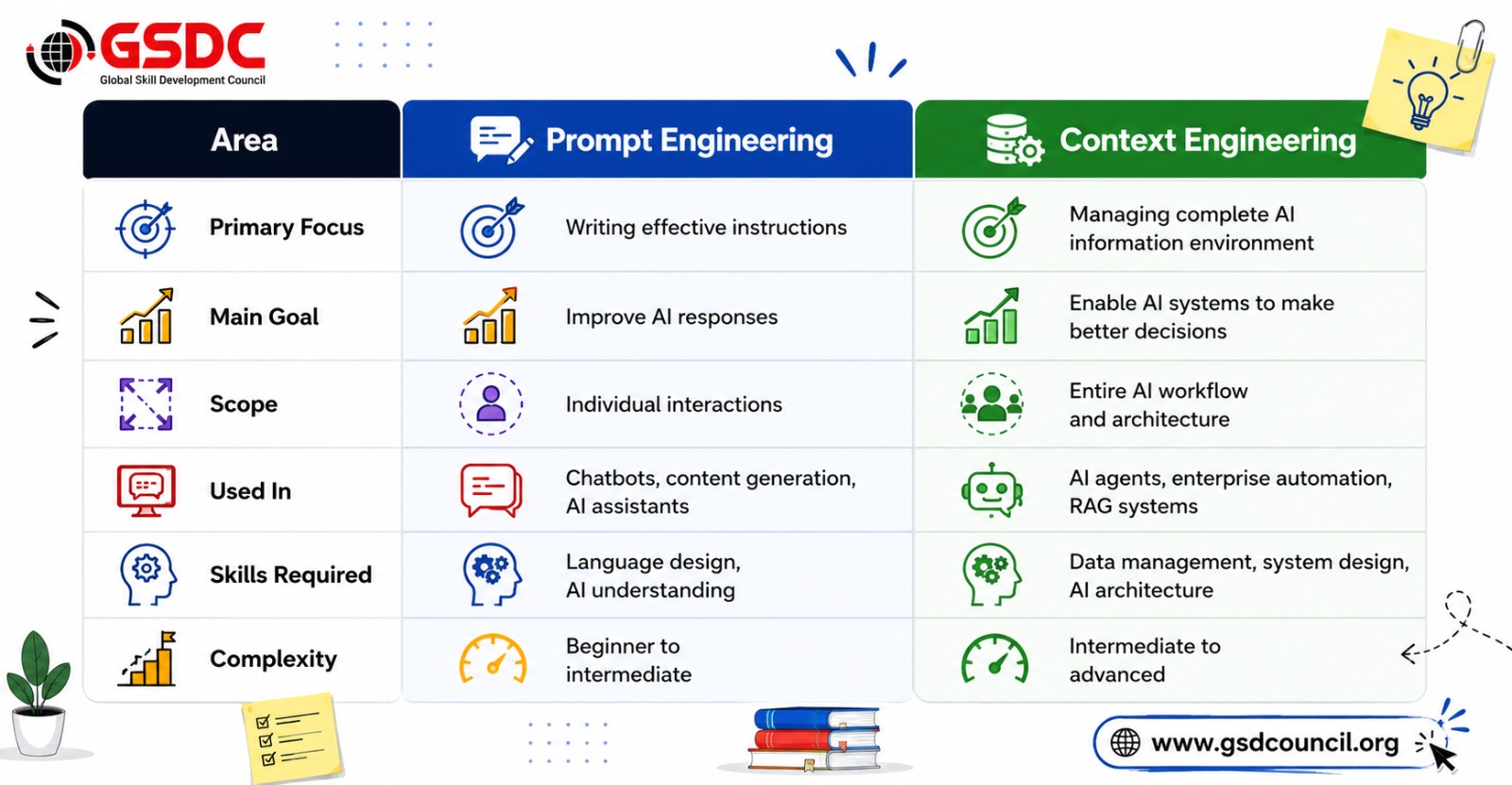
The discussion around context engineering vs prompt engineering is not about replacing one with the other. Instead, both skills work together to build more reliable, scalable, and intelligent AI solutions. While prompt engineering focuses on how we communicate with AI models, context engineering focuses on what information AI receives to perform effectively.
In this guide, we will explore the differences between context engineering and prompt engineering, their real-world applications, essential skills, career opportunities, and how professionals can prepare for the future of AI.
What Is Context Engineering vs Prompt Engineering?
Before comparing both concepts, it is important to understand what each discipline means.
What Is Prompt Engineering?
Prompt engineering is the process of designing and optimizing instructions given to AI models to achieve desired outputs.
A prompt acts as a communication layer between humans and AI. By structuring instructions properly, users can improve the quality, accuracy, and relevance of AI-generated responses.
For example:
A basic prompt:
“Write an article about cybersecurity.”
A better engineered prompt:
“Write a 1500-word beginner-friendly article explaining cybersecurity threats, include examples, statistics, and practical prevention strategies.”
The second prompt provides more context, expectations, and formatting instructions, resulting in a better output.
Common prompt engineering techniques include:
- Zero-shot prompting
- Few-shot prompting
- Chain-of-thought prompting
- Role-based prompting
- Structured output prompting
Professionals who specialize in creating effective AI instructions are known as prompt engineers.
What Is Context Engineering?
Context engineering is the process of designing, managing, and optimizing all the information an AI system receives before generating a response or making a decision.
Unlike prompt engineering, which focuses mainly on instructions, context engineering focuses on the complete environment surrounding the AI model.
The context may include:
- User history
- Business rules
- Company knowledge bases
- External databases
- Documents
- Memory systems
- APIs and tools
- Real-time information
- Previous conversations
A simple way to understand it:
Prompt engineering tells AI what to do.
Context engineering ensures AI has everything it needs to do it correctly.
For example, an AI customer support agent does not only need a prompt saying:
“Answer customer questions politely.”
It also needs:
- Customer purchase history
- Product documentation
- Refund policies
- Previous conversations
- Company guidelines
Building this complete information ecosystem is the role of a context engineer.
Why Is Context Engineering Becoming Important?
Traditional AI applications mostly depended on prompts. However, enterprise AI systems require more than instructions.
Imagine an AI sales assistant.
A prompt alone cannot help it complete sales tasks. It needs access to:
- Customer profiles
- CRM data
- Product catalogs
- Pricing information
- Market trends
- Communication history
Without proper context, even the most advanced AI model may generate incorrect or incomplete answers.
This is why context engineering is becoming a critical context engineering skill for professionals building next-generation AI solutions.
Companies are now focusing on:
- AI agents
- Retrieval-Augmented Generation (RAG)
- Enterprise copilots
- Autonomous workflows
- AI-powered decision systems
All of these require effective context management.
Context Engineering Examples in Real-World Applications
Understanding context engineering examples helps explain why this skill is becoming valuable.
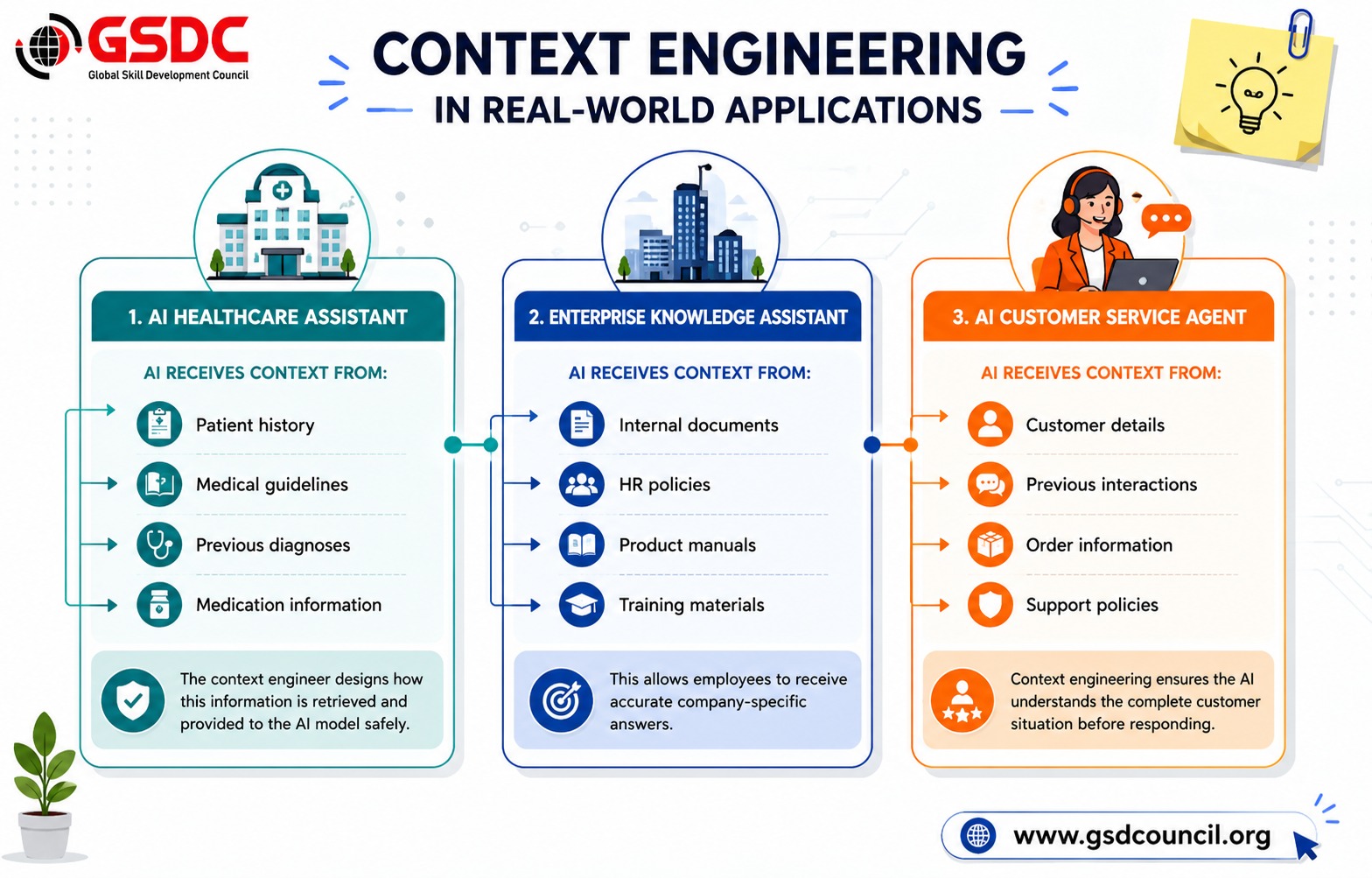
1. AI Healthcare Assistant
A healthcare AI assistant requires:
- Patient history
- Medical guidelines
- Previous diagnoses
- Medication information
The context engineer designs how this information is retrieved and provided to the AI model safely.
2. Enterprise Knowledge Assistant
Companies use AI assistants to answer employee questions.
Instead of only providing a prompt, the AI receives context from:
- Internal documents
- HR policies
- Product manuals
- Training materials
This allows employees to receive accurate company-specific answers.
3. AI Customer Service Agent
A customer service AI system needs:
- Customer details
- Previous interactions
- Order information
- Support policies
Context engineering ensures the AI understands the complete customer situation before responding.
Prompt Engineering Examples
While context engineering manages the environment, prompt engineering focuses on instructions.
Some practical prompt engineering examples include:
Content Creation Prompt
Instead of:
“Write a blog.”
A better prompt:
“Create an SEO-friendly 1500-word blog on AI governance. Include H2 headings, examples, FAQs, and a conclusion.”
Data Analysis Prompt
Instead of:
“Analyze this report.”
A better prompt:
“Analyze this financial report and identify revenue trends, risks, and opportunities in a structured table.”
AI Assistant Prompt
Instead of:
“You are a chatbot.”
A better prompt:
“You are an enterprise customer support assistant. Provide professional responses, follow company policies, and ask clarifying questions when required.”
Prompt Engineering Best Practices
Even with the rise of context engineering, prompt engineering remains an essential skill.
Following prompt engineering best practices can significantly improve AI performance:
1. Be Specific
Clearly define:
- Objective
- Audience
- Format
- Expected output
2. Provide Examples
Examples help AI models understand patterns and desired responses.
3. Assign Roles
Using role-based prompts improves consistency.
Example:
“You are an experienced cybersecurity consultant…”
4. Break Complex Tasks Into Steps
Large tasks should be divided into smaller tasks.
5. Test and Improve Prompts
Prompt engineering requires continuous experimentation and refinement.
Professionals looking for a structured prompt engineering guide can learn advanced techniques, frameworks, and optimization methods through specialized training programs.
Context Engineering Skills You Need to Build
A successful context engineer requires a combination of AI, technical, and business skills.
Important context engineering skills include:
1. Understanding Large Language Models
Professionals should understand:
- How LLMs work
- Token limitations
- Model behavior
- AI limitations
2. Data Management
Context engineers work with:
- Databases
- Knowledge repositories
- Vector databases
- Retrieval systems
3. AI Agent Architecture
Knowledge of:
- AI workflows
- Tool integration
- Memory systems
- Automation frameworks
is becoming increasingly valuable.
4. Problem-Solving Ability
Context engineers must understand business requirements and design AI systems accordingly.
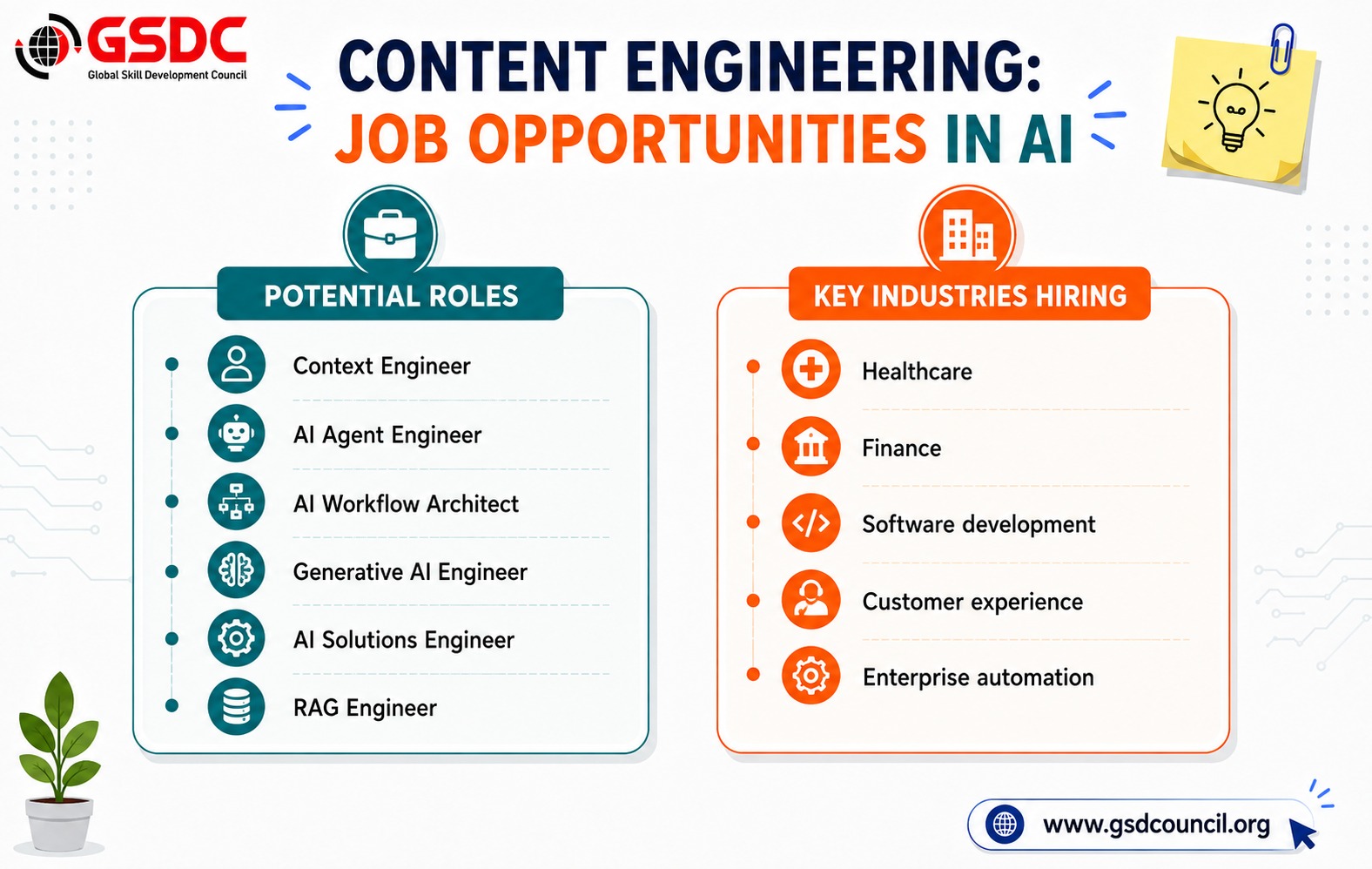
As companies invest in AI transformation, demand for professionals with context engineering expertise is increasing.
Potential roles include:
- Context Engineer
- AI Agent Engineer
- AI Workflow Architect
- Generative AI Engineer
- AI Solutions Engineer
- RAG Engineer
Professionals searching for context engineering jobs can expect opportunities across industries such as:
- Healthcare
- Finance
- Software development
- Customer experience
- Enterprise automation
Context Engineering Jobs and Career Opportunities
Prompt engineering has become one of the most discussed AI career paths.
The prompt engineering salary varies depending on:
- Experience level
- Technical background
- Industry
- Location
- AI expertise
Professionals with strong skills in AI models, automation, and domain expertise generally command higher compensation.
Many organizations now combine prompt engineering with:
- AI development
- Data science
- Machine learning
- AI governance
creating broader AI-focused career opportunities.
Context Engineering Certification vs Prompt Engineering Certification
As AI adoption grows, certifications can help professionals validate their expertise. The GSDC Context Engineering Certification helps professionals build expertise in designing AI systems that can effectively manage, retrieve, and utilize information.
The Context Engineering Certification focuses on context design, AI agent workflows, knowledge management, retrieval-augmented generation (RAG), and building reliable AI applications. It enables learners to understand how to create scalable AI solutions by providing models with the right data, tools, and operational context.
A context engineering certification helps learners understand:
- AI agent architecture
- Context management strategies
- Retrieval systems
- Enterprise AI workflows
- AI application design
The Prompt Engineering Certification equips professionals with practical skills to design effective prompts and optimize interactions with generative AI models. The certification covers prompt design techniques, AI communication strategies, prompt optimization, advanced prompting frameworks, and real-world applications.
It helps learners improve AI outputs, increase productivity, and apply prompt engineering best practices across business, content, automation, and technology use cases.
A prompt engineering certification focuses on:
- Prompt design techniques
- AI communication strategies
- Model optimization
- Generative AI productivity
Both certifications complement each other because modern AI professionals need skills in both instruction design and AI system optimization.
Which Part of Engineering Is the Best?
The answer depends on your career goals.
If you enjoy:
- Writing instructions
- Experimenting with AI models
- Improving AI responses
Then prompt engineering may be the right choice.
If you enjoy:
- Designing AI systems
- Working with data
- Building AI agents
- Creating enterprise solutions
Then context engineering may offer greater opportunities.
The future of AI will likely require professionals who understand both.
Why Did You Choose to Be a Context Engineer?
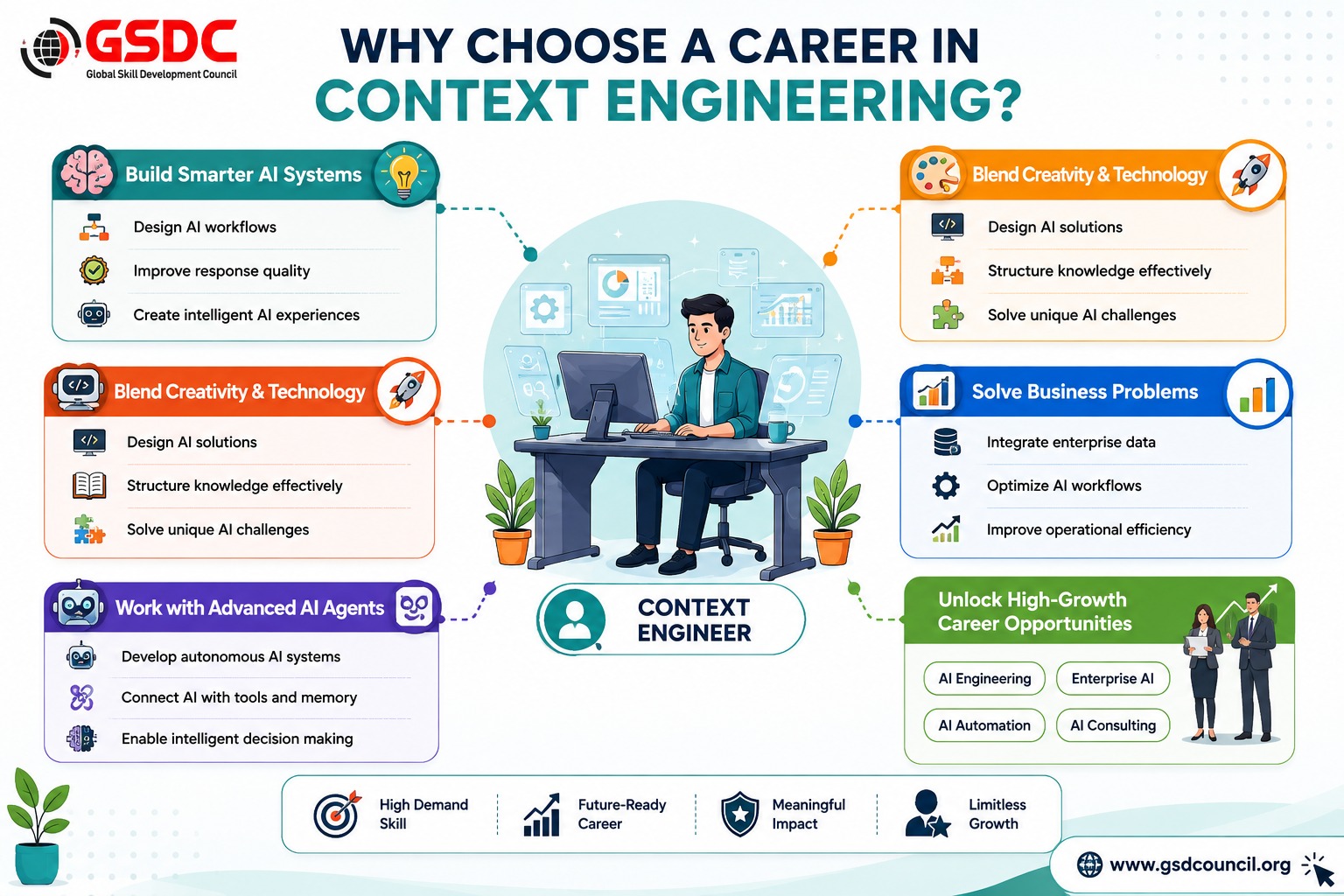
Many professionals choose context engineering because it combines creativity, technology, and problem-solving.
- Building Smarter AI Systems: Context engineers design the environment, workflows, and information structures that help AI systems deliver more accurate and intelligent outcomes.
- Combining Technology and Creativity: The role requires both technical expertise and creative thinking to design effective AI solutions for real-world challenges.
- Working With Advanced AI Agents: As organizations adopt autonomous AI agents, context engineers play a crucial role in developing systems that can understand, reason, and act effectively.
- Solving Complex Business Problems: Context engineers connect AI models with relevant data, tools, and business knowledge to create practical enterprise solutions.
Growing Career Opportunities: With increasing AI adoption across industries, context engineering is emerging as a high-demand skill with opportunities in AI development, automation, and enterprise transformation.
Conclusion: The Future of AI Requires Both Prompt and Context Engineering
The debate around context engineering vs prompt engineering is not about choosing one over the other.
Prompt engineering improves how we communicate with AI.
Context engineering improves how AI understands the world around it.
As AI systems become more advanced, professionals who can combine both skills will have a significant advantage. Organizations will need experts who can design prompts, manage context, build AI workflows, and create responsible AI solutions.
Whether you are starting your AI career or upgrading your existing skills, learning both disciplines can help you stay prepared for the future of artificial intelligence.

Related Certifications
Frequently Asked Questions
Prompt engineering focuses on creating instructions for AI models, while context engineering focuses on providing AI systems with relevant information, tools, and data.
No. Context engineering builds on prompt engineering. Both skills work together to create better AI systems.
Important skills include AI fundamentals, data management, RAG systems, AI agents, APIs, and workflow design.
Yes. Prompt engineering remains valuable for improving AI interactions, content generation, automation, and enterprise applications.
Both are valuable. Prompt engineering certification helps improve AI interaction skills, while context engineering certification prepares professionals for building advanced AI systems.
Stay up-to-date with the latest news, trends, and resources in GSDC
If you like this read then make sure to check out our previous blogs: Cracking Onboarding Challenges: Fresher Success Unveiled
Not sure which certification to pursue? Our advisors will help you decide!