15 Procurement Specialist Interview Questions and Answers
Written by Emily Hilton
- What Does a Procurement Specialist Actually Do?
- How to Prep for a Procurement Interview
- Basic Procurement Specialist Interview Questions
- Intermediate Procurement Specialist Interview Questions
- Advanced Procurement Specialist Interview Questions
- Procurement Specialist Salary: What Can You Expect?
- Strengthen a Candidacy with GSDC
- Final Thoughts
Procurement interviews test more than product knowledge. Interviewers want to see how a candidate thinks under pressure, negotiates, and makes trade-offs between cost, quality, and risk. This guide covers the 15 questions most likely to come up, what each one is actually testing, a sample answer to adapt, and a quick tip for delivering it well, along with current salary expectations and how the right procurement certification can strengthen an application.
What Does a Procurement Specialist Actually Do?
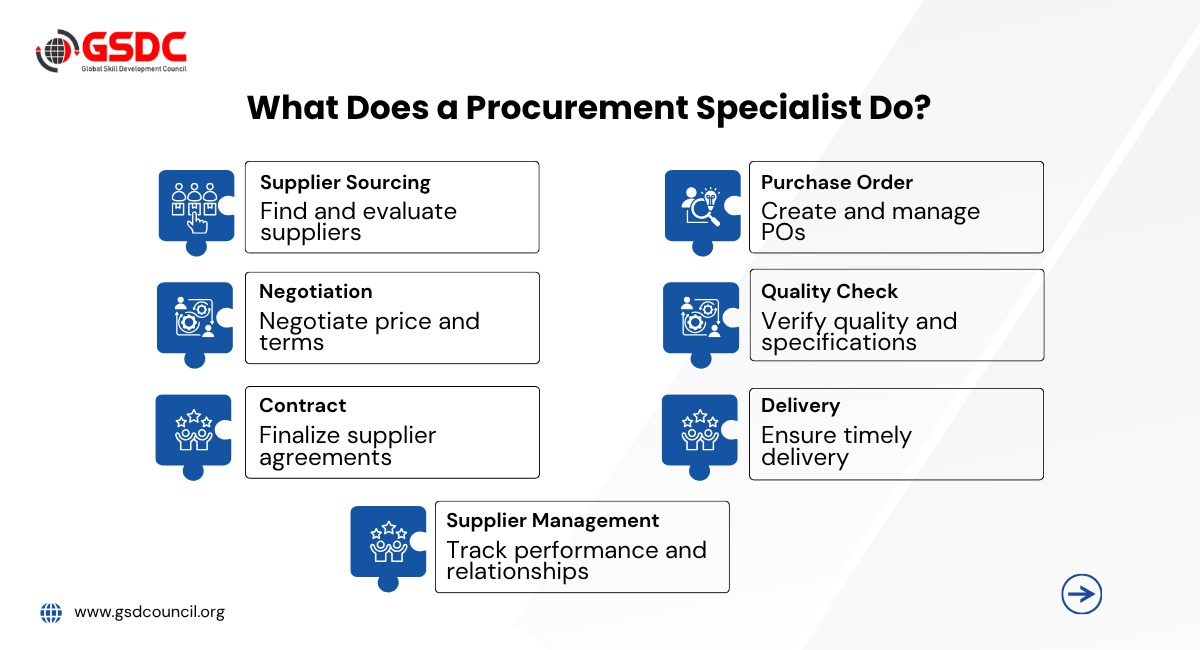
A procurement specialist manages the end-to-end procurement process: sourcing suppliers, negotiating contracts, tracking purchase orders, and making sure the business gets the right materials at the right price without compromising on quality. Part analyst, part negotiator, part relationship manager, and increasingly, someone who reads spend data and supplier risk reports to make faster, better-informed calls.
How to Prep for a Procurement Interview
A few things separate candidates who freeze up from candidates who walk out with an offer:
- Know the numbers. Reference actual cost savings, negotiation wins, or process improvements, with figures, not vague claims.
- Have a crisis story ready. Interviewers want to hear how a real problem was handled: a late shipment, a supplier going under, a budget cut mid-project.
- Name the tools. Mentioning the ERP, spend analytics, or sourcing platforms worked with signals real hands-on experience, not just textbook knowledge.
- Don't overstate it. If a specific tool or scenario hasn't come up before, say so directly, then pivot to something transferable
Basic Procurement Specialist Interview Questions
1. What is procurement. Why does it matter?
What the interviewer is testing: Understanding of procurements role beyond buying items.
Sample answer: Procurement means finding and buying the goods and services a business needs to run. Procurement matters because it directly influences cost, quality and the ability to keep operations running. Good procurement saves money lowers supply risk and creates supplier relationships that the business can count on.
Quick tip: Connect the answer to business results not just the buying step.
2. What's the difference between indirect procurement?
What the interviewer is testing: knowledge of procurement categories.
Sample answer: Direct procurement covers materials that go into what a company makes such as parts for a manufacturer. Indirect procurement covers everything that supports work. Does not become part of the final product, like office supplies, software licenses and building services. Direct procurement usually has supply risk and requires stricter supplier control, which is why the two are managed differently.
Quick tip: Give a clear example for each type instead of just defining them.
3. How would you handle a supplier who keeps missing delivery deadlines?
What the interviewer is testing: Problem solving, supplier management and risk control.
Sample answer: First look at the suppliers delivery record. Talk to them directly about what is really causing the delays. If the issue is something that can be fixed make a plan with clear deadlines. If delays keep happening then consider suppliers and review the contract, for remedies.
Quick tip: Show a willingness to solve the problem before deciding to replace the supplier.
4. How do you make sure incoming goods meet quality standards?
What the interviewer is testing: Attention to quality control and process discipline.
Sample answer: Quality specs belong in the contract or purchase order from the start, so there's no ambiguity later. Vet suppliers on reputation and track record before signing anything, then inspect deliveries against those specs every time, not just when something looks off.
Quick tip: Frame quality checks as something built in upfront, not caught after the fact.
5. How do you evaluate and select a new supplier?
What the interviewer is testing: Sourcing methodology and risk awareness.
Sample answer: Weigh suppliers against a defined set of criteria: cost, quality, reliability, financial stability, compliance history. Ask for references or case studies, run a trial order where possible, and check for red flags around financial health or past disputes before locking into a longer-term contract.
Quick tip: Naming specific evaluation criteria beats a vague claim of "doing research."
Intermediate Procurement Specialist Interview Questions
6. How do you assess supplier risk?
What the interviewer is testing: Strategic thinking around supply chain continuity.
Sample answer: Look at financial stability, geographic concentration, single-source dependency, and compliance history. Critical suppliers need a contingency plan and a shortlist of backups on standby. Risk isn't a one-time check at onboarding either; a supplier's situation can shift, so it's worth revisiting periodically.
Quick tip: Mention ongoing monitoring, not just a one-time check during supplier selection.
7. How do you handle tight deadlines and last-minute procurement requests?
What the interviewer is testing: Prioritization and composure under pressure.
Sample answer: Assess the actual urgency and business impact first, since not everything marked "urgent" truly is. From there, contact suppliers directly about expediting options and keep stakeholders updated so nobody's caught off guard. Staying organized under pressure is what keeps these requests from snowballing.
Quick tip: Emphasize triage. Interviewers want to know that not every request gets treated as equally urgent.
8. How do you keep costs down without sacrificing quality?
What the interviewer is testing: Commercial judgment and negotiation skill.
Sample answer: Figure out what's genuinely non-negotiable on quality and where there's room to flex. From there, market knowledge, competitor pricing, and alternative suppliers usually turn up savings that don't touch the things that actually matter to the business.
Quick tip: A real number lands better than a general claim. "Cut costs by 12% on a key category" beats "found savings."
9. Walk me through a tough negotiation and how you handled it.
What the interviewer is testing: Real-world negotiation experience, not theory.
Sample answer: Pick a negotiation where a supplier wouldn't budge on pricing against a fixed budget. Researching their business pressures and market conditions ahead of time revealed where the flexibility actually was, which led to a multi-year volume commitment in exchange for a better rate, a result that worked for both sides.
Quick tip: Use a specific story with a clear outcome. Vague answers here are the easiest to spot.
10. What procurement KPIs do you track, and why do they matter?

What the interviewer is testing: Whether procurement gets managed by data or by instinct.
Sample answer: Cost savings against baseline, supplier on-time delivery rate, purchase order cycle time, and contract compliance are the core ones worth naming. Together they show where the process runs smoothly and where it's leaking time or money, and they make it far easier to justify changes to leadership.
Quick tip: Naming three or four specific KPIs shows more credibility than describing metrics in general terms.
Advanced Procurement Specialist Interview Questions
11. How do you handle a purchase that exceeds the approved budget?
What the interviewer is testing: Judgment, communication, and governance awareness.
Sample answer: First, confirm whether the overage is a one-off or a sign of a bigger cost trend. Then flag it to the budget owner with options on the table: renegotiate terms, phase the purchase, or request formal approval for the increase with clear justification. An over-budget purchase shouldn't move forward without documented sign-off.
Quick tip: Interviewers are listening for appropriate escalation, not purchases quietly pushed through.
12. Tell me about a time you managed a full-blown procurement crisis.
What the interviewer is testing: Composure and problem-solving under real pressure.
Sample answer: A strong story here involves a key supplier going out of business mid-project: reviewing existing contracts for what could be renegotiated, reaching out to pre-vetted alternate suppliers, and prioritizing deliveries by project milestone. Stressful, but staying focused kept the project largely on schedule while a new supplier came online.
Quick tip: Structure this like a mini case study: situation, action, result.
13. How do you make sure your team stays compliant with procurement policy?
What the interviewer is testing: Process ownership and governance mindset.
Sample answer: A team needs to understand the reasoning behind policies, not just the rules themselves. Tracking tools that keep the process transparent from purchase order to payment turn compliance into part of the workflow rather than something checked at the end.
Quick tip: Mention a specific tool or system where possible; it makes the answer concrete rather than generic.
14. What procurement software, ERP, or AI-driven tools have you used?
What the interviewer is testing: Technical fluency and pace with how the role is evolving.
Sample answer: Common ground here includes ERP systems for purchase order management and contract tracking, spend analytics tools for spotting savings opportunities, and supplier risk monitoring platforms that flag issues before they turn into disruptions. Frame these as tools that free up time for negotiation and supplier strategy, the parts of the job that still need human judgment.
Quick tip: Limited experience with a specific tool is fine; lean on comfort learning new systems quickly rather than overstating familiarity.
15. How do you balance cost, quality, and sustainability in procurement decisions?
What the interviewer is testing: Strategic, big-picture thinking.
Sample answer: Look past the sticker price to total cost of ownership: reliability, environmental impact, long-term risk. Sustainability isn't a box to check anymore; it's woven into how procurement decisions get judged, so it belongs alongside cost and quality rather than off to the side.
Quick tip: A real example of weighing these trade-offs beats a general philosophy every time.
Procurement Specialist Salary: What Can You Expect?
Pulling from several current salary trackers, the national average lands roughly between $66,000 and $92,000 per year, according to Salary.com and Glassdoor. Entry-level roles typically start around $50,000 to $63,000, mid-career sits between $70,000 and $90,000, and senior specialists in the top 10% can earn $110,000 to $145,000 or more, especially in high-cost markets or industries like Energy, Mining & Utilities and Aerospace & Defense. Figures shift by source since Glassdoor, Payscale, and ZipRecruiter each pull from different data pools, so the mid-point of a few sources makes a reasonable baseline for negotiation. Certifications and specialized skills like cost reduction or ISO knowledge tend to push the number higher still.
Strengthen a Candidacy with GSDC
Knowing how to answer these questions gets a candidate through the interview. A recognized procurement certification on the resume is often what gets the interview in the first place, and it builds a stronger foundation for answering questions on process, compliance, and strategy with real depth.
The GSDC Certified Procurement Professional (CPP) certification covers modern procurement practices and current industry trends, carries lifetime validity, and is recognized across 100+ countries. Certified professionals consistently point to it as a credential that adds weight to a resume in a competitive field.
Final Thoughts
The procurement specialist role keeps evolving alongside the businesses it supports. Real examples, specific numbers, and a clear sense of how to weigh trade-offs set a candidate apart from anyone reciting textbook definitions.
Good luck with the interview.

Related Certifications
Stay up-to-date with the latest news, trends, and resources in GSDC
If you like this read then make sure to check out our previous blogs: Cracking Onboarding Challenges: Fresher Success Unveiled
Not sure which certification to pursue? Our advisors will help you decide!