Role Prompting: Turning ChatGPT into a Learning Architect
Written by Emily Hilton
- The Difference Between an Average Prompt and an Excellent One
- What You Will Learn
- What Is Role Prompting?
- What actually changes when you assign a role?
- Example: One Prompt, Two Completely Different Results
- Five High-Value Roles Worth Saving in Your Prompt Library
- Combine Role Prompting with the RTCF Framework
- When Should You Use Role Prompting?
- When Should You Avoid Role Prompting?
- Common Mistakes to Avoid in Role Prompting
- Try It Yourself
- Want to Apply AI More Effectively in HR & Learning?
- Final Thoughts
The Difference Between an Average Prompt and an Excellent One
Most people spend most of their time thinking about what they want ChatGPT to do. They carefully describe the task, add context, specify the format, and sometimes even mention the tone they expect. Surprisingly, very little attention is given to the first line of the prompt that is the role.
That first line often decides the quality of the response before the model has even started writing.
The reason is simple. Every profession approaches a problem differently. Ask a finance manager to improve a leadership workshop, and the conversation will probably revolve around business impact and performance metrics. Ask an organizational psychologist, and the discussion shifts toward behaviour, motivation, and team dynamics. Ask an instructional designer, and the first questions become, "What should learners be able to do by the end of the program?" and "How will we know they have actually learned it?"
The workshop hasn't changed. The audience hasn't changed. Only the perspective has.
Role prompting works in exactly the same way. It doesn't tell ChatGPT something it has never seen before. It simply tells the model which professional lens it should use while solving the problem.
What You Will Learn
By the end of this blog, you will understand:
- What role prompting is and why it works.
- Why detailed roles produce better responses than generic ones.
- Five useful HR and Learning & Development roles you can assign to ChatGPT.
- How to combine role prompting with the RTCF framework for even better prompts.
- Common mistakes that reduce prompt quality.
What Is Role Prompting?
Definition
Role prompting is the practice of telling an AI which professional role or expert identity it should assume before answering your request.
Instead of simply asking for an answer, you first define who the AI should become.
For example:
- Senior Learning Architect
- HR Business Partner
- Organizational Psychologist
- Leadership Coach
- Instructional Designer
The assigned role influences how the AI approaches the problem.
A well-defined role guides the AI toward the type of thinking you expect from someone with that expertise.
What actually changes when you assign a role?
A good role influences much more than the opening paragraph of the response. It quietly shapes the entire answer from beginning to end.
- The language becomes more natural for that profession. A Learning Architect talks about learning outcomes, assessments, learner engagement, and instructional flow. A Leadership Coach is more likely to discuss coaching conversations, feedback, and behavioural change.
- The response starts using relevant frameworks without being asked every time. Instead of randomly listing ideas, ChatGPT naturally introduces models that professionals in that field rely on, such as Bloom's Taxonomy or Kirkpatrick's Evaluation Model.
- Recommendations become more intentional. Rather than collecting information from different directions, the AI starts making decisions the way someone in that role would.
- The final output feels consistent. Every section supports the same objective instead of jumping between unrelated ideas or mixing different perspectives.
The biggest advantage isn't that the response becomes longer or more detailed. The advantage is that it becomes more focused. Every recommendation has a reason behind it because the AI is solving the problem from one clear point of view.
Example: One Prompt, Two Completely Different Results
Let's look at a practical example.
Imagine you're an L&D manager who has been asked to design a 12-week development program for newly promoted managers. You open ChatGPT and write:
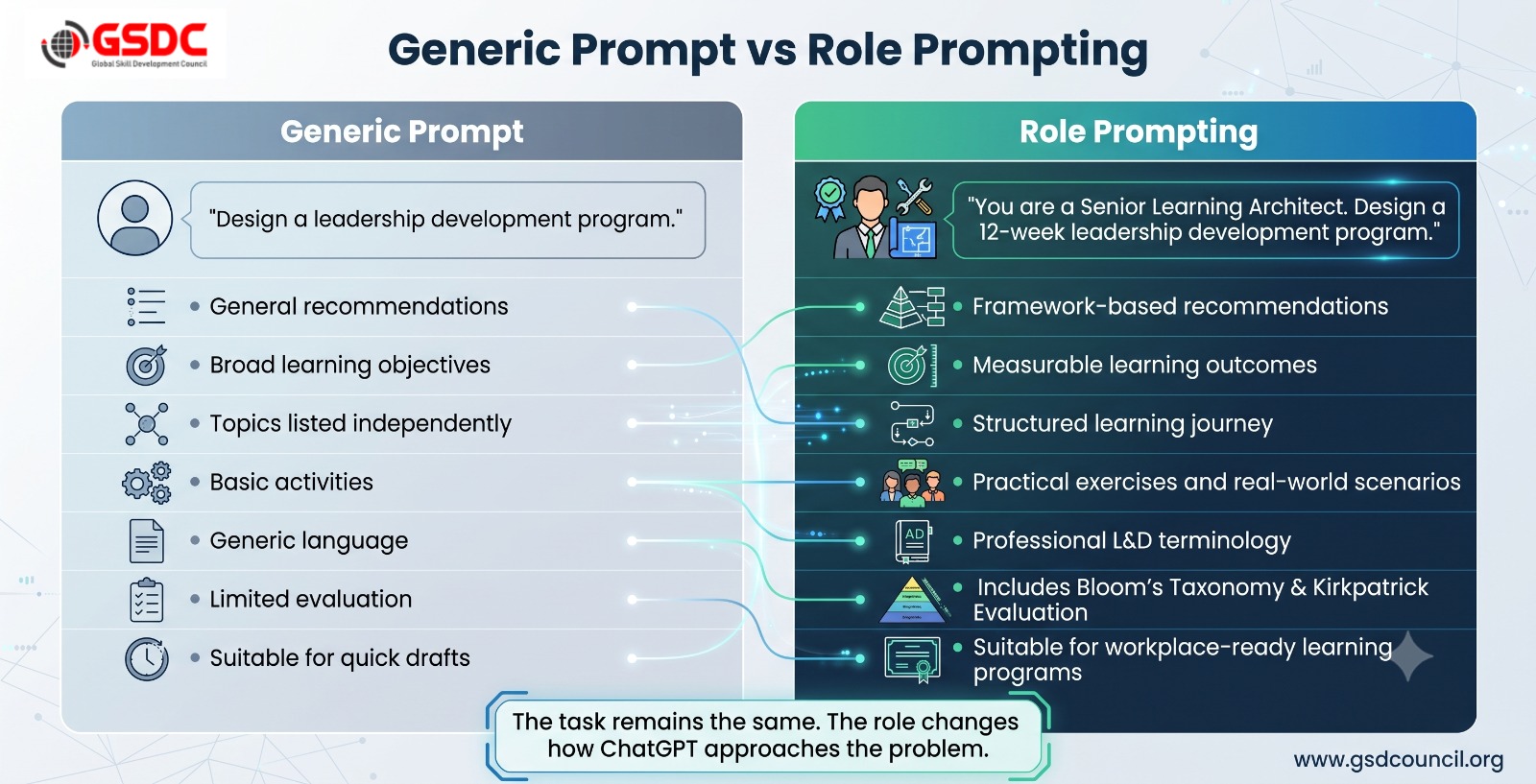
“Design a 12-week first-time manager program for 30 newly promoted team leads working in a 2,000-person fintech company.”
The response is perfectly usable. It covers communication, delegation, conflict management, coaching, and performance reviews. If all you needed was a rough outline, you could probably build on it.
However, after reading it carefully, you notice something important. The program feels like a list of training topics. It doesn't explain why one topic comes before another, how learners will practise new skills, or how success will be measured once the training is over. The content isn't wrong, it simply lacks the structure that experienced instructional designers usually bring to a learning program.
Now let's change only one thing.
Before describing the task, add this role:
“You are a Senior Learning Architect with 20 years of experience designing first-time manager programs. You specialize in Bloom's Taxonomy, the 70-20-10 learning model, and Kirkpatrick's Four Levels of Evaluation.”
Everything else in the prompt stays exactly the same.
The response immediately starts feeling different. Instead of jumping into weekly topics, ChatGPT begins by defining measurable learning outcomes. Those outcomes are linked to Bloom's Taxonomy because that's how experienced learning professionals describe success. The weekly curriculum follows a logical progression, with each module preparing learners for the next. By the end of the response, the AI even explains how the organization can measure whether managers are applying those skills back at work using Kirkpatrick's evaluation model.
What changed?
Interestingly, the task didn't become more detailed. The difference came from the role.
Here are some of the improvements you'll usually notice:
- The learning outcomes become measurable instead of broad statements like "Understand leadership."
- The weekly plan follows a learning journey where each topic builds on the previous one rather than appearing as an independent session.
- Well-known instructional design frameworks appear naturally because they are closely connected with the role you assigned.
- Evaluation becomes part of the design process, not something added at the end as an afterthought.
- The recommendations feel more practical because they reflect how an experienced Learning Architect would actually approach the project.
This is what makes role prompting so effective. It doesn't force ChatGPT to write a better answer. It encourages the model to think like the professional you've asked it to become.
Five High-Value Roles Worth Saving in Your Prompt Library
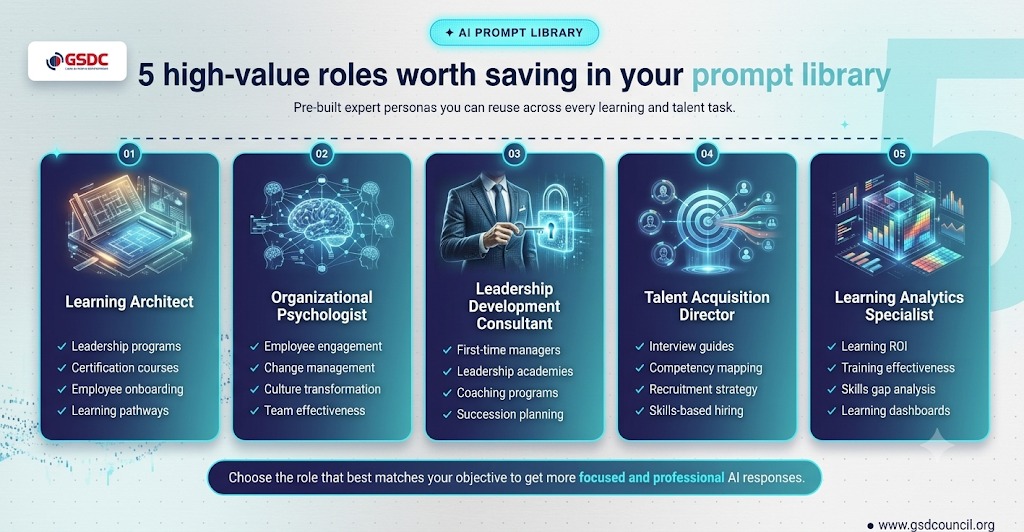
One of the best things about role prompting is that you don't have to start from scratch every time. Once you find roles that consistently produce better results, save them. Over time, you'll build a prompt library that helps you get more reliable and professional responses with very little effort.
Here are five roles that work particularly well for HR and Learning & Development professionals.
1. Learning Architect
If you're designing a learning program, this is one of the most valuable roles you can use. A Learning Architect doesn't just think about topics, they think about what learners should achieve, how they'll practice new skills, and how success will be measured. That's why responses often include clear learning outcomes, structured learning paths, and recognized frameworks like Bloom's Taxonomy or Kirkpatrick's Evaluation Model.
Best for:
- Leadership development programs
- Certification courses
- Employee onboarding
- Learning pathways
2. Organizational Psychologist
When your goal is to influence behaviour rather than simply share knowledge, this role works exceptionally well. Instead of focusing only on training content, it explores motivation, team dynamics, workplace behaviour, and organizational culture to recommend more meaningful solutions.
Best for:
- Employee engagement
- Change management
- Culture transformation
- Team effectiveness
3. Leadership Development Consultant
Leadership development is more than teaching management skills. This role approaches leadership as a long-term journey, helping ChatGPT create programs that build coaching, decision-making, communication, and people management capabilities through practical workplace scenarios.
Best for:
- First-time manager programs
- Leadership academies
- Coaching frameworks
- Succession planning
4. Talent Acquisition Director
If you're creating hiring resources, this role adds much more depth than a generic HR persona. It encourages ChatGPT to think about competencies, candidate evaluation, and long-term hiring strategies instead of simply generating interview questions.
Best for:
- Interview guides
- Competency mapping
- Recruitment strategies
- Skills-based hiring
5. Learning Analytics Specialist
A successful learning program doesn't end when the training is complete. This role focuses on measuring results, helping ChatGPT suggest meaningful learning metrics, evaluation methods, and ways to demonstrate the business impact of training initiatives.
Best for:
- Learning ROI
- Training effectiveness
- Skills gap analysis
- Learning dashboards
Combine Role Prompting with the RTCF Framework
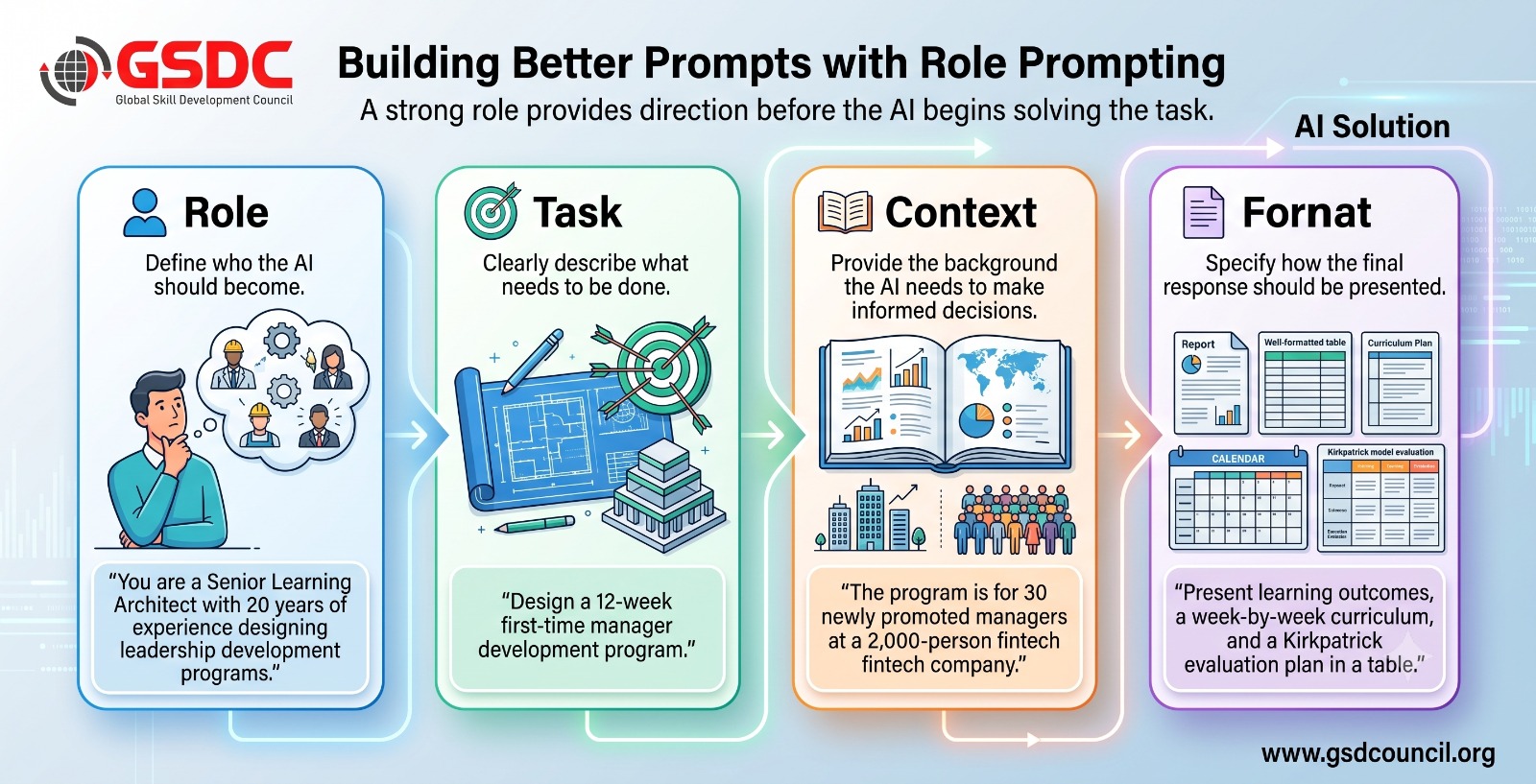
Role prompting becomes even more effective when you combine it with the RTCF Framework. While the Role tells ChatGPT who it should become, the remaining three elements explain what needs to be done, why it matters, and how the final answer should be presented. Together, they remove ambiguity and help the AI produce responses that are more structured, relevant, and ready to use.
Instead of writing a simple prompt like this:
“Create a leadership development program.”
Use the RTCF framework to provide complete direction.
Role
“You are a Senior Instructional Designer with 15 years of experience designing corporate leadership development programs. You specialize in Bloom's Taxonomy and Kirkpatrick's Evaluation Model.”
Task
“Design a 10-week leadership development program for newly promoted managers.”
Context
The learners are 40 newly promoted managers working in a global software company. The program will be delivered online and should focus on communication, coaching, performance management, and decision-making.
Format
Present the response with:
- Learning objectives
- Week-by-week curriculum
- Learning activities
- Assessments
- Evaluation strategy
When all four elements work together, ChatGPT spends less time guessing what you want and more time generating a response that matches your expectations. The role provides the expertise, the task defines the objective, the context adds business relevance, and the format ensures the output is easy to use.
When Should You Use Role Prompting?
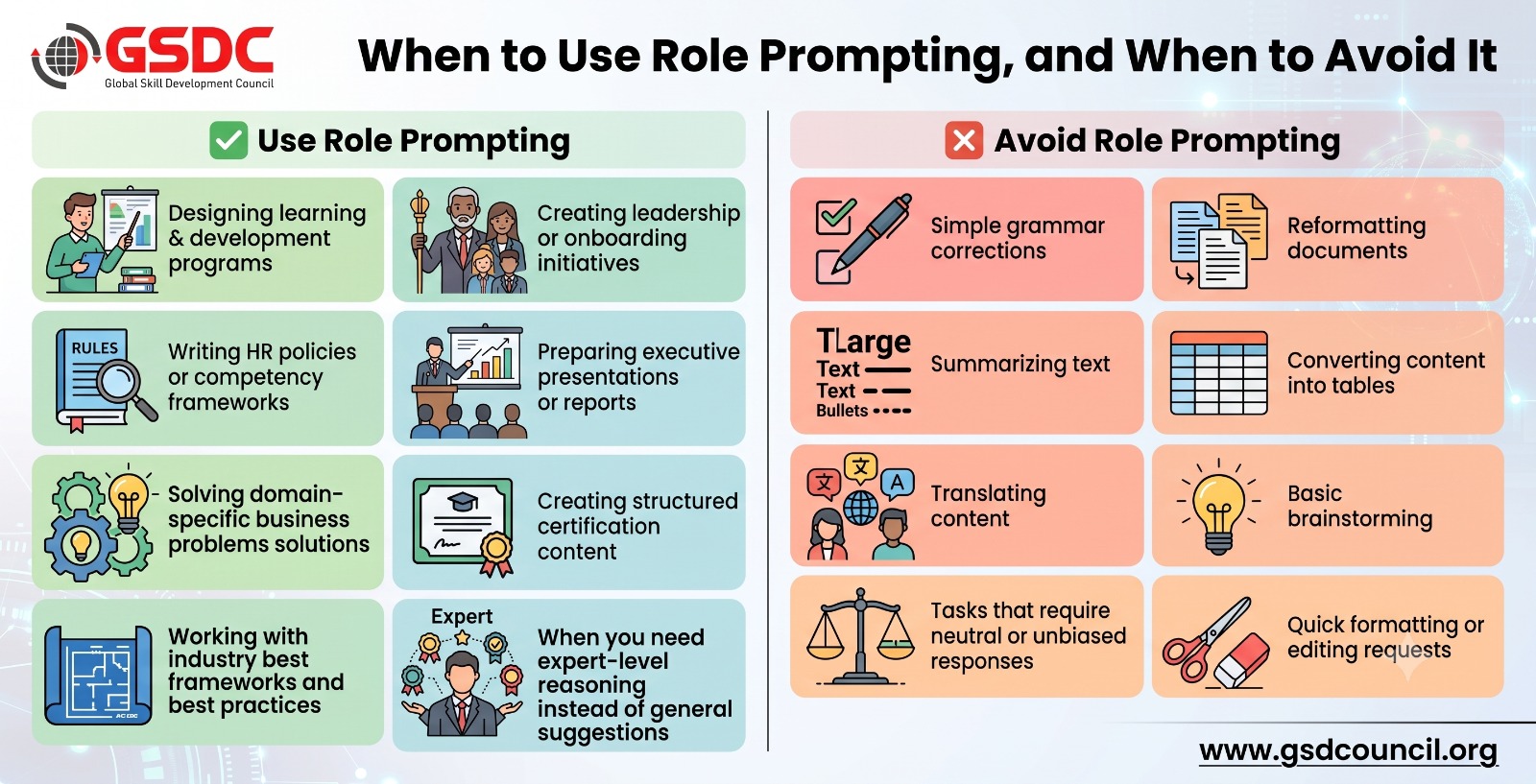
Role prompting works best when you need ChatGPT to think like a specialist rather than respond like a general AI assistant. It's especially useful in situations where experience, frameworks, and professional judgment matter.
- Designing learning programs that require structured learning outcomes, assessments, and learner journeys.
- Creating business strategies or reports where expert reasoning is more valuable than general suggestions.
- Developing leadership and management content for first-time managers, executives, or high-potential employees.
- Writing HR policies, competency frameworks, or SOPs that need a professional and practical approach.
- Preparing presentations or workshops that should follow industry-recognized frameworks and best practices.
- Generating role-specific content such as interview questions, coaching plans, performance reviews, or onboarding programs.
- Working in an unfamiliar domain where assigning the right expert helps ChatGPT bring in relevant knowledge automatically.
- Writing for senior stakeholders who expect strategic thinking, business terminology, and structured recommendations.
- Solving complex problems where different professionals would approach the same challenge differently.
- When generic responses aren't enough and you want answers that reflect the thinking process of an experienced practitioner rather than a general assistant.
When Should You Avoid Role Prompting?
Role prompting is not necessary for every request.
You can skip it when:
- Reformatting documents.
- Summarizing notes.
- Converting tables.
- Fixing grammar.
- Translating text.
- Extracting information from files.
In these situations, assigning a professional role usually adds little value.
Common Mistakes to Avoid in Role Prompting
Even a well-written prompt can produce average results if the assigned role is unclear or inconsistent. Here are some common mistakes that can reduce the effectiveness of role prompting.
- Using vague roles such as "HR Expert" or "Marketing Professional." Choose a role with a clear specialization instead.
- Assigning multiple roles in one prompt. Asking ChatGPT to be a coach, consultant, psychologist, and strategist at the same time often leads to mixed and inconsistent responses.
- Skipping relevant frameworks. If the role naturally works with frameworks like Bloom's Taxonomy, ADDIE, or NIST, mention them to guide the response.
- Choosing the wrong role for the task. A Leadership Coach and a Learning Architect will approach the same problem differently. Pick the role that best fits your objective.
- Giving conflicting instructions. For example, asking ChatGPT to act as a strict compliance auditor while also expecting highly creative and informal content can confuse the model.
- Relying only on the role. A good role is important, but it should still be supported with a clear task, sufficient context, and the expected output format.
- Making the role unrealistically complex. Adding too many qualifications, certifications, or responsibilities can dilute the role instead of making it stronger.
- Using the same role for every task. Different problems require different perspectives. Reusing one role for everything often limits the quality of the response.
- Not refining the role after the first response. If the output isn't what you expected, adjust the role before rewriting the entire prompt.
- Forgetting the audience. The role should match who the content is being created for. A prompt for executives should use a different expert persona than one designed for new employees.
Try It Yourself
Copy the template below and replace the placeholders with your own information.
You are a {{specific job title}} with {{years}} of experience in
{{niche specialty}}.
You are known for {{distinctive expertise}} and are deeply familiar
with {{2–3 frameworks or methodologies}}.
Now complete the following task using the RTCF framework.
Task:
{{Describe your task}}
Context:
{{Provide the business or learning context}}
Format:
{{Specify exactly how you want the answer presented}}
Want to Apply AI More Effectively in HR & Learning?
Learning role prompting is a great first step, but it's only one part of using Generative AI effectively at work. HR and Learning & Development professionals also need to understand how AI can support recruitment, onboarding, learning design, performance management, employee engagement, and talent development.
The GSDC Certified Generative AI in HR & Learning & Development certification is designed to help professionals move beyond basic prompting and learn practical ways to integrate AI into everyday HR and L&D activities. Through real-world use cases, prompt engineering techniques, and hands-on applications, you'll gain the skills to create smarter workflows, improve productivity, and deliver more impactful learning experiences.
What You'll Learn
- Apply Generative AI across HR and Learning & Development functions.
- Master prompt engineering techniques, including Role Prompting and the RTCF framework.
- Create AI-powered onboarding, learning, hiring, and performance management workflows.
- Improve productivity with practical AI tools, templates, and real-world use cases.
Take the next step and become a Certified Generative AI in HR & Learning & Development Professional with GSDC.
Final Thoughts
Role prompting is one of the simplest improvements you can make to your prompts, but it often produces noticeably better results.
Instead of asking the AI to respond as a general assistant, you guide it toward the perspective of an experienced professional who understands your domain.
For HR teams, learning professionals, instructional designers, and leadership consultants, this small change can lead to more structured programs, stronger recommendations, and outputs that are easier to apply in real work.
As you continue building your prompting skills, combine Role Prompting with the RTCF Framework. Together, they create clear, detailed prompts that consistently produce higher-quality responses.

Related Certifications
Stay up-to-date with the latest news, trends, and resources in GSDC
If you like this read then make sure to check out our previous blogs: Cracking Onboarding Challenges: Fresher Success Unveiled
Not sure which certification to pursue? Our advisors will help you decide!