Train the Trainer: Strategies to Empower Effective Learning Delivery

Written by Emily Hilton
- Why Train the Trainer Programs Important Today?
- Core Components of an Effective Train the Trainer Course
- Building Up the Training Facilitation Skills that Are Strong
- Modern Experiential Learning Methods
- How TTT Certification Elevates Training Credibility
- Why opt for GSDC for your Train the Trainer Certification?
- Future Trends in Corporate Training
- Closing Advise
The professional world is changing fast, and organizations today expect training that actually transforms performance, not just shares information. That’s why Train the Trainer programs have become essential for anyone responsible for developing people and driving capability building.
Whether you’re an HR professional, subject-matter expert, L&D specialist, or team leader, a train the trainer course helps you build the skills needed to design engaging learning experiences, improve facilitation, and confidently manage different learner needs. Modern training goes far beyond presentations; effective trainers must understand adult learning psychology, apply strong training delivery methods, and incorporate learning experience design and evaluation strategies into every session.
This blog is your ultimate guide to exploring practical strategies for delivering impactful training and discussing how earning a train the trainer certificate, TTT certification, or professional trainer certification can elevate your credibility and accelerate your career as a trainer.
Why Train the Trainer Programs Important Today?
Businesses are now recognizing that competent trainers directly influence employee productivity, customer experience quality, and business performance. Also, poorly provided training can lead to serious issues, including inconsistent execution, learning gaps, high onboarding time, and weak skill transfer. Therefore, the train-the-trainer certification develops credibility and allows trainers to use tools to design and implement engaging learning processes.
What Advantages Will Trainers Get?
The main advantages of a Train the Trainer Program include the following:
- Improvement in the efficiency of the instructor and in the treatment of the class
- Betterment of the teaching techniques and the use of the learner-centered methods
- Guidance for the trainers in the aspect of understanding and applying the evaluation methods
- General improvement of the skill for managing different kinds of learners, as well as unwanted behavior
- Establishment of the same training standard in all the branches of an organization
- Professional development and confidence in the case of face-to-face and virtual training
Professional credentials, such as a leadership trainer certification, a certified train the trainer, or a TTT certification, offer a considerable competitive advantage and recognition for trainers striving to establish their authority and seek career growth.
Core Components of an Effective Train the Trainer Course
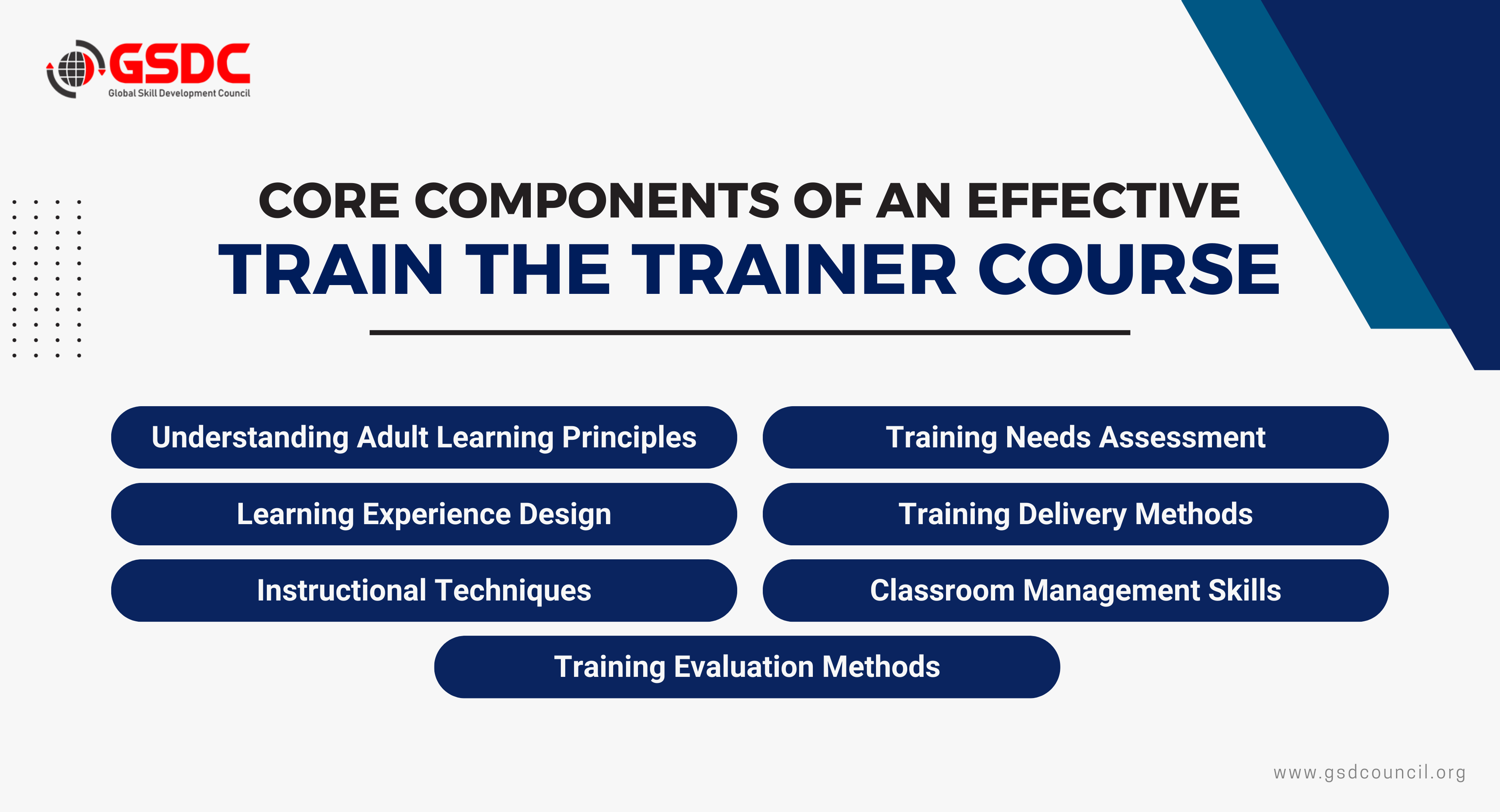
A good train-the-trainer course gives emphasis on building up the basic and advanced skills necessary for producing fruitful learning and development results. The major aspects that are often part of the organized train-the-trainer courses are stated below:
1. Understanding Adult Learning Principles
Adult learners are self-directed, goal-oriented, and prefer practical relevance. Trainers must know how to:
- Connect training with actual business requirements.
- Participatory learning should be encouraged.
- Connect new knowledge with previous experiences.
This foundation is essential for effective training facilitation skills.
2. Training Needs Assessment
Before designing or delivering training, trainers must conduct a training needs assessment. It helps identify:
- Differences in skills and performance needs.
- A group of people on whom the training is targeted.
- Business results that the training would contribute to.
- Learning priorities and timing.
Without a proper needs analysis, training can become irrelevant or ineffective.
3. Learning Experience Design
Effective trainers must be capable of building structured, high-impact learning journeys using modern learning experience design models. Key elements include:
- Well-defined learning objectives.
- Teaching method that is in accordance with the specified outcomes.
- Organizing content according to the learner's capacity.
- Mixing and using digital learning.
- Activities that are practical and promote application.
The learning experience design supports turning training sessions into memorable learning practices and experiences.
4. Training Delivery Methods
Adopting the right training delivery methods ensures that training suits learner preferences and program objectives. Common approaches include:
- In-person or virtual instructor-led sessions.
- Training through a mix of online and classroom sessions.
- Microlearning together with scenario-based learning.
- Coaching and mentoring models are in place.
- Using hands-on practice and experiential learning methods.
- Simulations and role-playing activities.
Great trainers know how to select the ideal method based on learner needs and the complexity of skills being taught.
5. Instructional Techniques
Utilizing effective training methods, trainers are able to organize the subject matter in a format that is easy to follow and stimulate the audience's interest, among others. The following are some techniques that might be used:
- Storytelling as a means of conveying a message that evokes feelings
- Questioning as a means of drawing thoughts
- Demonstrating and modeling as a way of imparting skills
- Case studies discussion
- Group activities for mutual teaching, etc.
6. Classroom Management Skills
Powerful training is not possible without strong classroom management skills. Trainers must know how to:
- Handle different participants and learning styles
- Deal with disruptive actions
- Create trust and support for contribution
- Keep a positive and respectful teaching atmosphere
7. Training Evaluation Methods
To measure training impact, trainers must apply systematic training evaluation methods, such as:
- Before and after tests
- Feedback surveys from the participants
- Observations of practical application
- Performance enhancement metrics
- ROI calculation of training activities
Evaluations ensure that learning outcomes align with business expectations and that the program continuously improves.
📘 Download the Train the Trainer Resource Pack
🎯 Designed to help trainers boost engagement, retention & real learning outcomes
📥 Get your FREE resource pack now & elevate your facilitation skills!
Building Up the Training Facilitation Skills that Are Strong
Facilitation is the primary reason for successful training delivery. It is not just the presentation of slides but also guiding learning, offering communication, and putting much reflection into learning.
Training Facilitating Skills Required:
- Being a good listener and understanding the speaker's point of view
- Verbal communication and non-verbal communication
- Managing the schedule and controlling the flow of the session
- Adjusting the teaching methods in light of the audience's response
- Inviting sharing and interaction
- Managing group dynamics of both energy and participation
- Being the peacemaker in the teaching/learning environment
A certified trainer knows how to apply strong facilitation skills to connect with the group and draw out the best when they encounter learning barriers. To build these capabilities in a practical and structured way, consider enrolling in the Master the Art of Training – Train the Trainer course for globally relevant trainer development.
Modern Experiential Learning Methods
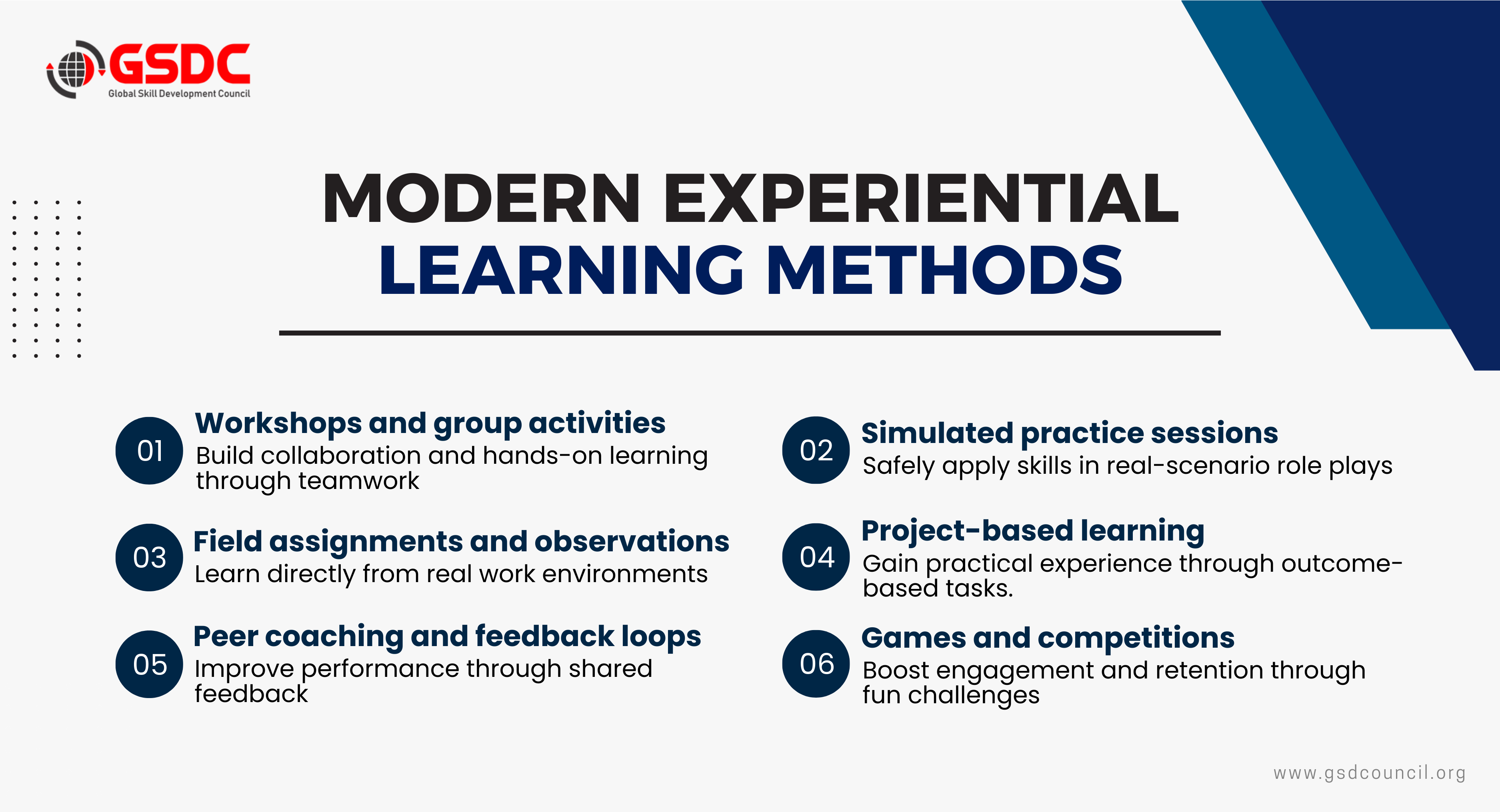
Experiential techniques help the learners use the knowledge right away and gain competence. The most common methods of experiential learning are:
- Workshops and activities for groups
- Simulated practice sessions
- Assignments in the field and observation tasks
- Learning through projects
- Peer coaching and feedback loops
- Participating in games and competitions
The use of experiential training guarantees deep learning and better retention.
How TTT Certification Elevates Training Credibility
A TTT certification, or train the trainer certificate, is proof of professional competence and shows excellence in creating and providing influential training sessions. Worldwide acknowledged certifications increase the trainer’s job chances and the trust of the profession.
Benefits of earning Train the Trainer Certification:
- Enhances training career opportunities worldwide
- Boosts professional credibility within organizations
- Demonstrates proven expertise in training design, delivery, and evaluation
- Builds confidence to handle high-impact corporate programs
- Increases ability to lead leadership training, behavioral training, and technical programs
Why opt for GSDC for your Train the Trainer Certification?
If a certification program for train the trainers, which is valid in all countries, trusted worldwide, and relevant to the industry, is what you need, then the GSDC (Global Skills Development Council) is among the very few and strongest options available even today. As a certification body, GSDC, which is independent and internationally accredited, supports the need for trainers with the competencies aligned to the present and the exact ones that the labor market requires.
The program is built with a very practical approach where real facilitation practice, case studies, and experiential learning are combined so that the participants not only learn the theory, they also apply it. The curriculum consists of training needs assessment, learning experience design, instructional techniques, classroom management skills, and training evaluation methods, which are the essential elements that enable participants to develop strong, evidence-based training delivery capabilities.For trainers who want to move beyond delivery into full course creation, following a structured career path for instructional designer roles is the logical next step one that builds directly on these training foundations.
One of the greatest advantages is the availability of expert mentorship and structured feedback, which assists trainers in refining their facilitating skills continuously. Getting a GSDC train the trainer certificate improves one’s reputation, opens up professional doors, and gets one recognized as a global, certified, confident train the trainer professional.

Future Trends in Corporate Training
The world of training is undergoing rapid change, and for us it's important to adopt the practices and strategies of it. For this, trainers have to be in line with the new developments, like:
- The use of AI in making learning more personalized.
- The setup of virtual coaching rooms and labs that utilize VR.
- The application of learning analytics in performance measurement.
- The use of hybrid training methods that integrate both instructor-led and digital learning.
- The implementation of microlearning for continuous training in the future.
Future professional development for trainers will focus on blending technical proficiency with human-centered facilitation skills.
Closing Advise
Structured development through trainers' empowerment is the main factor in unlocking the success of learning in the organizations. A train the trainer approach reinforces the competency of facilitation, increases engagement, and guarantees the measurable impact of the training. The investment in a train the trainer course or in a globally recognized train the trainer certification not only helps the trainers to deliver the transformational change but also to boost the learner's experience and the performance outcomes.
It does not matter whether you are an aspiring trainer, HR leader, corporate educator, or subject-matter expert; obtaining a train the trainer certificate, a professional trainer certification, or a leadership trainer certification can enhance your career while allowing you to make a very significant contribution to the growth of the organization.
If you acquire the skills of training needs assessment, learning experience design, training delivery methods, instructional techniques, and training facilitation, you will be able to become a highly effective trainer who delivers powerful learning experiences that change people.

Related Certifications
Stay up-to-date with the latest news, trends, and resources in GSDC
If you like this read then make sure to check out our previous blogs: Cracking Onboarding Challenges: Fresher Success Unveiled
Not sure which certification to pursue? Our advisors will help you decide!