ISO 20022: A Simple Guide to the New Payments Standard
Written by Matthew Hale
- What is ISO 20022?
- Why Is ISO 20022 So Important?
- What Problems Does ISO 20022 Solve?
- How ISO 20022 Migration Works (Step by Step)
- Impact on Banks and Financial Institutions
- Impact on Corporates and Treasury Teams
- What Does ISO 20022 Mean for Your Career?
- ISO 20022 Certification: Building Credible Expertise
- Conclusion: ISO 20022 Is Becoming the New Normal
Each time money is moved, be it your salary, a vendor payment or an online transfer, financial institutions are exchanging messages in the background to make the transaction happen. For a long time, these message exchanges have been using old formats that were not developed for the present fast, digital and data-intensive environment. Consequently, there are often delays, data loss, situations that require manual intervention and an increase in complexity in the case of cross-border payments.
ISO 20022 is a new communication standard that the financial industry is adopting to overcome these problems. Still, many professionals are wondering what ISO 20022 is and what the practical implications of ISO 20022 for banks and corporations are.
This blog offers ISO 20022 explained in a simple and structured way, highlighting how the standard is shaping the future of payments and financial communication.
What is ISO 20022?
ISO 20022 is an international standard for financial communications. It defines a shared language that banks, payment networks, and corporates use to design and uniformly send transactional data.
Different systems today use different formats, which often leads to extra work, errors, data loss and slower processing. ISO 20022 helps solve these issues by introducing:
- A standard and structured message format
- More detailed and accurate data fields
- An adaptable model that can handle new regulations and future payment requirements
Put simply, ISO 20022 is a way that financial systems can "talk" to each other more clearly and reliably, thus making transactions easier to process and understand.
Why Is ISO 20022 So Important?
ISO 20022 is becoming a core part of global payments modernisation, with adoption growing steadily. Recent data shows that 44.9% of central banks have already upgraded their RTGS systems, reflecting strong momentum toward standardisation.
1. Richer and More Detailed Data:
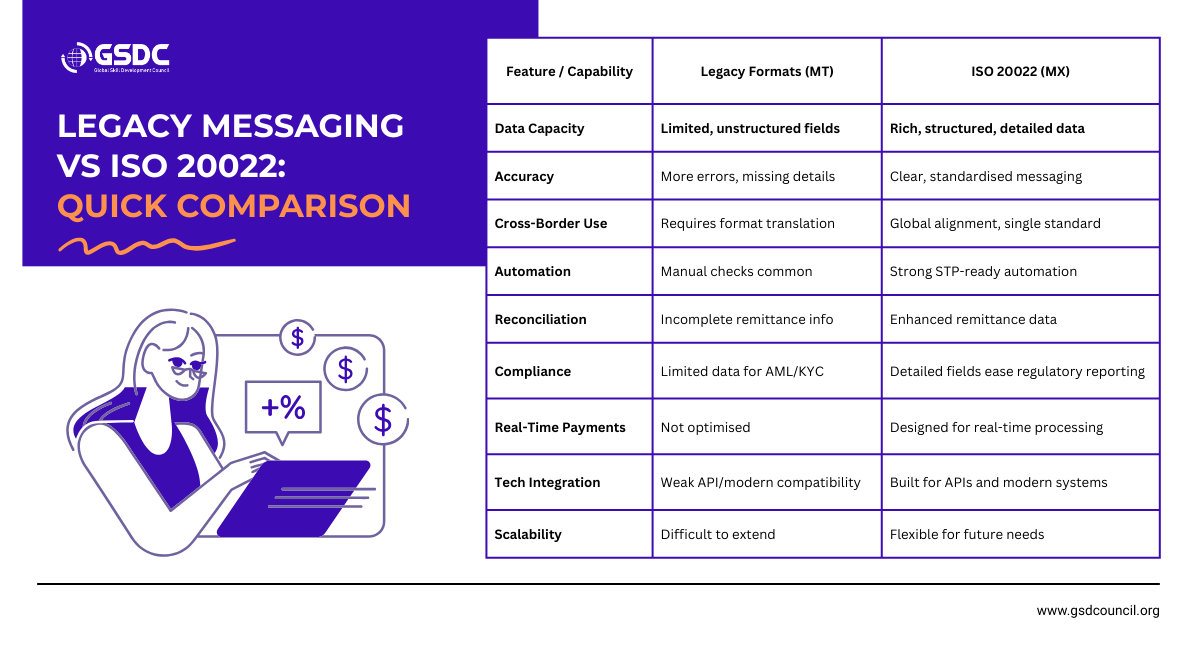
The amount of data accompanying a payment is severely limited by the old messaging formats.
In contrast, ISO 20022 can carry structured and detailed data like the sender information, purpose of payment, and invoice references, thus it makes reporting, analysis, and compliance more efficient.
2. Fewer Errors and Less Manual Work
Standardised and clearer messages reduce mismatches and ambiguity. With fewer exceptions to resolve, organisations experience less manual intervention and better straight-through processing.
3. Better Cross-Border Payments
Many international payment systems are now moving toward ISO 20022. More than 200 market infrastructures worldwide are implementing or planning to implement the standard, helping create faster, more transparent and more consistent cross-border transfers.
4. Support for Modern Financial Services
ISO 20022 enables real-time payments, advanced fraud detection, automated compliance and better use of analytics. It provides a strong foundation for the next generation of financial services and digital innovation.
The growing adoption of ISO 20022 has also increased the need for skilled professionals, prompting organisations to encourage ISO 20022-related training supported by bodies such as the Global Skill Development Council (GSDC).What Problems Does ISO 20022 Solve?
A large number of organisations are still dependent on outdated formats such as SWIFT MT that were not designed for the fast and data-driven payment world of today. ISO 20022 resolves several problems that have existed for a very long time:
Problem 1: Limited Data in Legacy Messages
Older formats limit the amount of information that can be sent along with a payment and thus often lead to details that are incomplete and require manual follow-ups.
Solution: ISO 20022 delivers more detailed and structured data fields that facilitate clarity, reporting, and automation.
Problem 2: Fragmented Message Formats Across Markets
The issue of translation arises with international payments when every nation or system utilises a different message format. Besides that, the complexity of such payments also increases.
Solution: ISO 20022 universally standardises communication, thus it becomes effortless for different markets to interact with each other.
A recent survey found that only 32.9% of payment systems had adopted ISO 20022 by 2025.
Problem 3: Poor Compatibility With Modern Platforms
Older formats are not suitable for APIs, real-time payments, or advanced analytics.
Solution: ISO 20022 is a modern technology-friendly standard that enables real-time processing, automation, and fraud detection as well as analytics.
Problem 4: High Manual Effort and Data Interpretation Issues
The most common causes of manual reconciliation and custom conversions are payment data that is either inconsistent or unstructured.
Solution: ISO 20022 gives standard, machine-readable data that facilitates straight-through processing and thus lowers the number of exceptions.
How ISO 20022 Migration Works (Step by Step)
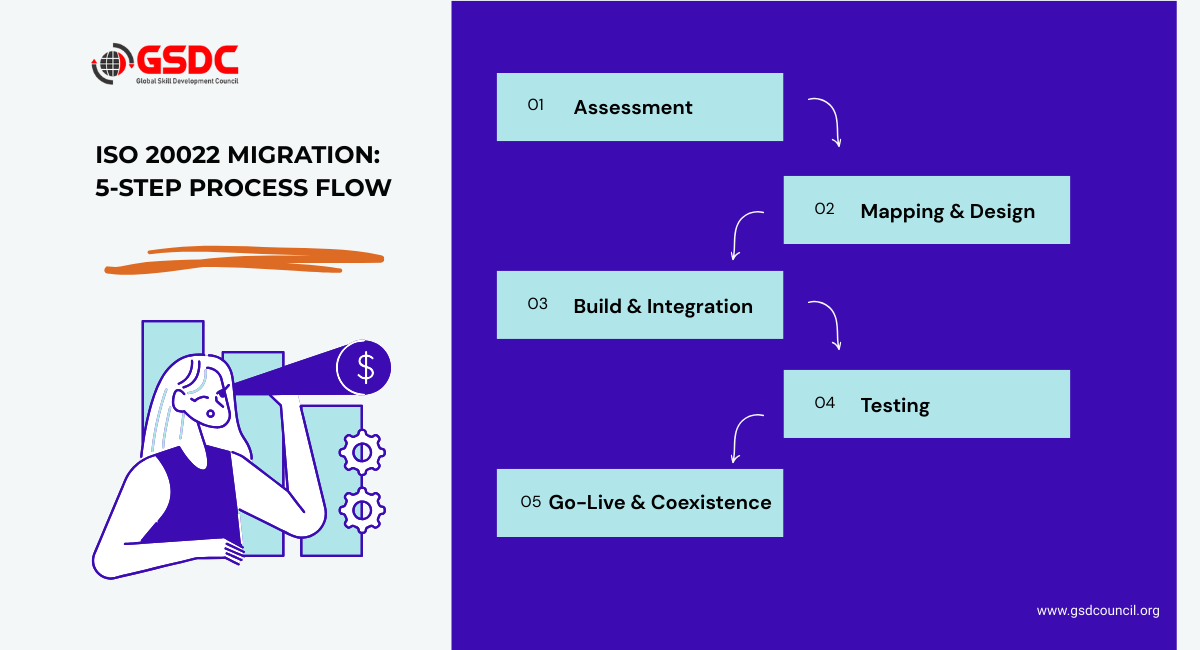
ISO 20022 migration follows a clear set of phases as organisations move from legacy formats to a modern, structured standard.
1. Assessment: Review all systems involved in sending or receiving payments, including internal applications and external integrations, to define the scope.
2. Mapping and Design: Map existing message formats to ISO 20022 and design the required data fields and validation rules to ensure accurate and consistent messaging.
3. Build and Integration: Upgrade payment engines, connectivity channels and related applications to support ISO 20022. Payment instructions are often prioritised.
4. Testing: Test messages internally and with external partners such as RTGS systems, instant payment networks and cross-border schemes.
5. Go-Live and Coexistence: Run legacy formats and ISO 20022 in parallel during early adoption to refine templates and resolve any issues.
Migration also provides a chance to improve data quality, strengthen automation and align with partner banks on timelines. As part of this shift, many organisations now prefer teams that hold an ISO 20022 certificate to ensure they can support the migration effectively.🧰 ISO 20022 Quick Toolkit
Impact on Banks and Financial Institutions
ISO 20022 has significantly changed the way banks handle payment data and messaging. The changeover demands a thorough comprehension of the channels, systems, and processes that are affected, as well as a well-organised approach to the transition.
Key internal areas affected include:
- Payment engines and processing workflows
- Messaging systems and connectivity channels
- Data models and data storage
- Reporting and analytics frameworks
- Compliance and regulatory monitoring
In addition, banks should coordinate closely with:
- Market infrastructures and RTGS operators
- Correspondent and cross-border banking partners
- Fintech providers and service platforms
- Corporate clients using bank integration channels
With the right planning, ISO 20022 enhances data quality, increases processing efficiency and creates a stronger foundation for automation and future innovation.
Impact on Corporates and Treasury Teams
ISO 20022 is a source of significant operational changes for corporates, especially concerning the methods of initiating, processing, and reconciling payments.
Some of the key points where adjustments are needed include:
- ERP and treasury management systems
- Payment file formats and message structures
- Bank connectivity and integration channels
- Internal processes for cash flow and payment tracking
Organisations implementing these changes find that they:
- Have better cash visibility across accounts and regions
- Get more accurate reporting with richer and standardised data
- Have stronger payment reconciliation automation due to enhanced remittance details
- Experience a reduction in manual intervention and fewer processing errors
The transition to ISO 20022 is gradually being recognised as a fundamental obligation for finance and treasury departments, as it facilitates clearer data, enhances automation, and ensures a more efficient end-to-end payment flow.
What Does ISO 20022 Mean for Your Career?
ISO 20022 is a major change in the way that financial data is shared, and this change is opening up a multitude of new career possibilities in banking, payments, and corporate finance. Firms are now eager to hire people who have knowledge of structured payment data, message formats, and process changes.
Roles that benefit from ISO 20022 skills include:
- Payment operations
- Business analysts and product owners
- Treasury and cash management teams
- Compliance, AML and risk roles
- Internal and external auditors
- Lead Auditors focused on payment standards
- Payment technology and integration specialists
Professionals who can connect business needs with technical understanding will stand out. ISO 20022 expertise is quickly becoming a valuable differentiator for career growth and specialist roles.
ISO 20022 Certification: Building Credible Expertise
As ISO 20022 becomes widely adopted, certification is an effective way for professionals to demonstrate formal knowledge of the standard, including message structures, governance, data quality and implementation assessment.
A recognised pathway for gaining this expertise is the Certified ISO 20022 Lead Auditor credential. For those looking to pursue this qualification, GSDC offers a dedicated program that provides a structured route to build and validate the required skills.

Conclusion: ISO 20022 Is Becoming the New Normal
ISO 20022 is redefining how financial data is exchanged, bringing clearer messages, richer information and faster, more consistent cross-border payments. As global adoption accelerates, understanding what is ISO 20022 and the broader ISO 20022 meaning is no longer optional — it is becoming a core requirement across the financial ecosystem.
For banks and corporates, this transition is an opportunity to modernise payment systems, strengthen data quality and unlock greater automation. For professionals, it opens doors to new roles and responsibilities as organisations seek deeper expertise in standards, messaging and payment transformation.
The shift is already underway, and very soon, ISO 20022 will not be viewed as a future standard but simply the default way payments operate in a modern, data-driven financial world.

Related Certifications
Stay up-to-date with the latest news, trends, and resources in GSDC
If you like this read then make sure to check out our previous blogs: Cracking Onboarding Challenges: Fresher Success Unveiled
Not sure which certification to pursue? Our advisors will help you decide!