ISO 42001 Implementation Roadmap (Step-by-Step Guide)
Written by Hafiz Sheikh Ahmed
Artificial Intelligence is transforming how organizations operate, make decisions, and deliver value. Still, as the use of AI continues to increase, it will be crucial to regulate it carefully. The ISO 42001 provides the AIMS (AI Management System) structure that can be used to ensure AI technologies are ethical, transparent, and compliant.
The implementation of ISO 42001 might appear to be difficult, especially for those developing and operating AI technologies within fast-paced organizations. However, if one follows a clear AIMS implementation roadmap, then the entire process becomes less daunting and thus more practical.
In our recent Friday session, Hafiz Sheikh Ahmed guided attendees through a hands-on ISO 42001 roadmap, breaking down complex processes into actionable steps and practical strategies for seamless organizational implementation.
So, this guide to ISO 42001 gives you a step-by-step walkthrough of each of the stages, starting from the comprehension of the ISO 42001 clauses and going all the way up to certification, while also putting stress on the crucial policies, controls, risk assessments, and training initiatives.
In case you want to acquire advanced knowledge, GSDC ISO 42001 Lead Auditor Certification is a good option to consider, which will not only advance your auditing skills but will also guide you through the effective implementation of AI management systems.
What Is ISO 42001 and Why Implementation Matters?
ISO 42001 outlines the specification for the deployment of an AI Management System (AIMS) framework. It guarantees that companies put in place organized governance, policies, and processes to handle AI ethically.
ISO 42001 is applied by organizations for the following reasons:
- To minimize the risks involved in assessing the AI lifecycle in terms of bias, errors, and non-compliance.
- To build stakeholder trust by ushering in transparency and accountability.
- To create a reservoir of continuous improvement across AI applications.
Adhering to this standard not only helps companies to meet the ISO 42001 documentation requirements but also shows their commitment to responsible AI.
ISO 42001 Implementation Steps
Step 1: Conduct ISO 42001 Gap Analysis
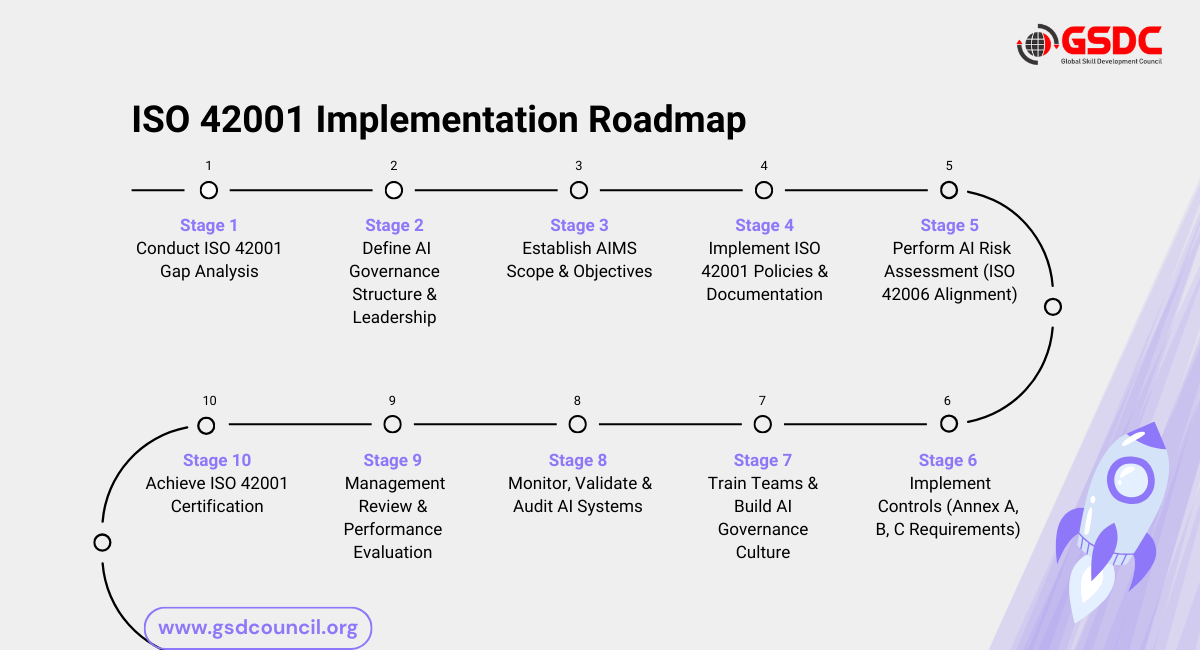
Begin with a comprehensive ISO 42001 gap analysis checklist to evaluate your current AI practices against ISO 42001 clauses. Review governance policies, identify missing controls, and highlight areas for improvement. This initial assessment forms the foundation of your ISO 42001 implementation plan for organizations and helps prioritize action steps in the AIMS implementation roadmap.
Step 2: Define AI Governance Structure & Leadership
A robust AI governance implementation requires assigning a dedicated Responsible AI Lead or AIMS Manager, creating governance committees, and defining accountability roles. A well-defined AI governance structure ensures that decision-making, risk management, and ethical oversight are implemented effectively.
Step 3: Establish AIMS Scope & Objectives
Define the AIMS scope, including AI systems, datasets, models, stakeholders, and regulatory obligations. Set AI governance objectives that align with organizational goals. Clear scope and objectives are essential for an ISO 42001 readiness assessment and to streamline documentation and auditing processes.
Step 4: Implement ISO 42001 Policies & Documentation
Develop formal policies, such as AIMS policy and procedures, an AI Governance Policy, and Responsible AI guidelines. ImplementISO 42001 documentation requirements, including data lineage, model transparency, and AI risk registers. Proper documentation ensures traceability and audit-readiness for certification.
Step 5: Perform AI Risk Assessment (ISO 42006 Alignment)
Conduct a detailed AI lifecycle risk assessment aligned with ISO 42006 risk management requirements. Identify risks, assess impact and likelihood, and define appropriate risk controls. Maintaining a well-structured AI risk register is essential for compliance and for ongoing AIMS monitoring & evaluation.
Step 6: Implement Controls (Annex A, B, C Requirements)
Implement ISO 42001 controls (Annex A/B/C) across technical, operational, and governance areas. Technical controls may include algorithm security and model monitoring, while operational controls cover workflows and documentation. Governance controls focus on accountability and decision-making. Applying these controls is critical for ISO 42001 compliance and certification readiness.
Step 7: Train Teams & Build AI Governance Culture
Awareness and training are crucial. Conduct sessions for developers, auditors, and leadership to build a culture of ethical AI practices. Linking training to ISO 42001 lead auditor certification or ISO 42001 internal auditor training ensures teams are prepared for audits and governance compliance.
Step 8: Monitor, Validate & Audit AI Systems
Establish continuous monitoring and validation for AI models. Conduct internal audits in line with ISO 19011 and maintain a model validation checklist. Effective AIMS monitoring & evaluation ensures ongoing compliance, risk mitigation, and operational excellence.
Step 9: Management Review & Performance Evaluation
Leadership should review performance reports, KPIs, and corrective actions. Tracking metrics and evaluating governance effectiveness ensures the AI Management System evolves with changing technology and regulatory requirements.
Step 10: Achieve ISO 42001 Certification
Certification involves a formal audit process, including initial and surveillance audits. Completing certification demonstrates adherence to ISO 42001 implementation requirements. Continuous improvement is key to maintaining compliance and adapting to evolving AI regulations.
Explore options such as ISO 42001 certification cost and ISO 42001 auditor training for preparation and readiness.
🚀 Elevate Your AI Management Career
Turn your expertise into a recognized global advantage!
✅ Enhancing your profile with a global lead auditor certification
✅ Mastering ISO 42001 standards for AI governance
✅ Building safe, ethical, and compliant AI systems
ISO 42001 Lead Auditor Certification
GSDC’s ISO 42001 Lead Auditor Certification enables professionals to conduct and manage AIMS proficiently. It includes the study of the ISO 42001 clauses, AI risk management and controls in governance, and also techniques of auditing. In this way, the participant is prepared to conduct audits, check compliance, and promote the use of responsible AI in companies.
Benefits for Professionals:
- Acquire the knowledge of ISO 42001 implementation requirements and clauses.
- Be trained in performing ISO 42001 gap analysis and risk assessments.
- Master the art of auditing AI governance and controls (Annex A/B/C).
- Boost the market value in the area of AI risk management and compliance.
- Increase chances of getting hired in positions dealing with AI governance, risk, and compliance.
- Empower organizations to get the ISO 42001 certification easily.
- Be the one who develops the skills in AIMS monitoring & evaluation and ethical AI practices.
Final Thoughts
ISO 42001 implementation is a tool for organizations to ensure the responsible, ethical, and compliant management of AI. A step-by-step AIMS implementation roadmap from gap analysis to certification helps foster trust, reduce risks, and enhance the quality of operations. Organizations, as well as professionals, can improve AI governance, increase accountability, and be up to date with the responsible AI evolution by taking the ISO 42001 standards on board.
FAQ
1. What is an ISO 42001 Implementation Roadmap PDF, and how can it help my organization?
An ISO 42001 implementation roadmap PDF provides a structured step-by-step plan for adopting AI Management Systems (AIMS). It guides organizations through gap analysis, policy creation, risk assessment, controls implementation, and certification, ensuring compliance with ISO 42001 standards efficiently.
2. How to implement AIMS step by step in my organization?
Implementing AIMS step by step involves: conducting a gap analysis checklist, defining AI governance structure, establishing scope and objectives, implementing policies, performing AI risk management steps, training teams, monitoring AI systems, and preparing for certification. Following a structured roadmap ensures effective adoption and compliance.
3. What should be included in an ISO 42001 Implementation Plan for organizations?
An ISO 42001 implementation plan for organizations should cover: current-state assessment, governance structure, AIMS documentation checklist, AI risk assessment, controls implementation (Annex A/B/C), team training, monitoring & auditing processes, and performance evaluation to achieve certification readiness.
4. How do I perform an ISO 42001 readiness assessment and gap analysis?
A readiness assessment evaluates current AI practices against ISO 42001 requirements. Using an ISO 42001 gap analysis checklist, organizations identify missing controls, documentation gaps, and areas for improvement in governance, risk management, and operational processes to prepare for certification.
The ISO 42001 AIMS maturity model assesses the maturity of an organization’s AI management system across governance, risk, documentation, and monitoring. It helps organizations benchmark progress, prioritize improvements, and implement structured AI risk management steps to achieve responsible AI adoption and ISO 42001 compliance.

Related Certifications
Stay up-to-date with the latest news, trends, and resources in GSDC
If you like this read then make sure to check out our previous blogs: Cracking Onboarding Challenges: Fresher Success Unveiled
Not sure which certification to pursue? Our advisors will help you decide!