Top Sustainability Trends in Business for 2026
Written by Matthew Hale
- 1. Sustainability Reporting Is Becoming More Practical
- 2. Clean Energy Fuels Sustainable Growth
- 3. Nature and Biodiversity Are Entering Business Strategy
- 4. Climate Risk Is Being Treated as a Business Risk
- 5. Adaptation Is Becoming a Business Priority
- 6. Carbon Markets Are Gaining Credibility
- 7. AI Is Transforming Sustainability Work
- 8. Supply Chain Sustainability Is a Strategic Focus
- What This Means for Businesses in 2026
- Empowering Business Towards Sustainability with GSDC Certification
- Conclusion
What is sustainability in business in 2026? For most organisations, it’s no longer a long-term aspiration; it’s a daily operational reality. From managing climate risks to responding to customer expectations, sustainability is shaping how businesses grow, compete, and plan for the future.
With the escalating challenges of climate change, resource scarcity, and heightened regulatory pressure, businesses are being compelled to go beyond mere commitments and show real, tangible impacts. Consumers demand brands that are responsible, investors look for sustainability reports that are transparent, and employees, especially the new generation, are more and more attracted to companies that not only talk of sustainability but also implement it.
These sustainability trends in business constitute a direct reflection of how companies are responding to the changes in the sustainability market in 2026.
1. Sustainability Reporting Is Becoming More Practical
The sustainability report is becoming a day-to-day management tool rather than just a compliance document. The focus is expected to shift to better decision-making and improved day-to-day operational management by 2026.
In 2026, businesses are:
- Collecting accurate and verifiable ESG data
- Using reporting insights to guide operational and strategic decisions
- Strengthening internal systems for tracking emissions, energy use, waste, and water
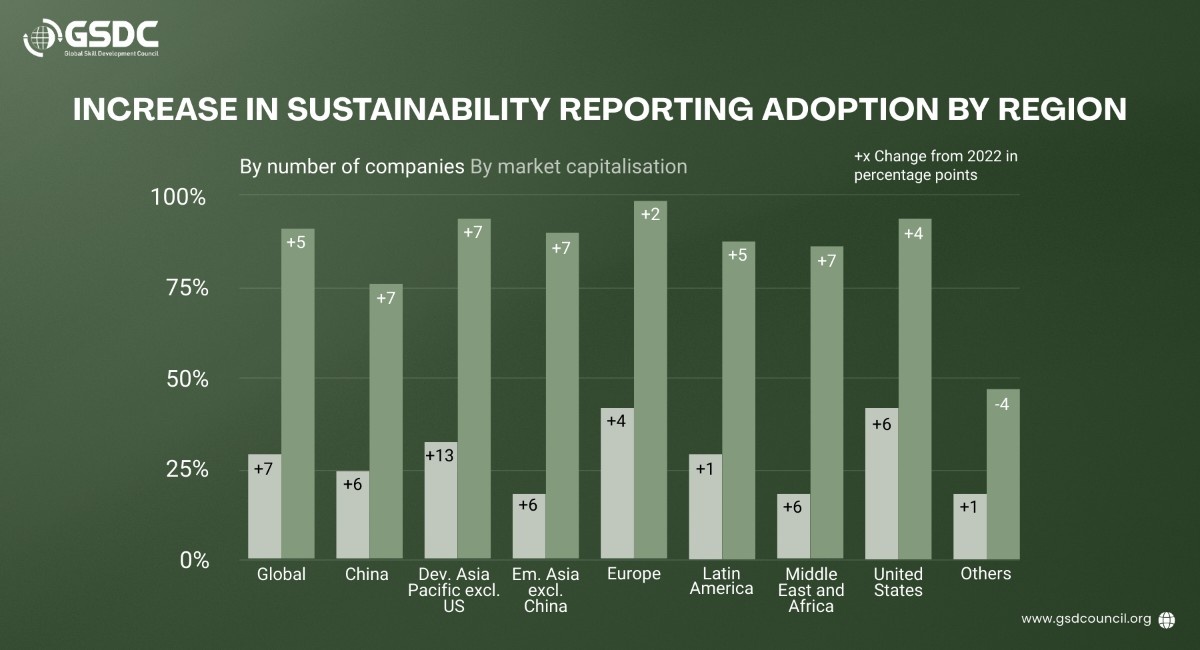
With 91% of companies by global market capitalisation now disclosing sustainability information and around 90% of S&P 500 companies publishing ESG or sustainability reports, reporting has become mainstream. High sustainability reports are essential for strong sustainability reporting, enabling an organisation to comply with regulations, win investor trust, and ultimately record high levels of sustainability reporting as one of the biggest industry trends currently.
2. Clean Energy Fuels Sustainable Growth
Clean energy adoption is one of the most visible sustainability examples across industries and a core driver of sustainable business growth strategies.
In 2026, businesses are:
- Investing in solar and wind power
- Signing long-term renewable energy contracts
- Improving energy efficiency across facilities and data centres
With global clean energy investment exceeding USD 2.1 trillion, clean energy is no longer just an environmental commitment; it is a strategic business advantage. Organisations are reducing operating costs, improving energy security, and embedding clean energy into their sustainability business strategy to strengthen competitiveness and resilience.
The ability to design and launch clean energy projects is perhaps now more vital than ever. Learning paths and the Certified Sustainability Professional credential could help professionals carry out these transitions smoothly and effectively.
3. Nature and Biodiversity Are Entering Business Strategy
Businesses are increasingly recognising that current sustainability issues, such as deforestation, water stress, and biodiversity loss, pose direct operational and supply chain risks. Nature protection is becoming part of core business planning.
In 2026, businesses are:
- Assessing environmental impacts across operations and supply chains
- Managing risks related to water use and land use
- Integrating nature protection into a sustainability business strategy
This marks a shift in what is sustainability in business, moving beyond carbon alone to include broader ecosystem protection and nature-positive outcomes. Organisations are aligning with global initiatives and frameworks to embed nature considerations into strategy, disclosures, and long-term growth planning.
4. Climate Risk Is Being Treated as a Business Risk
Climate risk is no longer a specialised risk within the broader realm of sustainability; it’s a business issue that impacts strategy and the bottom line. Leaders are feeling the business impacts, both from physical impacts and the stress of a transition to a low-carbon economy, such that climate risk has become a tangible risk to the business.
In 2026, businesses are:
- The incorporation of climate risks into their Enterprise Risk Management frameworks
- Determining the financial outlays associated with physical impacts as well as transitions
- Enhancing infrastructure and building operational resilience
In other words, climate risk is being integrated into business strategy and financial planning, as opposed to being held as a standalone sustainability agenda. This represents an important shift in how business approaches sustainability: prioritising business resilience and continuity, and value creation in a low-carbon world.
5. Adaptation Is Becoming a Business Priority
Adaptation is going up the ladder to become a top business priority item. No longer are companies just trying to reduce greenhouse gas emissions; they are hardwiring adaptation into the DNA of business operations. Climate adaptation has become a key component of business continuity planning.
In 2026, businesses are:
- Shielding facilities from extreme weather
- Keeping employees safe during a heatwave
- Construction of more resilient and diverse supply chains
- Weaving integration of adaptation into risk management and continuity planning
These moves illustrate the relevance of sustainability to operational resilience, the workforce, and long-term stability. Thus, adaptation is not just about keeping up; it can also help limit the disruption, preserve the assets, and uncover the new opportunity, whether it is related to innovation or stability and resilience itself.
As these capabilities evolve within organisations, practical frameworks, tools, and professional development opportunities - such as those offered by the Global Skill Development Council (GSDC) - support the enhancement of team preparedness to both plan for and respond to climate-related events.
6. Carbon Markets Are Gaining Credibility
Carbon markets have been evolving with the increasing scrutiny and the upgrade of the standards. Companies are now more strategic and careful in the use of carbon credits.
In 2026, businesses are:
- Focusing on carbon credits that are of high quality and can be verified
- Asking for greater transparency and long-term environmental benefits
- Using carbon credits as a complement to direct emissions reduction efforts
Global carbon markets have already topped USD 114 billion, and carbon pricing currently covers a significant proportion of global emissions. Credibility and accountability are becoming indispensable. This situation demonstrates how sustainability market trends are changing, where carbon markets are a tool for, but not a substitute for, corporate decarbonisation strategies.
7. AI Is Transforming Sustainability Work
Technology involving artificial intelligence is altering the manner of operation of various groups of sustainability professionals. It improves quality, accelerates work, and enhances understanding, thus affecting various sustainable sustainability jobs.
In 2026, businesses are:
- Automating data collection for sustainability reports
- Identifying data gaps and reporting errors
- Using AI for scenario analysis and forecasting
- Applying predictive modelling for resource use and environmental risk
As sustainability becomes more data-driven, demand for digitally skilled professionals in sustainability jobs continues to grow. AI enables teams to move beyond manual reporting and focus on strategy, stakeholder engagement, and long-term value creation.
8. Supply Chain Sustainability Is a Strategic Focus
Supply chains account for a significant share of environmental impact, making supply chain sustainability central to effective sustainability business strategy.
In 2026, businesses are:
- Working with suppliers to reduce emissions and resource use
- Sharing tools, frameworks, and best practices
- Building long-term partnerships to improve transparency
Organisations increasingly recognise that sustainability goals cannot be achieved in isolation. Strong supplier collaboration improves resilience, reduces risk exposure, and strengthens stakeholder trust, aligning closely with leading sustainability trends in business and long-term value creation.
What This Means for Businesses in 2026
The sustainability trends shaping 2026 make one thing clear: sustainability is no longer separate from business performance; it is a driver of competitiveness and resilience. Organisations that lead in sustainability are turning strategy into action by:
- Using sustainability reports to guide real-time decision-making
- Applying sustainability examples across energy, operations, and supply chains
- Aligning sustainability with long-term growth and risk management
- Creating meaningful sustainability jobs and clear career pathways
- Investing in training and sustainability certification to build internal capability
Ultimately, understanding what is sustainability and what is sustainability in business means recognising that sustainable practices now directly support resilience, cost control, reputation, and long-term growth. Organisations that embed sustainability into core strategy will be better positioned to navigate regulatory pressure, shifting market dynamics, and rising stakeholder expectations in 2026 and beyond.
Empowering Business Towards Sustainability with GSDC Certification
The Global Skill Development Council prepares professionals and organisations for hands-on sustainability competencies with the Certified Sustainability Professional Program. This highly sought-after certification weaves together current sustainability theory and leading real-world applications to facilitate learners in backing up credible sustainability reporting and reinforcing their business strategies, given evolving trends in sustainability and market expectations.
Conclusion
In 2026, sustainability in business is defined by real action, not just intent. As environmental and regulatory pressures grow, organisations are embedding sustainability into everyday decision-making through clearer strategies and more transparent reporting. The leading trends show why sustainability now plays a critical role in managing risk, building resilience, and supporting long-term growth.
Companies that invest in the right skills, tools, and professional development will be better positioned to strengthen internal capability, create meaningful career pathways, and scale sustainable growth across their operations and value chains.

Related Certifications
Stay up-to-date with the latest news, trends, and resources in GSDC
If you like this read then make sure to check out our previous blogs: Cracking Onboarding Challenges: Fresher Success Unveiled
Not sure which certification to pursue? Our advisors will help you decide!