Performance Appraisal: The Complete HR Guide for Managers and Teams
Written by Matthew Hale
- What Is a Performance Appraisal?
- Why Performance Appraisals Matter in Human Resources
- Types of Performance Appraisal Methods
- Best Practices for Effective Performance Appraisals
- How to Create an Effective Performance Appraisal Form
- Performance Appraisal Examples
- Turning Performance Appraisals into Career-Defining HR Skills
- Conclusion
- FAQs
When companies like Amazon ask employees to clearly list their achievements during performance reviews, it sends a clear message - performance appraisals are no longer just about ratings, they are about real results. Other organisations are also changing how they reward top performers, making reviews more meaningful and practical.
For anyone wondering what does HR do or what does human resources do beyond hiring, this change explains it well. Modern appraisals show how HR connects employee performance with business goals.
This blog works as an easy HR guide for understanding today’s appraisal systems and is part of the ultimate guide to human resources for building strong, high-performing teams.
What Is a Performance Appraisal?
A performance appraisal is a planned review of how well an employee has worked over a certain time. It looks at what the employee has done well, where they can improve, and how their work supports company goals. This process clearly shows what is human resources management in real working environments.
Most organisations conduct performance appraisals once or twice a year. These reviews are a key part of the HR employee handbook and play an important role in career growth across human resources jobs and leadership development.
Why Performance Appraisals Matter in Human Resources
Performance reviews should not be seen only as routine HR processes. Besides they have a power to influence company culture, employee development, and retention. If you, as a leader, look for the straightforward HR advice that managers can get, take a look at what real difference appraisals make:
- Identify Strengths and Development Needs: Appraisals are helpful in revealing employees' strengths and weaknesses. However, only about 14% of employees are inspired to change their behavior after a conventional review, which is why modern, developmental feedback is all the more crucial.
- Enable Career Growth: Helpful feedback supports promotions and learning. Organisations using continuous feedback models report up to 40% higher engagement and 26% better overall performance.
- Strengthen Engagement: Employees who receive regular feedback are four times more likely to be highly engaged than those who do not.
- Improve Manager–Employee Communication: Performance reviews create space for honest conversations and reflect what frameworks guide HR in daily operations. Still, fewer than 30% of managers feel fully engaged at work, highlighting the need for better dialogue.
- Support Compliance and Fairness: A clear and documented appraisal process is a key part of every organisation’s HR compliance guide. Nearly all organisations recognise performance management as critical to business success, proving how central appraisals are to HR strategy.
To build these skills in practice, many HR professionals choose structured learning programs offered by the Global Skill Development Council, which focus on strengthening performance management, leadership capability, and modern HR practices.
Types of Performance Appraisal Methods
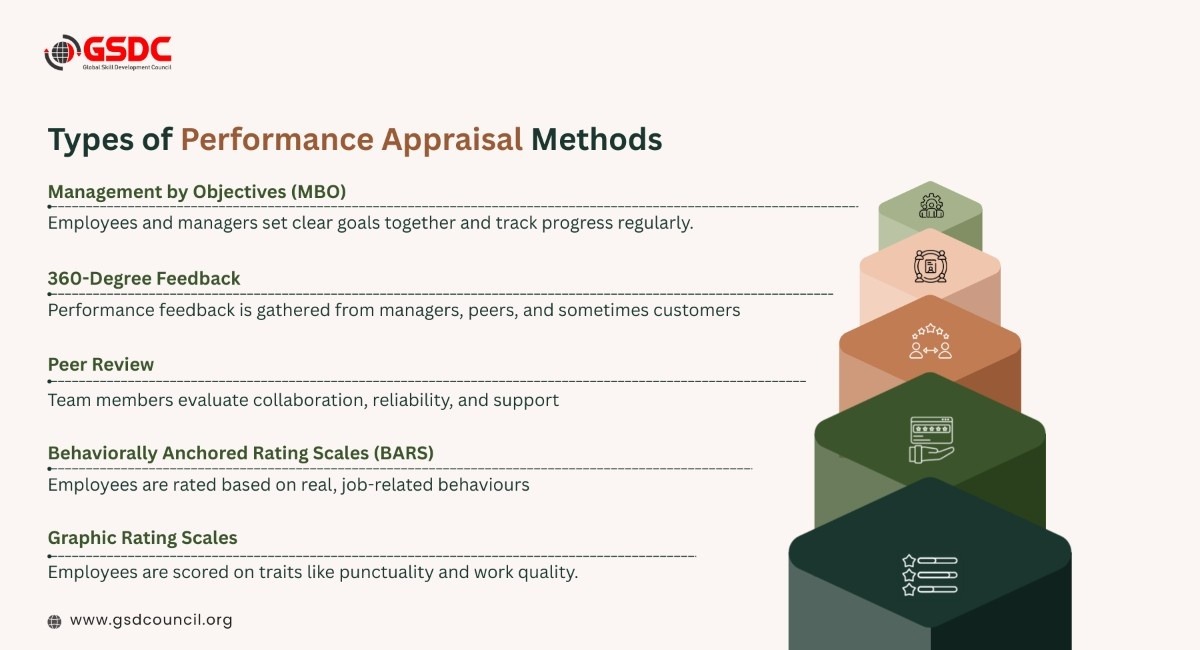
There is no one perfect method for every organisation. Most HR teams use different approaches based on team size, company culture, and business goals.
- Management by Objectives (MBO): During a performance review cycle, both employees and managers, first of all, agree on the objectives, then they monitor the progress on a regular basis.
Example: Improve customer response time by 20% over the next three months.
- 360-Degree Feedback: To get a thorough performance preview, feedback is solicited from co-workers, superiors, and occasionally, customers as well.
Example: Team members recognize excellent teamwork but recommend clearer communication.
- Peer Review: Team members share feedback on teamwork, reliability, and support.
Example: Colleagues note that the employee consistently supports others during project deadlines.
- Behaviorally Anchored Rating Scales (BARS): Performance is rated based on specific job-related behaviours rather than vague scores.
Example: Rating 5 – Proactively mentors team members.
Rating 2 - Requires reminders before completing tasks.
- Graphic Rating Scales: Such are the scales on which employees are rated on qualities like punctuality, work quality, and responsibility.
Example:Punctuality rated as Excellent because of no late arrivals.
Together, these methods clearly explain what frameworks guide HR teams around the world when building reliable performance appraisal systems.
Best Practices for Effective Performance Appraisals
To make performance reviews truly useful, HR leaders need to go beyond basic checklists and focus on clarity, fairness, and growth.
- Set clear expectations: Outline job responsibilities, goals, and performance standards clearly in the HR employee handbook so employees know what success looks like from day one.
- Document every review: Maintain written records of discussions, ratings, and action plans to meet audit requirements and follow your organisation’s HR compliance guide.
- Encourage open discussions: Use simple question frameworks and structured feedback formats as part of your HR guidance for managers, ensuring that reviews feel supportive rather than stressful.
- Focus on development: Shift the conversation from “what went wrong” to “how can we improve,” helping employees build skills and confidence.
- Check in regularly: Schedule quarterly or monthly touchpoints aligned with clear HR guidelines for employees so feedback becomes a continuous habit instead of a yearly event.
How to Create an Effective Performance Appraisal Form
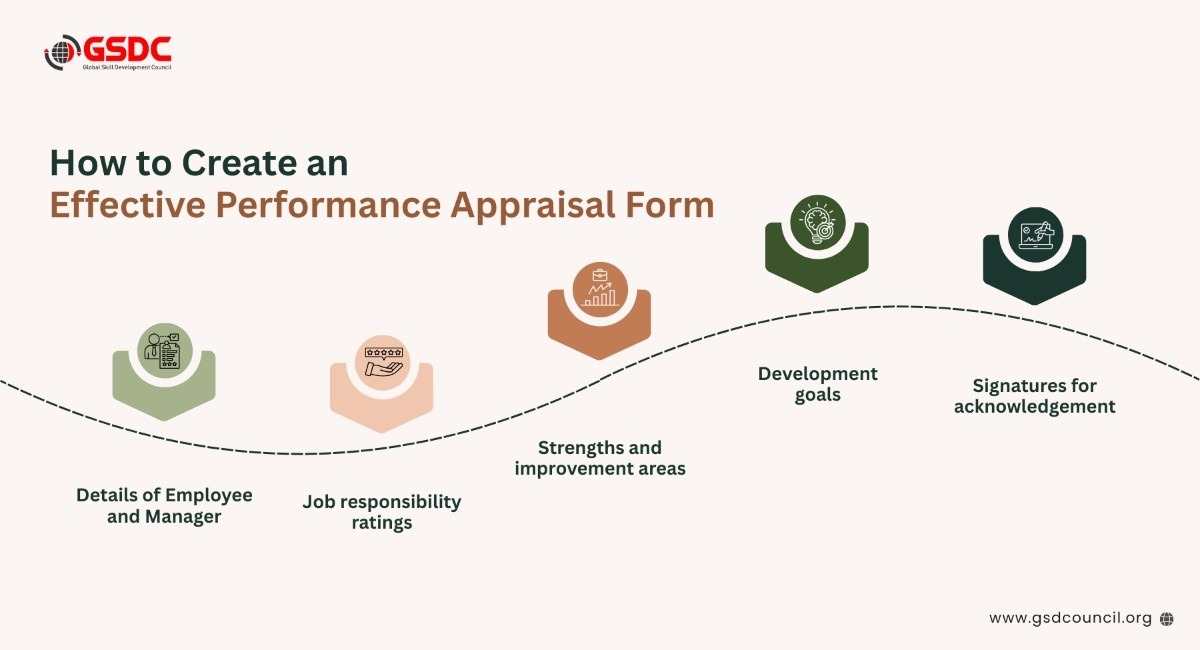
A solid performance appraisal form shouldn't be just another piece of paperwork it should be the medium through which engaging and productive conversations between managers and employees are conducted.
It should include:
- Details of Employee and Manager: It is necessary that there is a record of an employee’s role, department, review cycle, and manager in order to have an organised system of employee details.
- Job responsibility ratings: Identify the key work areas and skills such as teamwork, problem-solving, communication, quality of work, and reliability. Employ a straightforward scale (e. g. , Needs Improvement, Meets Expectations, Exceeds Expectations).
- Strengths and improvement areas: Give managers enough room to and encourage them to provide explanations of the ratings they have given. This will also allow employees to recognize the areas where they perform well and the areas where they are in need of support.
- Development goals: Set both short-term and long-term goals, for instance, finishing a course, honing a skill, or assuming new duties. In this way, performance evaluations will be oriented towards the future, rather than solely reflecting the past.
- Signatures for acknowledgement: Add a section for both employee and manager to confirm that the discussion took place and that expectations are clear.
When used consistently, this format improves transparency, supports career growth, and meets your organisation’s HR compliance guide requirements. Many professionals strengthen their skills in designing such systems through the Certified Human Resources (HR) Professional Certification.
Performance Appraisal Examples
Clear examples make it much easier for managers to provide equitable feedback and for employees to comprehend what is expected.
Punctuality
- Positive: Always meets deadlines, is on time for meetings, turns in work beforehand, and organises the task schedule so that the deadline is not the final minute for the task’s completion.
- Negative: Often late for meetings and fails to meet deadlines without a reminder to complete tasks on schedule.
Communication
- Positive: Shares updates with the team, listens carefully, reacts to emails and messages in a timely manner, and shares ideas in an understandable manner.
- Negative: Transmission of vague or unclear data, delayed response, shying away from inconvenient discussions, and confusion leading to slowing down team development.
If you’re updating your HR compliance guide or redesigning your appraisal process, this is the right time to move beyond outdated templates and adopt modern performance frameworks.
Turning Performance Appraisals into Career-Defining HR Skills
Modern performance management is no longer just an HR task - it is a strategic capability. The GSDC (Global Skill Development Council) focuses on building this capability through globally recognised learning pathways.
The Certified Human Resources (HR) Professional Certification equips professionals to design appraisal systems that balance business goals with employee growth. Instead of relying on outdated templates, learners gain the confidence to create fair review processes, structured feedback models, and development-focused performance frameworks that organisations can trust.

Conclusion
Performance appraisals are more than just paperwork; they are an integral ingredient in the development of organisations and their employees too. They illustrate very effectively what HR does in day-to-day operations and also illustrate human resources management in action.
For professionals planning long-term careers, understanding this process is essential - whether you are exploring human resources jobs, thinking about is human resources a good career, or building skills through a recognised human resources certification.
When done with purpose and care, performance appraisals become the foundation of a high-trust, high-performance workplace.
FAQs
- What does HR do in the performance appraisal process?
HR designs the performance review framework, updates the HR employee handbook, trains managers using clear HR guidance for managers, and ensures fairness through the organisation’s HR compliance guide.
- What does human resources do beyond hiring?
Beyond recruitment, HR manages performance systems, employee development, workplace policies, and engagement strategies. This shows clearly what does human resources do in everyday operations.
- What frameworks guide HR in performance management?
Common methods include Management by Objectives (MBO), 360-degree feedback, peer review systems, BARS, and graphic rating scales. These approaches explain what frameworks guide HR teams globally.
- What is human resources management in simple words?
It is the process of managing people in an organisation - including hiring, training, performance appraisals, employee support, and compliance. This is what is human resources management in practice.
- Is human resources a good career today?
Yes. With the growing focus on people strategy, engagement, and compliance, many professionals are finding that is human resources a good career with strong long-term growth.
- How do performance appraisals support human resources jobs?
They help HR professionals build skills in leadership development, feedback systems, and employee engagement - all key areas in modern human resources jobs.
- Do I need a human resources certification to work in HR?
While not always mandatory, a recognised human resources certification helps professionals gain practical knowledge, credibility, and career confidence in HR roles.

Related Certifications
Stay up-to-date with the latest news, trends, and resources in GSDC
If you like this read then make sure to check out our previous blogs: Cracking Onboarding Challenges: Fresher Success Unveiled
Not sure which certification to pursue? Our advisors will help you decide!