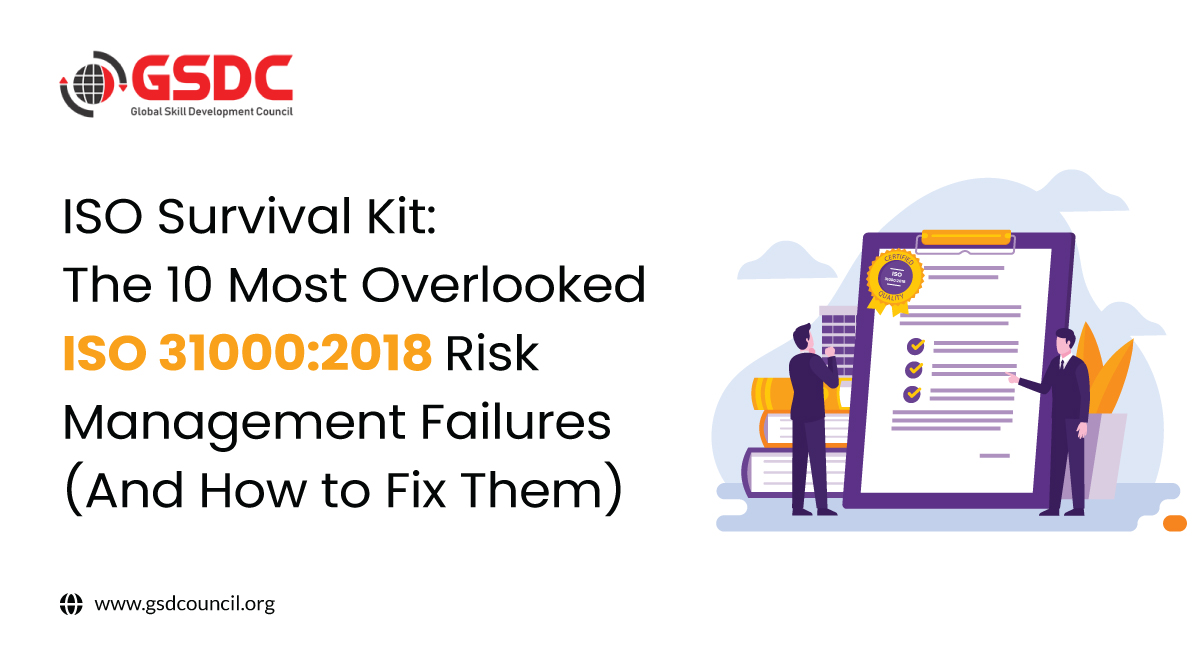
ISO Survival Kit: The 10 Most Overlooked ISO 31000:2018 Risk Management Failures (And How to Fix Them)
Written by Matthew Hale
Welcome to the ISO Survival Kit. The blog series by the experts is aimed at an organization to help them know the audit risks, avoid the non-conformities, and strengthen compliance.
In this edition, we will be dealing with ISO 31000:2018, which is the global standard for enterprise risk management. It serves to prepare you for ISO 31000 certification or a formal ISO 31000 audit or simply to further your strategy for risk - it will uncover for you what many often leave unexamined.
Unlike rigid compliance standards, the ISO 31000 framework 2018 is principle-based - flexible by design but also prone to inconsistent application. A risk framework should do more than satisfy a checklist - it should drive smarter decisions, improve resilience, and support long-term growth.
We identified, based on auditor insight, interaction with practitioners, and real-world gaps found through our ISO 31000 audit checklist reviews, the most ignored failures in risk management systems to help strengthen your own system.
10 Most Overlooked ISO 31000:2018 Risk Management Failures
1. No Formalized Risk Criteria or Evaluation Methodology
📌 Clause: 6.3.3 – Risk Analysis
What’s going wrong:
In many organizations, risk assessments are informal — based on gut instinct, previous experience, or departmental opinion. There’s no consistent structure for evaluating the likelihood or impact of risk events, leading to skewed risk profiles and poor prioritization.
Why it matters during an ISO 31000 audit:
A key principle of the ISO 31000 framework 2018 is structured, evidence-based decision-making. Auditors expect a documented and repeatable method for risk evaluation that removes subjectivity and creates consistency across teams.
How to fix it:
✔ Create a standardized risk matrix, defining clear scales for impact (e.g., financial loss, reputational damage) and likelihood (e.g., rare to almost certain).
✔ Train stakeholders on how to apply the matrix uniformly.
✔ Document risk ratings and rationales in your risk register.
✔ Integrate your methodology into your ISO 31000 audit checklist for consistent internal review.
Real-world result:
Organizations that apply a structured risk evaluation process can compare risks more accurately across departments, leading to smarter decisions and stronger audit performance.
2. No Documented Risk Appetite or Tolerance Statement
📌 Clause: 5.4 – Integration and Alignment
What’s going wrong:
While leadership may understand which risks are acceptable and which aren’t, that understanding is rarely formalized — especially for different risk categories (strategic, operational, compliance, etc.). This causes teams to either overreact to minor risks or ignore
serious ones.
Why it matters during an audit:
The auditors require insight into whether the organization has defined risk levels against which tolerability can be gauged-and and acted upon. Without a defined risk appetite, auditors may raise governance deficiencies in risk escalation and control selection.
How to fix it:
✔ Facilitate workshops with leadership to define risk appetite by category (e.g., "we tolerate low financial risk but no reputational risk").
✔ Develop a formal risk appetite statement and circulate it organization-wide.
✔ Use risk tolerance thresholds to guide acceptance or treatment strategies.
✔ Revisit these thresholds annually or when major changes occur.
Real-world result:
Clear risk appetite statements empower decision-makers to take calculated risks and avoid unnecessary bureaucracy — all while staying aligned with executive direction.
3. Risk Management Not Embedded into Decision-Making Processes
 📌 Clause: 5.3 – Integration into Organizational Processes
What’s going wrong:
In many cases, risk management is a parallel process — not one that influences how budgets are set, projects are approved, or vendors are selected. It becomes reactive, not proactive.
Why it matters during an ISO 31000 audit:
The ISO 31000 framework 2018 demands that risk management be part of the organization’s governance and operations, not an isolated compliance function.
How to fix it:
✔ Include risk assessments in project initiation, procurement, and strategic planning templates.
✔ Require documented risk evaluations for all high-value or high-impact decisions.
✔ Link identified risks to decisions (e.g., "This vendor was chosen despite moderate cyber risk because…") and document mitigation steps.
Real-world result:
When risk management is embedded, organizations reduce costly oversights and improve the quality and agility of strategic decisions.
4. No Mechanism for Monitoring Risk Treatment Plans
📌 Clause: 6.5 – Risk Treatment
What’s going wrong:
Teams often assign treatment actions (like “implement MFA” or “review vendor contracts”) without timelines, owners, or performance indicators. As a result, actions are delayed or forgotten, leaving risk exposures open.
Why it matters during an ISO 31000 audit:
Auditors will look for evidence that risk treatments are being executed, monitored, and reviewed for effectiveness. It’s not enough to plan — you have to prove follow-through.
How to fix it:
✔ Assign a responsible owner and deadline for every treatment action.
✔ Track progress in a centralized dashboard or spreadsheet.
✔ Include treatment updates in monthly or quarterly risk committee reviews.
✔ Add progress checks to your ISO 31000 audit checklist.
Real-world result:
Organizations with strong treatment tracking reduce their exposure window, improve accountability, and demonstrate maturity during audits and executive reviews.
5. No Structured Review or Update of the Risk Register
📌 Clause: 6.6 – Monitoring and Review
What’s going wrong:
Many companies develop a risk register once during an implementation or audit and never update it. Meanwhile, the business changes, the environment shifts, and new risks emerge. a gap that a structured program covering risk register template best practices and ongoing review cycles can decisively close.
Why it matters during an ISO 31000 certification or audit process:
A static risk register signals a stagnant risk culture. Auditors need to see a living risk register — reviewed regularly, updated after incidents, and responsive to change.
How to fix it:
✔ Set a formal review schedule (e.g., quarterly) to reassess existing risks.
✔ Trigger unscheduled reviews after key events (e.g., cyber breach, M&A, regulation change).
✔ Log all changes to maintain an audit trail.
✔ Involve cross-functional risk owners in each review cycle.
Real-world result:
An up-to-date, dynamic risk register becomes a strategic tool — not just a compliance artifact — and significantly boosts audit confidence.
Download the ISO 31000 Audit Checklist & Risk Assessment Toolkit
To help you close these gaps, we’ve built a ready-to-use ISO 31000 audit checklist and aligned risk assessment template based on real-world audit findings and ISO 31000:2018 best practices.
✅ Score and prioritize risks consistently
✅ Track treatment plans with accountability
✅ Align your program with the full ISO 31000 framework 2018
✅ Stay prepared for internal reviews and ISO 31000 audits
Strengthening Your ISO 31000 Risk Management Framework
Strengthening your ISO 31000:2018 risk management framework is about much more than being ready for audits: It is about embedding resilience into the very fabric of your organization.
You will garner greater improvement in alignment with the ISO 31000 framework 2018 and enhanced capacity for anticipating, responding to, and recovering from uncertainty, simply by addressing these common nonconformities: embedment of resilience within the organization itself.
Proactive risk culture, well-documented processes, structured evaluation, and continuous monitoring together transform risk management from a compliance obligation into an enabling strategic activity.
These improvements would certainly maximize the assurance that your framework will provide for the long haul, whether preparing for an ISO 31000 audit, improving internal controls, or working towards ISO 31000 certification alignment.

Related Certifications
Stay up-to-date with the latest news, trends, and resources in GSDC
If you like this read then make sure to check out our previous blogs: Cracking Onboarding Challenges: Fresher Success Unveiled
Not sure which certification to pursue? Our advisors will help you decide!