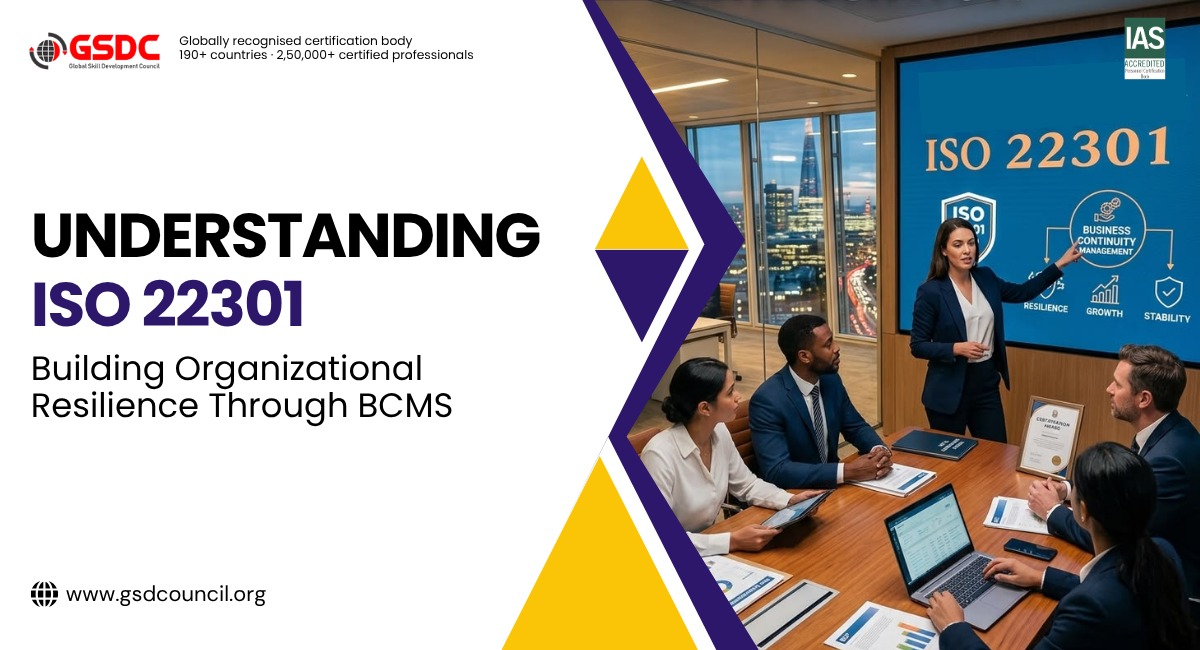
Understanding ISO 22301: Building Organizational Resilience Through BCMS
Written by Daman Dev Sood
- Organizations Rarely Fail Because of a Crisis
- The Real Challenge Is Operational Continuity
- Why Continuity Matters More Than Avoidance
- Understanding Organizational Resilience
- Why Disruptions Are No Longer Rare Events
- Business Continuity Management: The Foundation of Resilience
- Understanding BCMS and ISO 22301
- Building Organizational Resilience Through Integration
- The Critical Role of Crisis Communication
- Creating a Culture of Continual Improvement
- How GSDC’s ISO 22301 Lead Auditor Certification Helps You Build Audit Expertise?
- Conclusion
A cyberattack shuts down critical systems. A key supplier suddenly becomes unavailable. Severe weather disrupts operations across multiple locations. While the causes may differ, the outcome is often the same: organizations are forced to answer a critical question-can they continue operating when disruption occurs?
In today's interconnected business environment, disruptions are no longer rare events. They can emerge from technology failures, supply chain challenges, cybersecurity incidents, regulatory changes, or external events beyond an organization's control. The organizations that succeed are not necessarily those that avoid disruptions altogether, but those that are prepared to respond, adapt, and recover effectively.
This is where organizational resilience becomes a strategic priority. Resilience enables organizations to continue delivering value during uncertainty, protect stakeholder confidence, and recover stronger from challenging situations. Business Continuity Management (BCM) plays a central role in building this capability by ensuring critical operations can continue even when normal business conditions are disrupted.
Organizations Rarely Fail Because of a Crisis
Many organizations invest significant resources in preventing disruptions, and prevention remains an important part of risk management. However, experience shows that organizations rarely fail simply because a crisis occurs.
The Real Challenge Is Operational Continuity
What often creates lasting damage is the inability to continue critical operations once a disruption begins.
Customers still expect products and services. Employees still require guidance and support. Suppliers, partners, and regulators continue to have expectations. When organizations cannot maintain these essential activities, the operational and financial consequences can escalate rapidly.
Why Continuity Matters More Than Avoidance
This is why resilience focuses on continuity rather than avoidance. While organizations should work to reduce risks wherever possible, they must also develop the capability to operate effectively when disruptions occur.
The ability to maintain critical functions during challenging circumstances is often what separates resilient organizations from vulnerable ones.
Understanding Organizational Resilience
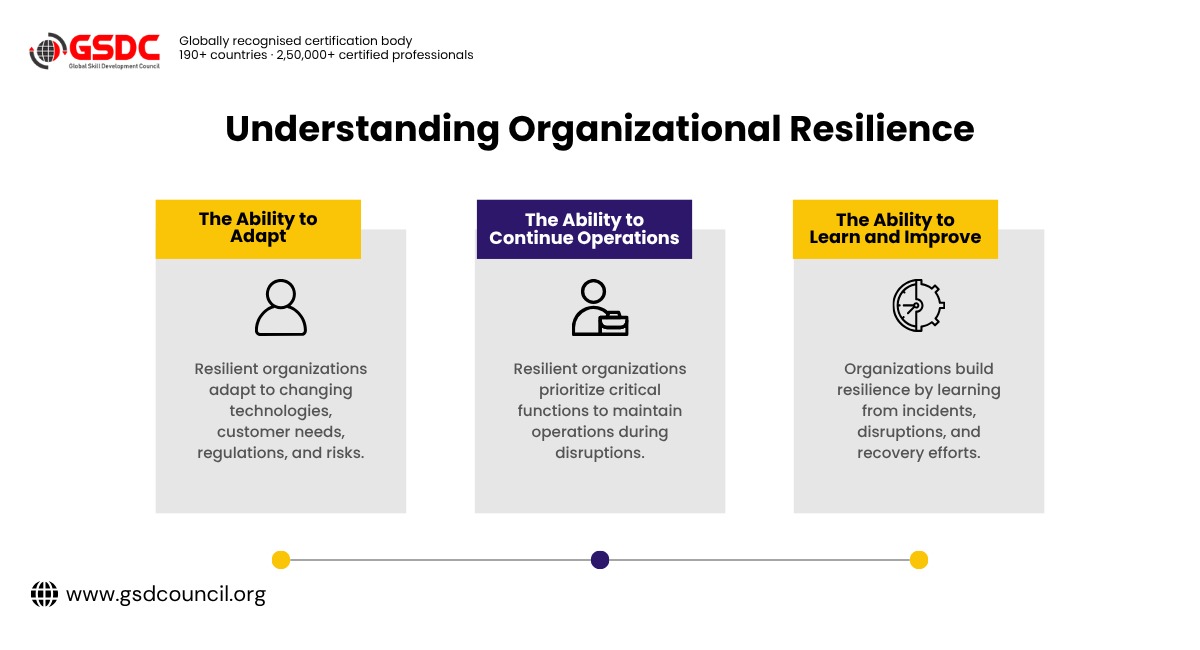
Organizational resilience is often defined as the ability to absorb and adapt in a changing environment while continuing to achieve business objectives. However, resilience extends beyond simply recovering from a disruption.
The Ability to Adapt
Business environments are constantly evolving. New technologies emerge, customer expectations shift, regulations change, and risks continue to develop. Resilient organizations recognize that adaptability is essential for long-term success.
Rather than relying solely on fixed processes and assumptions, they continuously evaluate their operating environment and adjust strategies when necessary.
The Ability to Continue Operations
A resilient organization understands which products, services, and activities are most critical to its success. When disruptions occur, these critical functions remain the priority.
Maintaining operational continuity helps reduce financial losses, protect customer relationships, and preserve stakeholder confidence during uncertain periods.
The Ability to Learn and Improve
Resilience is not built through a single project or certification effort. It develops through continuous learning.
Organizations that review incidents, analyze disruptions, and apply lessons learned are often better prepared for future challenges. Every exercise, disruption, and recovery effort provides opportunities to strengthen resilience capabilities.
Why Disruptions Are No Longer Rare Events
Organizations today face risks from multiple directions, making resilience more important than ever.
Cybersecurity and Technology Risks
Cyberattacks, ransomware incidents, data breaches, and technology outages continue to disrupt organizations across industries. As businesses become increasingly dependent on digital infrastructure, technology-related disruptions can affect operations within minutes.
Supply Chain and Operational Challenges
Modern organizations rely on extensive networks of suppliers, contractors, logistics providers, and service partners. A disruption affecting one part of the supply chain can quickly impact business operations elsewhere.
Climate and Geopolitical Uncertainty
Extreme weather events, energy shortages, geopolitical tensions, and global conflicts continue to create operational uncertainty. Many of these risks originate outside an organization's direct control, making preparedness essential.
Business Continuity Management: The Foundation of Resilience
Organizations today face risks from multiple directions, making resilience more important than ever.
Cybersecurity and Technology Risks
Cyberattacks, ransomware incidents, data breaches, and technology outages continue to disrupt organizations across industries. As businesses become increasingly dependent on digital infrastructure, technology-related disruptions can affect operations within minutes.
Supply Chain and Operational Challenges
Modern organizations rely on extensive networks of suppliers, contractors, logistics providers, and service partners. A disruption affecting one part of the supply chain can quickly impact business operations elsewhere.
Climate and Geopolitical Uncertainty
Extreme weather events, energy shortages, geopolitical tensions, and global conflicts continue to create operational uncertainty. Many of these risks originate outside an organization's direct control, making preparedness essential.
Business Continuity Management: The Foundation of Resilience
Business Continuity Management is one of the most important contributors to organizational resilience.
Identifying Critical Activities
BCM helps organizations identify the processes, services, resources, and dependencies that are essential for maintaining operations during a disruption.
This understanding enables leaders to prioritize recovery efforts and allocate resources more effectively.
Preparing Before a Crisis Occurs
One of the core principles of BCM is proactive preparation. Effective continuity planning takes place before an incident occurs, not during one.
Organizations assess risks, identify vulnerabilities, establish recovery priorities, and develop response strategies while operating under normal conditions.
Supporting Recovery and Continuity
When disruptions occur, BCM provides a structured framework for maintaining operations and restoring services. This reduces uncertainty and helps organizations recover more efficiently.
BCM Focus Area | Objective |
Identify Critical Activities | Understand essential operations |
Assess Risks and Impacts | Evaluate disruption consequences |
Develop Recovery Strategies | Maintain continuity during disruptions |
Test and Improve | Strengthen preparedness over time |
Understanding BCMS and ISO 22301
As organizations mature their continuity programs, many establish a Business Continuity Management System (BCMS).
A BCMS provides a structured framework for managing continuity activities across the organization. It includes governance structures, policies, procedures, continuity plans, testing activities, and continual improvement mechanisms.
ISO 22301 serves as the internationally recognized standard for Business Continuity Management Systems. It provides organizations with a systematic approach for identifying critical processes, understanding potential impacts, developing recovery capabilities, and maintaining preparedness over time.
The true value of a BCMS is not the documentation it produces but the capability it creates. Effective continuity programs ensure organizations can respond confidently and consistently when disruptions occur.
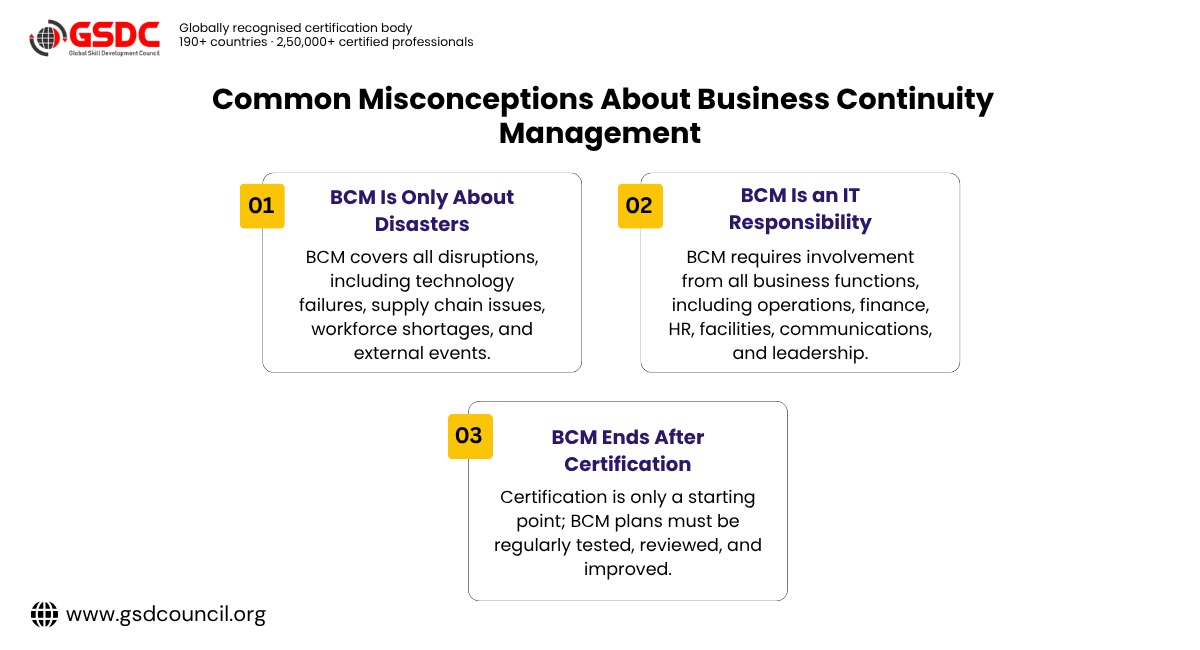
Building Organizational Resilience Through Integration
Resilience is most effective when it is integrated across the organization rather than managed in isolation.
Management System | Contribution to Resilience |
ISO 9001 | Process quality and operational consistency |
ISO 14001 | Environmental preparedness and response |
ISO 27001 | Information security and cyber resilience |
ISO 45001 | Employee health and safety |
ISO 22301 | Business continuity and recovery capability |
When these disciplines work together, organizations gain a more comprehensive approach to risk management, operational stability, and long-term resilience.
The Critical Role of Crisis Communication
Even the most effective continuity plans can struggle without clear communication.
Delivering Accurate Information
Employees, customers, suppliers, and stakeholders need timely and accurate information during disruptions. Clear communication reduces uncertainty and supports informed decision-making.
Maintaining Stakeholder Confidence
Organizations that communicate openly and consistently during challenging situations are often better positioned to maintain trust and credibility.
Supporting Faster Recovery
Effective communication improves coordination, reduces confusion, and helps recovery efforts progress more efficiently.
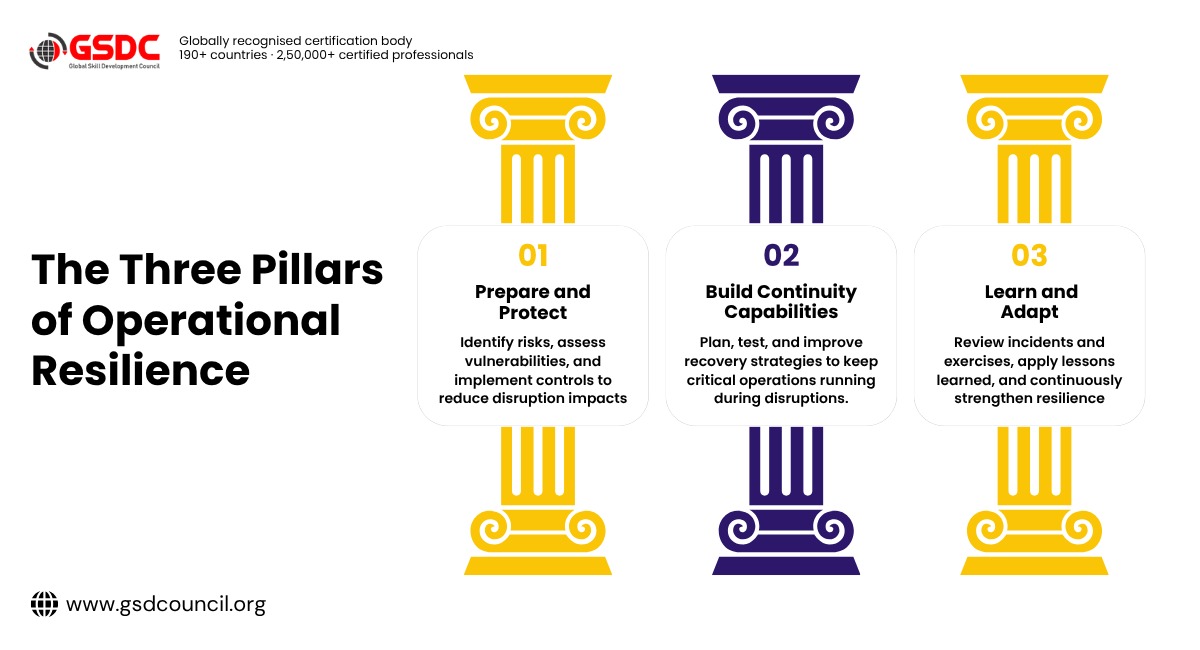
Creating a Culture of Continual Improvement
Resilience is not a destination. It is an ongoing organizational capability.
Organizations should regularly test continuity plans, conduct exercises, review recovery arrangements, and evaluate performance. These activities help identify weaknesses before they become significant problems.
A culture of continual improvement ensures resilience capabilities evolve alongside changing risks, technologies, and business requirements. Organizations that continuously learn and adapt are generally better prepared to navigate uncertainty and maintain operational stability.
How GSDC’s ISO 22301 Lead Auditor Certification Helps You Build Audit Expertise?
GSDC’s Certified ISO 22301 Lead Auditor Certification helps professionals build a strong understanding of auditing Business Continuity Management Systems (BCMS) in line with ISO 22301:2019.
The Certified ISO 22301 Lead Auditor Certification program focuses on audit planning, business impact analysis, risk assessment, identifying non-conformities, and evaluating business continuity controls. It helps learners understand how to assess continuity plans, review processes, and determine whether an organization is prepared to manage disruptions effectively.
Designed for auditors, risk managers, compliance professionals, and business continuity specialists, this certification can strengthen auditing skills, improve knowledge of business continuity requirements, and support efforts to build organizational resilience.
Conclusion
In an environment where disruption has become a business reality, resilience is no longer a competitive advantage-it is a business necessity.
Organizations cannot prevent every cyberattack, supply chain interruption, technology failure, or external crisis. What they can do is prepare for uncertainty and develop the capability to continue operating when disruptions occur.
Business Continuity Management provides the structure, discipline, and preparedness needed to build that capability. Through effective planning, testing, communication, and continual improvement, organizations can protect critical operations, maintain stakeholder confidence, and recover more effectively from unexpected events.
The organizations that thrive in the future will not be those that avoid disruption altogether. They will be the ones that are prepared to adapt, respond, and emerge stronger when challenges arise.

Related Certifications
Stay up-to-date with the latest news, trends, and resources in GSDC
If you like this read then make sure to check out our previous blogs: Cracking Onboarding Challenges: Fresher Success Unveiled
Not sure which certification to pursue? Our advisors will help you decide!