Establishing Responsible AI Practices in Financial Services with ISO 42001
Written by Luv Johar
Financial institutions across the world are racing to adopt artificial intelligence for fraud detection, credit scoring, customer service, and risk modeling. But as AI systems take on more decision-making power, banks and NBFCs face a growing challenge: how do you deploy AI that is trustworthy, fair, and compliant with an expanding web of regulations?
This was the central theme of a recent webinar, "Establishing Responsible AI Practices in Financial Services with ISO 42001," led by AI governance expert Lov Johar. The session unpacked how the ISO 42001 AI management system gives financial organizations a structured way to establish ISO 42001 AI governance and strengthen responsible AI in financial services throughout the AI lifecycle while addressing AI governance in financial services, AI risk management in financial services, and AI compliance in financial services.
Why Responsible AI Matters in Finance?
AI systems in banking touch deeply personal outcomes, whether someone gets approved for a loan, whether a transaction gets flagged as fraudulent, or how a customer's data is used. When these systems go wrong, the consequences are not abstract; they translate into denied opportunities, legal penalties, and eroded public trust. The webinar highlighted a real-world example: a credit scoring model that unintentionally disadvantages women entrepreneurs by systematically denying their loan applications. This isn't a hypothetical risk; it's a pattern that emerges when the underlying data or model design carries hidden bias.
The core message was straightforward: AI models are only as good as the data they're trained on. If the datasets used to build a model are flawed, incomplete, or biased, the model will inherit those flaws no matter how sophisticated the underlying algorithm is. This is why responsible AI isn't just an ethical nicety; it's a business and legal necessity.
The Four Pillars of Responsible AI
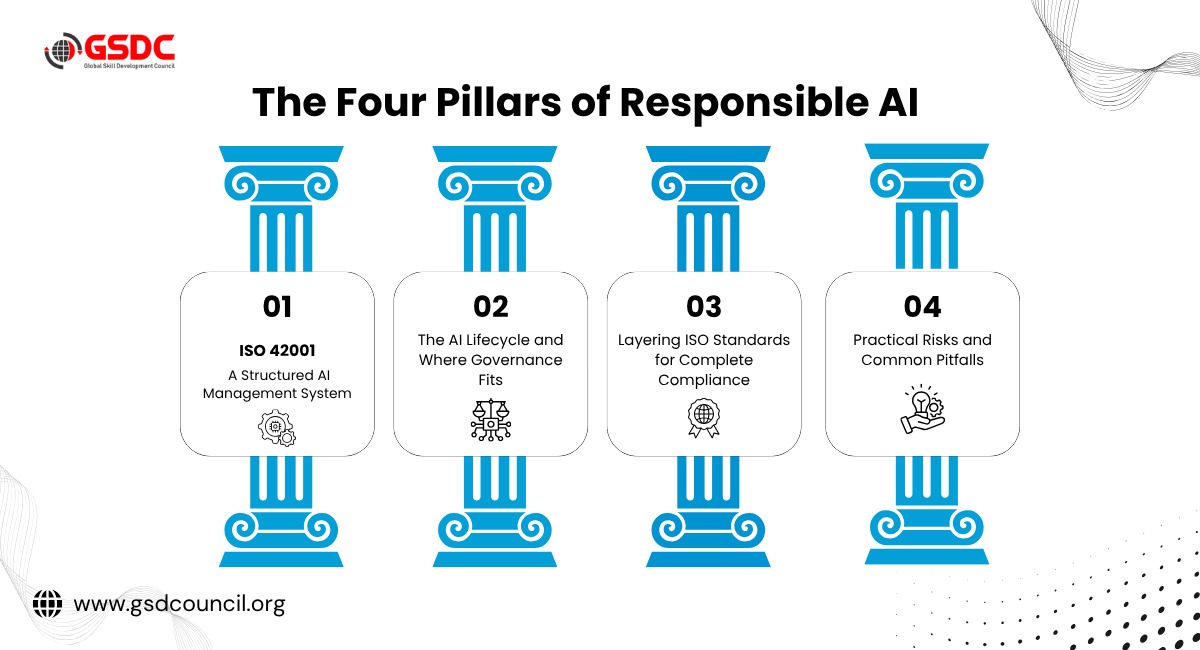
The webinar organized responsible AI practices around a few interconnected principles. Transparency means disclosing a system's capabilities, its limitations, and exactly what data it collects, especially when personal information from EU citizens is involved, which requires explicit consent. Data governance was described as resting on three legs: data provenance (where the data came from), data lineage (how it flows through the AI lifecycle), and data quality. Weakness in any one of these undermines AI governance in financial services entirely.
Risk management was tied closely to a practice called AI impact assessment, evaluating how an AI system affects society, individuals, specific genders, or cultural groups before those risks are catalogued in a formal risk register. This forms an important part of AI risk management in financial services and supports stronger responsible AI governance. Finally, fairness was defined simply as the absence of bias across gender, ethnicity, culture, or caste, ensuring that outcomes like loan approvals remain consistent for equally qualified applicants regardless of demographic background.
A principle that received special emphasis was post-market monitoring—the ongoing process of tracking how an AI system performs after deployment. The webinar drew a comparison to how large AI products are continuously updated based on user-reported issues, illustrating that responsible AI isn't a one-time certification but a continuous commitment to catching and correcting problems. This approach reflects the ISO 42001 responsible AI principles and provides a foundation for understanding how to implement responsible AI in banking through an ISO 42001 AI governance framework that supports AI compliance in financial services.
ISO 42001: A Structured AI Management System
ISO 42001 was introduced as an AI management system standard, built to bring formal governance to AI development the same way ISO 27001 brought structure to information security. The standard requires organizations to define clear policies, assign specific roles and responsibilities, and establish scope for every AI system they build or deploy. It includes 38 controls in Annex A, mapped across the entire AI lifecycle, giving organizations a practical checklist rather than vague guidance.
Crucially, the standard applies to any organization in the AI value chain whether acting as a provider, a deployer, or even a consumer of AI systems. For financial institutions with any connection to the EU market and the webinar noted that few large organizations today have none ISO 42001 offers a practical pathway to compliance with the EU AI Act. Properly implemented across the full lifecycle, the standard was described as achieving roughly 90% alignment with the Act's requirements, sparing organizations from needing to parse dense legal text on their own.
The AI Lifecycle and Where Governance Fits
A central theme was that responsible AI cannot be bolted on after a model is built it has to be embedded across the lifecycle. That lifecycle begins at inception, where business goals are defined, followed by design, where appropriate datasets are selected. Development involves training and initial validation against baseline accuracy targets, while verification and validation tests for fairness, transparency, and accountability occur before deployment. The webinar stressed that verification asks whether the output is correct, while validation asks whether the model actually achieves the intended business objective; both must be satisfied before go-live.
After deployment, continuous monitoring becomes essential to catch model drift and false positives, since no AI system operates at 100% accuracy. Eventually, models reach decommissioning a process the webinar described as far more complex than simply retiring a system, since it involves systematically cleaning up all data used to build and operate the model, in compliance with legal and regulatory requirements.
Layering ISO Standards for Complete Compliance
Perhaps the most emphatic point in the session was that ISO 42001 cannot stand alone. Because financial AI systems handle sensitive personal data, the webinar argued that ISO 42001 must be implemented alongside ISO 27001 (information security management) and ISO 27701 (privacy information management). Skipping any one of these three standards, it was argued, leaves an organization non-compliant there is no shortcut. The recommended sequence was to first establish information security through ISO 27001, then build privacy protections via ISO 27701, and only then layer AI governance through ISO 42001 on top.
Practical Risks and Common Pitfalls
The webinar catalogued several risk categories financial firms should watch for: bias risk (leading to legal penalties and reputational harm), data risk (from poor data quality or missing lineage), security risk (data poisoning, breaches, model tampering), ethical risk (unexplainable decisions that erode customer trust), and operational risk (model drift and false positives). Common implementation pitfalls included inadequate stakeholder engagement, unclear roles, insufficient data quality controls, and failure to conduct regular impact assessments. Organizations were encouraged to track progress using concrete KPIs bias indices, explainability scores, and similar metrics since, as the session put it, what can't be measured can't be managed.
Build Expertise with GSDC Certified ISO 42001:2023 Lead Auditor
GSDC’s Certified ISO 42001:2023 Lead Auditor certification helps professionals develop the skills to plan, conduct, report, and manage audits of AI Management Systems. It covers ISO 42001 requirements, audit principles, risk-based assessment, evidence evaluation, and continual improvement.

Designed for AI governance, compliance, risk, and audit professionals, the Certified ISO 42001:2023 Lead Auditor certification strengthens practical capabilities for assessing whether organizations effectively implement and maintain responsible AI management practices.
Conclusion
Responsible AI in financial services isn't a single checkbox—it’s an ongoing discipline that spans data governance, risk management, transparency, and continuous monitoring. ISO 42001 provides the structural backbone for this discipline, but it only delivers its full value when paired with ISO 27001 and ISO 27701, and when supported by trained staff, a functioning AI ethics committee, and rigorous impact assessments conducted before every deployment. For banks and NBFCs planning AI initiatives in the years ahead, the path forward is clear: build responsible AI governance in from day one, rather than trying to retrofit it after problems emerge.

Related Certifications
Frequently Asked Questions
Verification checks whether the AI model is producing the correct, expected output. Validation checks whether that output actually achieves the underlying business objective. Both are necessary before a model can be considered ready for deployment.
Because financial AI systems process sensitive personal data, information security and privacy protections form the foundation that AI governance in financial services depends on. Implementing ISO 42001 alone leaves security and privacy gaps that can lead to non-compliance despite having an AI management system in place.
An AI impact assessment evaluates how an AI system affects society, individuals, or specific groups—examining fairness, transparency, and accountability concerns. Findings from this assessment that reveal negative impacts then feed directly into the organization's formal risk register, meaning impact assessment happens first and AI risk management in financial services follows.
Data lineage tracks how data flows from its source through training, monitoring, and eventual decommissioning. Without clear lineage, provenance, and quality controls, biased or flawed data can enter a model undetected, which is one of the common root causes of biased AI outcomes and a key concern in responsible AI practices.
Common roles include data scientists, a chief risk officer, a compliance officer, and members of an AI ethics committee. Organizations may expand this list based on their scale, but clearly defined roles and responsibilities are considered essential to avoiding governance gaps and supporting AI compliance in financial services.
Stay up-to-date with the latest news, trends, and resources in GSDC
If you like this read then make sure to check out our previous blogs: Cracking Onboarding Challenges: Fresher Success Unveiled
Not sure which certification to pursue? Our advisors will help you decide!