Leadership Responsibility in Business Continuity Management Under ISO 22301
Written by Emily Hilton
- Why Leadership Is the Foundation of Business Continuity?
- 5 Leadership Mistakes That Weaken Business Continuity
- 5 Leadership Practices That Strengthen Business Continuity
- The Crisis Communication Framework Every Leader Should Know
- Creating a Culture of Business Continuity
- GSDC Certified ISO 22301 Lead Auditor Certification
- Conclusion
Every organization has a business continuity plan. Whether it's a cyberattack, natural disaster, supply chain disruption, or power outage, most businesses have documented procedures to keep operations running. Yet when disruption strikes, some recover quickly while others struggle-even with similar plans in place.
The difference often isn't the plan itself-it's the leadership behind it.
Under ISO 22301, Business Continuity Management (BCM) is more than documenting recovery procedures. It helps organizations prepare for, respond to, and recover from disruptions while keeping critical business operations running. Achieving this requires more than well-written plans-it demands leadership that sets direction, allocates resources, and fosters a culture of preparedness.
In this blog, we'll explore the leadership principles, communication strategies, and organizational practices that help build a resilient Business Continuity Management System under ISO 22301.
Why Leadership Is the Foundation of Business Continuity?
Business Continuity Management (BCM) helps organizations maintain critical operations during disruptions such as cyberattacks, natural disasters, and system failures. While plans and technology are important, effective BCM starts with leadership commitment.
Under ISO 22301, leaders are responsible for:
- Setting the direction for business continuity.
- Allocating resources and defining responsibilities.
- Participating in emergency drills and preparedness activities.
- Building a culture of resilience across the organization.
- Ensuring business continuity remains a priority, not just a compliance requirement.
Strong leadership turns business continuity plans into effective action.
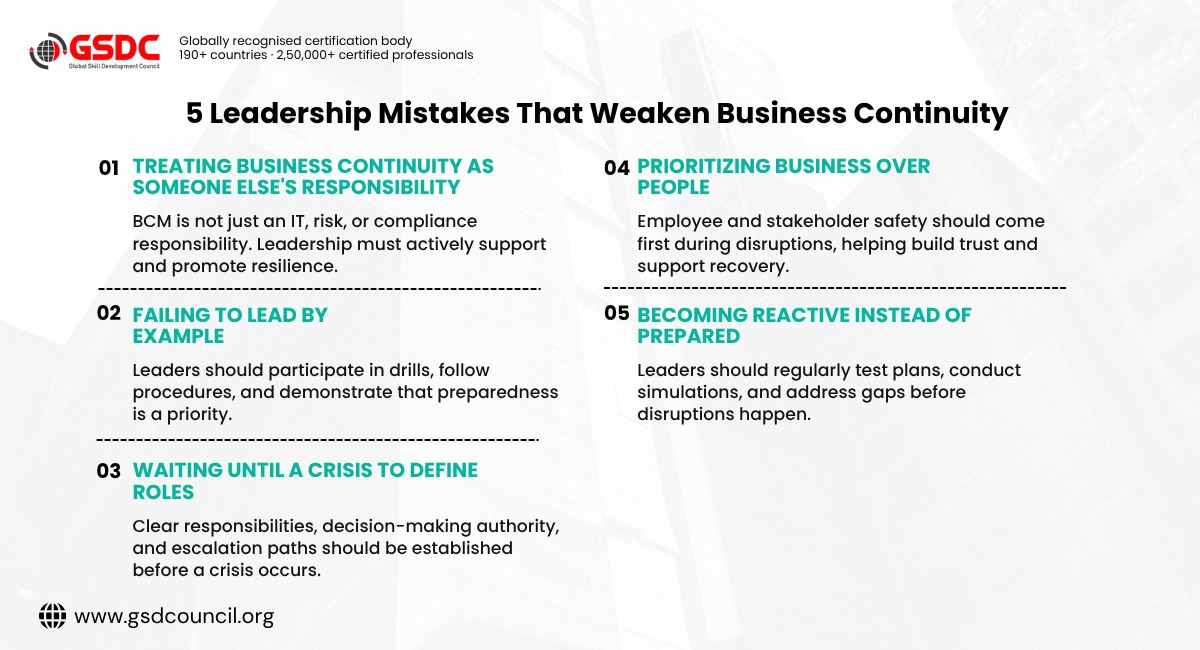
5 Leadership Mistakes That Weaken Business Continuity
Organizations rarely fail during a crisis because they lack a business continuity plan. More often, they struggle because leadership wasn't actively engaged before the disruption occurred.
Business continuity requires more than policies and annual audits. It demands visible leadership, proactive planning, and consistent involvement. Here are five common leadership mistakes that weaken organizational resilience.
1. Treating Business Continuity as Someone Else's Responsibility
Business Continuity Management (BCM) isn't solely the responsibility of risk, compliance, or IT teams. Without executive ownership, employees are likely to view business continuity as a compliance exercise rather than a strategic priority. Leadership participation in planning, training, and simulations reinforces that resilience is everyone's responsibility.
2. Failing to Lead by Example
Employees follow what leaders do-not just what they say. When executives skip emergency drills or ignore established procedures, they unintentionally signal that preparedness isn't important. Strong leadership reinforces a culture of resilience through visible participation and consistent actions.
3. Waiting Until a Crisis to Define Roles
Confusion during a crisis often stems from unclear responsibilities. Decision-makers, communication owners, and escalation paths should be defined and practiced well before an incident occurs. Clear roles enable faster, more coordinated responses when every minute matters.
4. Prioritizing Business Over People
In any disruption, protecting people must come before protecting operations. Organizations that consistently prioritize employee and stakeholder safety build greater trust and recover more effectively than those focused solely on business continuity.
5. Becoming Reactive Instead of Prepared
Resilient leaders prepare before a crisis occurs. They challenge assumptions, conduct simulations, and regularly test response plans to identify gaps. Preparation builds confidence, while reacting without preparation creates confusion.
A business continuity plan provides the roadmap, but leadership determines whether the organization can execute it when it matters most.
5 Leadership Practices That Strengthen Business Continuity
Avoiding common leadership mistakes is only part of the equation. Resilient organizations are built on consistent leadership practices that strengthen preparedness before disruption. These five practices help embed business continuity into everyday decision-making.
Here are five leadership behaviors that strengthen organizational resilience.
1. Participate in Training and Simulations
Leadership participation in tabletop exercises, emergency drills, and crisis simulations demonstrates that preparedness is a business priority. These exercises also help leaders identify gaps, clarify responsibilities, and build confidence before a real disruption occurs.
2. Make Timely, Informed Decisions
During a crisis, leaders must balance speed with sound judgment. By preparing for different scenarios and establishing clear decision-making processes in advance, organizations can respond quickly without creating unnecessary confusion.
3. Put People First
Protecting employees, customers, and stakeholders should always come before protecting operations. Organizations that prioritize people build trust, strengthen morale, and create a culture where safety is never compromised.
4. Think Beyond the Immediate Crisis
Effective leaders look beyond today's disruption and consider its long-term impact on customers, suppliers, operations, and resources. This forward-thinking approach helps organizations anticipate challenges instead of simply reacting to them.
5. Make Resilience Part of Everyday Decisions
Business continuity shouldn't be limited to emergency plans. The most resilient organizations consider resilience when making strategic decisions-from technology investments and supplier selection to business expansion and dgiital transformation.
Great leaders don't wait for disruption to test resilience-they strengthen it through the decisions they make every day.
The Crisis Communication Framework Every Leader Should Know
A strong business continuity plan can still fail if communication breaks down. During a crisis, employees need direction, customers expect transparency, and stakeholders look to leadership for reassurance. Clear, timely communication is essential to maintaining trust and minimizing uncertainty.
An effective crisis communication plan should answer five key questions:
Question | Purpose |
Who communicates? | Assign a designated spokesperson. |
What should be communicated? | Share verified, accurate information. |
To whom? | Identify employees, customers, regulators, suppliers, and partners. |
When? | Define the timing and frequency of updates. |
How? | Select the most appropriate communication channels. |
Leaders should also communicate early rather than waiting for complete information. During an evolving situation, stakeholders value transparency and regular updates over perfect certainty. Timely communication helps reduce anxiety and reinforces confidence that the situation is being managed effectively.
Preparing communication templates for common scenarios-such as cyberattacks, natural disasters, or system outages-can further improve response times while ensuring messages remain accurate and consistent.
During a crisis, people may forget the decisions leaders made, but they'll remember how clearly and confidently those leaders communicated.
Creating a Culture of Business Continuity
Business continuity isn't built through policies or audits alone-it becomes effective when resilience is part of an organization's culture. While ISO 22301 provides the framework, leadership determines whether preparedness becomes an everyday habit or remains a compliance exercise.
A resilient culture starts with open communication. Employees at every level should feel comfortable reporting potential risks, whether it's a system vulnerability, supply chain issue, or operational concern. Just as importantly, leaders must listen, act on that feedback, and demonstrate that every concern is taken seriously. This encourages continuous participation and helps identify risks before they escalate.
Strong organizations also learn from every disruption. Instead of simply documenting incidents, they identify root causes, implement corrective actions, and apply those lessons to strengthen future preparedness. Continuous improvement is what transforms experience into resilience.
Finally, business continuity should be integrated into everyday decision-making. Whether investing in new technology, selecting suppliers, or planning business growth, leaders should consider how each decision affects the organization's ability to respond to disruption.
A resilient culture isn't created by policies alone. It's built by leaders who encourage openness, learn continuously, and make resilience part of every business decision.
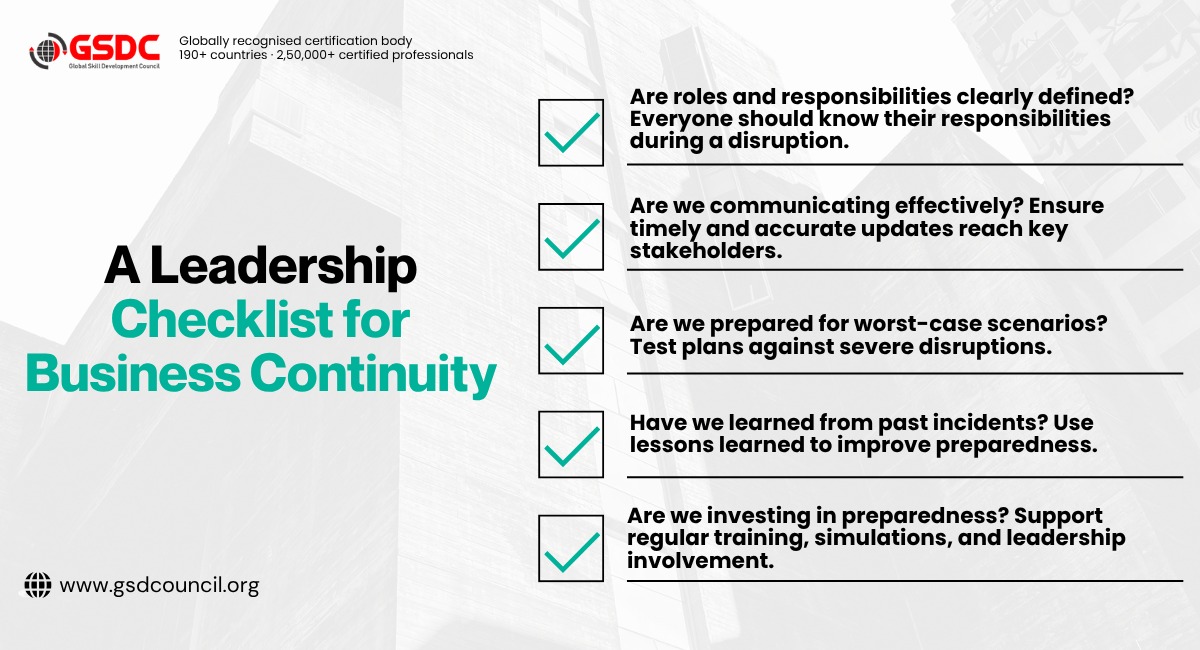
GSDC Certified ISO 22301 Lead Auditor Certification
GSDC’s Certified ISO 22301 Lead Auditor Certification helps professionals develop the skills to plan, conduct, and manage audits of Business Continuity Management Systems (BCMS) based on ISO 22301:2019.

The program covers business impact analysis, risk assessment, audit planning, identifying non-conformities, and evaluating business continuity practices. Through practical exercises, case studies, and expert-led learning resources, professionals can strengthen their auditing knowledge and understand how to assess organizational preparedness for disruptions.
This certification can benefit auditors, risk managers, compliance professionals, and business continuity specialists seeking to improve their expertise and support organizational resilience.
Conclusion
Business continuity isn't measured by the quality of a written plan-it's measured by how effectively an organization responds when disruption occurs. While ISO 22301 provides the framework, leadership determines whether that framework translates into action.
Leaders who prioritize preparedness, communicate with clarity, empower their teams, and continuously learn from every incident build organizations that are better equipped to navigate uncertainty. In doing so, Business Continuity Management becomes more than a compliance requirement-it becomes a strategic advantage.

Related Certifications
Frequently Asked Questions
Leadership sets direction, allocates resources, promotes resilience, and ensures the organization is prepared for disruptions.
Leadership ensures timely decisions, clear communication, employee safety, and effective execution of response plans.
Organizations can build a continuity culture by encouraging risk reporting, learning from incidents, and integrating resilience into daily decisions.
Effective crisis communication defines who communicates, what is shared, whom it reaches, when updates are given, and how messages are delivered.
Common mistakes include ignoring BCM responsibilities, skipping drills, delaying decisions, underinvesting in preparedness, and relying on reactive planning.
Stay up-to-date with the latest news, trends, and resources in GSDC
If you like this read then make sure to check out our previous blogs: Cracking Onboarding Challenges: Fresher Success Unveiled
Not sure which certification to pursue? Our advisors will help you decide!