Leveraging AI to Automate Compliance Audits & Streamline Risk Mitigation
Written by Emily Hilton
- 1. What is a Compliance Audit?
- 2. What Does Leveraging AI Mean?
- 3. How to Leverage AI in Compliance Audits - A Modern Approach
- 4. How to Automate Compliance Audits with AI
- 5. What Is Leveraging Technology in Risk Mitigation?
- 6. Key Benefits of Leveraging AI in Compliance Management
- 7. Real-World Examples + Key Platforms in 2026
- 8. Challenges to Overcome in 2026
- 9. GSDC Certification: Generative AI for Smarter Compliance
- 10. Conclusion: A Strategic Imperative
Running a business today isn’t easy. Digital transformation is moving fast, and regulations keep changing. AI is helping organizations stay ahead by automating audits, improving risk management, and turning mountains of data into actionable insights.
Implementing AI effectively, however, goes beyond simply adopting new tools. Organizations must understand how AI can integrate into existing processes, scale operations, and deliver measurable business value.
This guide explores the fundamentals of compliance audits, demonstrates how AI can enhance these workflows, highlights the latest tools and techniques for 2026, and presents strategies to build a resilient, next-generation compliance framework.
1. What is a Compliance Audit?
Before diving into cutting-edge automation, it’s critical to understand what is compliance audit.
A compliance audit is a structured review that evaluates whether an organization is meeting legal, regulatory, and internal policy requirements. It examines documentation, processes, controls, and performance to validate adherence to standards such as GDPR, SOX, PCI-DSS, HIPAA, ESG reporting requirements, or industry-specific norms. It also assures stakeholders and regulators that compliance obligations are being satisfied and risks are being managed effectively.
Traditionally, compliance audits have been manual, time-intensive, and labor-heavy, involving significant human effort to gather documents, analyze records, and check controls. Auditors often sample data, review spreadsheets, and interview team members to compile audit evidence. This manual approach has inherent challenges: error risk, inconsistent coverage, delayed insights, and high cost.
Today’s most forward-thinking organizations are transforming this picture using AI-driven automation to make compliance audits scalable, real-time, and far more accurate.
2. What Does Leveraging AI Mean?
At its core, what does leveraging AI mean?
Applying artificial intelligence technologies such asmachine learning, natural language processing (NLP), and predictive analytics to augment or automate tasks traditionally done by humans.
AI doesn’t just speed up routine work. It learns patterns, interprets unstructured data, predicts outcomes, and makes real-time decisions, delivering insights far beyond what manual processes can achieve.
When we talk about leveraging generative AI for project management, compliance, or risk workflows, we’re referring to harnessing AI’s ability to analyze large volumes of data, generate relevant summaries, propose recommendations, and drive intelligent actions, all with minimal human intervention.
In practical terms, this might look like automatically scanning thousands of contracts for compliance gaps, alerting your team to regulatory changes, or generating ready-to-submit evidence packages for auditors.
3. How to Leverage AI in Compliance Audits - A Modern Approach
One of the most common practical questions leaders ask is how to leverage AI tools in compliance workflows. These tools integrate advanced analytics, automation, and AI intelligence, enabling real-time insights and reducing manual overhead.
Here’s how organizations today are approaching this transformation:
3.1 Identify Repetitive and High-Volume Tasks
Before selecting technology, understand where manual effort is highest. Common areas ripe for automation include:
- Document collection and categorization
- Controls testing
- Regulatory surveillance and policy mapping
- Evidence collation
- Reporting and audit traceability
Once identified, organizations can define clear objectives for how to leverage AI, improving precision and speed while reducing risk exposure.
3.2 Choose the Right AI Compliance Platforms
There is no one-size-fits-all solution, but many modern platforms provide powerful capabilities:
- Automated compliance tracking with real-time control evidence
- Predictive risk scoring using historical and behavioral data
- Intelligent regulatory monitoring that flags new legal changes
- Generative AI assistants that draft audit memos and policy updates
Selecting the right suite depends on your industry, regulatory complexity, and existing data infrastructure. Modern systems integrate with your data sources, ERP systems, and security tools to deliver a unified perspective.
4. How to Automate Compliance Audits with AI
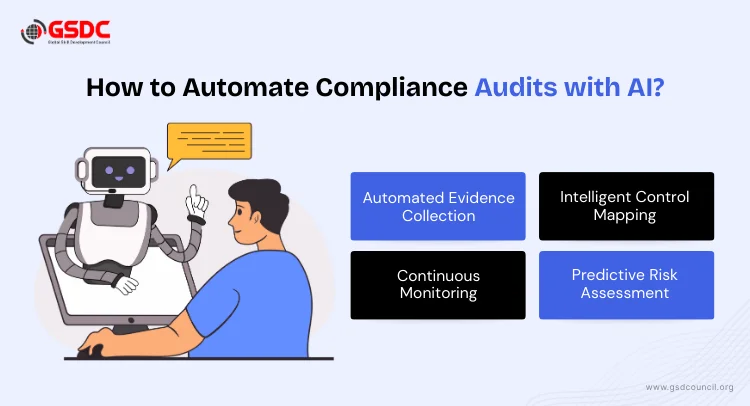
A major shift we’re seeing in 2026 is that top organizations are actively exploring how to automate compliance audits using AI, not just partially, but end-to-end. Here’s how this works:
4.1 Automated Evidence Collection
AI crawls structured and unstructured data, extracts relevant information, and maps it against compliance requirements, e.g., ISO standards, GDPR provisions, and SOC reports. This removes tedious manual evidence gathering and ensures traceability for regulators.
4.2 Intelligent Control Mapping
AI automatically maps internal controls to regulatory frameworks. Instead of manual cross-referencing, AI understands obligations across multiple standards and correlates them intelligently, significantly reducing human error and oversight.
4.3 Continuous Monitoring
Instead of point-in-time reviews, AI enables continuous assurance monitoring systems, transactions, and anomalies in real time, so compliance issues are detected before they escalate.
4.4 Predictive Risk Assessment
With predictive analytics, AI identifies risk trends and future compliance failures based on past patterns, enabling preemptive action instead of reactive reporting.
For modern compliance functions, this means your audit program becomes smarter, faster, and more aligned with risk appetite.5. What Is Leveraging Technology in Risk Mitigation?
A related but broader question is what is leveraging technology is for risk mitigation.
Risk mitigation refers to actions taken to reduce the severity or likelihood of risks that could impact your business. Traditionally, this has involved manual risk registers, periodic reviews, and static controls. However, with digital transformation and AI advancements, risk management is no longer a quarterly checklist; it’s dynamic, continuous, and data-driven.
By applying AI tools to risk mitigation strategies, organizations can:
- Detect emerging risks in real time
- Prioritize responses based on potential impact
- Automate risk score calculations
- Enhance decision-making with predictive models
AI doesn’t replace human judgment it amplifies it by bringing objective, data-backed intelligence to strategic decisions.
6. Key Benefits of Leveraging AI in Compliance Management
As regulatory environments grow more complex, organizations must rethink how to leverage AI to maintain compliance without slowing business operations.
Understanding what does leveraging AI mean in this context is critical it refers to applying intelligent systems to enhance accuracy, efficiency, and decision-making across compliance functions.
By leveraging AI tools, compliance teams can move beyond manual, reactive processes and adopt scalable, technology-driven models aligned with modern regulatory demands.
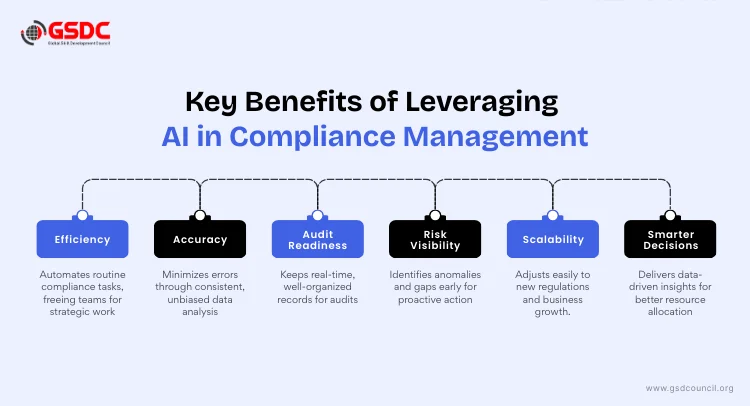
- Efficiency: Automates repetitive tasks like data validation, evidence collection, and control testing, freeing teams for strategic work.
- Accuracy & Consistency: Reduces errors by analyzing large data sets without bias or fatigue.
- Audit Readiness: Maintains organized, real-time compliance records for instant audit preparedness.
- Risk Visibility: Detects patterns, anomalies, and gaps, enabling proactive risk mitigation.
- Scalability: Adapts to evolving regulations and expanding operations without major process changes.
Download the checklist for the following benefits:
📊 Learn how top organizations leverage AI for smarter audits
📥 Download your free guide now and transform your compliance workflows!
7. Real-World Examples + Key Platforms in 2026
Today, enterprises across industries are using AI-powered compliance platforms like AuditBoard, LogicGate Risk Cloud, Hyperproof, and Risk Cognizance to automate audit workflows, manage evidence, and monitor controls. These tools integrate predictive risk analytics, continuous compliance dashboards, and automated reporting functions.
Examples include:
- AI predictive models that spotlight risk concentrations
- Automated evidence libraries that ensure audit readiness
- NLP systems that parse policies and map obligations
- Control-assurance engines that validate compliance in real time
The common theme? AI brings speed, scale, and intelligence to areas that humans alone previously could not sustain.
8. Challenges to Overcome in 2026
AI is a blessing as well as a burden, and it is still the case:
- Data Privacy and Security
The use of AI in processing personal data is very common. Therefore, robust policies and privacy-oriented approaches are essential.
- Interpretability and Trust
It is becoming a trend for the authorities to demand that AI systems be explainable and can defend their decisions and results in a clear way.
- Control Over AI Itself
One has to control not only the performance of the AI systems but also the quality of the models through model validation, versioning, and ethical checks.
The standardization of AI audit criteria and the creation of assurance mechanisms are developments that are getting widespread adoption across the globe, thus ensuring that AI systems are subject to consistent and transparent evaluations.
9. GSDC Certification: Generative AI for Smarter Compliance
The Certified Generative AI in Risk & Compliance program by GSDC equips professionals with practical skills to harness AI for smarter compliance and risk management.
Participants learn how to leverage generative AI to automate audits, map controls, and perform predictive risk assessments, transforming traditional, manual workflows into data-driven, scalable processes.
The risk compliance certification emphasizes hands-on application, industry best practices, and real-world use cases, enabling compliance and risk leaders to implement AI solutions confidently while ensuring regulatory adherence and operational efficiency.
10. Conclusion: A Strategic Imperative
In 2026, compliance and risk functions are no longer back-office checkboxes; they are strategic assets. Organizations that embrace AI not just as a technology, but as a partner in compliance intelligence, unlock significant operational advantage.
By understanding what is compliance audit is, and learning how to automate compliance audits through leveraging AI and leveraging generative AI for project management, risk professionals can elevate their function from reactive reporting to proactive assurance and risk mitigation. With the right tools, processes, and governance frameworks in place, your business can navigate regulatory complexity with confidence.
If there’s one strategic truth in today’s digital economy, it’s this:
Organizations that know how to leverage AI effectively in their compliance and risk strategies don’t just survive, they thrive.

Related Certifications
Stay up-to-date with the latest news, trends, and resources in GSDC
If you like this read then make sure to check out our previous blogs: Cracking Onboarding Challenges: Fresher Success Unveiled
Not sure which certification to pursue? Our advisors will help you decide!