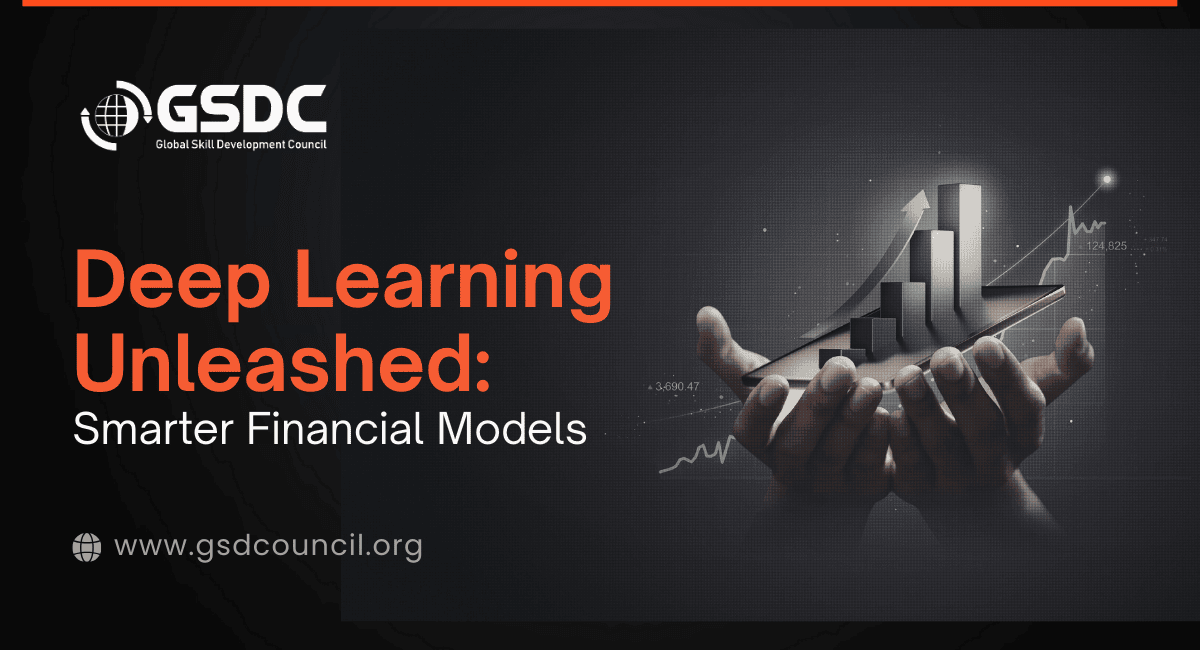
Deep Learning Unleashed: Smarter Financial Models
Written by Akshad Modi
The financial sector is witnessing a profound transformation, driven by the rise of deep learning and artificial intelligence. Traditional rule-based systems, while reliable, often struggle to adapt to the rapid changes and complex patterns that define today’s financial markets. Deep learning offers a paradigm shift, moving from rigid, predefined algorithms to adaptive, intelligent models that learn from vast amounts of data and improve over time.
In this blog, we explore how deep learning is revolutionizing finance, the practical applications in areas like credit scoring and fraud detection, and the broader implications for financial institutions and customers alike.
Understanding Deep Learning in Finance
Deep learning is a subset of machine learning inspired by the human brain’s neural networks. Unlike traditional algorithms that rely heavily on explicit instructions, deep learning models can automatically identify patterns, correlations, and insights from complex datasets. In finance, this capability is particularly valuable because:
- Financial data is vast, varied, and continuously evolving.
- Traditional models struggle to detect subtle patterns in high-dimensional data.
- Real-time decision-making is increasingly crucial for competitiveness and risk management.
By leveraging deep learning, financial institutions can create models that are not only predictive but adaptive, continuously learning from new information to make more accurate decisions.
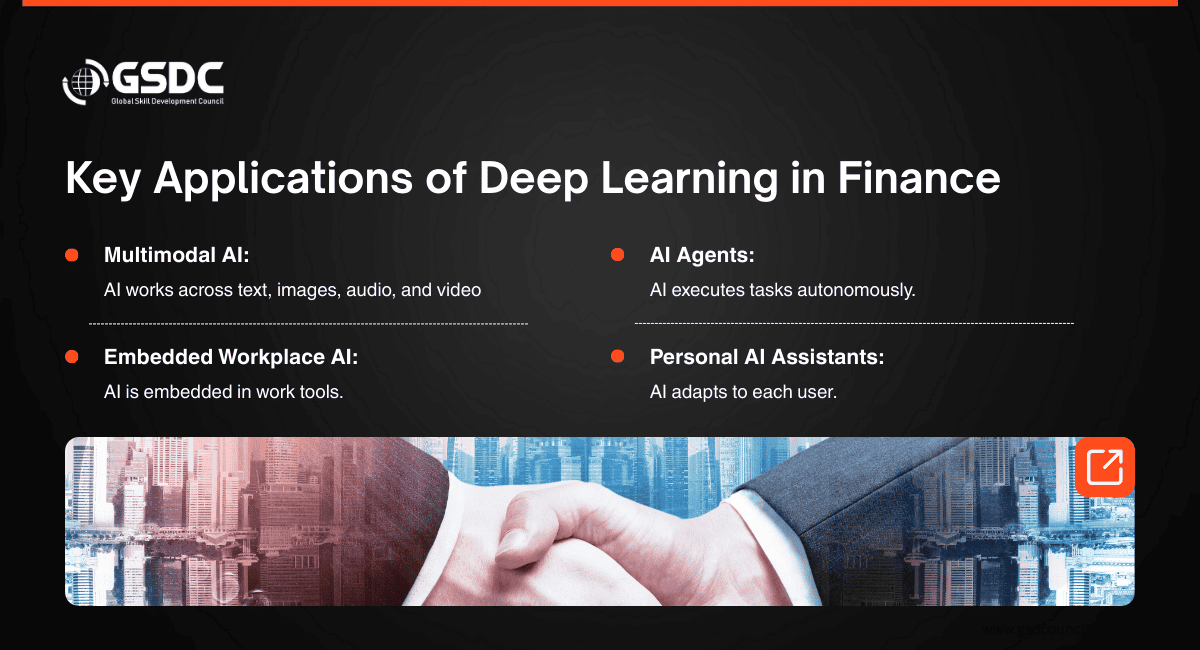
Key Applications of Deep Learning in Finance
1. Credit Scoring and Risk Assessment
Credit scoring is one of the most fundamental functions in finance, determining whether individuals or businesses qualify for loans or credit cards. Traditional scoring systems rely on a fixed set of criteria such as income, employment history, and credit history. However, deep learning models enhance this process in several ways:
- Pattern Recognition: Models can identify subtle trends and correlations in spending behavior, transaction history, and repayment patterns.
- Adaptive Learning: Scores update in real-time as new data becomes available, allowing for dynamic risk assessment.
- Fraud Prevention: By analyzing transaction anomalies, deep learning can flag potential fraudulent applications before approval.
For consumers, this translates into faster and more accurate loan approvals, and for banks, it reduces defaults and operational risk.
2. Fraud Detection and Prevention
Financial fraud is a significant concern, costing institutions billions of dollars annually. Deep learning models excel at detecting irregularities that might elude traditional systems. Unlike rule-based approaches, which require constant updates to catch new fraud patterns, deep learning offers:
- Real-time Analysis: Transactions can be monitored as they occur, flagging suspicious activity instantly.
- Behavioral Insights: Models learn the typical behaviors of customers and detect deviations that may indicate fraud.
- Scalable Solutions: Deep learning systems can process millions of transactions simultaneously, making them ideal for large banks and payment processors.
This proactive approach not only minimizes losses but also enhances customer trust, as fraudulent activity is mitigated before it impacts users.
3. Algorithmic Trading
Algorithmic trading uses computer programs to make trading decisions at speeds and frequencies impossible for humans. Deep learning further refines this by:
- Predicting Market Trends: Models analyze historical and real-time market data to forecast price movements.
- Identifying Hidden Patterns: Neural networks can detect correlations between seemingly unrelated market variables.
- Automated Decision Making: Trading strategies can adapt to changing market conditions without human intervention.
While high-frequency trading is often associated with complex algorithms, deep learning adds an extra layer of intelligence, making trades smarter, faster, and more profitable.
4. Personalized Financial Services
Modern consumers expect services tailored to their unique financial needs. Deep learning enables banks and fintech companies to:
- Recommend Investment Opportunities: Models suggest personalized portfolios based on individual risk appetite and goals.
- Enhance Customer Engagement: Chatbots and AI advisors provide context-aware financial advice.
- Predict Life Events: By analyzing spending patterns, models can anticipate significant financial decisions, like buying a home or taking a loan, and proactively offer suitable products.
This personalization not only improves customer satisfaction but also increases customer lifetime value for financial institutions.
Advantages of Deep Learning over Traditional Financial Models
The adoption of deep learning for finance and machine learning in finance is driven by several key advantages.
- High Accuracy: Neural networks can process complex and large datasets, enabling more precise predictions and insights, one of the major benefits of AI in finance.
- Scalability: AI-driven models can efficiently handle increasing data volumes, making them suitable for global financial operations.
- Adaptability: Continuous learning allows deep learning models to adjust to new data, improving performance over time without human intervention.
- Cost Efficiency: By automating decision-making, risk analysis, and fraud detection, deep learning significantly reduces operational costs.
- Risk Mitigation: Predictive models help identify potential defaults, market downturns, and fraudulent activities early, minimizing financial losses.
However, organizations must also address deep learning challenges, such as data quality, explainability, and integration complexity. In contrast, traditional models often require manual recalibration, may miss subtle trends, and are less effective when dealing with unstructured or high-dimensional financial data.
Challenges and Considerations
While deep learning offers significant benefits, financial institutions must navigate certain challenges that highlight the importance of financial modeling in AI-driven decision-making.
- Data Quality and Availability: Accurate AI financial analysis, AI financial planning, and AI financial statement analysis depend on high-quality, comprehensive datasets. Missing, inconsistent, or biased data can significantly impair model performance and reliability.
- Explainability: Deep learning models are often perceived as “black boxes,” making it difficult to explain outcomes of AI financial analysis to regulators, auditors, or clients.
- Regulatory Compliance: Financial institutions must ensure AI-driven financial modeling and AI financial planning systems comply with strict regulatory standards related to fairness, transparency, and accountability.
- Integration with Legacy Systems: Implementing AI financial analysis tools alongside existing financial infrastructure can be technically complex, requiring careful system alignment and data interoperability.
Addressing these challenges requires structured financial modeling frameworks, close collaboration between data scientists and financial experts, and continuous model monitoring to ensure reliable, compliant, and explainable AI-driven financial analysis.
Future of Deep Learning in Finance
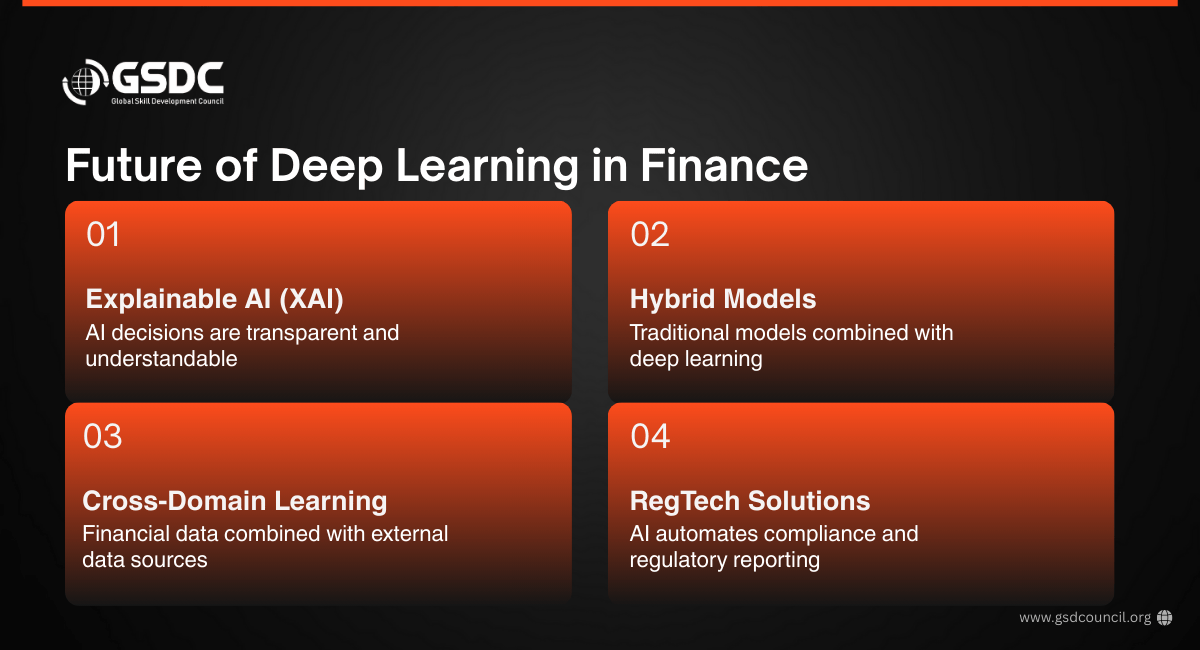
The potential of deep learning in finance is immense, with ongoing advancements in AI and computing power accelerating innovation. Some trends to watch include:
- Explainable AI (XAI): Tools and techniques that make deep learning models more transparent and understandable.
- Hybrid Models: Combining traditional financial models with deep learning to leverage the strengths of both approaches.
- Cross-Domain Learning: Integrating financial data with other data sources, such as social media or macroeconomic indicators, for better predictions.
- RegTech Solutions: Using AI to streamline regulatory compliance and reporting, reducing human error and operational burden.
As financial institutions embrace these technologies, deep learning will continue to shift the industry from reactive decision-making to proactive, predictive strategies.
How does the GSDC AI Expert Tool Certificate Accelerate Your Success?
The GSDC AI Expert Tool Certificate is designed to equip professionals with practical knowledge and hands-on skills in using AI-driven tools and technologies. This certification empowers learners to enhance productivity, improve data-driven decision-making, and drive innovation across business functions.
By earning the AI Expert Tool Certification, you demonstrate proven proficiency in applying AI for content creation, search optimization, and business process automation. This validation strengthens your professional credibility, builds employer trust, and unlocks global career opportunities in the rapidly evolving AI ecosystem.

Conclusion
Deep learning is no longer a futuristic concept in finance it is actively shaping how banks, fintech companies, and investors operate. From credit scoring and fraud prevention to algorithmic trading and personalized financial services, deep learning enables smarter, faster, and more accurate decision-making.
While challenges such as data quality, explainability, and regulatory compliance remain, the benefits far outweigh the risks for institutions willing to innovate. Financial organizations that leverage deep learning effectively can expect enhanced efficiency, reduced risk, and superior customer experiences, ultimately redefining what it means to be competitive in the modern financial landscape.
The transformation has just begun, and the institutions that adopt deep learning today will be the leaders of tomorrow’s finance.

Related Certifications
Stay up-to-date with the latest news, trends, and resources in GSDC
If you like this read then make sure to check out our previous blogs: Cracking Onboarding Challenges: Fresher Success Unveiled
Not sure which certification to pursue? Our advisors will help you decide!