9 Myths About Becoming an ISO 27001 Lead Auditor
Written by Matthew Hale
- A Quick Refresher: What Is ISO 27001 Lead Auditor, Really?
- Myth 1: "You Need Years of Cybersecurity Experience Before You Can Even Apply"
- Myth 2: "It's Just a Certificate, the Requirements Are a Formality"
- Myth 3: "ISO 27001 Certification Isn't Worth It Anymore, Too Many People Have It"
- Myth 4: "Lead Auditor and Lead Implementer Are Basically the Same Thing"
- Myth 5: "You Can Become a Lead Auditor Without Any Formal Training, Just Study the Standard"
- Myth 6: "The Job Only Pays Well in a Few Countries"
- Myth 7: "Lead Auditors Don't Need Technical or Soft Skills, Just Knowledge of the Standard"
- Myth 8: "The Audit Process Itself Is Rigid and the Same Every Time"
- Myth 9: "There Aren't Many Real Job Opportunities for This Role"
- So, Is ISO 27001 Lead Auditor Certification Worth Pursuing?
- Final Thoughts
If you've spent any time researching the ISO 27001 Lead Auditor certification, you've probably run into a wall of conflicting opinions. One LinkedIn post says it's "useless without years of audit experience." Another says you can pass it in a weekend with a crash course. A recruiter tells you it guarantees a six-figure job; a forum comment says it's oversaturated and pointless.
So which is it?
None of the extremes, really. Like most professional certifications, the truth about the ISO 27001 Lead Auditor credential sits quietly in the middle, and most of what's holding people back from pursuing it isn't a real obstacle. It's a myth that got repeated enough times to sound like fact.
This blog walks through the most common misconceptions about ISO 27001 Lead Auditor certification, grounds the ones that involve numbers in real data, and gives you a clear, honest picture of what the qualification actually involves, so you can decide if it's right for you without the noise.
A Quick Refresher: What Is ISO 27001 Lead Auditor, Really?
ISO 27001 is the international standard for Information Security Management Systems (ISMS). It tells organisations how to identify, manage, and reduce information security risks, covering everything from access control to supplier security to incident response.
A Lead Auditor is the professional trained and certified to independently assess whether an organisation's ISMS actually conforms to ISO 27001 requirements. Lead Auditors don't just check boxes: they plan audits, lead audit teams, interview stakeholders, evaluate evidence, and report findings that can determine whether a company earns or keeps its certification.
That distinction, leading an audit versus simply understanding the standard, is where a lot of the misconceptions begin. Let's go through them one by one.
Myth 1: "You Need Years of Cybersecurity Experience Before You Can Even Apply"
The truth: There's no universal, ISO-mandated prerequisite that locks you out of training. It helps to think of this in layers, because "requirements" actually come from four different places, and conflating them is where most confusion starts:
- The ISO 27001 standard itself: sets no personal prerequisites for who can train as an auditor.
- Training providers: most accredited Lead Auditor courses are open to information security professionals, IT managers, compliance officers, internal auditors, quality managers, and even career-changers with a foundational understanding of information security concepts.
- Certification/registration bodies (e.g., IRCA, Exemplar Global): these set their own criteria, often including logged audit experience, if you want to be formally registered as a practising Lead Auditor.
- Employers: often add their own expectations on top, such as prior audit exposure or a related degree.
That said, experience does matter for two things, regardless of which layer you're looking at:
- Passing the exam comfortably. The course assumes familiarity with ISMS concepts, risk management, and ideally ISO 27001 Foundation or Internal Auditor-level knowledge.
- Getting hired to actually lead audits. Certification bodies and employers typically want to see some practical audit exposure before handing you a lead role.
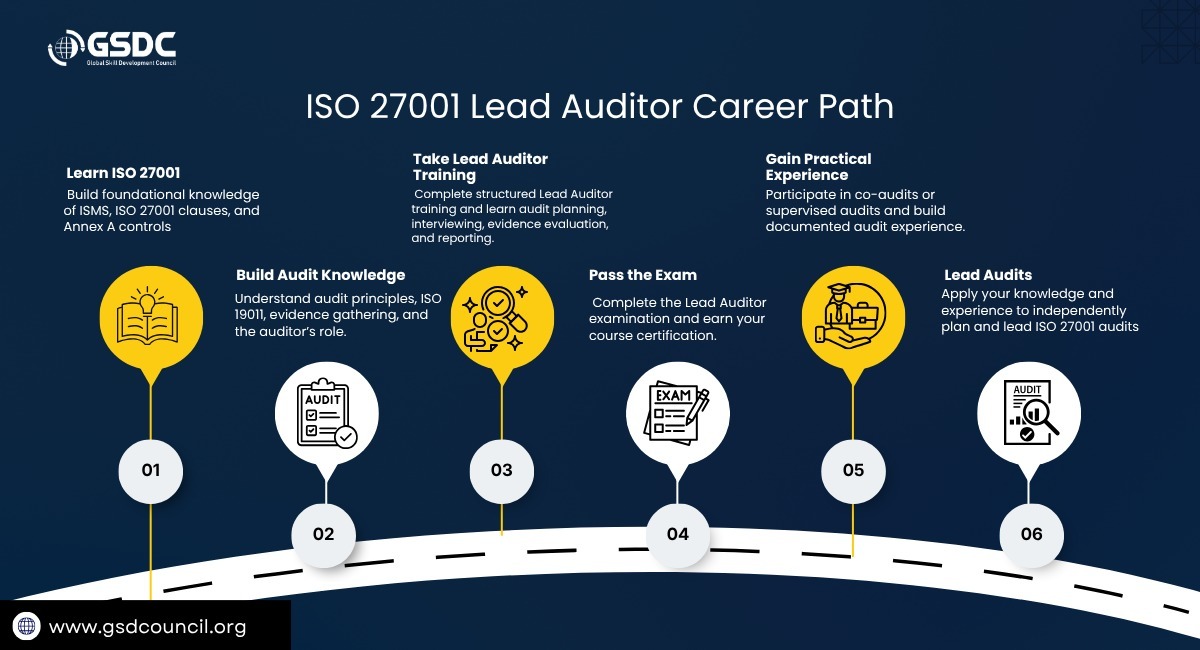
So the realistic path looks like this:
- Build a working knowledge of ISO 27001 (Foundation-level training helps)
- Get Internal Auditor experience, even informally
- Take the Lead Auditor course and exam
- Start with co-audits or supervised audits to build real-world credibility
Myth 2: "It's Just a Certificate, the Requirements Are a Formality"
The truth: This one deserves a closer look, because the exact ISO 27001 Lead Auditor certification requirements trip people up more than any other part of the process, largely because "requirements" mean different things depending on whether you're talking about the training course, the exam, or formal registration as a practising auditor (see the layers explained under Myth 1).
Most accredited training providers (following IRCA or CQI-aligned criteria) expect candidates to demonstrate:
Requirement | What It Typically Means |
Course completion | 5-day accredited Lead Auditor training (in-person or live virtual) |
Exam | Written exam covering ISO 27001 clauses, Annex A controls, and audit methodology |
Practical exercises | Case studies, mock audits, and role-play scenarios during training |
Knowledge base | Familiarity with ISO 19011 (guidelines for auditing management systems) |
Experience (for registration as an auditor) | Documented audit days, often verified by a certification/registration body like IRCA or Exemplar Global |
The certificate you get after the course, often titled something like Certified ISO 27001:2022 Lead Auditor, confirms you understand how to audit. Being formally registered as a practising Lead Auditor with a professional body is a separate step that usually requires logged audit experience. Conflating the two is one of the most common sources of confusion.
Myth 3: "ISO 27001 Certification Isn't Worth It Anymore, Too Many People Have It"
The truth:
This is one of the most common questions people have: is ISO 27001 certification worth it, still, today? It's worth answering with actual data rather than a gut reaction.
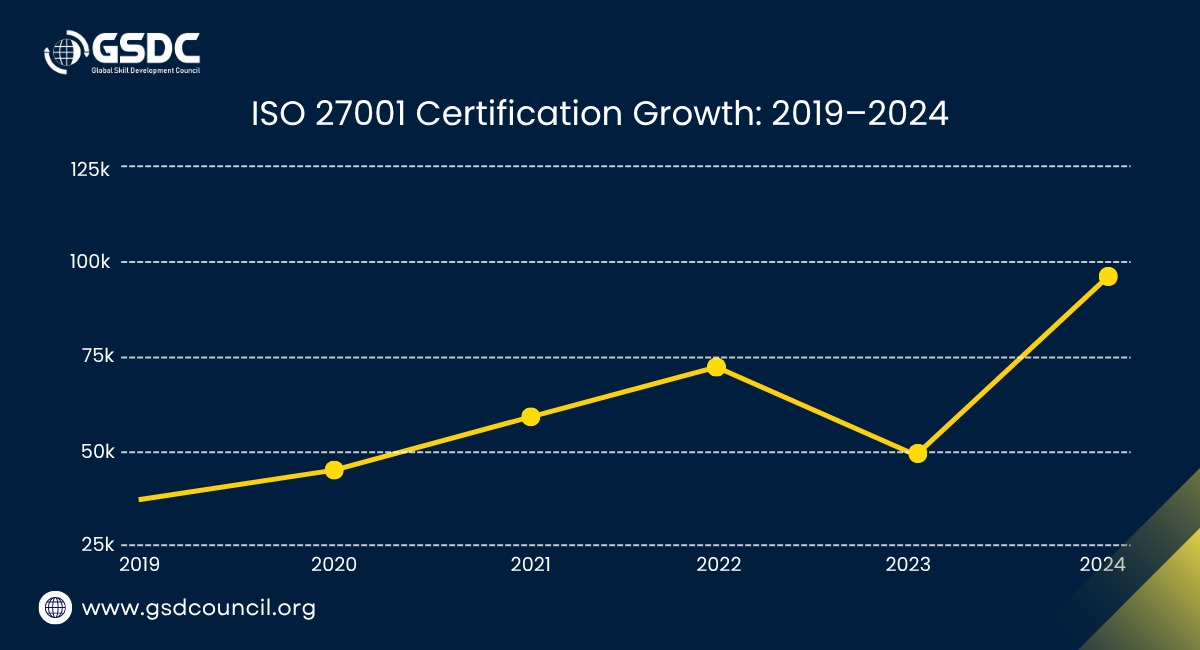
Here's what we can say with confidence. According to the ISO Survey 2024, conducted jointly by ISO and the International Accreditation Forum, the number of valid ISO/IEC 27001 certificates worldwide reached 96,709 in 2024, up from 36,362 in the 2019 survey, roughly a 2.7x increase in five years. Certified sites also grew sharply, with valid certificates nearly doubling from 48,671 in 2023 to 96,709 in 2024.
Year | Valid ISO/IEC 27001 Certificates (Global) |
2019 | 36,362 |
2020 | 44,486 |
2021 | 58,687 |
2022 | 71,549 |
2023 | 48,671* |
2024 | 96,709 |
*2023 figures were affected by incomplete reporting from some countries (notably China), which partly explains the sharp jump in 2024 once data collection improved and the survey moved to the IAF CertSearch database.
Multiple commercial market-research firms, including Persistence Market Research, independently track this space too, and while their exact dollar figures and growth-rate projections vary quite a bit from report to report (a common issue with paid market forecasts, which use different methodologies and assumptions), they consistently rank ISO 27001 among the fastest-growing ISO certification categories worldwide, attributed to rising cybersecurity threats and tightening data privacy regulations such as GDPR and CCPA.
What the data doesn't tell us is exactly how many Lead Auditors exist relative to that demand; there's no public figure tracking the global supply of certified individuals the way the ISO Survey tracks certified organisations. So it would be overreaching to say the market is definitely undersupplied.
What's fair to conclude is this: the growth in certified organisations suggests continued, real demand for people who can support, implement, audit, and maintain ISO 27001 programs, but it doesn't guarantee that every certification holder will walk into a Lead Auditor role. As with most professional credentials, the certificate opens doors; what you do with it determines the outcome.
Myth 4: "Lead Auditor and Lead Implementer Are Basically the Same Thing"
The truth: They're related but built for different jobs, and this mix-up costs people time and money on the wrong course.
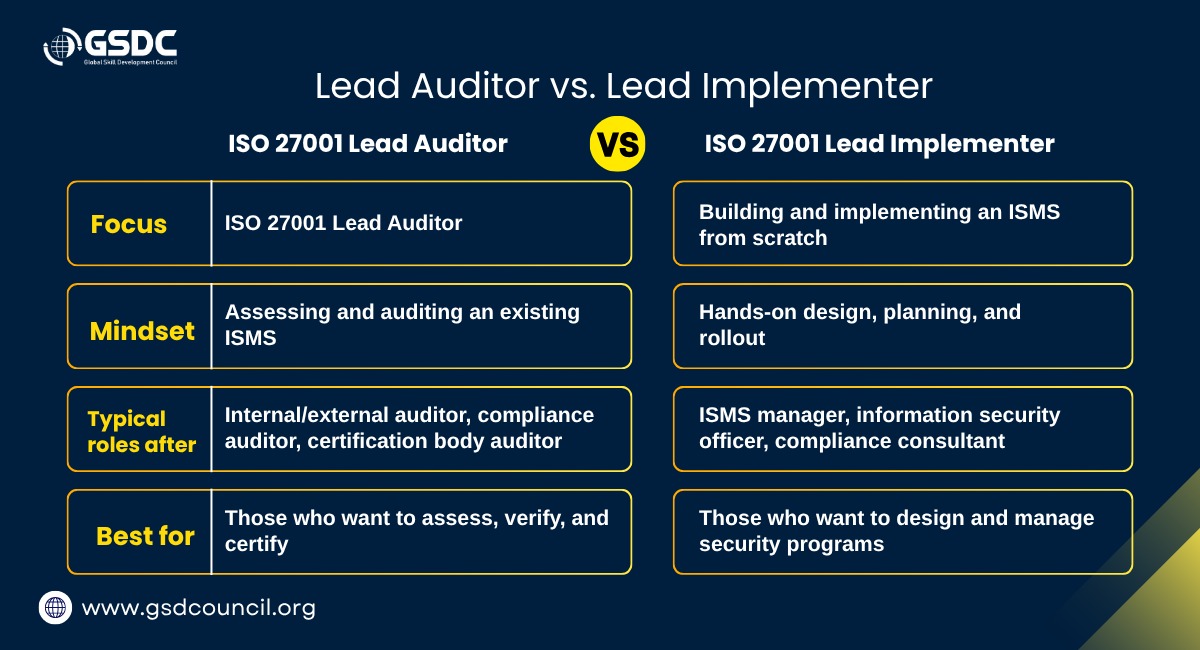
Some professionals, especially consultants, pursue both, since implementers benefit from understanding audit expectations, and auditors benefit from understanding implementation realities.
Myth 5: "You Can Become a Lead Auditor Without Any Formal Training, Just Study the Standard"
The truth: Reading the ISO 27001 standard cover to cover teaches you what the requirements are, not how to audit against them. Auditing is a distinct skill: sampling techniques, evidence gathering, interviewing, writing non-conformities, managing audit team dynamics, and staying objective under pressure.
If you're wondering how to become an ISO 27001 Lead Auditor, the realistic route is:
- Enrol in an accredited 5-day Lead Auditor training course
- Learn the standard's clauses (4 to 10) and the 93 Annex A controls in depth
- Study ISO 19011 audit principles
- Practice through mock audits and role-plays included in the course
- Pass the certification exam
- Gain supervised audit experience to build practical competence
Self-study alone generally does not satisfy the structured training requirements used by accredited Lead Auditor certification schemes, since most bodies (IRCA, PECB, and others) require documented completion of an approved course, not just demonstrated knowledge of the standard.
Myth 6: "The Job Only Pays Well in a Few Countries"
The truth: Compensation varies significantly by country, seniority, employment type, and audit experience. Salary data from the US, UK, and India shows that experienced professionals can command substantially more than entry-level candidates, but there is no single global salary benchmark, and different salary-tracking sites often disagree on the exact number for the same role. What holds up consistently across sources, though, is that practical audit experience matters more than the certificate alone: professionals who've actually led audits tend to out-earn those who only know the standard theoretically.
This is one of the reasons training providers like the Global Skill Development Council (GSDC) build practical audit exercises into their Lead Auditor courses, since the earning potential tends to follow real audit competence, not just the certificate itself.
If you want a full country-by-country salary breakdown, that's a topic worth its own dedicated guide rather than a few paragraphs here.
Myth 7: "Lead Auditors Don't Need Technical or Soft Skills, Just Knowledge of the Standard"
The truth: Knowing the standard is table stakes. What separates a good auditor from a great one is a specific blend of technical and interpersonal skills. If you're assessing your own ISO 27001 auditor skill set, here's what actually matters:
- Risk assessment thinking: evaluating likelihood and impact, not just checking for a documented process
- Attention to detail: spotting gaps between documented policy and actual practice
- Communication and interviewing skills: extracting honest, useful information from auditees without creating defensiveness
- Report writing: documenting findings clearly enough that they hold up to scrutiny
- Objectivity and independence: staying neutral even when auditing under commercial or internal pressure
- Familiarity with adjacent frameworks: GDPR, NIST, SOC 2, or industry-specific regulations, depending on your sector
Technical knowledge gets you into the room. These softer, harder-to-teach skills determine how effective you are once you're in it.
Myth 8: "The Audit Process Itself Is Rigid and the Same Every Time"
The truth: The ISO 27001 audit process follows a structured framework, but it's a skeleton, not a script; it adapts to the organisation's size, sector, and risk profile. Broadly, it moves through five stages:
- Stage 1 audit: a documentation review to check whether the ISMS is ready for full assessment.
- Stage 2 audit: the on-site (or remote) assessment of how the ISMS actually operates, including interviews and evidence sampling.
- Non-conformity reporting and corrective action: gaps are categorised as major or minor, and the organisation has to show it's addressed them.
- Certification decision: the audit findings go to the certification body, which decides whether to issue the certificate.
- Ongoing surveillance and recertification: annual surveillance audits keep the certificate valid, with a full audit cycle roughly every three years.
A well-prepared ISO 27001 audit checklist typically maps each Annex A control area, including access control, cryptography, physical security, supplier relationships, incident management, and business continuity, to specific evidence requirements. But experienced auditors know the checklist is a starting point, not a substitute for judgment. Two organisations with identical checklists can face very different audit conversations depending on their risk context.
Myth 9: "There Aren't Many Real Job Opportunities for This Role"
The truth: This misconception usually comes from searching too narrowly, literally typing "iso 27001 lead auditor jobs" and expecting a flood of exact-title listings. In reality, the skill set is embedded across a much wider set of roles:
- Internal Auditor (Information Security / IT)
- External / Third-Party Compliance Auditor
- Information Security Consultant
- GRC (Governance, Risk & Compliance) Analyst
- Compliance Manager
- Cyber Risk Analyst
- Certification Body Auditor
Job platforms consistently show ISO 27001 Lead Auditor certification listed as a preferred or required qualification for cybersecurity, compliance, and audit roles, not just for positions with "Lead Auditor" in the title. Employers increasingly bundle it with certifications like CISA, CISM, or CRISC as a marker of serious GRC expertise.
So, Is ISO 27001 Lead Auditor Certification Worth Pursuing?
It's not a shortcut to a six-figure job with zero effort, but it is a credible, globally recognised qualification with real earning potential once paired with experience. It doesn't require years of prior experience to start, though practical audit exposure matters for growth afterward. It's not identical to Lead Implementer certification, so the right choice depends on whether you want to audit systems or build them. And it's not something self-study can replace, since structured, accredited training remains the accepted path in.
If your goal is a long-term career in information security governance, audit, or compliance, this is a solid, well-timed investment, and courses like Global Skill Development Council's (GSDC) Certified ISO 27001:2022 Lead Auditor program are built around exactly that gap between knowing the standard and being able to audit against it.

Final Thoughts
Most of the doubts around becoming an ISO 27001 Lead Auditor come down to one thing: confusing what people assume about the path with what it actually takes. Real career growth comes after the training, through the audits you shadow, the experience you log, and the judgment you build over time.
If something you read online has been holding you back, it's worth checking whether it's a real barrier or one of the myths covered here. Get trained properly, get real audit experience, and let the results do the rest.

Related Certifications
Frequently Asked Questions
An ISO 27001 Lead Auditor is someone trained and certified to independently assess whether an organisation's ISMS meets ISO 27001 requirements. Unlike an internal auditor checking one department, a Lead Auditor plans the full audit, manages the audit team, and signs off on findings that can affect certification.
Take an accredited five-day Lead Auditor course through a body like IRCA or PECB, then pass the written exam on the standard and ISO 19011 audit methodology. Most people first complete an ISO 27001 Foundation course and pick up some Internal Auditor experience, since the Lead Auditor course moves fast and assumes that groundwork.
More than the job title suggests. It's a preferred qualification for information security consultants, GRC analysts, compliance managers, cyber risk analysts, and certification body auditors, not just roles with "Lead Auditor" in the title. Finance, healthcare, government, and tech tend to value it most, often alongside CISA or CISM.
Choose Lead Auditor if you want to assess and verify ISMS compliance, suited to audit, compliance, or certification body work. Choose Lead Implementer if you'd rather build and roll out an ISMS, which fits ISMS manager or information security officer roles better. Some consultants eventually get both.
For most people building a career in information security governance or compliance, yes, especially with how fast ISO 27001 adoption is growing. But the certificate alone isn't a guaranteed high-paying job; it's a credible entry ticket. The biggest returns go to those who pair it with real audit experience and often a complementary credential like CISA or CISM.
Stay up-to-date with the latest news, trends, and resources in GSDC
If you like this read then make sure to check out our previous blogs: Cracking Onboarding Challenges: Fresher Success Unveiled
Not sure which certification to pursue? Our advisors will help you decide!