Defining the Right L&D Metrics That Matter to Business Leaders
Written by Mariana Khomitska
- Why Traditional L&D Metrics Are No Longer Enough
- Transforming L&D from a Cost Center to a Strategic Business Function
- Start with the Business Goal, Not the Training Solution
- Align Every Learning Initiative with Business Strategy
- Understanding Leading and Lagging Metrics
- Learning Alone Doesn't Create Business Results
- Measuring Learning Impact Using Proven Frameworks
- Focus on Fewer Metrics That Truly Matter
- The Growing Role of AI in L&D Measurement
- Common Mistakes That Prevent Effective L&D Measurement
- GSDC Certified L&D Analytics & Metrics Professional: Measure Learning That Drives Business Impact
- Conclusion
Organizations invest billions every year in learning and development (L&D). Yet one question continues to challenge L&D professionals across industries:
"What business value did this training actually create?"
It's a fair question. Business leaders aren't interested in knowing how many employees completed a course, how many training hours were delivered, or whether learners enjoyed the workshop. They want to know whether learning initiatives improved productivity, increased revenue, reduced costs, minimized risks, or accelerated business growth.
This was the central theme of the webinar "Defining the Right L&D Metrics That Matter to Business Leaders," which shared practical insights on building learning functions that operate as true business partners rather than administrative support teams.
Instead of focusing on theoretical models alone, the session explained how organizations can design learning programs that align with business goals from day one and measure success using metrics executives actually care about.
Why Traditional L&D Metrics Are No Longer Enough
For years, many organizations have measured learning success through metrics like:
- Course completion rates
- Number of training hours
- Learner satisfaction scores
- Assessment scores
- Training participation
While these indicators help evaluate program execution, they don't answer the most important business question:
What changed after the learning program?
A course may receive excellent feedback and still fail to improve business performance.
Business leaders evaluate investments differently. They expect every initiative including L&D to contribute to organizational outcomes such as:
- Revenue growth
- Higher productivity
- Better customer experience
- Faster onboarding
- Lower operational costs
- Reduced business risks
- Improved employee retention
Closing this gap requires shifting from measuring learning activity to measuring business impact.
Transforming L&D from a Cost Center to a Strategic Business Function
One of the webinar's strongest messages was that L&D should no longer be viewed as a training department it should function as a strategic business partner.
Traditionally, learning teams are often seen as cost centers. During periods of budget reductions, training is among the first areas considered for cuts because its value is difficult to quantify.
However, when L&D demonstrates measurable business outcomes, it becomes a value driver rather than an expense.
This shift requires changing what gets measured.
Instead of reporting:
- Training hours delivered
- Number of courses created
- Completion percentages
Organizations should focus on outcomes like:
- Reduced time to productivity
- Improved sales performance
- Lower quality defects
- Faster project delivery
- Better customer satisfaction
- Increased employee effectiveness
The conversation changes from:
"We trained 500 employees."
to
"The onboarding program reduced time-to-productivity by 30%."
That's the language business leaders understand.
Start with the Business Goal, Not the Training Solution
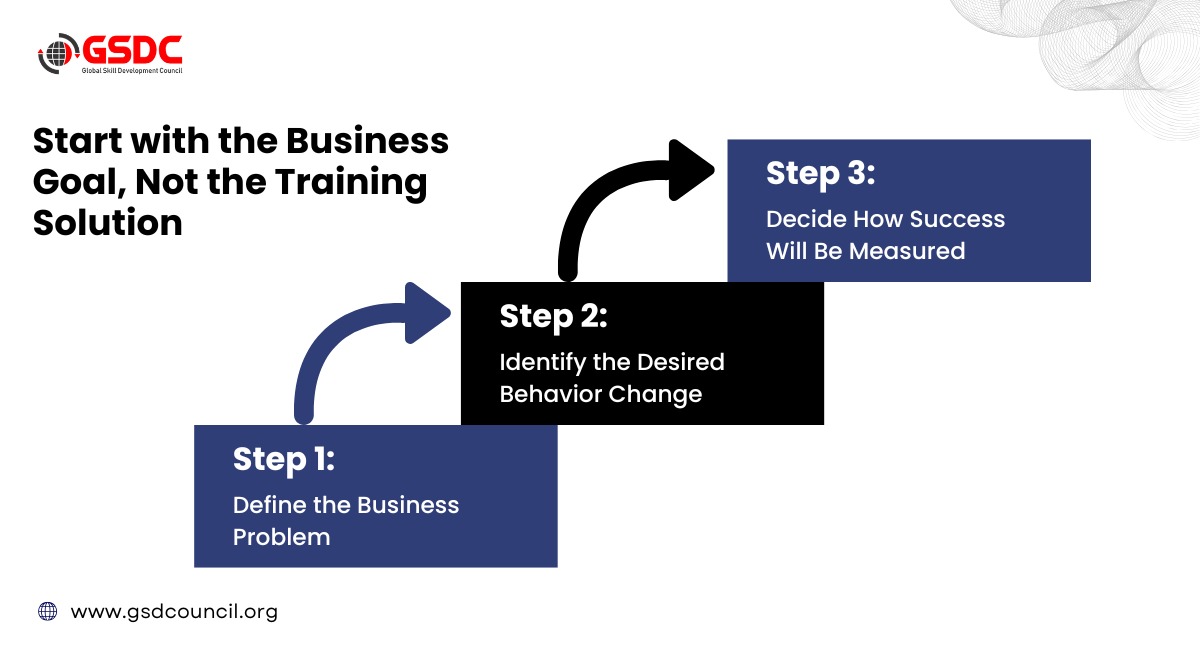
One of the most valuable frameworks discussed during the webinar was Backward Design.
Many learning teams make the same mistake:
A manager requests training.
L&D immediately begins designing workshops, creating content, or purchasing courses.
Step 1: Define the Business Problem
Before creating any learning intervention, identify:
- What business outcome needs improvement?
- What organizational problem are we solving?
- Why is this initiative necessary?
Without a clearly defined business problem, measuring success becomes nearly impossible.
Step 2: Identify the Desired Behavior Change
Business results don't improve simply because employees attended training.
Performance improves only when employees begin doing something differently.
Ask questions like:
- Which behaviors must change?
- What actions should employees perform differently?
- What new habits should become part of daily work?
Behavior change becomes the bridge between learning and business performance.
Step 3: Decide How Success Will Be Measured
This step should happen before developing the learning program.
Determine:
- Which business KPIs will improve?
- What baseline data already exists?
- How will improvement be measured?
- When will success be evaluated?
Only after answering these questions should the learning solution be designed.
Align Every Learning Initiative with Business Strategy
Successful learning programs don't operate independently.
Instead, every initiative should directly support organizational strategy.
For example:
Business Goal | Capability to Build | Business Metric |
| Reduce sales cycle | Consultative selling | Deal cycle time |
| Improve onboarding | Role readiness | Time-to-productivity |
| Reduce operational errors | Process adherence | Error rate |
| Improve customer service | Communication skills | Customer satisfaction |
| Increase productivity | Digital skills | Output per employee |
This strategic alignment ensures learning investments contribute to measurable organizational outcomes rather than isolated training activities.
Understanding Leading and Lagging Metrics
One of the webinar's most practical concepts was distinguishing between leading indicators and lagging indicators.
Leading Metrics
Leading metrics predict future business performance.
Examples include:
- Skill assessment improvements
- Learner confidence
- Knowledge retention
- Manager coaching
- Application of new skills
These are easier for L&D teams to collect because they occur immediately after learning.
However, they don't necessarily prove business value.
Lagging Metrics
Lagging metrics confirm whether learning produced real organizational results.
These include:
- Revenue growth
- Productivity improvements
- Customer satisfaction
- Employee retention
- Reduced operational costs
- Quality improvements
These metrics matter most to business leaders because they reflect actual organizational performance.
The challenge is that they often take weeks or months to appear and usually reside in business systems rather than learning platforms.
Effective L&D teams monitor both leading and lagging metrics to tell a complete performance story.
Learning Alone Doesn't Create Business Results
A particularly insightful takeaway from the webinar was that training itself is only one part of successful organizational change.
Even the best-designed learning program may fail if employees return to workplaces that reinforce old behaviors.
For lasting impact, organizations need:
Manager Reinforcement
Managers must actively coach employees after training.
Continuous Practice
Employees need opportunities to apply new skills regularly.
Accountability
Performance expectations should include the new behaviors.
Recognition and Rewards
Desired behaviors should be encouraged through recognition, incentives, or career growth.
Research consistently shows that workplace environment plays a far greater role in behavior change than classroom learning alone.
Learning starts the journey but organizational support sustains it.
Measuring Learning Impact Using Proven Frameworks
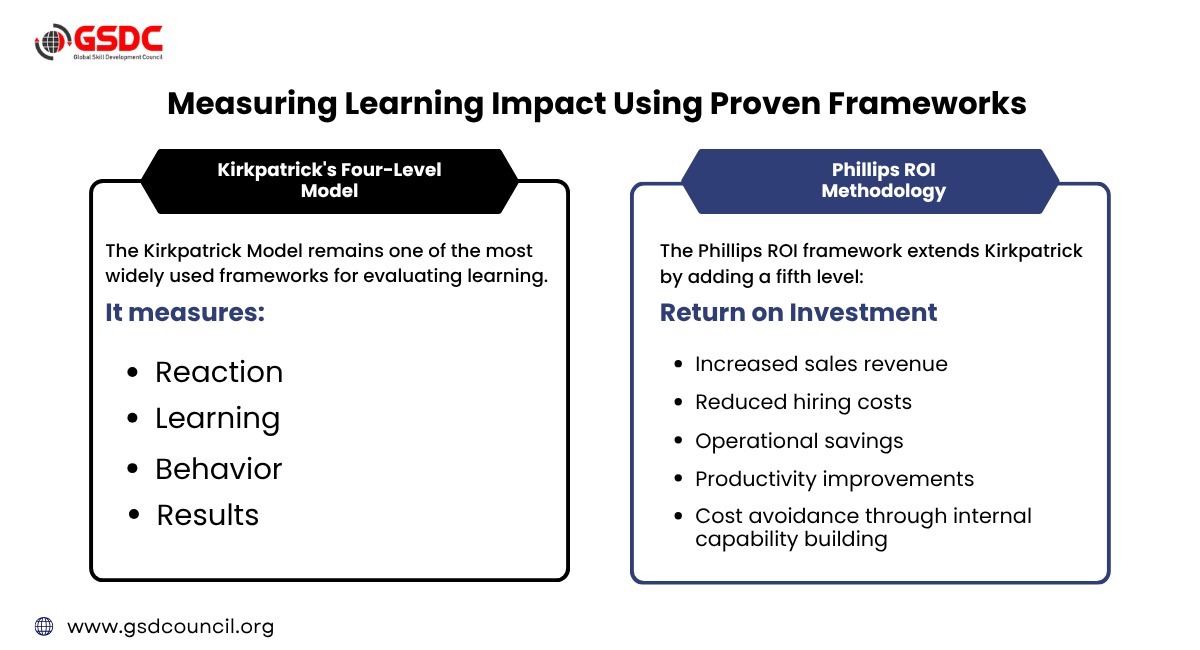
The webinar explored two of the most respected learning measurement models.
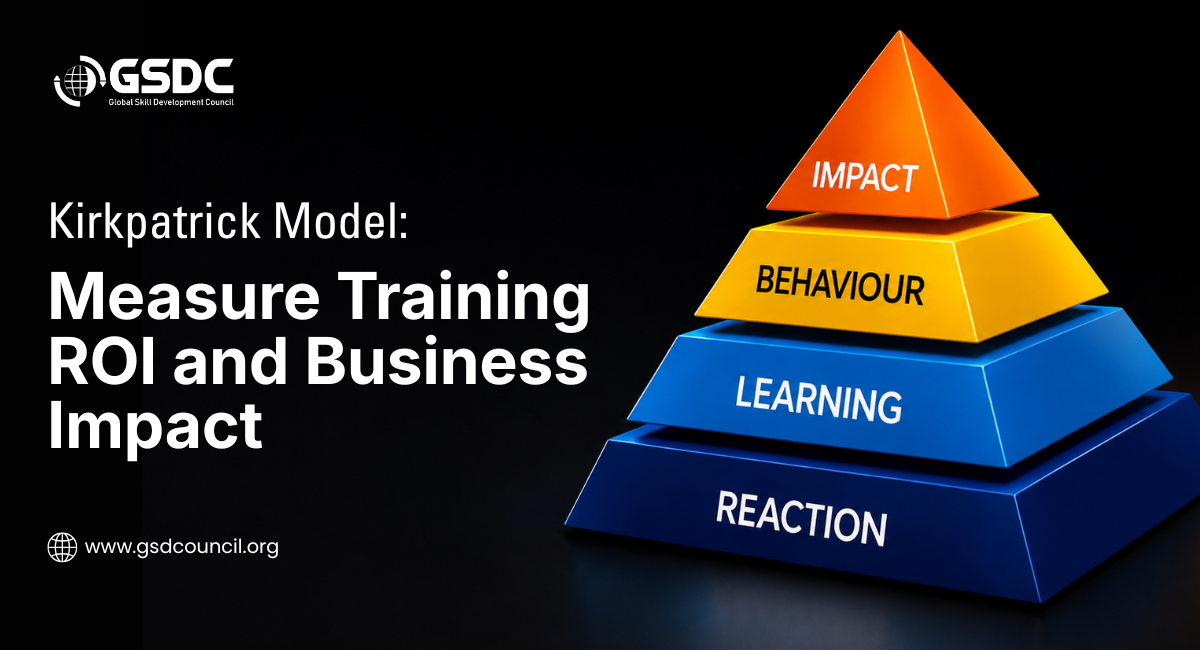
Kirkpatrick's Four-Level Model
The Kirkpatrick Model remains one of the most widely used frameworks for evaluating learning.
It measures:
- Reaction
- Learning
- Behavior
- Results
While Levels 1 and 2 help evaluate the learner experience, Levels 3 and 4 provide the business insights executives care about.
Phillips ROI Methodology
The Phillips ROI framework extends Kirkpatrick by adding a fifth level: Return on Investment (ROI).
ROI compares the financial benefits generated by learning against the total investment made. This approach strengthens learning and development metrics by connecting learning outcomes with measurable business value.
Typical ROI calculations may include:
- Increased sales revenue
- Reduced hiring costs
- Operational savings
- Productivity improvements
- Cost avoidance through internal capability building
This financial perspective makes learning investments easier for Business Leaders to evaluate alongside other business initiatives and supports stronger learning and development KPIs.
Focus on Fewer Metrics That Truly Matter
One common mistake discussed during the webinar is measuring too many indicators. Large dashboards filled with dozens of learning metrics often create confusion rather than clarity.
Instead, each learning initiative should focus on two to five meaningful learning and development metrics directly connected to business objectives. Selecting the right learning and development KPIs helps organizations demonstrate measurable value to Business Leaders.
Every selected metric should answer at least one of these questions:
- Did we generate more revenue?
- Did we save money?
- Did we reduce risk?
- Did we improve productivity?
- Did we decrease time spent on a process?
If a metric doesn't support one of these outcomes, it probably isn't essential for executive reporting or effective business leadership.
The Growing Role of AI in L&D Measurement
Artificial intelligence is rapidly changing how organizations evaluate learning effectiveness.
Rather than simply generating training content, AI is becoming a valuable analytics partner.
According to the webinar, AI can help organizations:
- Consolidate data across LMS, HRMS, CRM, and business systems
- Analyze learner feedback at scale
- Detect skill gaps earlier
- Identify at-risk learners
- Generate executive-ready reports
- Correlate learning trends with business performance
However, AI has limitations.
It cannot replace high-quality data, determine causation, or make strategic decisions independently.
Organizations must still ensure:
- Reliable data quality
- Ethical AI usage
- Privacy protection
- Human oversight
AI should support decision-making not replace it.
Common Mistakes That Prevent Effective L&D Measurement
Many organizations struggle to prove learning impact because of avoidable mistakes. The webinar highlighted four major pitfalls:
Measuring Vanity Metrics
Completion rates and satisfaction scores are useful operational learning metrics, but they rarely demonstrate business value or answer what are key metrics in business.
Measuring Everything
Tracking dozens of learning and development metrics often distracts from what truly matters. Focus on a small set of meaningful learning and development KPIs.
No Baseline Data
Without knowing where performance started, you can't measure improvement accurately. Baseline metrics should always be established before launching a learning initiative.
Assuming Correlation Equals Causation
Learning contributes to business results, but it's rarely the only factor. External influences such as market conditions, technology changes, leadership decisions, and organizational processes also affect outcomes.
Being transparent about learning's contribution builds greater credibility with Business Leaders and strengthens business leadership.
GSDC Certified L&D Analytics & Metrics Professional: Measure Learning That Drives Business Impact
GSDC’s Certified L&D Analytics & Metrics Professional helps professionals develop the skills to measure and demonstrate the business impact of learning initiatives. The certification focuses on selecting meaningful learning and development metrics, defining relevant KPIs, aligning learning outcomes with business objectives, and using data to support better decisions.

Professionals learn how to move beyond vanity metrics such as completion rates and focus on measurable outcomes including productivity, cost savings, performance improvement, and ROI with Certified L&D Analytics & Metrics Professional. Designed for L&D professionals, HR leaders, learning managers, and business professionals, this certification strengthens data-driven learning and development KPI practices and supports strategic L&D decision-making.
Conclusion
Learning and Development is evolving from a support function into a strategic business capability.
Today's organizations expect L&D teams to demonstrate measurable contributions to business success, not simply deliver engaging learning experiences.
The webinar reinforced one powerful idea: the true value of learning is not measured by what employees complete, but by what changes afterward.
By aligning learning initiatives with business strategy, defining success before designing programs, selecting meaningful learning and development KPIs, and leveraging frameworks like Kirkpatrick and Phillips ROI, organizations can confidently demonstrate how learning drives measurable business outcomes.
Ultimately, when L&D begins speaking the language of business revenue, productivity, quality, customer outcomes, and ROI it earns a stronger seat at the leadership table and becomes a genuine driver of organizational growth.

Related Certifications
Frequently Asked Questions
Metrics like completion rates and learner satisfaction only measure training activity. Business Leaders want evidence of improvements in revenue, productivity, quality, customer satisfaction, or operational efficiency.
Backward design starts with the desired business outcome, identifies the required behavior change and success metrics, and only then designs the learning solution.
Leading metrics predict future performance, such as skill application or learner confidence, while lagging metrics measure actual business outcomes like revenue growth, productivity, and customer satisfaction.
AI can analyze learning data, identify skill gaps, automate reporting, and connect learning insights with business KPIs, helping organizations make faster and more informed decisions. This is especially relevant to AI for business leaders.
Most programs should focus on 2–5 business-relevant learning metrics that directly align with organizational goals rather than tracking numerous operational indicators.
Stay up-to-date with the latest news, trends, and resources in GSDC
If you like this read then make sure to check out our previous blogs: Cracking Onboarding Challenges: Fresher Success Unveiled
Not sure which certification to pursue? Our advisors will help you decide!