From AI Curiosity to P&L Impact: How Generative AI Is Reshaping Operations
Written by Matthew Hale
- Why Operations Are the Right Place to Start with AI
- The Hidden Problem - Too Much Data, Too Little Clarity
- What Generative AI Actually Does in Operations
- Why AI Must Help Humans, Not Replace Them
- Where AI Starts Creating Real P&L Impact
- The Risk of Misusing AI
- The Bigger Shift: From AI Adoption to Operational Maturity
- Final Thought
- FAQ’s
Artificial Intelligence has moved from early experimentation to a boardroom priority. But in manufacturing and IT-driven operations, one question keeps surfacing:how does Generative AI work in real operational environments, and how does it improve business performance?
This blog breaks that journey down, from the fundamentals of how Generative AI works, to how Generative AI for operations and Generative AI for IT operations are driving measurable P&L impact.
Moving from curiosity to execution requires more than access to tools. Exposure to practical use cases, hands-on problem solving, and decision-focused thinking is what enables teams to move from curiosity to execution. In that sense, applied learning initiatives such as the GSDC Certified Learning Holiday AI Bootcamp reflect the same philosophy discussed in the session, building capability around Generative AI so it supports better decisions, smarter delivery, and measurable business outcomes rather than remaining an isolated experiment.
One idea that came through clearly in the session is that meaningful AI impact does not come from tools alone, but from how professionals learn to apply them in real operational contexts.
Why Operations Are the Right Place to Start with AI
When enterprises fathom AI, its biggest worth is revealed in the workplace, where there is a high degree of intricacy, and the decisions have a direct influence on the performance of a business.
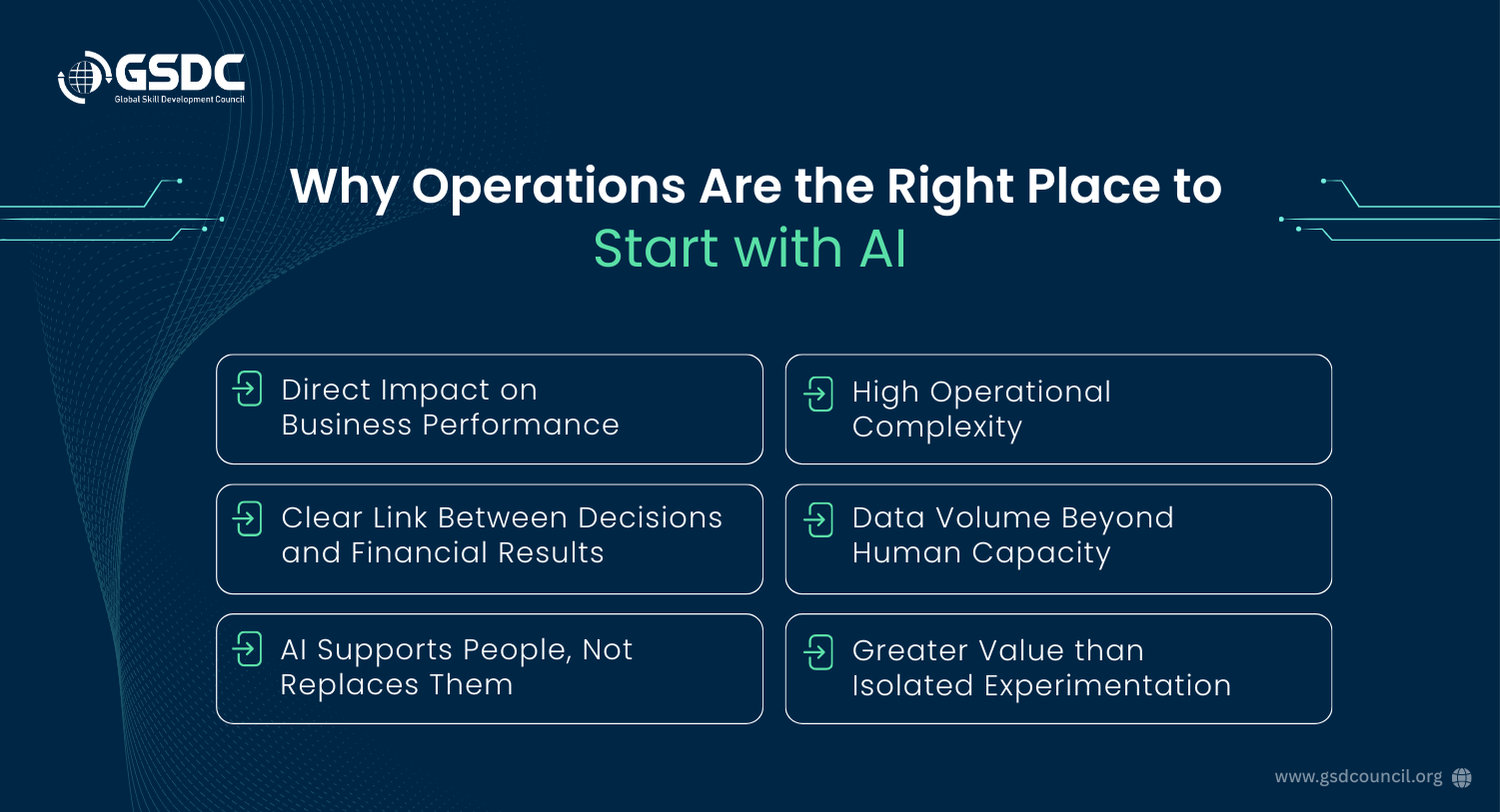
Operations are by far the most logical place for AI use as they are data-driven, which makes them the natural starting point for AI use in managing complexity and enabling better decision-making.
- Direct Impact on Business Performance: Manufacturing and operations are the major influencers of cost, productivity, quality, customer experience, and margins; thus, the improvements in decision-making become very quickly reflected in measurable outcomes.
- High Operational Complexity: Teams handle the interrelationships of variables such as equipment health, downtime, inventory, schedules, safety, quality, and workforce coordination, whereby a minor disruption can result in a much larger operational issue.
- Clear Link Between Decisions and Financial Results: Delayed or suboptimal decisions, bring about increased costs, lowered output, quality problems, or, ultimately, customer dissatisfaction.
- Data Volume Beyond Human Capacity: MES, CMMS, ERP systems, and sensors produce an enormous amount of data, making it difficult to obtain timely insights without the use of an intelligent assistant.
- AI Supports People, Not Replaces Them: When AI is implemented in the right manner, it should be viewed as a tool that helps employees by reducing their analytical effort, showing them what is most important, and giving them time for judgment and execution.
- Greater Value than Isolated Experimentation: By embarking on this journey with operations, a company can be certain that AI will be the driver of action and impact, rather than just being another experimental initiative.
As of 2025, 71% of businesses report using generative AI in at least one function, and 78% of organizations use AI in at least one business function, demonstrating how AI is permeating operations and other crucial business domains.
The Hidden Problem - Too Much Data, Too Little Clarity
New plants generate huge volumes of data from various systems. Although this data is very valuable, it is, nevertheless, a source of teams' agitation, as it distracts them from making decisions more quickly.
- Data from many disconnected sources: For example, sensors may be used to track vibration, temperature, and current, while MES systems monitor production, CMMS platforms log maintenance activity, and ERP systems manage inventory and costs. This leads to a very complicated data landscape.
- Information overload instead of insight: On top of a complicated data landscape, the data is scattered across different dashboards and reports, which are very time-consuming and require a lot of effort for the users to understand.
- High analytical effort for operational teams: Practically, engineers and leaders spend a lot of time going through dashboards, comparing reports, looking for SOPs, and recreating spreadsheets to arrive at conclusions.
- Insights arrive too late: Hence, by the time they can see the trends, the chance to stop, for instance, production downtime, delays, or even quality problems has usually passed.
- A widening gap between data and decisions: The problem of this discrepancy between data and decisions is actually the main reason why Generative AI is expected to be of great help in operational environments. It is the central challenge that lies at the heart of this technology.
What Generative AI Actually Does in Operations
One of the common misconceptions about generative AI is that it is a chatbot or a simple automation tool.
In operations, the main thing that matters the most is that the technology serves as an intelligence layer that enables teams to efficiently deal with complicated systems.
- Acts as a conversational intelligence layer: This technology is implemented in MES, CMMS, and ERP systems. Therefore, employees are now able to retrieve operational data in their own words instead of having to go through dashboards.
- Changes how questions are asked: The members of the team can directly ask what is causing the downtime, availability drops, or recent changes without going through several tools.
- Connects data across systems: It helps in linking the past and present data so that the trends can be noticed quickly. For instance, historical data, sensor inputs, maintenance logs, and documentation are connected to surface patterns and likely causes rapidly.
- Accelerates insight, not system replacement: Generative AI is not a system that can replace the existing ones, but it is a system that makes their information accessible at the speed of a decision.
- Reduces time from data to action: Without a doubt, analysis is compressed into minutes, thus teams have more time to focus on validation, decisions, and execution.
That is the reason why decision support, system integration, and insight acceleration are the main areas of focus for Generative AI in IT operations rather than mere task automation.
Why AI Must Help Humans, Not Replace Them
One of the most powerful and repeated messages from the session was straightforward: AI has to help humans to think, not to think for them.
In the use case of Generative AI in the field of operations, technology should be used to support human decision-making instead of trying to automate it.
- Where Generative AI is Helpful: AI can be very helpful in drastically narrowing down the problem space, picking up on anomalies, and lowering the time spent on the investigation process so that the team can get to potential issues way faster.
- Where Human Judgment is Still Necessary: AI cannot capture the real-world context, verify the correctness of the assumptions, or even be responsible for the decisions and results.
- Human ownership of core responsibilities: Root-cause analysis, judgment, and execution remain firmly human responsibilities, supported but not replaced by AI insights.
- The risk of shortcut-driven use: Once AI is considered as a mere shortcut and not as a support tool, users may lose problem-solving skills, solving skills which in turn can result in a decrease of their operational capability that may become difficult to recover later on.
Where AI Starts Creating Real P&L Impact
These use cases represent some of the most practical Generative AI opportunities available today, because they are tied directly to operational metrics leaders already track.
When applied correctly, Generative AI creates value through practical, operational use cases that directly influence financial performance.
- Predictive maintenance: By analyzing sensor patterns, AI can flag early signs of equipment failure, enabling planned maintenance and reducing the cost and disruption of reactive downtime.
- SOP access at the point of use: Instead of stopping work to search through physical manuals or files, operators can access the right SOP instantly, reducing production loss and preserving tribal knowledge.
- Time studies and process improvement: AI-assisted video analysis helps identify value-added and non-value-added activities faster, improving throughput without increasing headcount.
- Field service and customer operations: Technicians resolve issues more quickly by querying AI rather than sifting through PDFs, reducing MTTR and improving customer satisfaction.
Each of these applications directly impacts the metrics leaders care about most-uptime, cost, quality, and margin.
The Risk of Misusing AI
The session also highlighted an important caution: AI can create risk when it is overused or poorly governed, especially in operational decision-making.
- Blind acceptance of outputs: AI can produce confident answers, which may lead users to accept results without questioning assumptions or validating inputs.
- Flawed problem statements: When the underlying problem is poorly defined, AI may reinforce incorrect conclusions rather than surface the real issue.
- Reduced analytical rigor: Over-reliance on AI can weaken critical thinking and problem-solving skills if human judgment is not actively applied.
- Data and governance risks: Uncontrolled AI usage can introduce risks related to data access, leakage, and compliance.
AI will provide answers even when the inputs are wrong. This is why human oversight, clear governance frameworks, and skill readiness are essential for sustainable and responsible AI adoption.
The Bigger Shift: From AI Adoption to Operational Maturity
Generative AI should not be considered a way to quickly achieve excellence. In organizations that have good operational fundamentals, have positive impact. On the other hand, in organizations with weaker systems, it makes more noise without adding value.
This is a moment reflecting a wider Generative AI revolution that is not driven by novelty but by the capability of embedding intelligence in routine operational decisions.
- Machine intelligence: AI is a great help for teams as it adds speed, pattern recognition, and analytical scale, out of which complexity can be navigated more effectively.
- Human judgment: Understanding, verification, responsibility, and implementation are the aspects that still belong to humans, and this ensures that the decisions are based on real-world conditions.
- Clear governance: Without help, protection, and responsible usage, it is very likely that AI will be misused, and therefore, trust in AI-supported decisions must be maintained.
- Relentless focus on outcomes: AI can be of great help only if the performance and business results to which it is connected can be measured.
The move from trial to operational maturity also puts structured capability building in the spotlight.
Enterprises are progressively relying on the Global Skill Development Council (GSDC), supported frameworks and learning ecosystems, as well as on practical programs like the Certified AI Tool Expert Program, to ensure that AI usage is a lever for better decision-making, governance, and execution rather than a separate initiative.
Final Thought
AI curiosity is easy. Dashboards are comfortable. Real impact requires discipline.
Generative AI is reshaping operations not because it replaces people, but because it aligns insight with execution. When used responsibly, it helps teams cut through complexity, focus on the right problems, and act before inefficiencies turn into financial losses. The organizations that see real P&L impact are those that treat AI as a decision-support capability-anchored in human judgment, clear governance, and consistent execution rather than experimentation alone.
At an operational level, this is a small but meaningful example of how Generative AI will change the world, not through abstraction, but by improving how real work gets done every day.
FAQ’s
- Which operational areas see the highest impact from Generative AI?
By far, maintenance is the area that was most often mentioned as the top use case, where AI can foresee malfunctions through sensor data and hence, lower the reactive downtime that is caused by failure. In addition to that, SOP creation and time studies were also heavily emphasized as methods of drastically cutting manual effort and speeding up the work of analysis.
- How do organizations maintain human oversight when using AI?
This is accomplished by having definite governance and user qualification. AI is a tool that should be used by professionals who already have a deep operational knowledge; in this way, judgment and accountability will, as always, be retained by humans.
- Should AI be used to replace full-time roles?
Absolutely not. AI is a tool that should be used by the existing teams to make the teams more efficient by doing away with low-value analytical work. The existing teams are the ones that should be there to make the final decision on whether to eliminate the roles or not.
- Can AI support financial and CapEx decisions?
Certainly, AI can be such a tool that engineers utilize it to get through CapEx justification smoothly, and at the same time, it can help make operational improvements recognizable as financial outcomes, while the human decision on the final step stays unchanged.
- What are the risks of over-reliance on AI?
If you were to blindly trust all that AI provides you with, then you may overlook that the assumptions are wrong and that your critical thinking is getting weaker. The role of a human validator is very important.
- Where should organizations start with AI implementation?
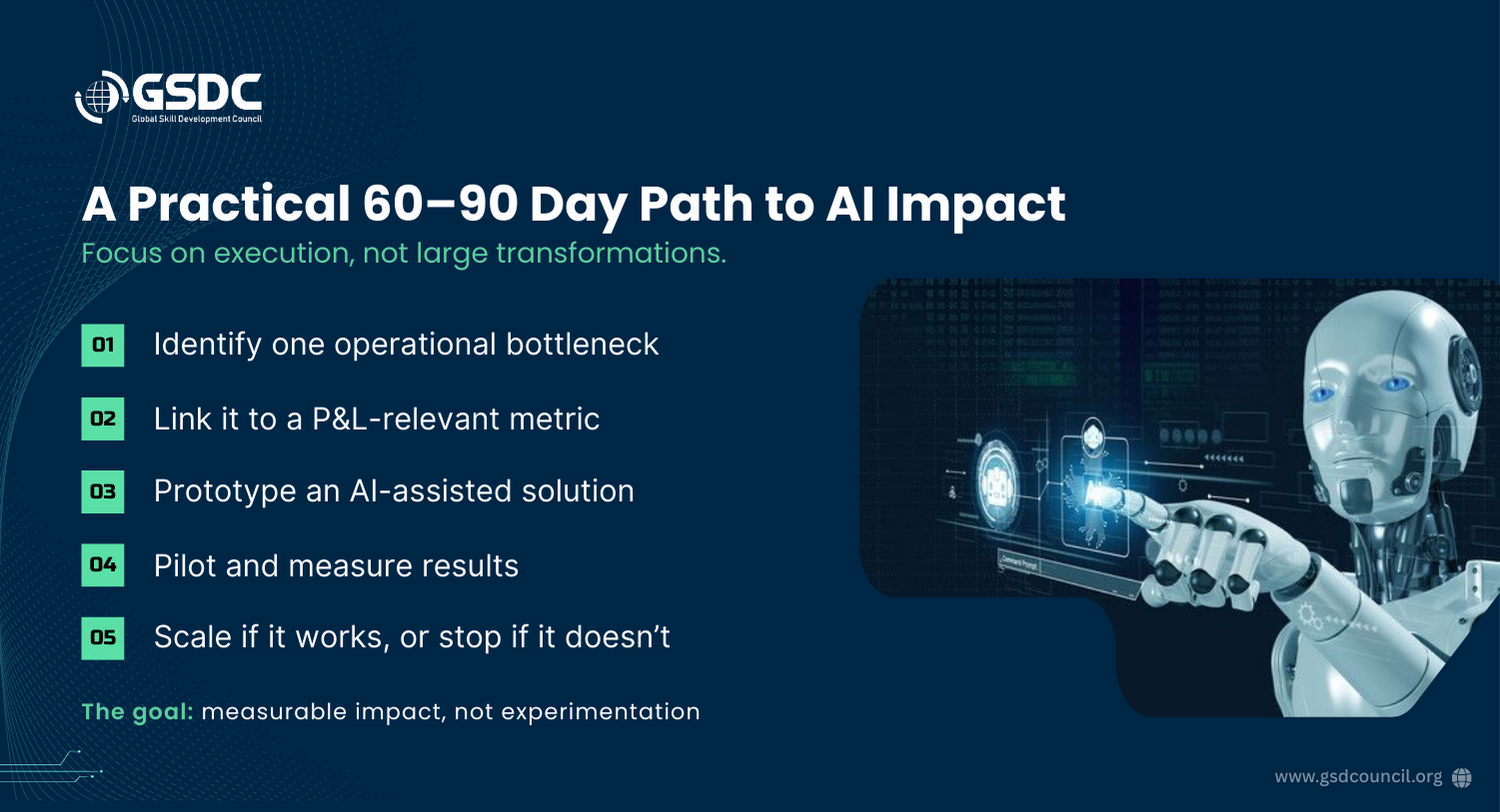
If you want to do something with AI, it is always better to start small. Pick out an operational bottleneck, link it with a P&L metric, pilot, make the measurement of results, and only then if the effect is real, go ahead with scaling it.

Related Certifications
Stay up-to-date with the latest news, trends, and resources in GSDC
If you like this read then make sure to check out our previous blogs: Cracking Onboarding Challenges: Fresher Success Unveiled
Not sure which certification to pursue? Our advisors will help you decide!